Hey there Teacher Tappers!
For some of you, this is the last week before your half-term, but for others, you still have another week to go 🤪. Whenever your holiday comes, we hope you take the time to recharge and have nice things planned!
Teacher Tapp out and about 🧭
We’re heading to Birmingham for the Schools and Academies show on the 18th and 19th of November. We will have a stand to share our findings and give out badges and goodies plus members of the team will be taking part in talks. It’s not too late to register, and if you’re a teacher you get a free ticket here. Do come and say hello if you’re there!
Sharing photos of students on social media
There has been a lot of press coverage about schools using images of students in social media posts, and then some dreadful instances of criminals manipulating these images to create sexually explicit images and then demanding money from the school in exchange for not releasing them.
We checked back in the summer term, and senior leaders told us that in their school:
- Among primary leaders, 54% reported they shared photos of pupils on public social media accounts.
- Among secondary leaders, 71% shared photos of pupils on public social media accounts.
In July, 17% of primary leaders and 15% of secondary leaders said their school had changed their rules compared to the previous academic year. And 28% and 19% of primary and secondary leaders said they plan to change their policies on sharing images for the next academic year.
When we checked in again this September, we asked more detailed questions about how images are being used:
- 56% of primary and 69% of secondary leaders say their schools share images with faces fully visible.
- 9% of primary and 7% of secondary leaders share side profiles or partial faces of pupils.
- 13% of primary and 8% of secondary leaders share photos of pupils, but never their faces.
- 7% of primary and 6% of secondary leaders say their school doesn’t share photos at all.
- 15% of primary and 10% of secondary have different rules for their website and social media.
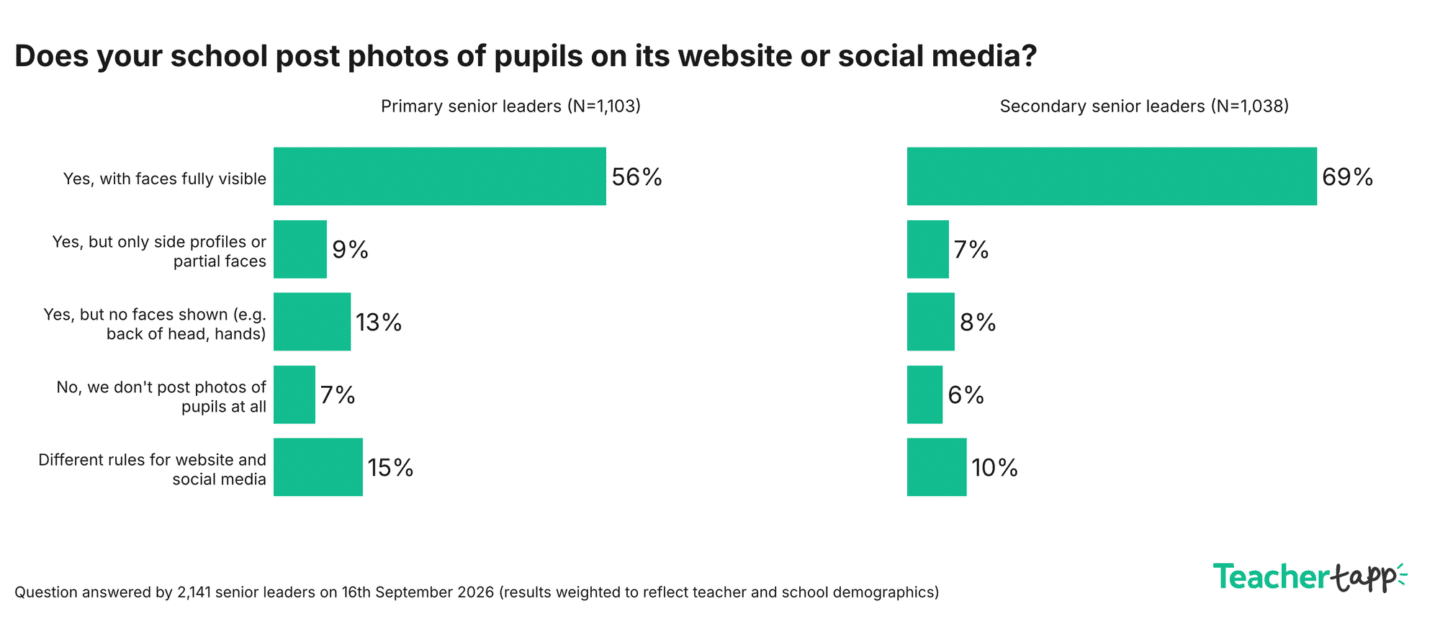
These rules seem to be tightening up: in September, 43% of primary and 32% of secondary leaders reported that their rules have become more restrictive since last year. This is something we’ll keep checking in on – we predict more schools will stop sharing photos online.
Cyber attacks – how do schools prepare?
Another type of attack schools have experienced is a direct hack into their computer networks. Cyber attacks have the potential to massively disrupt schools – from losing access to your files to student details being stolen and whole systems being wiped altogether. We asked secondary teachers: “Has your school or college taken any of the following steps to improve its cyber security?”
- 50% say their school has implemented a cyber security policy.
- 22% report they have completed a cyber security risk assessment.
- 21% say their school has set up backup and data recovery procedures.
- 18% say their school has completed or updated a cyber incident response plan.
Half of teachers reporting that their schools have implemented a cyber security policy is a solid start, but preparation is still lagging – fewer than 1 in 5 have a response plan. And a response plan is a really useful document when a cyber attack hits!
If you want to hear more about cyber attacks, we have this podcast full of Teacher Tapp data 👇.
Aspirations for leadership
At Teacher Tapp, one of the most useful developments has been the ability to target questions at certain demographics or job roles. When you sign up to Teacher Tapp, and then every September that follows, we ask a question about your job role so we can sort you into a ‘seniority’ group. This lets us ask classroom teachers and middle leaders specific questions, like this one about wanting to be on the senior leadership team (SLT)!
11% of classroom teachers and middle leaders have already been on SLT, so just looking at those who haven’t, we found:
- 14% definitely want to be on SLT
- 31% were less sure but open to the idea, saying ‘perhaps’ they would want to be
- 26% thought it unlikely, saying ‘probably not’
- 29% were certain it was ruled out, saying ‘definitely not’
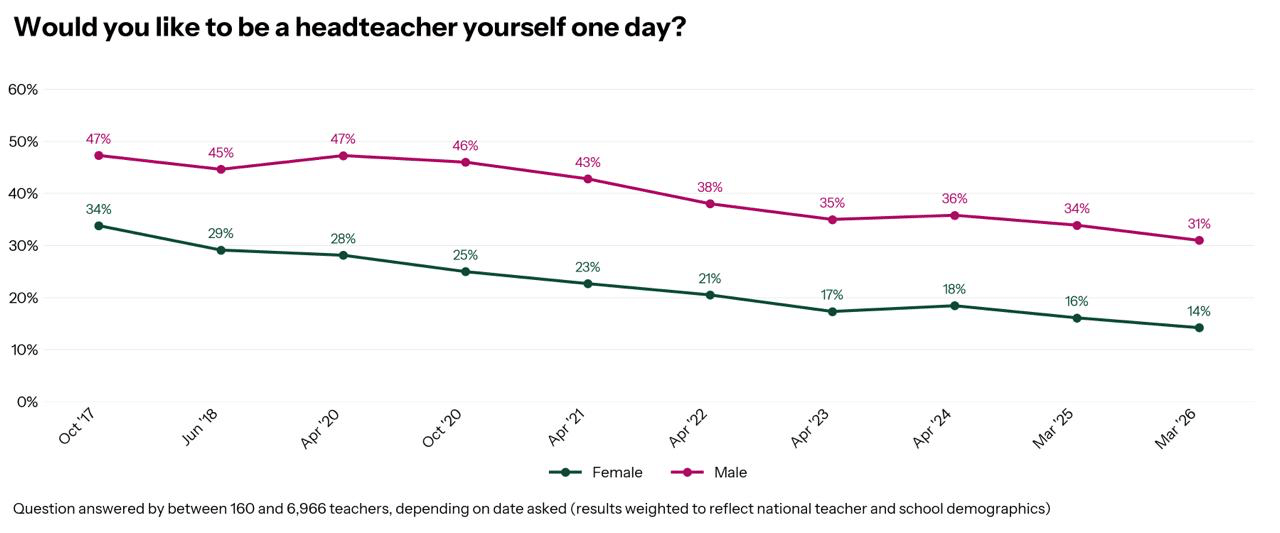
When we broke this down by male/female, we found male teachers to be far more open to the idea of future senior leadership, with 21% reporting they definitely wanted to become a senior leader, vs 12% of female teachers.
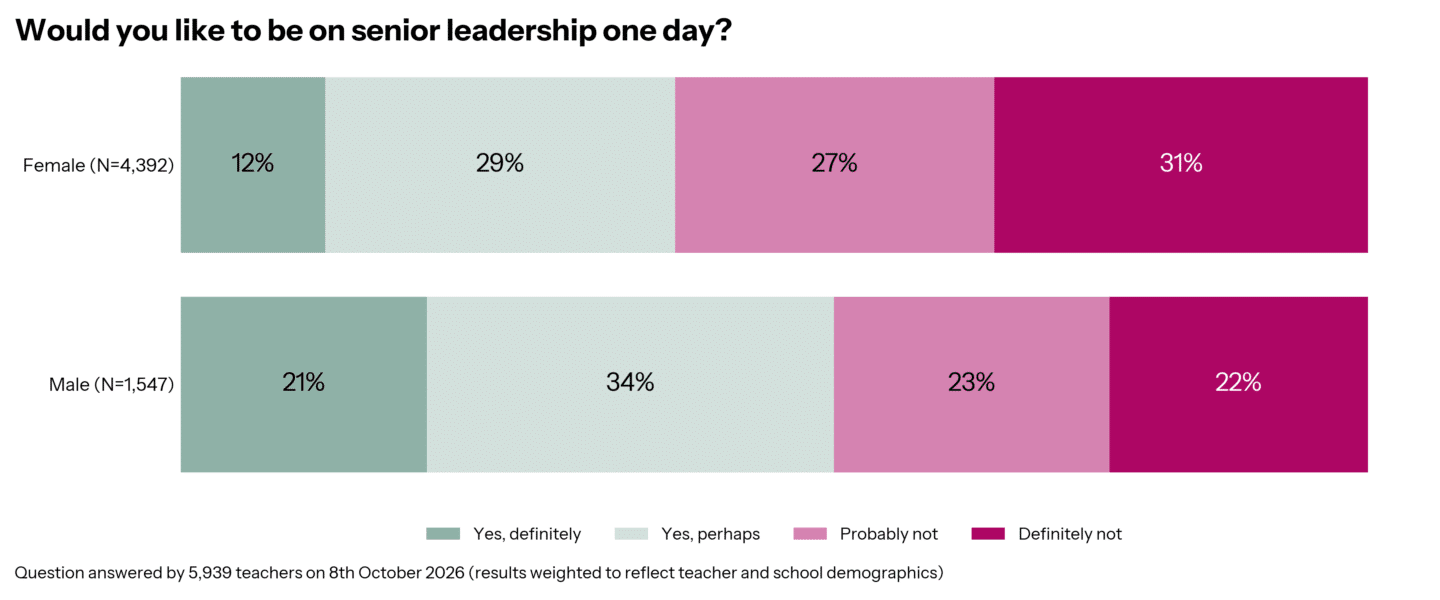
This mirrors similar aspirations seen among male and female teachers when we have asked about headship. Just 14% of female teachers aspire to be a headteacher, compared to 31% of male teachers. This is part of a downward trend we’ve observed since 2017, when 34% of female teachers and 47% of male teachers hoped to be a headteacher one day. Both groups have fallen, but female aspiration has dropped by 57% in relative terms, compared with 34% for men
Following instructions
Friend of Teacher Tapp, Adam Boxer (co-host of the They Behave For Me podcast with Amy Forrester), wrote in to ask about following instructions. He was interested in how common it was for teachers to find students ignoring instructions, or teachers finding they had to repeat their instructions after the activity had started.
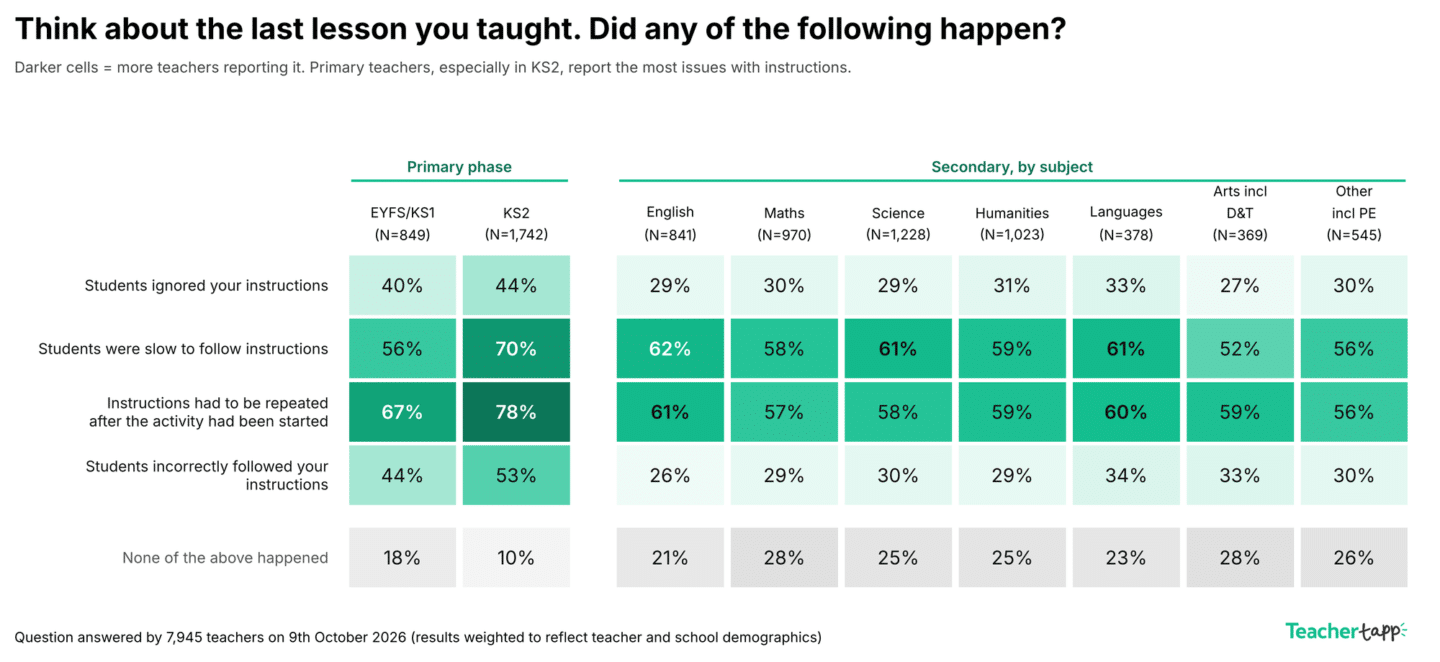
KS2 teachers had a tough time of it, and were the most likely to report trouble with students following instructions in every category:
- KS2 teachers had the highest reports of students ignoring instructions (44%), while Arts incl D&T were the lowest reports (27%).
- KS2 teachers had the most reports of students being slow to follow instructions (70%), but Arts incl D&T were the lowest (52%).
- KS2 teachers were the most likely to report they had to repeat their instructions after an activity had started (78%), while Other, including PE, had the lowest reports (56%).
- KS2 teachers had the highest reports of students incorrectly following their instructions (53%), while English had the lowest reports (26%).
- KS2 were the least likely to say ‘none of the above’ happened (10%), while maths and Arts incl D&T were the most likely (28% for both).
AI non-adopters
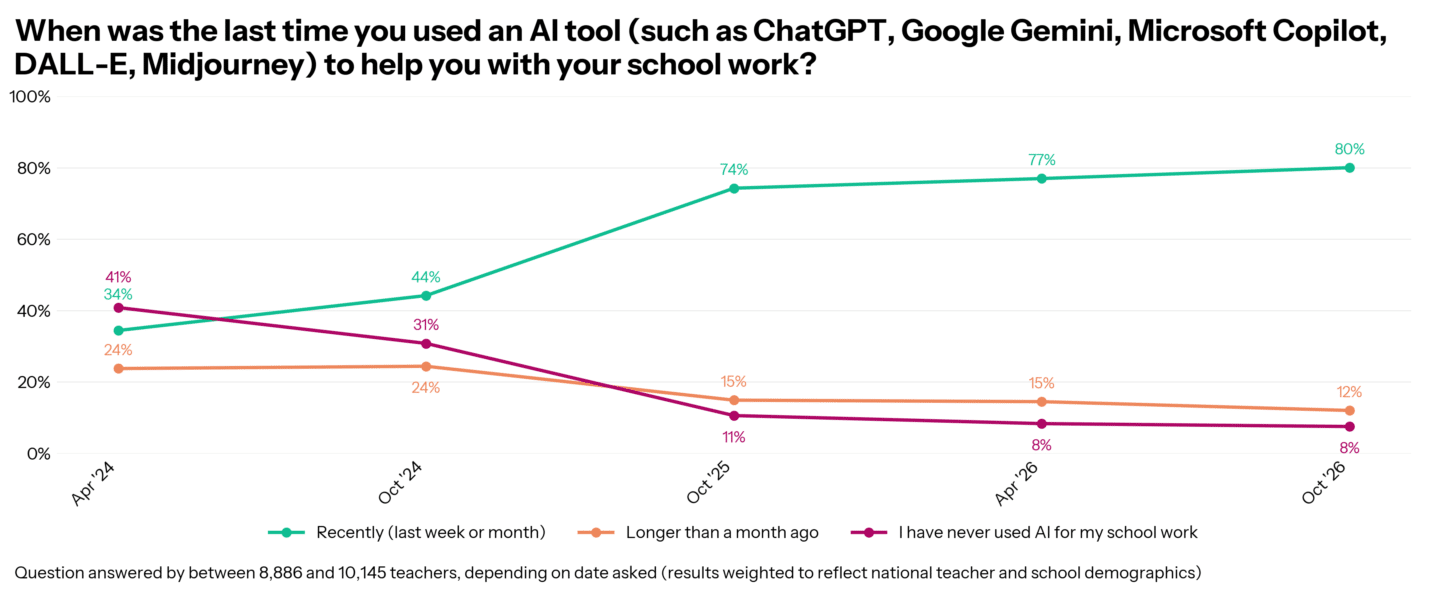
Back in April 2026, we made a prediction that the number of teachers who haven’t used AI for their schoolwork would now be unlikely to move.
This week, we checked in again and found that this prediction was correct, and the growth of those who report regular AI use has slowed down, with 80% reporting they used AI for schoolwork in the last week or month, UP from 77% in April and 74% this time last year. Those who have never used AI for their schoolwork remain unchanged since April at 8%.
A Teacher Tapper asked…break duty length
This week, an email landed in the Teacher Tapp inbox, asking if we could find out about break duty length and what was normal to expect primary classroom teachers without responsibilities to do over a week.
This Tapper had joined a new school as a senior leader and had discovered the duty expectations for classroom teachers were much higher than at her previous school. She wanted to know if her new school was the ‘normal’ one, as when she had enquired about the workload, she was told this was completely normal. She felt reducing duties would be something they could do to improve workload for classroom teachers, but wanted some numbers to support her proposal.
This was a really interesting one to answer, as to do it we had a few different steps and number crunching!
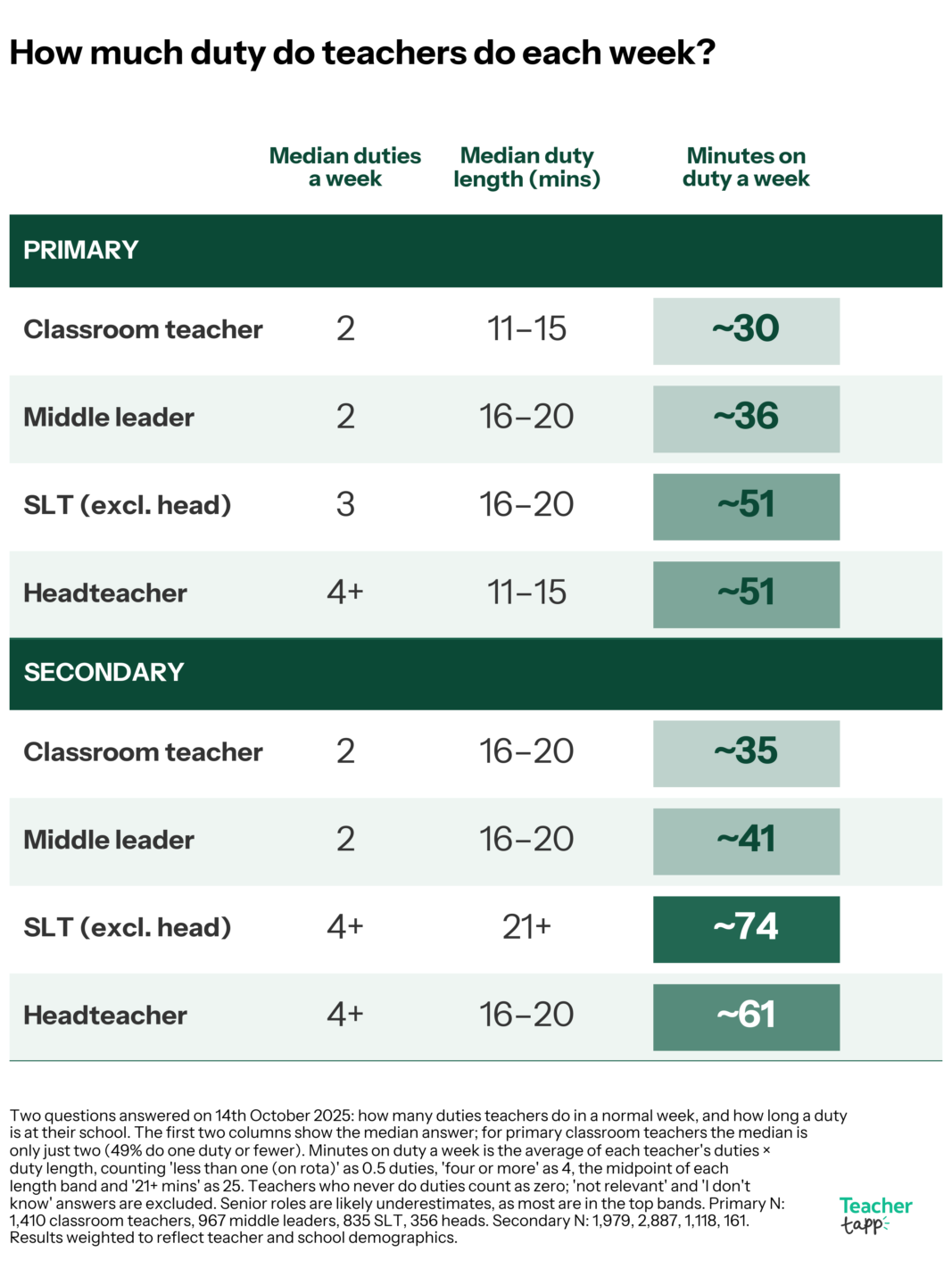
We have two questions to answer this query: first, how many duties do you do a week, and then how long were those duties?
Then we crossed these two answers together, so we could see how long duties were for teachers doing two a week, compared with three, and so on.
And then, we broke this down into primary and secondary, and then broke it down again for classroom teachers and teachers on the leadership scale.
Once we had done all of that, we discovered:
The average primary classroom teacher has two duties a week, 11-15 minutes long, for a total of 30 minutes of duties a week.
Secondary classroom teachers have a slightly higher average, still doing two a week, but 16-20 minutes long, for a total of 35 minutes a week.
We’ve written back to the teacher, and the good news – she is going to take these figures to form part of her workload reduction proposal in her school!
If you have a question you would like Teacher Tapp to check, get in touch and let us know! England@teachertapp.co.uk 📧
Ups and Downs of…topic-based learning
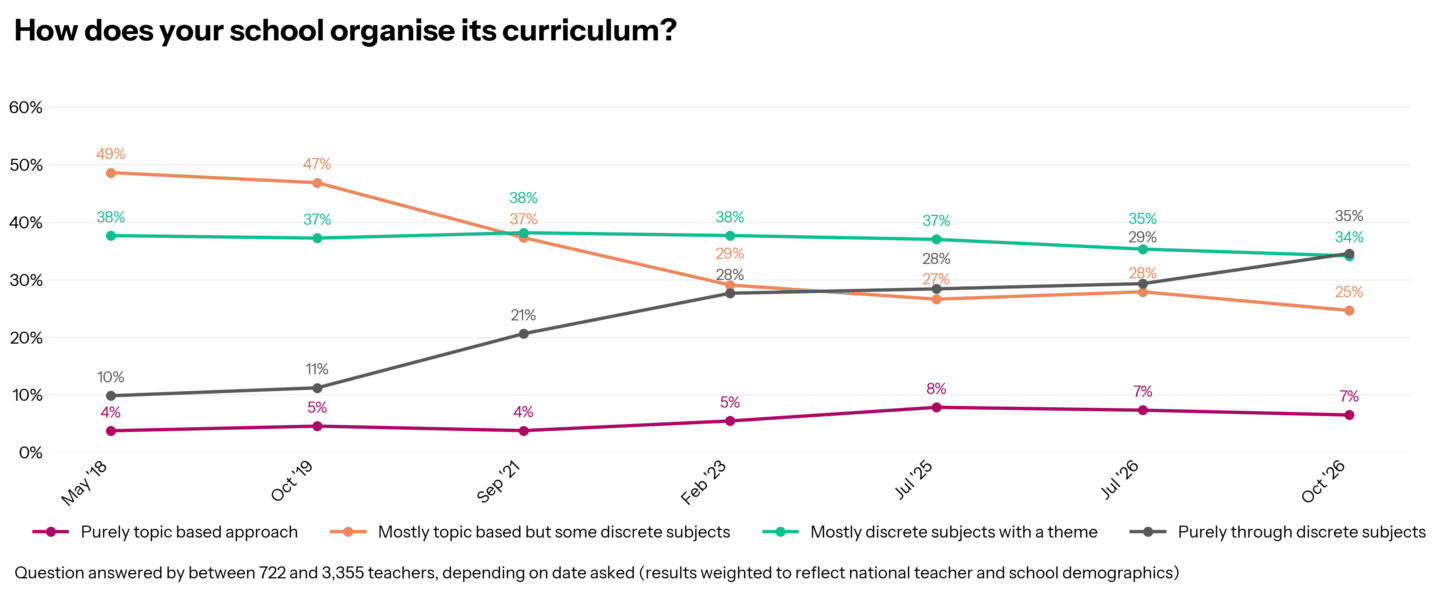
There have been some significant changes in the proportion of primary teachers reporting that their school uses topic-based learning:
🔴 The minority who teach purely through topics has remained relatively stable since 2018, with a slight increase to 7% from 4% in 2018.
🟠 ⬇️ The ‘mostly topics-based’ approach has dropped, with 25% reporting its use in 2026, DOWN from 49% in 2018.
🟢Teachers who say their school uses ‘mostly discrete subjects with a theme’ have stayed stable, with a slight drop to 34% from 38% in 2018.
🌑 ⬆️ And teachers who say their school uses ‘purely discrete subjects’ have risen: 35% in 2026, UP from 10% in 2018.
These changes paint a very different picture of primary curriculum organisation compared to eight years ago, and “purely discrete” (35%) has now overtaken “discrete with a theme” (34%) for the first time!
Daily Reads
The most-read tip was a ‘research bite’ from Craig Barton, all about dual coding!
There are so many great blogs out there, and we love featuring them on Teacher Tapp. If you have a blog you think we should feature, please email us at England@teachertapp.co.uk, and we will check it out!