Hey there Teacher Tappers!
Congratulations – we have almost made it through September! For primary and secondary schools, the September to December window is a key time for student “recruitment” as thoughts turn to next year’s cohort. We’ve had a few requests hit our England@teachertapp.co.uk inbox with questions about Open Evening and what schools are doing to attract students. If you would like to add your suggestion to the list, or share your experience, please let us know!
Teacher Tapp Reward Store
Badges, stickers and sausage rolls have been flying out the Teacher Tapp Reward Store!
Every question you answer earns you one point, and then you can exchange those points for Teacher Tapp goodies. We have classic Tapper merch like badges and mugs, PLUS special offerings from Greggs and Costa! If you haven’t seen it yet, be sure to check it out, and send us any suggestions of other items you would like to see in the store!
Now, our edu-findings!
Ofsted – is change going to happen?
Ofsted has been in the news frequently over the last few weeks following The NAHT says the framework poses a “risk to life” and is urging the government to halt graded inspections.
ASCL have raised concerns about the wellbeing of leaders during inspections, and in a letter to ASCL’s Pepe Di’Iasio, the Education Secretary, Lucy Powell, said she took this “incredibly seriously”, and questioned whether Ofsted considers school context. She said the pressure the accountability system puts on staff is “constantly on our minds”.
Ofsted’s November 2025 framework is facing fresh criticism. Education Select Committee chair Helen Hayes called it “problematic” after a Tes investigation raised concerns about inclusion.
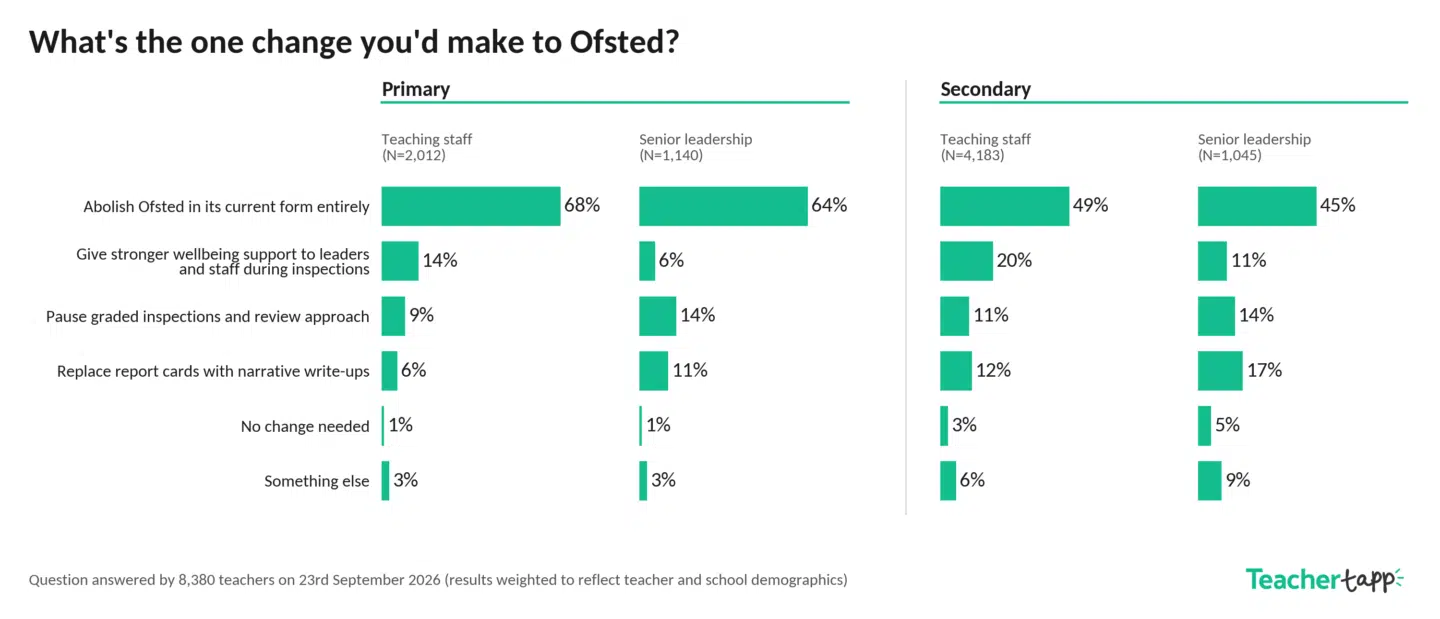
What do teachers want to happen? We put the question to Teacher Tappers and found:
Among senior leaders and headteachers
- 1% of primary and 5% of secondary felt no change was needed.
- 14% of primary and secondary wanted to pause graded inspections and review Ofsted’s approach to inspections.
- 11% of primary and 17% of secondary want to replace report cards with a narrative write-up of the inspection.
- 6% of primary and 11% of secondary want to give stronger wellbeing support during inspections.
- 64% of primary and 45% of secondary would abolish Ofsted in its current form entirely.
- 3% of primary and 9% of secondary want something else.
Among classroom teachers
- 1% of primary and 3% of secondary felt no change was needed.
- 9% of primary and 11% of secondary wanted to pause graded inspections and review Ofsted’s approach to inspections.
- 11% of primary and 17% of secondary want to replace report cards with a narrative write-up of the inspection.
- 6% of primary and 11% of secondary want to give stronger wellbeing support during inspections.
- 64% of primary and 45% of secondary would abolish Ofsted in its current form entirely.
- 3% of primary and 9% of secondary want something else.
A few things to note about these results:
- Although abolishing Ofsted was the most common response among both primary and secondary teachers and leaders, those in the primary sector feel much more strongly. Whatever changes happen, it is important to look at what about the current inspection programme might explain this difference in feelings.
- Teaching staff are more likely than senior leaders to pick stronger wellbeing support during inspections. A lot of focus has been given to the support of the headteacher, but what might more support for classroom teachers and middle leaders look like?
Mobile phones in the classroom
Now onto day-to-day school life: mobile phone disruptions!
Primary classroom teachers continue to report 0% disruptions from mobile phones (hooray), and over in secondary, that figure is 3% – the lowest we have ever recorded since we began asking this question in 2023. It has remained steady every year with a dramatic drop this Autumn: 2023 it was 10%; 2024 8%; 2025 9% and now 3%.
However, the amount disruption varies depending on the mobile phone policy held by the school.
Classroom teachers where mobile phones are banned from school site, 0% reported a phone disruption, DOWN from 2% in 2024.
Where mobiles are collected in or put in pouches or lockers, 1% reported disruptions; this was the same as in 2024.
Where the rule is ‘out of sight all day’, 3% reported disruptions, DOWN from 6% in 2024.
If phones are allowed at break and lunch, 25% reported disruptions, UP from 20% in 2024.
And if phones are ‘out of sight all day, unless directed by a teacher’, 3% reported disruptions, DOWN from 10% in 2024.
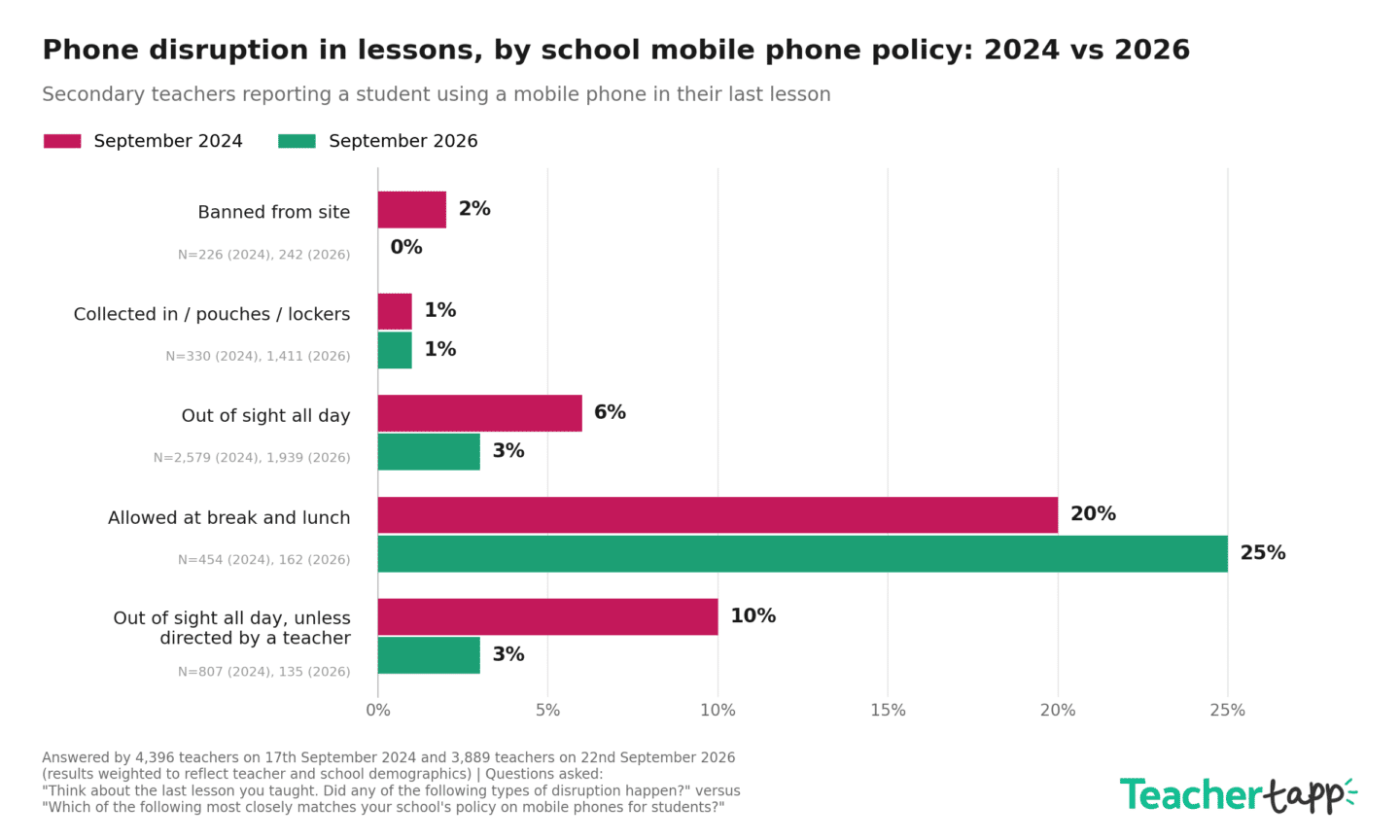
Only schools where mobile phones are allowed at break and lunch saw an increase in mobile phone misuse, but this should be caveated with the fact that the group of schools using this rule has shrunk, and far fewer teachers report that their school use this rule compared to last year.
What other questions should we be asking about mobile phones? Have you had parents
PPA at home
Among secondary staff, spending PPA at home is relatively unusual, with 5% of classroom teachers and 3% of senior leaders reporting they weren’t in school for their PPA.
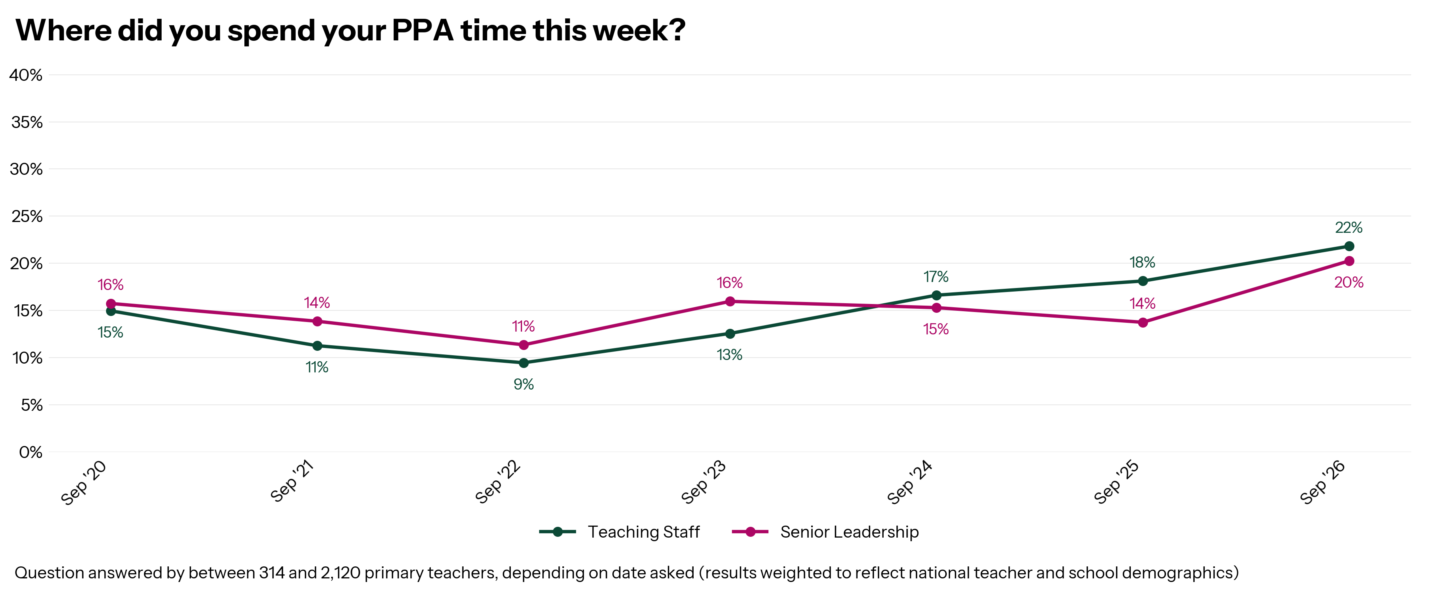
In primary, it’s far more common to have PPA at home, and this has increased year-on-year since 2022: 22% of classroom teachers and 20% of senior leaders had PPA at home last week, compared to 18% and 24% last year, and 17% and 15% in 2024.
Primary classroom teachers and senior leaders spending PPA at home
ADHD support
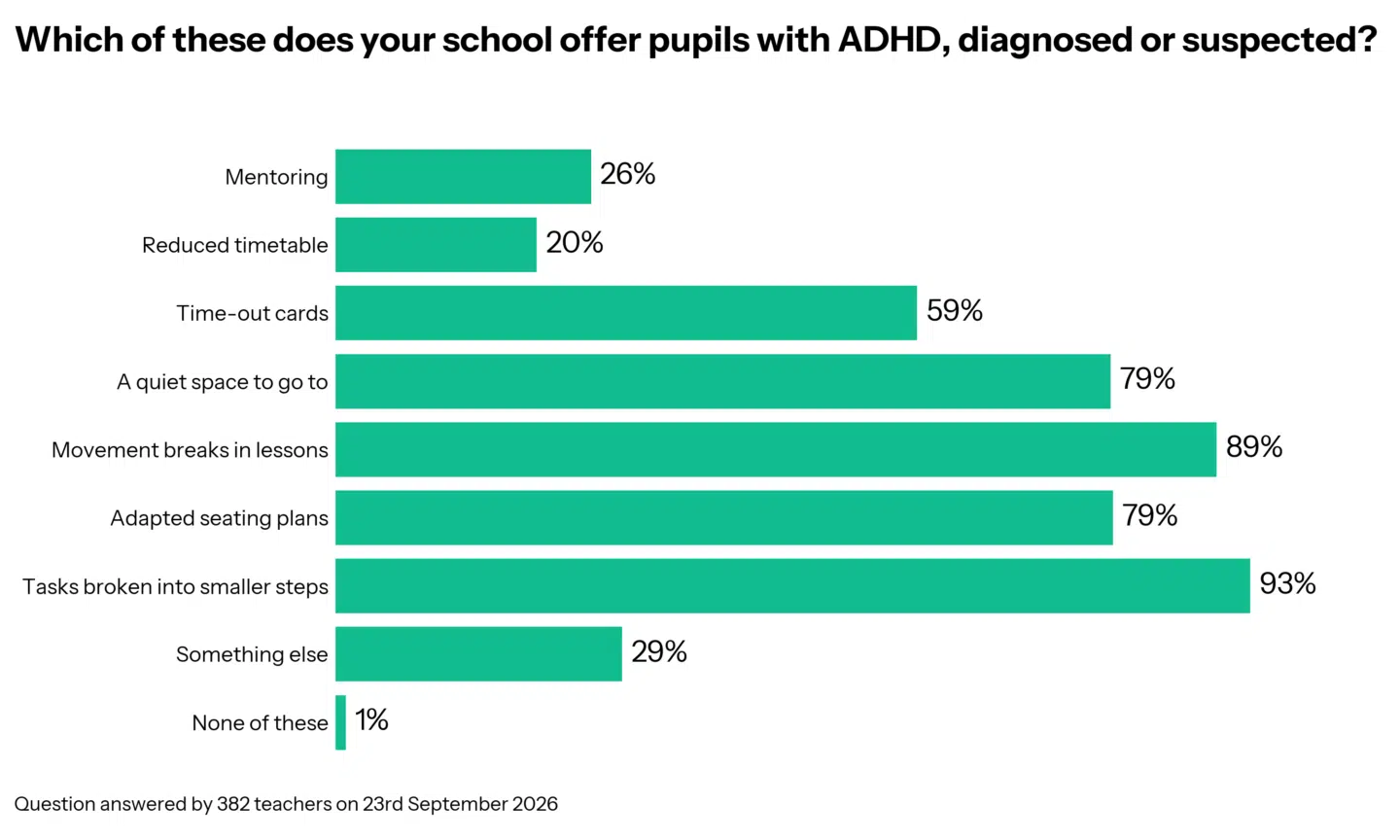
Last week, a teacher got in touch to ask about support offered to students with ADHD. Using the clever ‘target only SENCOs’ option, we found out that alongside the perhaps more obvious options of chunking steps in lessons (93%), and movement breaks in lessons (89%), that 26% offer mentoring, 79% provide a quiet space, and 59% use time-out cards.
AI literacy
As AI use increases, there have been various announcements about the approach being adopted around the world: New York has banned AI use in public schools until High School; in Denmark, teenagers will have to make an oral defence of their written essays to combat AI cheating, and Norway has banned AI for its younger learners.
But what approach do teachers think should be taken in their school?
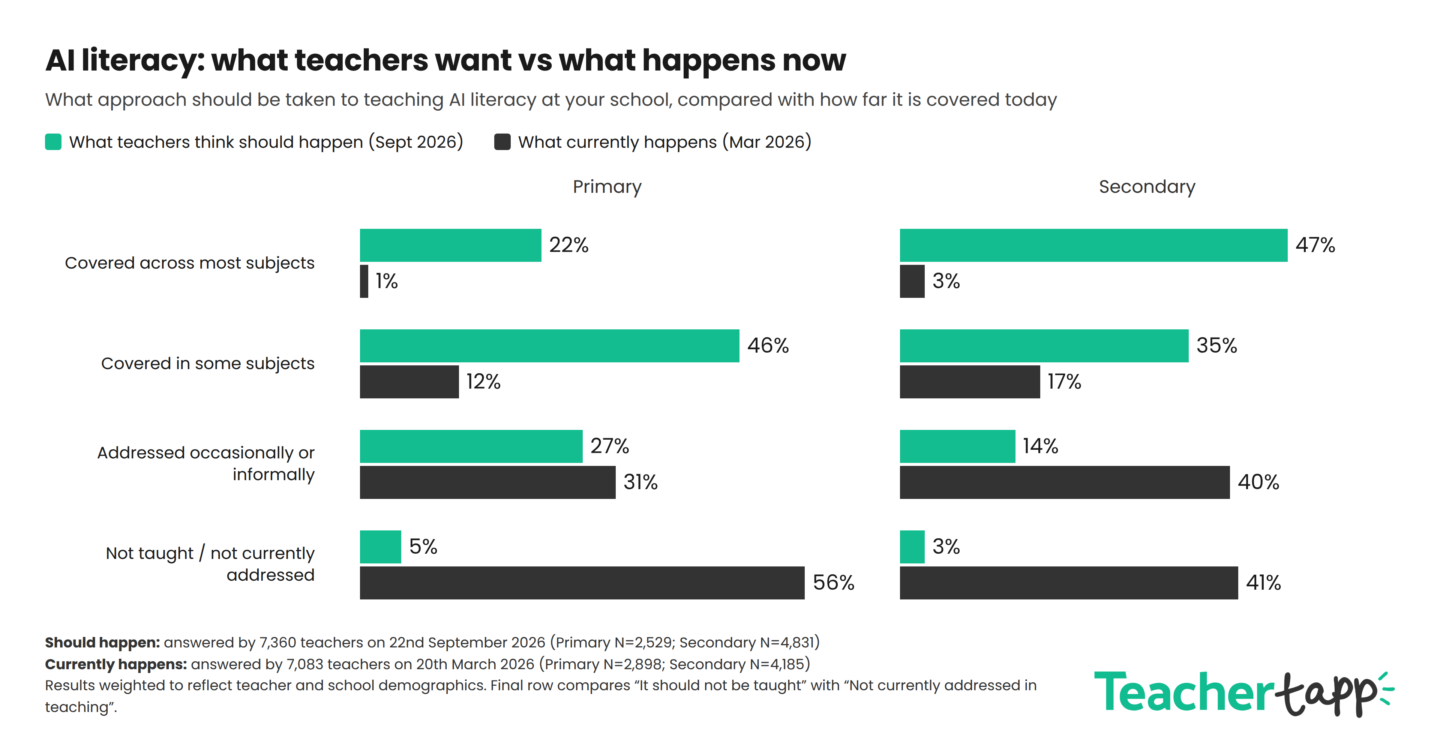
- 68% of primary teachers think AI literacy should be covered across most or some subjects, 27% think it should be addressed occasionally or informally, and just 5% believe it should not be taught.
- Secondary teachers are more in favour of formalising lessons, with 82% thinking AI literacy should be covered across most or some subjects, 14% think it should be addressed occasionally or informally, and just 3% believe it should not be taught.
How does that match what is actually happening? Not very well at all.
- 13% of primary and 20% of secondary teachers say their school is covering in most or some subjects;
- 31% of primary and 40% of secondary say it’s being covered occasionally or informally, and 56% of primary and 41% of secondary say it’s not currently addressed in teaching at all.
From students using AI, to teachers saving time!
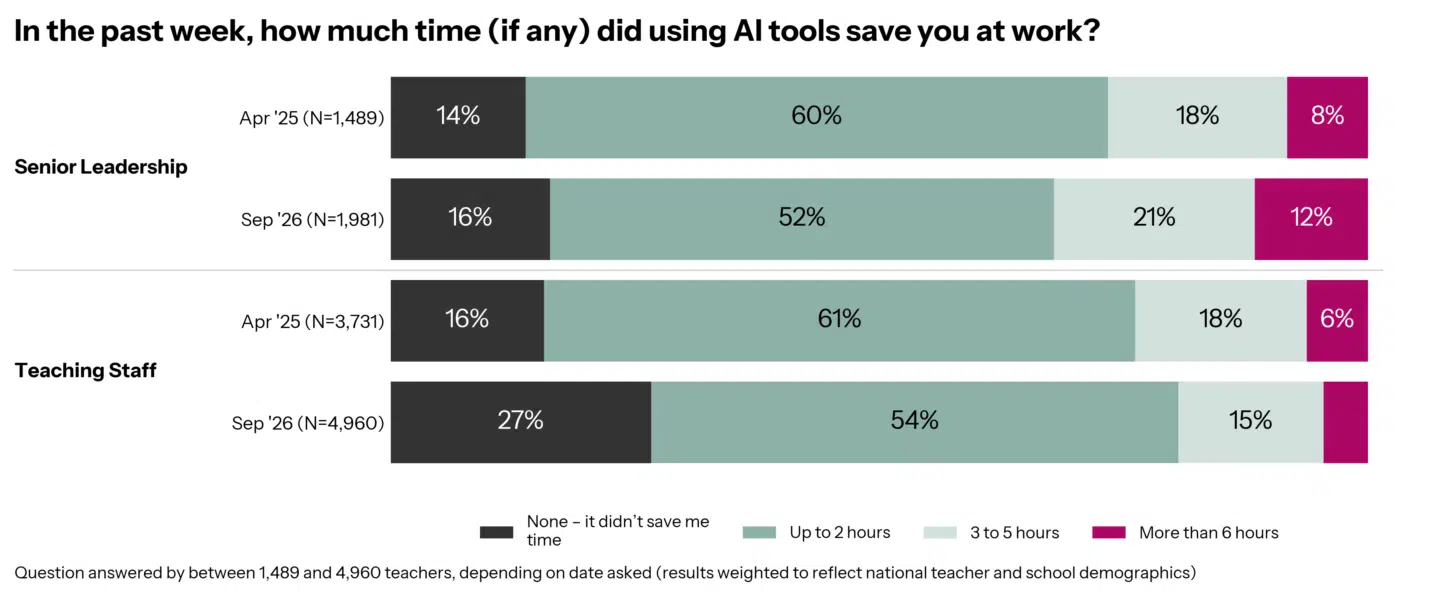
7% of classroom teachers and 18% of senior leaders say they didn’t use AI tools in the last week at all, but among those who did – did it save them time?
27% of classroom teachers and 16% of senior leaders said no, this was UP 11 percentage points for classroom teachers, and 2 percentage points for senior leaders.
Those who did say it saved them time, 54% of classroom teachers and 52% of senior leaders say they saved up to 2 hours of time.
A Teacher Tapper asked…are schools asking students to purchase laptops?
Last week a teacher-parent got in touch, as her daughter’s school had sent a letter home asking for all students to purchase a laptop. As a primary teacher, she wanted to know if this was a “secondary thing” or just a “not at my primary” thing. So we set about finding out!
Primary schools
- 0% of primary teachers in Local Authority (LA) and Multi Academy Trust (MATs) reported parents were asked to buy devices in their school;
- 27% of primary teachers in LA schools provide devices to all those who need them, and 73% say no device is needed.
- The picture is similar among primary teachers in MATs, with 29% saying their school provides devices to those who need them, and 70% reporting no device is needed.
- Teachers in independent schools share a different story: 20% say they ask parents to provide laptops to all or some students, 50% provide the devices, and 29% say no device is needed.
Secondary schools
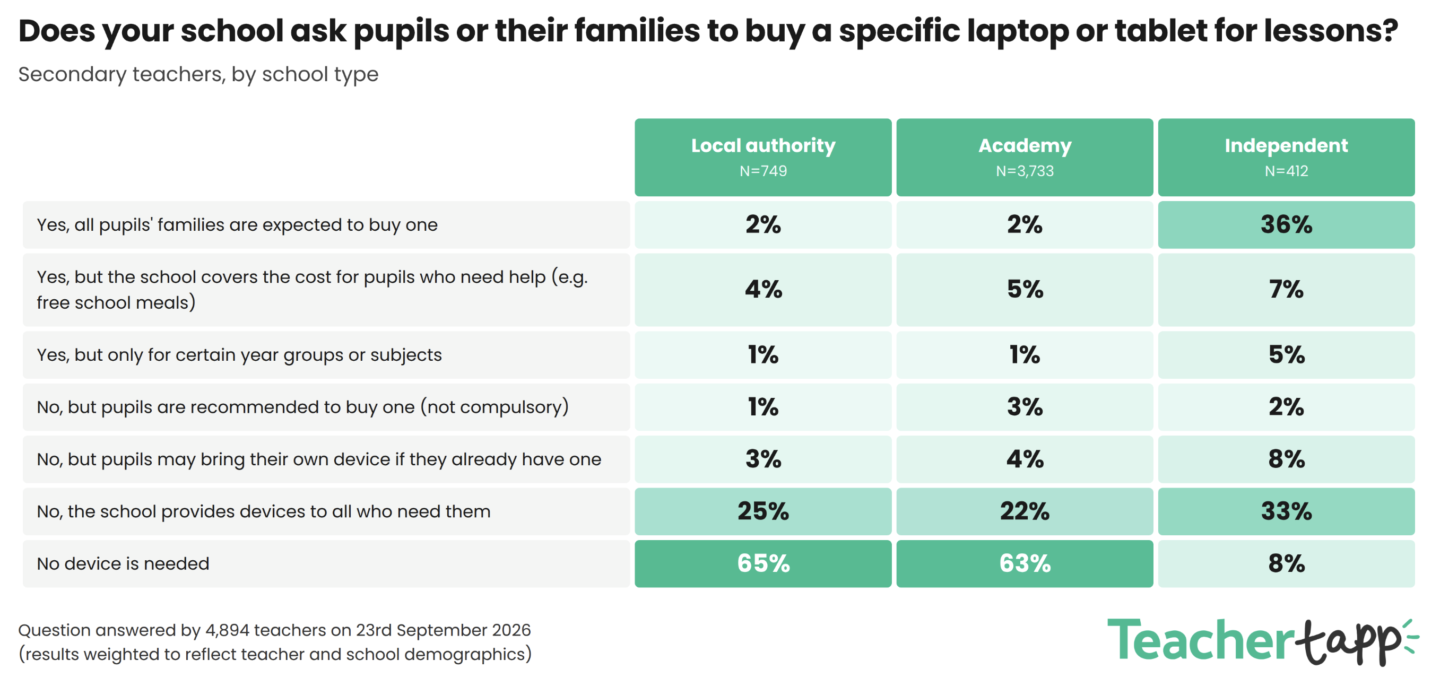
2% of teachers in LAs and MATs say their school expects all pupils to buy a device.
4% of teachers in LAs and 5% of teachers in MATs say their school expects pupils to buy a device, but provide them for those who need help.
1% of teachers in LAs and MATs say their school expects pupils only in specific year groups or studying certain subjects to buy a device.
1% of teachers in LAs and 3% of teachers in MATs say pupils are recommended to buy a device.
3% of teachers in LAs and 4% of teachers in MATs say they have a ‘bring your own device’ policy.
25% of teachers in LAs and 22% of teachers in MATs say their school provides devices to those who need them.
But the most common response for those in the state sector was that no device was needed: 65% in LAs and 63% in MATs.
If you have a question you would like Teacher Tapp to check, get in touch and let us know! England@teachertapp.co.uk 📧
Downs and Downs of…behaviour charts
Only downs without the ups this week. Behaviour charts have dropped in use, but not by much:
DOWN ⬇️ Teachers using behaviour charts in EYFS/KS1 classrooms: 27% in 2026, vs 33% in 2024.
DOWN ⬇️ Teachers using behaviour charts in KS2 classrooms: 29% in 2026 vs 32% in 2024.
Daily Reads
The most-read tip was a long one, but very thought-provoking, looking at the impact removing a subject from the curriculum could have on a whole nation. Check it out here.
There are so many great blogs out there, and we love featuring them on Teacher Tapp. If you have a blog you think we should feature, please email us at england@teachertapp.co.uk, and we will check it out!