Hey there Teacher Tappers!
With term fully in swing now with new primary starters on full days, and (most) year seven teething problems sorted, you might feel like the summer break never happened. But holiday-bounce back is a real thing, and we’ve got some interesting numbers on it in this week’s blog.
Teacher Tapp Reward Store
We hope the Reward Store has made your return to school a little better, especially for the 67 Tappers who have downloaded the Higher and Lower cards, and the 5 who have swapped their points for a 40% off a PGL October holiday.
Every question you answer earns you one point, and then you can exchange those points for Teacher Tapp goodies. We have classic Tapper merch like badges and mugs, PLUS special offerings from Greggs and Costa! If you haven’t seen it yet, be sure to check it out.
…and Teacher Tapp Events
The start of the new school year might be the time when you’re thinking about CPD to support your teaching career. Scroll through the Teacher Tapp events feed to find something useful – plenty of on-demand and in-person options to choose from. Things like ‘How to Educate a Citizen with Prof E.D. Hirsch on Naylor’s Natter – a podcast you can listen to anytime 🎙️.
Right – onto this week’s findings!
Mobile phone rules and mobile phone use
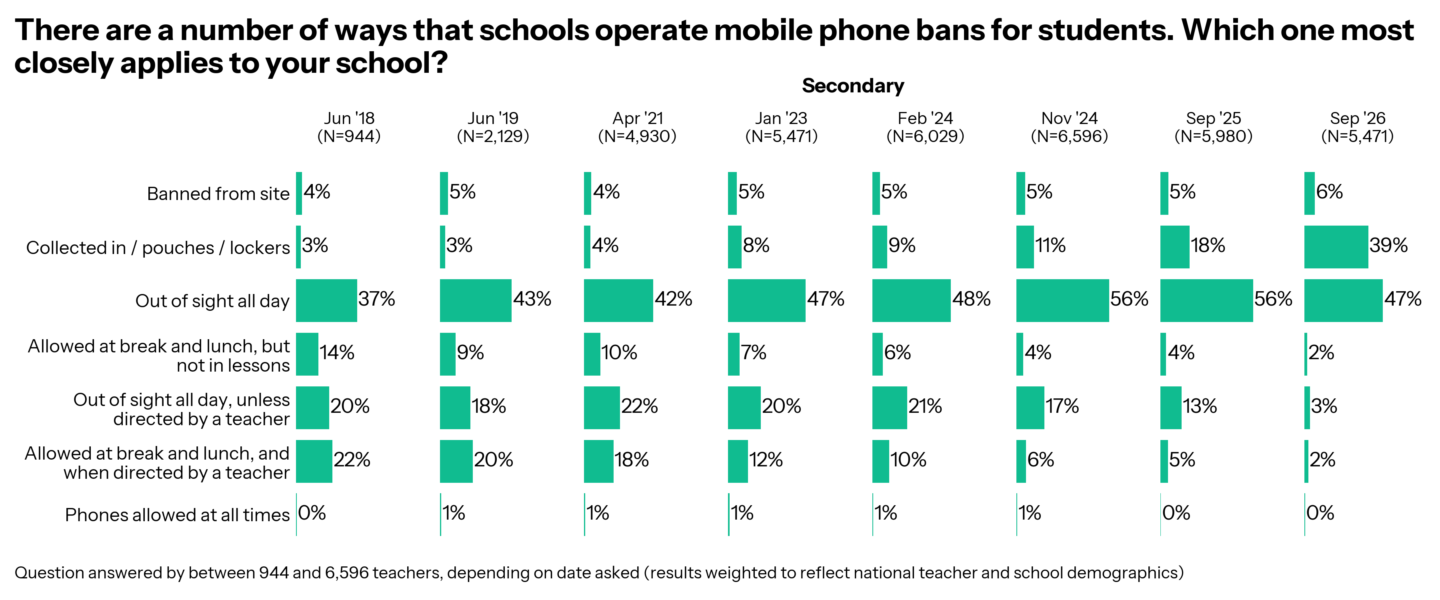
The changes to mobile phones hit schools back in June, but how much difference has the change in guidance had on teachers? The latest data shows that rules on mobiles have been slowly tightening over time, and then in the last 12 months, movement towards ultra-strict phone policies has ramped up.
Secondary school mobile rules:
- 6% of teachers say their school ban phones from the site, very similar to 5% last year and 4% in 2018.
- 39% say they collect in, use pouches or lockers, UP from 19% in 2025 and 3% in 2018.
- 47% say mobiles must be out of sight all day, DOWN from 56% in 2025, but UP from 37% in 2018.
- 2% allow at break and lunch, but not in lessons, similar to 4% last year and DOWN from 14% in 2018.
- 3% say out of sight all day, unless directed by a teacher, DOWN from 13% in 2025, and 20% in 2018.
- 2% allow at break and lunch and when directed by a teacher, DOWN from 5% in 2025, and 22% in 2018.
- 0% allow phones at all times, and this hasn’t gone above 1% since 2018.
Looking just at the 39% of teachers in secondary schools collecting mobiles in or using pouches or lockers: 60% use pouches, 29% collect in, and 10% use lockers.
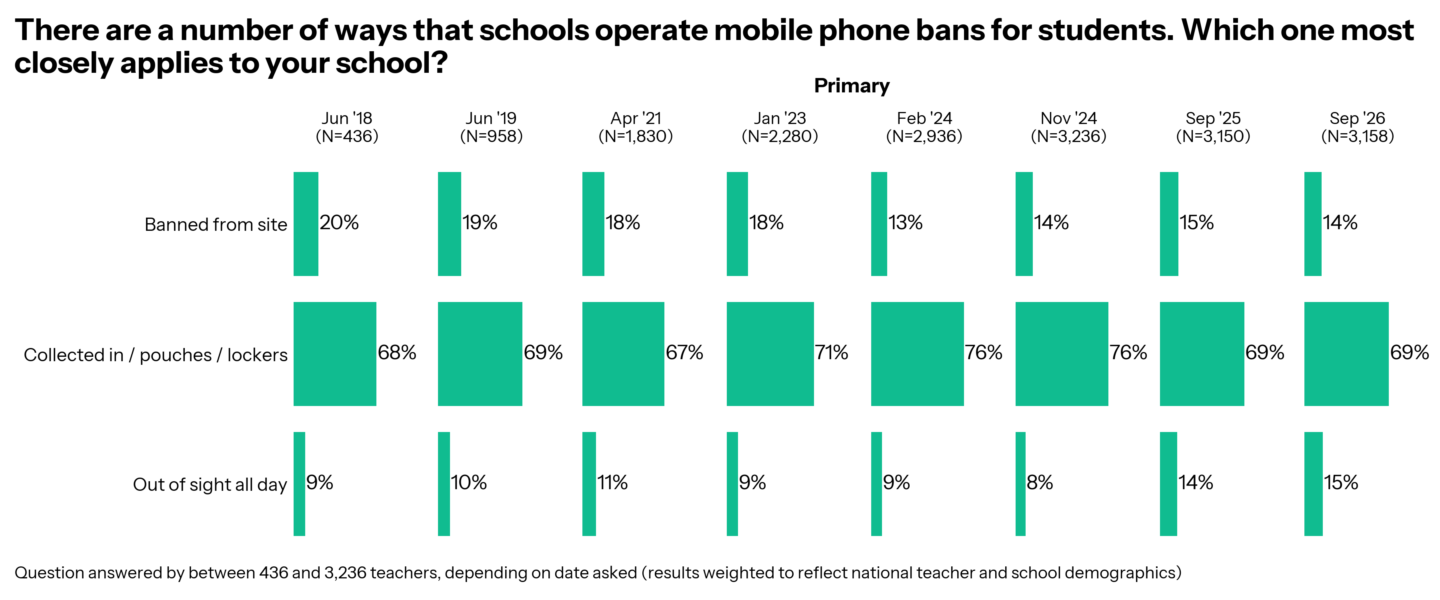
In primary, there are far fewer variations on the rules, with less than 2% allowing phones at break and lunch, or when directed by a teacher. The three most common setups are:
- Banned from site 14%, down from 20% in 2018.
- Collected in/pouches/lockers 69%, no change from 2018 when it was 68%, but down from 2024 when it was 76%.
- Out of sight all day 15%, up from 9% in 2018.
Looking only at the 69% of primary schools where the rule is lockers, collected in or pouches: 95% of primary teachers say they collect the phones in, 2% use lockers, 1% use mobile phone pouches, and 1% use another arrangement.
Mobile phone misuse in school
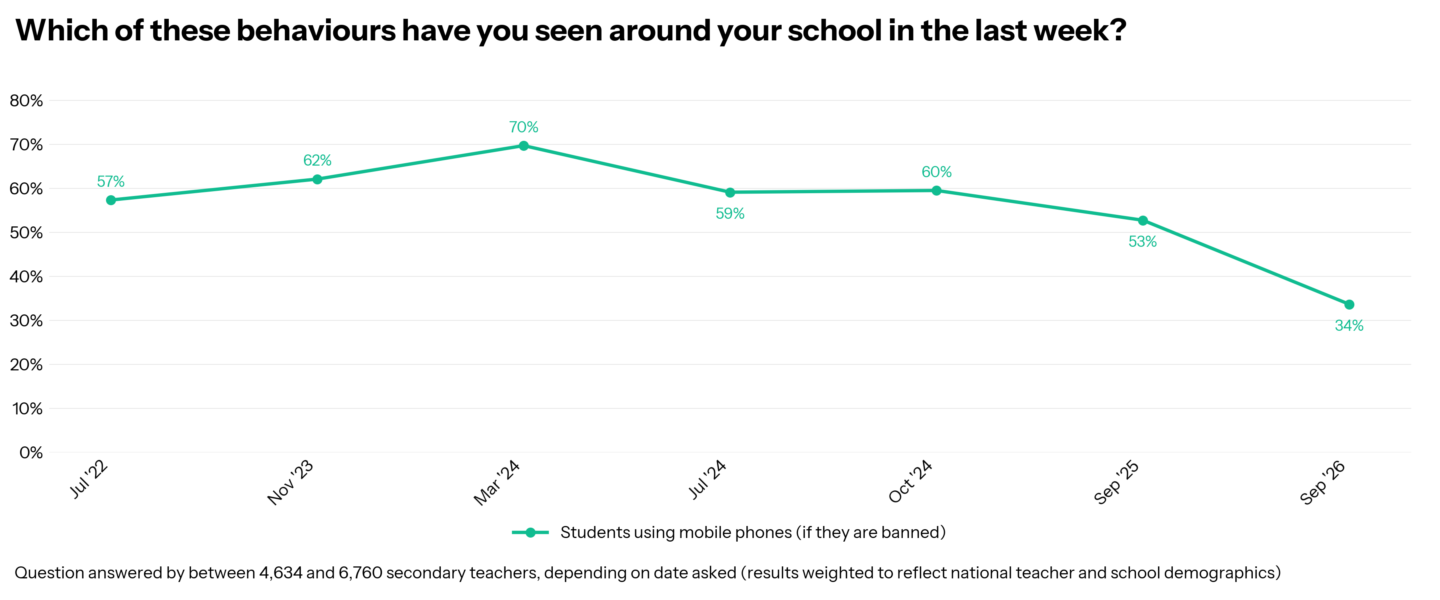
Now, onto the good news! Mobile phone misuse around secondary schools is at its lowest since we started asking in 2022.
The number of teachers in secondary schools reporting that they saw mobiles being used has dropped compared to previous years: 60% in October 2024, 53% in September 2025, and now 34% in 2026.
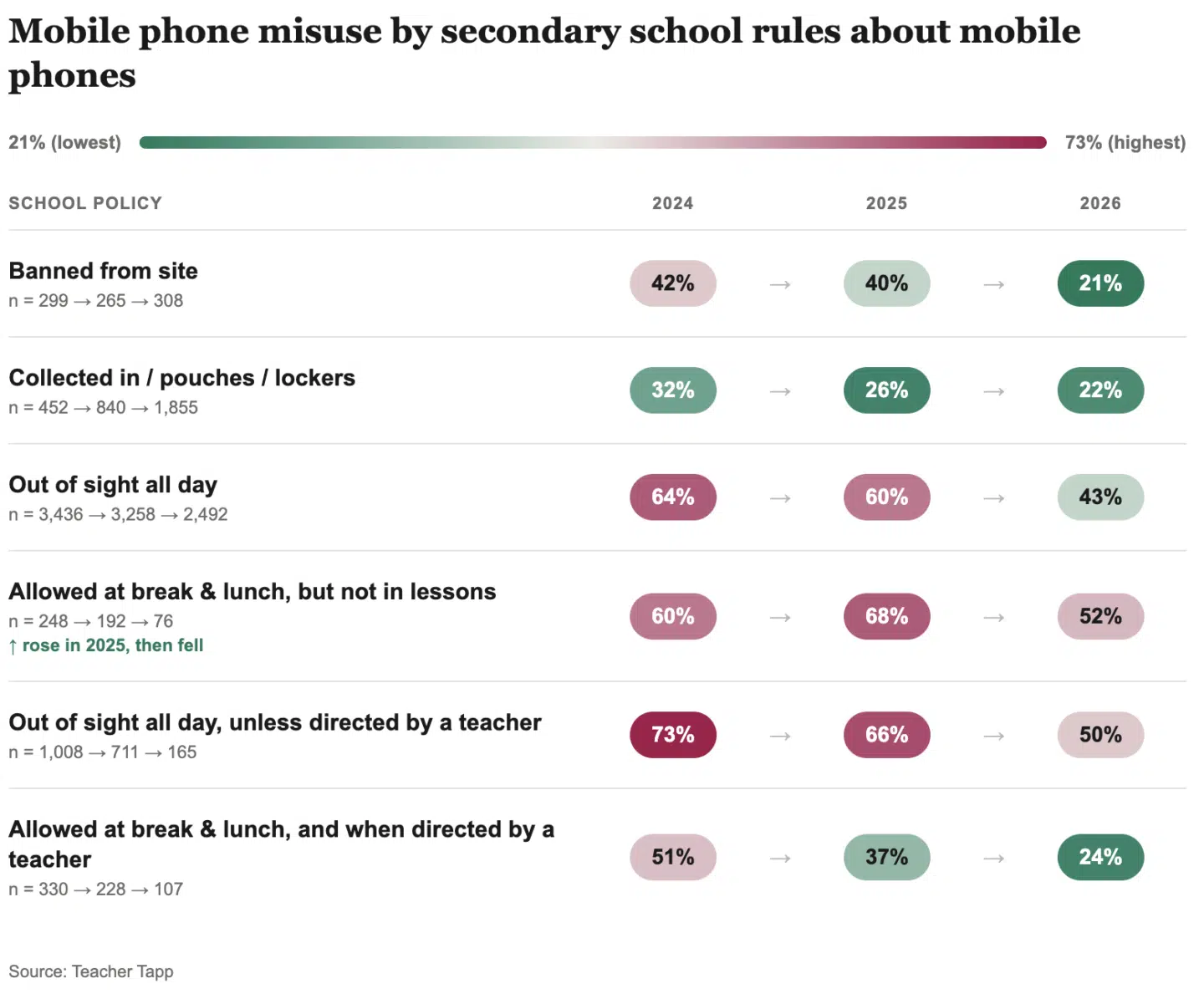
And we checked to see what difference the rules around mobile phones make to the likelihood of seeing a student using a phone when they shouldn’t, and as you would expect, the stricter the rules, the less likely the teacher is to report seeing misuse BUT it doesn’t stamp it out completely:
- Teachers in schools where phones are banned from the school site, only 21% saw a phone when they shouldn’t, very similar to teachers in schools are collected in or use pouches or lockers (22%).
- The numbers slightly increase among teachers who work in schools where mobiles are allowed at break and lunch, and when directed by a teacher (24%).
- When the rule is ‘out of sight all day’, 43% of teachers reported seeing a mobile.
- Responses were similar among teachers in schools where the rule is out of sight all day unless directed by a teacher, and when mobiles are allowed at break and lunch, but not in lessons (50% and 52%).
Coming up next, we have mobile phone use in lessons. Will the change in rules lead to a drop here? We will be reporting back!
Coaching in schools
One of the many questions Tappers wrote in to ask us for information on was coaching in schools. So, a huge thank you to everyone who suggested questions!
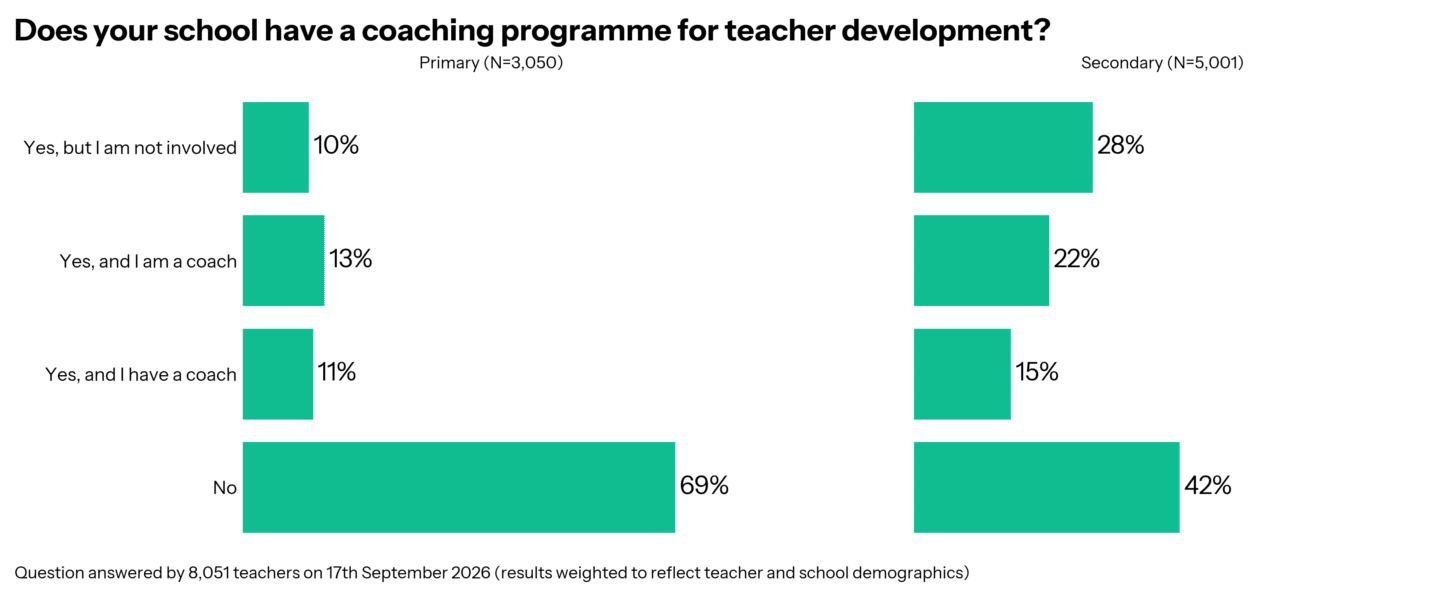
In the academic year 2024/25, 25% of primary teachers and 50% of secondary teachers said they had a coaching programme. Today, those figures have jumped to 31% of primary teachers and 68% of secondary teachers.
What do the coaching programmes cover? Most coaching programmes cover classroom practice (94%), but a smaller number said they also cover delivering line management (17%), professional relationships (24%), and confidence and assertiveness (30%).
When given the option of what coaching someone would choose to have, things look a little different: only 19% want classroom practice, 23% would like to have it in delivering line management, only 4% want coaching on professional relationships, but 18% would like it in confidence and assertiveness. Only 18% would turn down coaching altogether.
Can coaching make a difference to someone’s people management skills? People are pretty optimistic: 27% think any teacher can improve, 71% think most can improve, but some will always struggle even with support, and only 2% think training can’t help.
Anxiety level tracker
Anxiety levels in term time vs the holidays are always going to be different – but do they return to ‘normal’ straight after a break?
A new research study suggests that although wellbeing declined moderately after participants returned to work, it remained higher than before their holiday. Although research carried out previously has suggested that post-holiday wellbeing benefits disappear quickly, the new research found that wellbeing stayed elevated even 21 days after returning.
Here at Tapp, we use a 0 to 10 scale for work-related anxiety, and by grouping responses into low (0-2), mid (3-7) and high (8-10) levels, we can track how work-related anxiety changes depending on the month asked.
- In April, three weeks after the Easter holiday, 13% reported high anxiety, 58% reported mid-level anxiety, and 29% low level anxiety.
- Between April and June, before schools finish for the term, the number reporting low-level anxiety increases to 34%, and when July hits and the summer break begins, it rises again to 41%.
- In August, 64% report low-level anxiety, and just 4% report high anxiety.
- However, in September, the figure for low-level anxiety drops to 32%, and high-level anxiety rises to 11%.
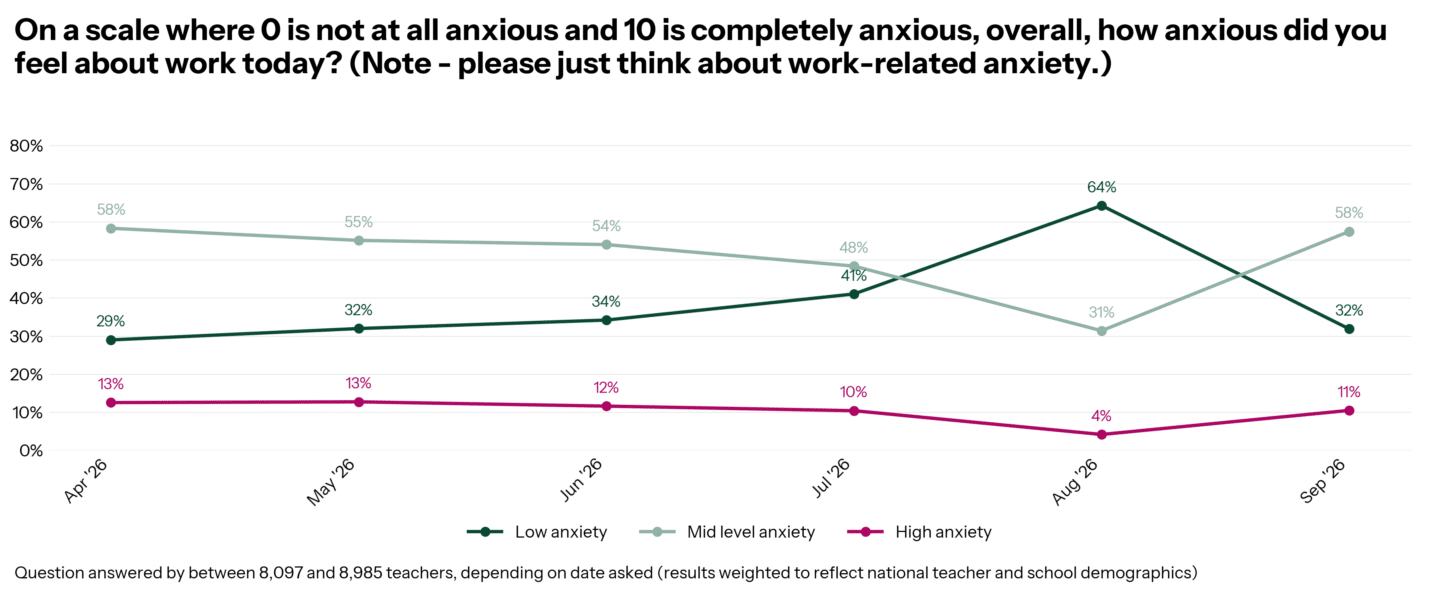
It looks like levels of work-related anxiety in September are slightly better when compared to April, but the ‘benefit bounce back’ is hard to judge here for another reason: unlike other professions, a six-week break doesn’t mean a six-week break, and for many, that time was also spent working.
What we can see is a stark difference between term-time and holiday, and it’s one we’re going to be keeping a closer eye on this year, so be sure to check back next month so see what difference October makes.
A Teacher Tapper asked…icebreakers
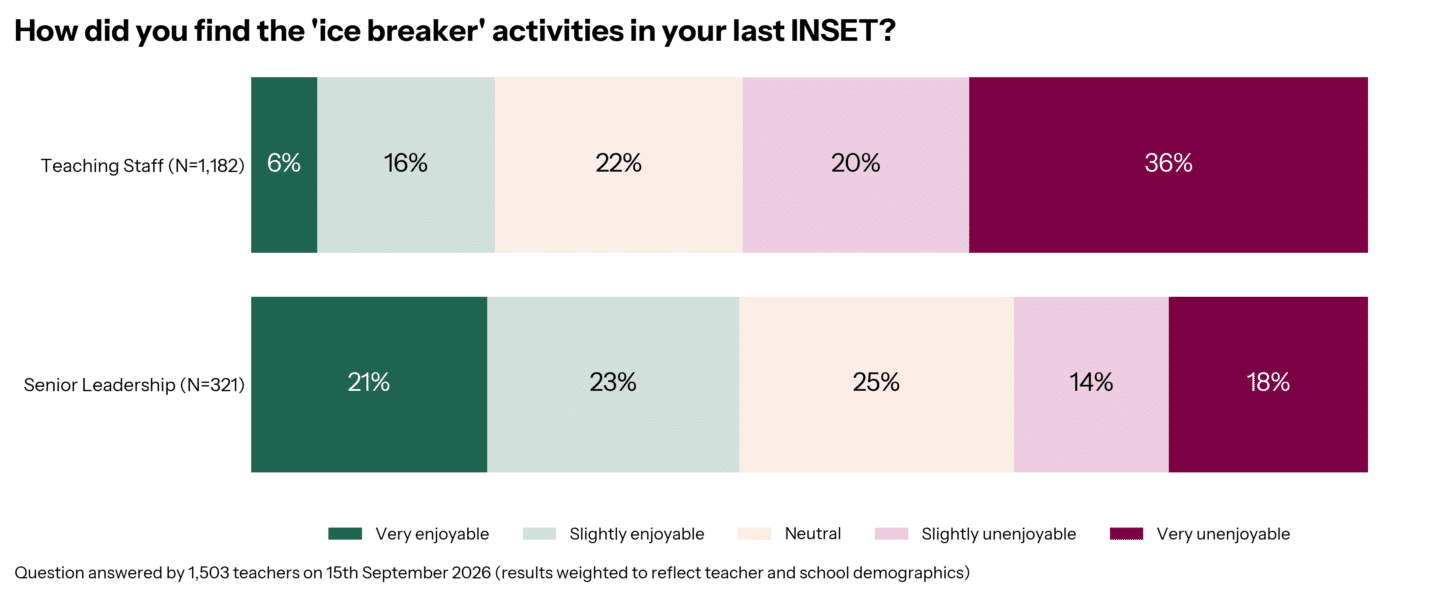
A school leader got in touch to ask how enjoyable teachers found the icebreakers they do as part of their INSETs. Only 19% of Tappers had done icebreakers, and of those who had, for most classroom teachers, they did not find them enjoyable (56%); senior leaders were more split, with 45% finding them enjoyable and 32% unenjoyable.
If you have a question you would like Teacher Tapp to check, get in touch and let us know! England@teachertapp.co.uk 📧
Ups and Downs of…school food
School food has been back in the papers with the announcement that there will be changes to the Food Standards in schools (and you can read more about what the changes will entail in the Government guidance here).
But how do teachers in state-funded schools feel about the food on offer?
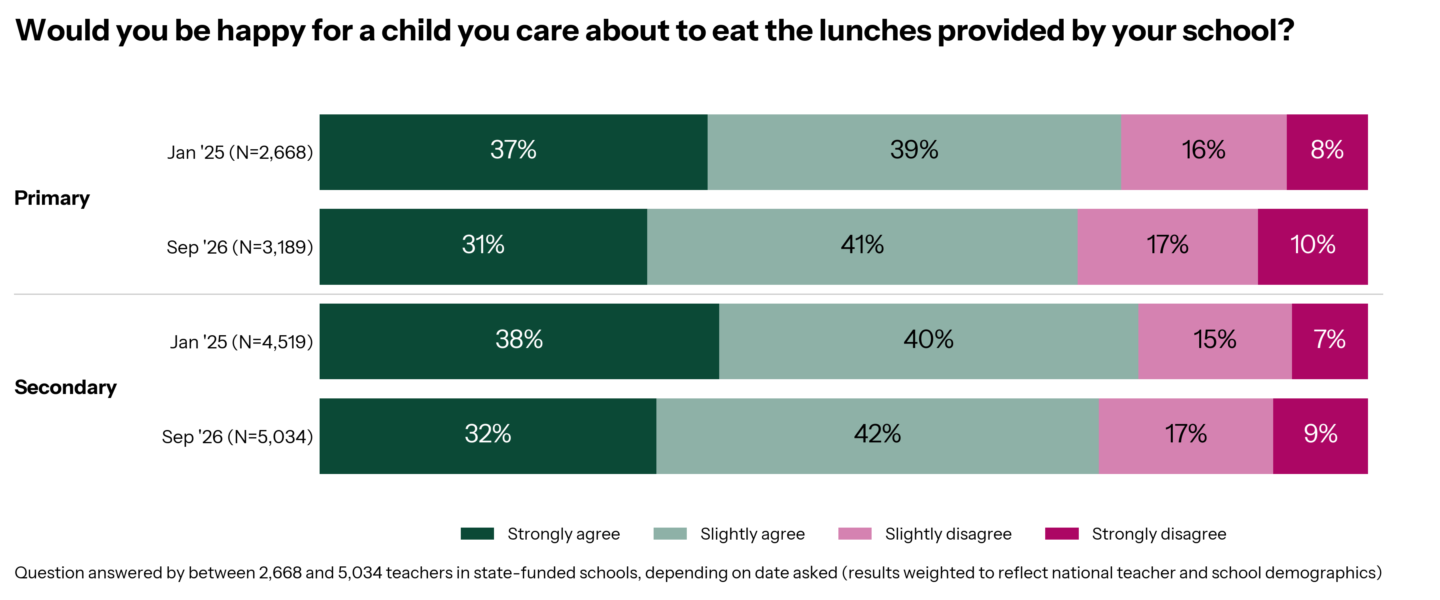
DOWN ⬇️ In the academic year 2024/25, 76% of primary teachers agreed they would be happy for a child they cared about to eat the lunches provided by their school, but this year that has dropped to 72%.
DOWN ⬇️ And the pattern looks similar in secondary: 2024/25, 78% agreed, but now it’s dropped to 74%.
Not huge swings, but a downward trend. We will be checking back in to see if these figures change.
Daily Reads
The most-read tip was a long one, but very thought-provoking, looking at the impact removing a subject from the curriculum could have on a whole nation. Check it out here.
There are so many great blogs out there, and we love featuring them on Teacher Tapp. If you have a blog you think we should feature, please email us at england@teachertapp.co.uk, and we will check it out!