Hey there Teacher Tappers!
For some of you, this is the last week before your half-term, but for others, you still have another week to go 🤪. Whenever your holiday comes, we hope you take the time to recharge and have nice things planned!
Reward Store Updates 👀
The Teacher Tapp Reward Store has been up and running for a good few weeks now – and we’ve loved seeing which items have been most popular, and your suggestions for new items have been listened to! Do go and check out our new stickers, badges, and planners!
Sanctions
We asked classroom teachers whether they used their school’s sanctions policy in their last lesson. Around half did: 58% of primary and 55% of secondary classroom teachers – overwhelmingly to challenge minor misbehaviour rather than major incidents.
Secondary classroom teachers were much more likely to say there wasn’t any poor behaviour that needed sanctioning (40% vs 27% in primary).
Very few classroom teachers deliberately avoid the policy: just 4% in primary and 2% in secondary said they didn’t feel able to use it, and 7% of primary classroom teachers and 2% of secondary teachers said they use their own system instead.
Behaviour
And with sanctions, of course, we have to track behaviour!
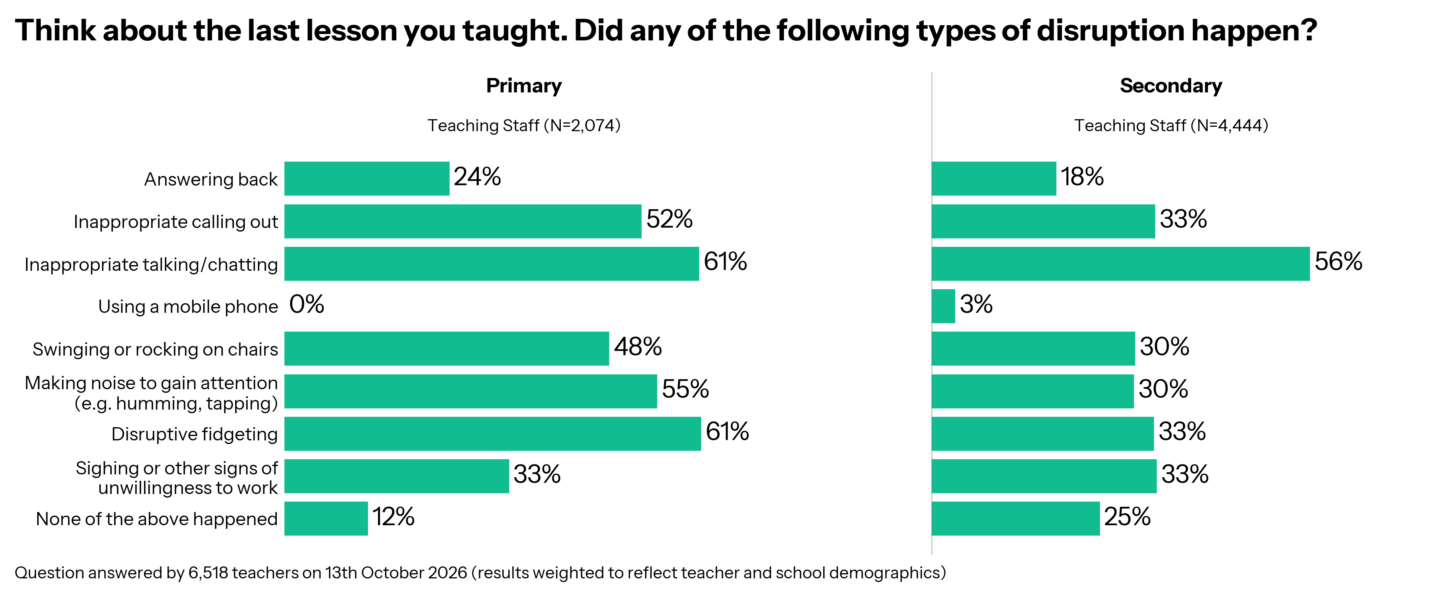
Primary teachers were more likely to report disruptions, with only 12% reporting none of the things on our list happened, compared to 25% of secondary teachers.
Disruptive fidgeting was reported by more primary teachers, compared with secondary teachers (61% vs 33%).
Making noise to gain attention happened to more primary teachers than secondary teachers (55% vs 30%).
But sighing or unwillingness to work was as likely to happen to both primary and secondary teachers at 33% for both!
The biggest source of stress
This question, where we ask about your biggest source of stress, has entered our monthly rotation of regular asks. This will give us better insights into how the shifting challenges of the school year impact stress levels, and the different challenges facing teachers at different stages of their career.
What can we tell from the data we’ve collected so far?
- Very few teachers are stress-free. Only 5–7% say they haven’t felt stressed or unhappy in the last two weeks, and that figure has barely moved in the four years we have been asking.
- Seniority makes the biggest difference to the answer you give. In October 2026, headteachers’ top answer was relationship with parents (23%), followed by accountability 21% and then pastoral concerns 15%. Behaviour is only 9%. Other members of SLT had different top answers, with behaviour, parents and accountability each around 13%. Middle leaders are most likely to say behaviour 20%, but then admin was second at 16%, which is a stronger second than for any other group. For classroom teachers, behaviour dominates 29%.
- Although behaviour is a significant concern, the good news is that it falls from 30% for teachers in their first 5 years to about 20% for those with 10+ years. Early-career teachers are also the least likely to say they’re not stressed 3%, compared with 7% for those with 20+ years.
- Admin and accountability have swapped places since May. Accountability ranked second when we asked in May 2024, at 13%, and that makes sense, as that’s when SATs and exam pressure peak. But admin overtakes it in September when it hit 17%, the time when the start-of-year paperwork piles up.
A Teacher Tapper asked…do friendships make a difference?
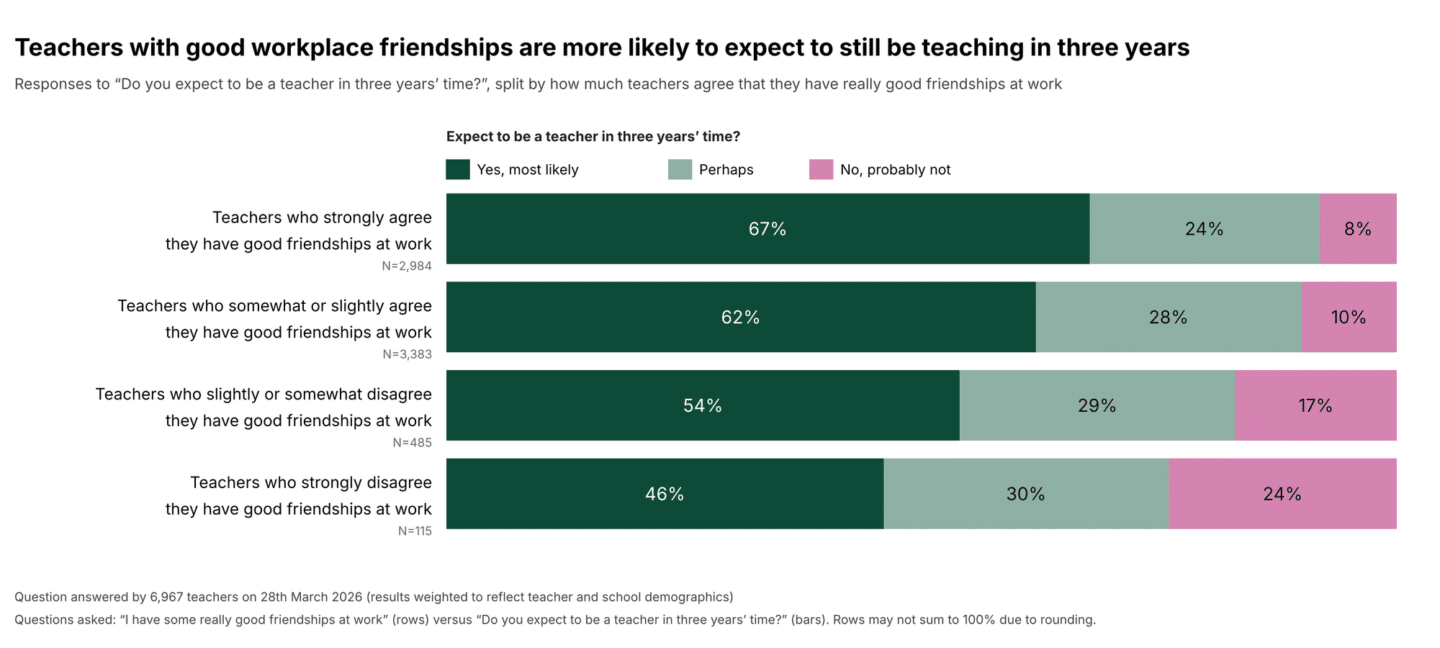
A Teacher Tapper wrote in with a question about friendships at work: do teachers with a friend at work tend to want to stay in teaching when compared to those who don’t? The reason she wanted us to find out was that her school was actively trying to discourage friendships between staff – something she felt was likely to be detrimental to staff morale.
To answer this, we had to ask two questions: one about friendships at work, and another about the likelihood that you’ll still be a teacher in three years. Crossing these together gives us the answer.
The result is clear: teachers who strongly agree they have good friendships at work are significantly more likely to report it is “most likely” they will still be teaching in three years, when compared to those who strongly disagree (67% vs 46%).
If you have a question you would like Teacher Tapp to check, get in touch and let us know! England@teachertapp.co.uk 📧
Ups and Downs of…SEND support
As we wait for the details of the new SEND changes to be fully revealed, our regular SEND questions have been re-asked to see what teachers’ actual experience of SEND support has been:
➡️ Primary teachers’ use of their own scaffolds is steady: 58% create specific resources to help SEND pupils work independently, broadly unchanged since we started asking (57% in 2022).
⬇️ Fewer primary teachers rely mainly on teaching assistants: 18% say they primarily relied on TA support for SEND pupils in their last lesson, down from 28% in 2022 and 2024.
⬇️ Secondary teachers are leaning less on TAs too: 10% primarily relied on TA support, down from 15% in 2023 and 2024.
Daily Reads
The most-read tip was all about learning walks! Wow – this was particularly popular with leaders; 13% clicked it! I think it’s time we re-asked our questions about learning walks…
There are so many great blogs out there, and we love featuring them on Teacher Tapp. If you have a blog you think we should feature, please email us at England@teachertapp.co.uk, and we will check it out!