Hey there Teacher Tappers!
The “back-to-school” collections are out in force now, but there is still holiday time for many of you, plus a Bank Holiday coming up. So we hope you have felt the benefit of the break, even if many of you have been thinking about the new term (we have more on working in the holiday later in the blog).
Prize draw!
Our prize draw is still running, and in case you missed it, this month’s prize draw is a sartorial one 👚 🧢 👖. Everyone who answers questions between 7 August 2026 and 31 August 2026 will be entered into a prize draw to win a £500 gift card to a clothes shop of their choice. Read the full Ts and Cs here, and good luck to all you Tappers!
Right – onto this week’s findings!
GCSE and BTEC results day round-up
Last week saw GCSE and BTEC results released to students, and 56% of secondary teachers went in for results day; 44% did so voluntarily, and the rest did so because it is part of their role. And we’re sure every student who received your support was grateful that you did!
Staff attendance is important – but it’s also really important that students are there too! Particularly those who might need a bit of extra help navigating the implications of their results if they missed their target grades. This year, experts voiced worries that a new Government-backed app delivering results to students digitally would see students stay away from schools. Fortunately, this didn’t seem to have a significant impact on in-person attendance, with two-thirds saying numbers were the same as last year, 17% noticed higher numbers compared to previous years, and 16% reported they had lower numbers than usual.
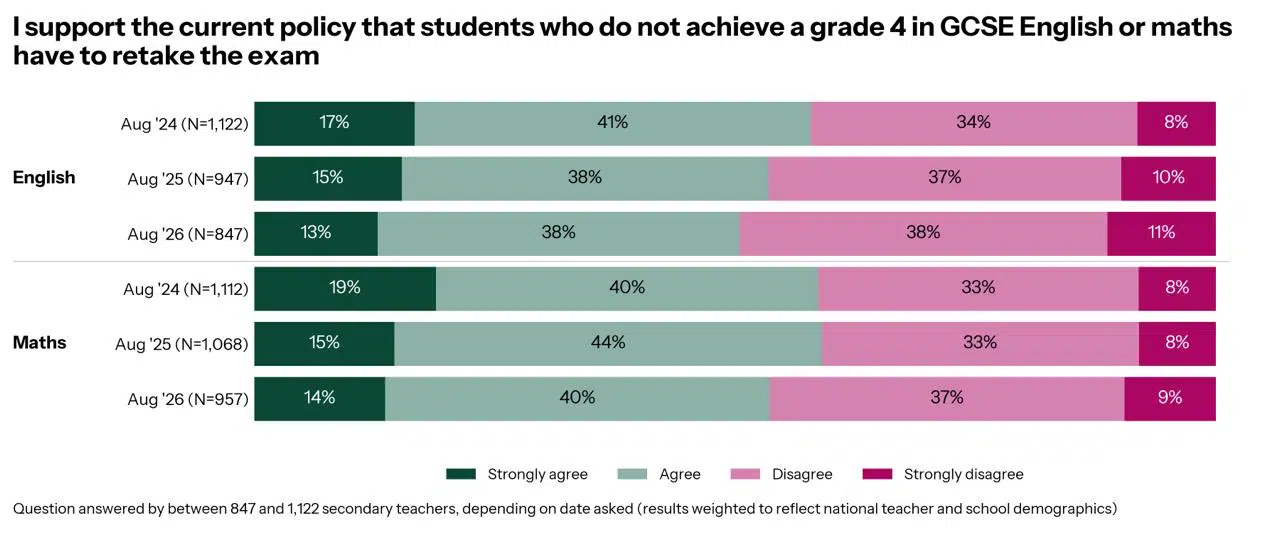
A question mark hangs over the current resit policy that requires students who do not achieve a grade 4 in GCSE English or maths to retake the exam, with plans to introduce a new level 1 “stepping stone” qualification. But how do teachers feel about the policy? In 2024, 58% of English teachers supported the resit policy; today, that has dropped to 51%. It’s a similar pattern in maths, where 59% supported the policy, and now that has dropped to 54%.
Those that argue resits should be kept will sometimes point to data around the reasons why a person might become ‘NEET’ (not in work or education). For example, a report by NATCEN says students without GCSEs are more likely to be out of work and education, when compared to those with GCSEs (young people who did not achieve any GCSEs were over five times more likely to experience a period of NEET than those who achieved five or more).
However, not everyone agrees that qualifications are the best way to prevent future unemployment. In the Government-commissioned report into Young People and Work authored by the Rt Hon Alan Milburn, he puts forward a different perspective.
In the report, Milburn says, “there seems to be emerging evidence that educational qualifications on their own, are becoming less protective against the risk of young people becoming NEET” and points out that the “growth in the proportion of NEET young people with A Level qualifications or above has outpaced the rise in the proportion of young people attaining those qualifications overall”. Milburn says one explanation for this increase may be because parts of the schools system “are not sufficiently developing students’ capabilities or work readiness.”.
Once more details on these plans for change emerge, expect more questions on Teacher Tapp to ensure we’re amplifying the voice of the professionals, as changes happen to the assessment system 📣.
NEETs in primary
In an interview speaking about the report, Mr Milburn made a recommendation that primary school teachers should be involved in spotting students who might eventually be NEET. He told The Guardian: “The warning signs are there from a very early, early age. Definitely primary schools should be identifying children who are at risk of being NEET.
“Secondary schools and other services should be intercepting, intervening, supporting and helping those young people to get on a different path.”
Opinions from primary schools are mixed on this suggestion: 44% agree it would be useful, but 56% disagree.
Secondary teachers are similarly divided; when asked how useful it would be to have an incoming Year 7 student flagged as at risk of NEET, 38% would find it useful, 26% wouldn’t find it useful, and 36% wouldn’t want students flagged this early.
New Ofsted questions
From one government initiative to the next: Ofsted changes! When Ofsted revised its framework, its teacher questionnaire also changed. To ensure our questions were up to date, Teacher Tapp added these new questions to its question bank.
One of the new Ofsted questions elicited several messages from Tappers, who had made use of the ‘Teachers like me’ feature, and noted a huge difference between the responses of leaders vs teachers.
Many more primary senior leaders than classroom teachers believe leaders at the school support their staff in managing behaviour (89% vs 51%), and the same pattern can be seen in secondary (86% vs 52%).
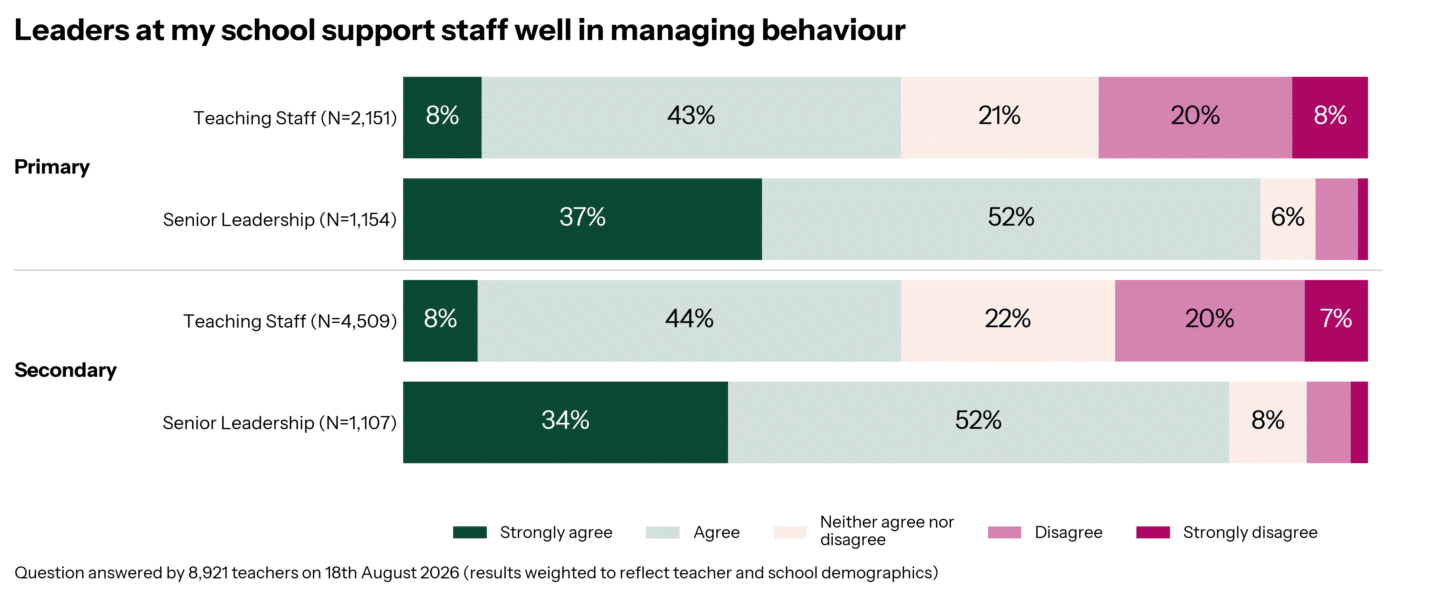
Tappers who wrote in expressed concern that this gap is what leads to friction in schools. “When leaders and teachers have such different views of the reality of what is happening in their school, it will inevitably lead to frustrations on both sides.”
Of course, the best way to uncover whether or not there is a split in your own school is to ask this difficult question to your own teachers…and then follow it up with what would help you feel supported with behaviour. It doesn’t mean that the things staff want can be delivered, but a clear understanding of the challenge you face will always be a stronger starting point than guessing at what the problem is.
If you’re interested in finding out more about how you can use Teacher Tapp in your school surveys, do check out School Surveys by Teacher Tapp!
A Teacher Tapper asked…what are you going into school to do?
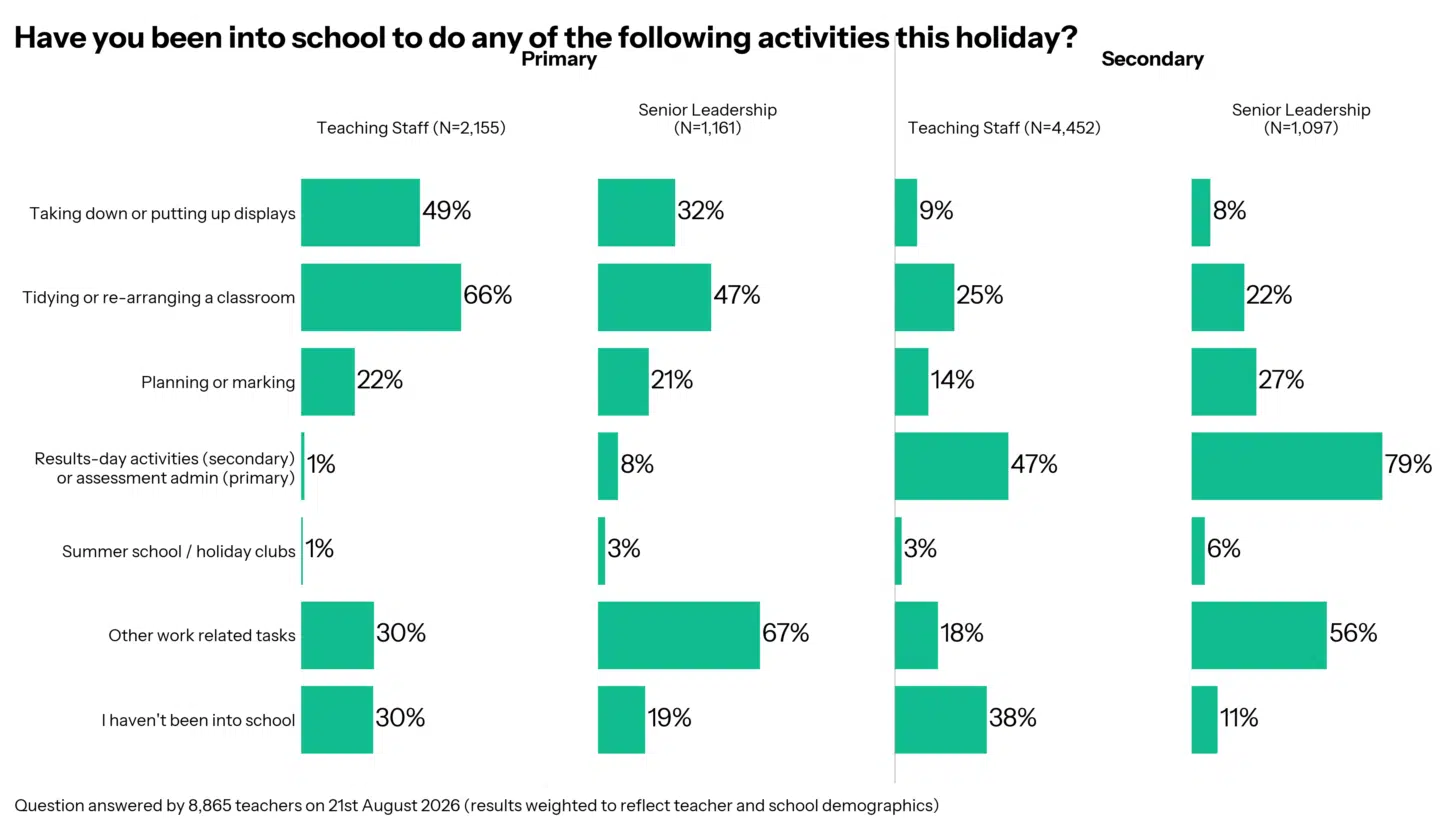
Last week, a Tapper got in touch to ask what other teachers were going into school to do. Easy! We popped a question in and discovered significant differences when you adjust for phase and seniority:
In primary, 30% of classroom teachers and 19% of senior leaders haven’t been into school at all. The most common activities were…
- Tidying the classroom (66% of classroom teachers vs 47% of senior leaders)
- Sorting displays (49% vs 32%)
- Planning or marking (22% vs 21%)
In secondary, 38% of classroom teachers and 11% of senior leaders haven’t gone into school. Common activities were…
- Results day activities (47% of classroom teachers vs 79% of senior leaders)
- Other work related tasks (18% vs 56%)
- Tidying the classroom (25% vs 22%)
If you have a question you would like Teacher Tapp to check, get in touch and let us know! England@teachertapp.co.uk 📧.
The teacher “baddies”
We asked for your favourite teacher “baddies” (although we did learn “baddies” can also mean “very attractive” – we didn’t mean it like that!). We were polling on the best worst teachers…the villains! From your votes, we worked out the top three best worst teachers.
In third place was Mr Gilbert from The Inbetweeners (13%), in second place was Dolores Umbridge from Harry Potter (24%) and the winner, in first place, was Miss Trunchbull from Matilda (34%).
Ups and Downs…of teachers’ views of private school
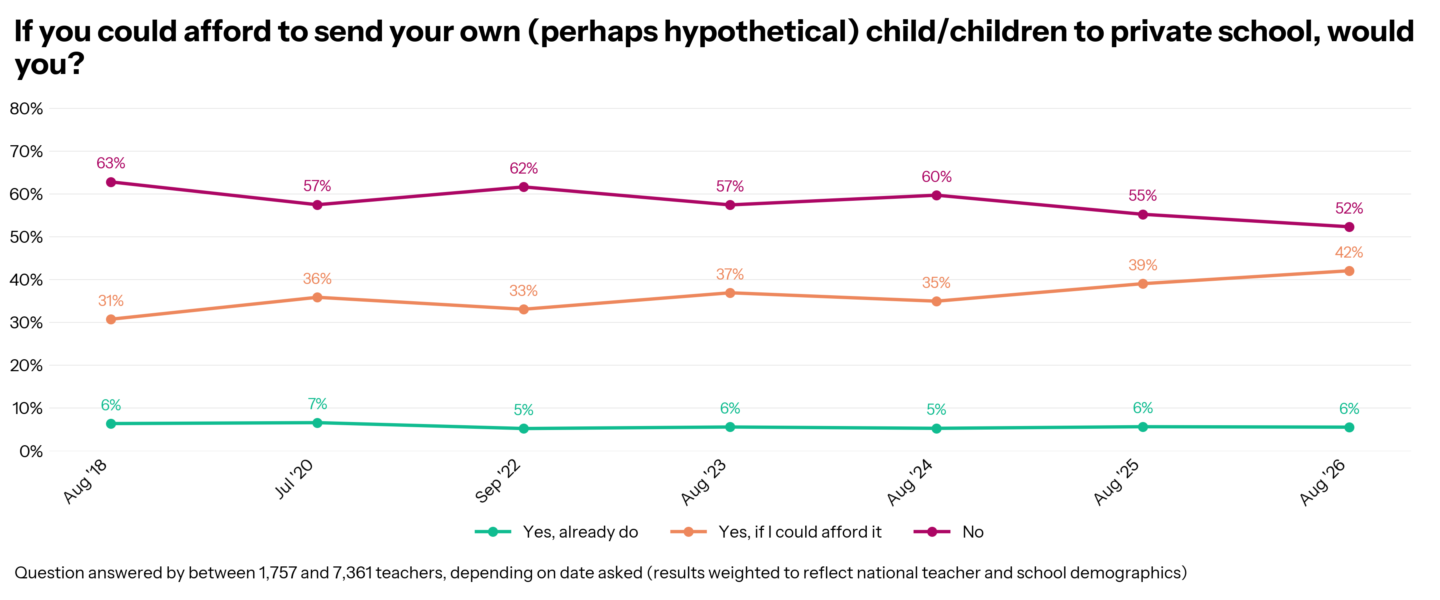
Since we first asked about whether or not you would send your own (perhaps hypothetical) child to private school, we have seen a few changes:
Going UP is the number who would send to private school if they could afford it (42% in 2026 vs 31% in 2018).
And that’s not because more are sending to private school – as this is unchanged (6% now and in 2018).
So, logic follows, that it must be a drop in those saying “no, not even if I could afford to” (52% in 2026 vs 63% in 2018).
Daily Reads
The most-read tip was from FFT on the findings from GCSE results day.
There are so many great blogs out there, and we love featuring them on Teacher Tapp. If you have a blog you think we should feature, please email us at england@teachertapp.co.uk, and we will check it out!