Hey there Teacher Tappers!
Every school will organise its In-Service Education and Training days, or more commonly referred to as ‘INSET’, slightly differently. But what is the typical approach found in schools? We have pulled together our best INSET questions so you can see whether your school’s approach puts you in the majority, the minority…or somewhere in between!
How many INSET days at the start of the year?
Teachers tell us that starting the year with INSET is the approach taken by almost everyone! 99% of teachers say they have INSET days before pupils arrive at the start of the year. Most last for two days (53% in primary vs 55% in secondary), with one day also common (39% in primary vs 33% in secondary).
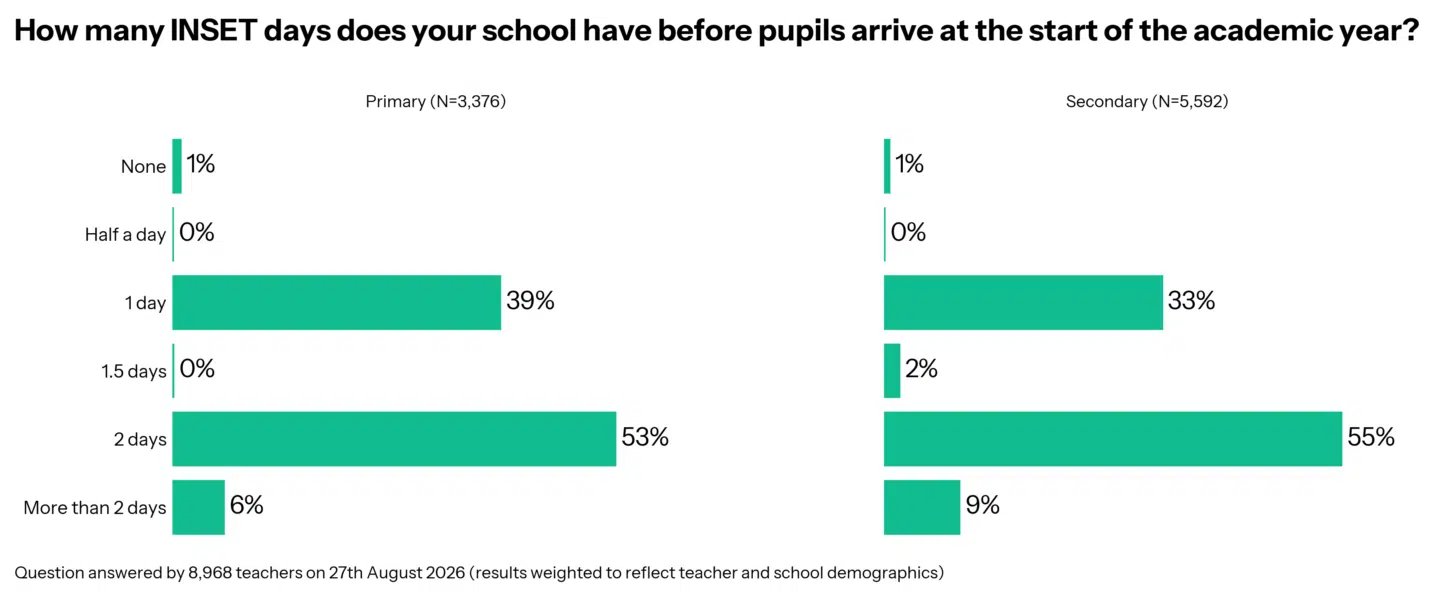
Over time, there has been a change in the popularity of a two-day INSET, with the percentage of secondary teachers reporting two or more INSET days at the start of the year having gone up (64% in 2026 vs 54% in 2018), and the percentage of primary teachers also increased (59% in 2026 vs 52% in 2018).
Twilight or daytime?
The INSET “day” where students stay home, but teachers are in school, isn’t the only delivery method for INSET.
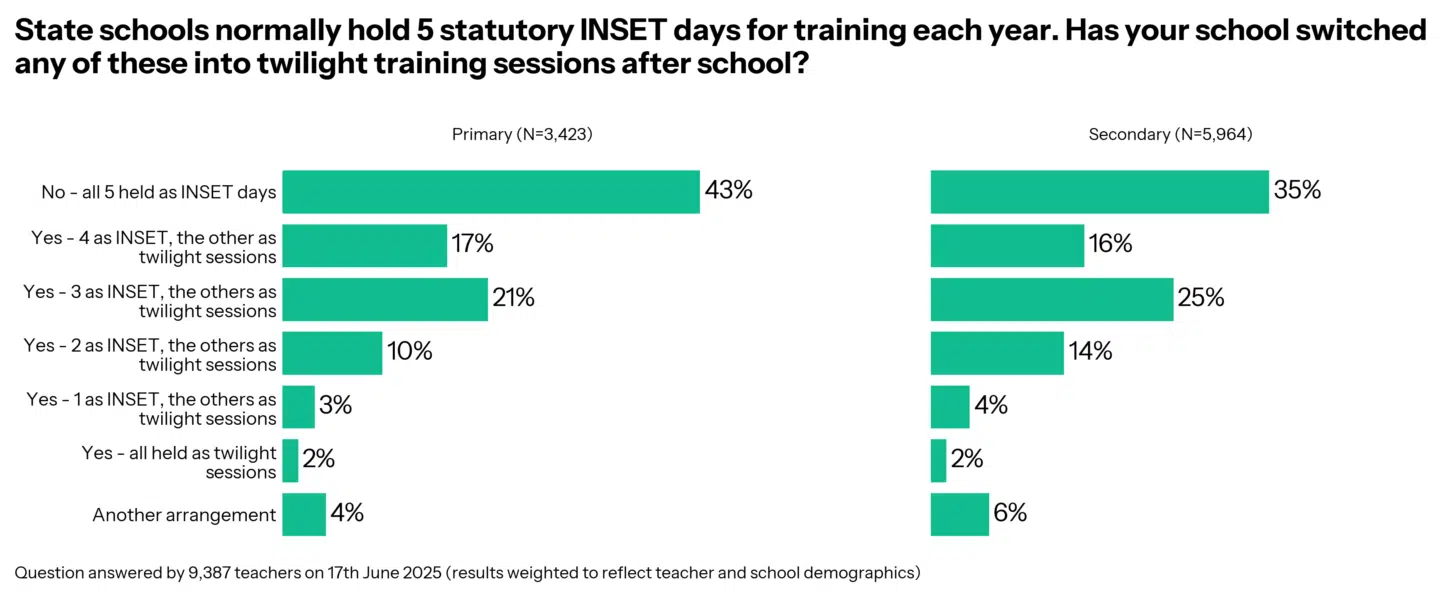
- 43% of primary and 35% of secondary say they do all daytime INSET.
- 51% of primary and 59% of secondary have a mixed approach of daytime and twilight.
- 2% of primary and secondary teachers say they do all INSET as twilights.
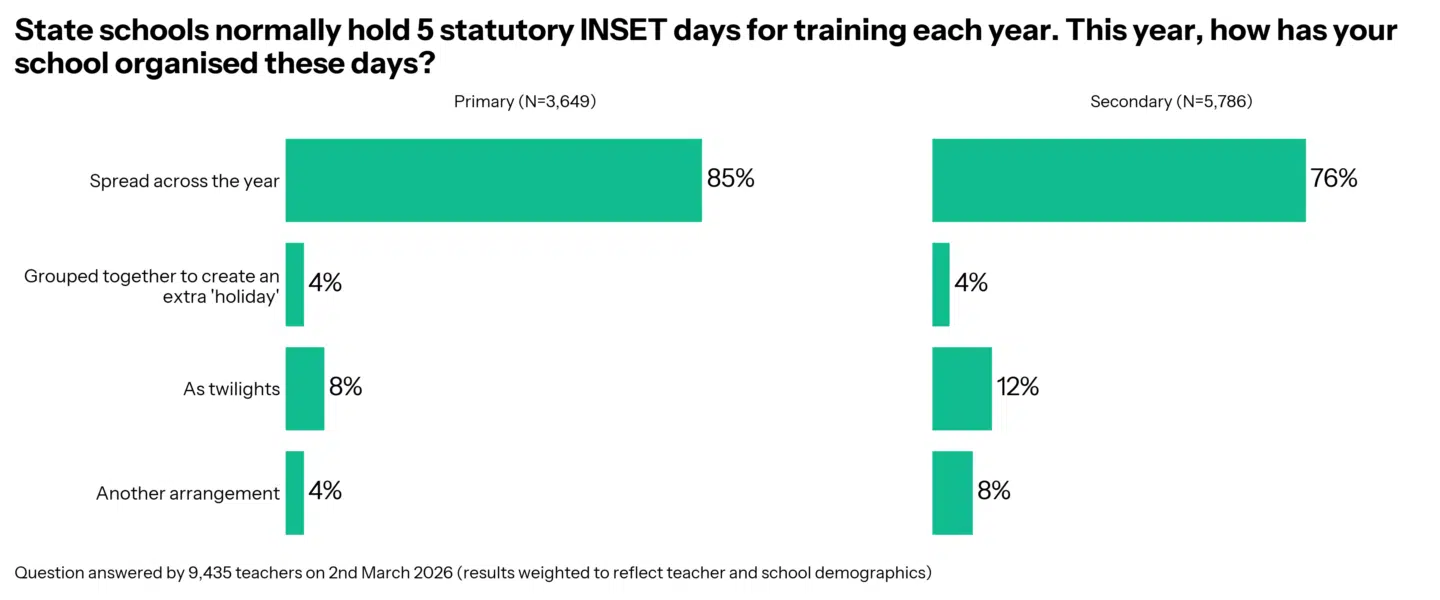
For some schools, arranging INSETs at the beginning or end of a normal break allows them to offer an “extra holiday” to the students. 4% of primary and secondary teachers reported taking this approach, with the majority spreading them across the year (85% primary vs 76% secondary).
What did you do in your INSET?
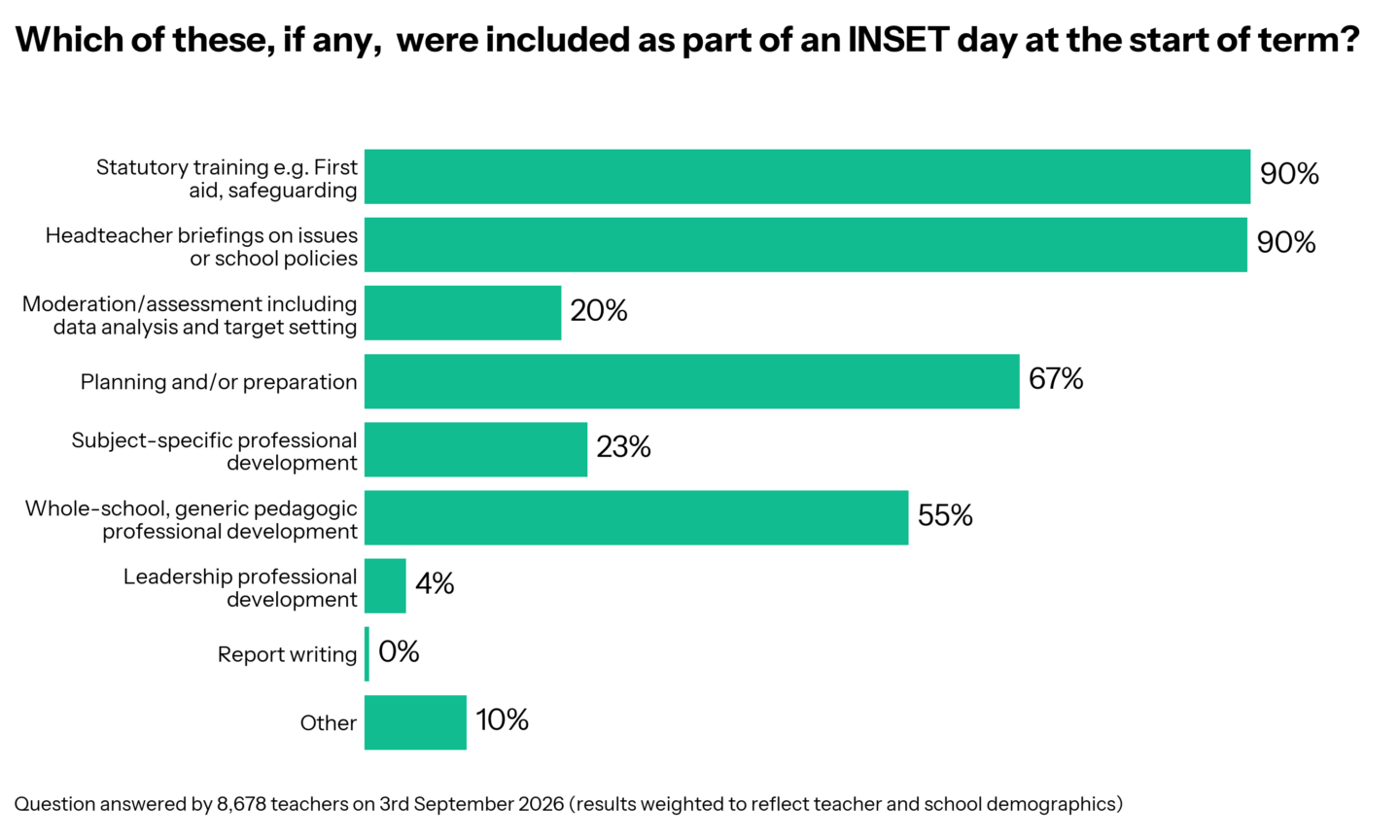
Those first INSET days are pretty predictable in their content, with 90% of teachers reporting they covered statutory training, and 90% say they heard from the headteacher on issues or policies.
67% had planning or preparation time, and 55% spent time on whole-school generic pedagogic professional development.
20% said they did some moderation or data analysis, and 23% did some subject-specific professional development. 4% did leadership development (rising to 7% when looking at just leaders).
But what do teachers want to do?
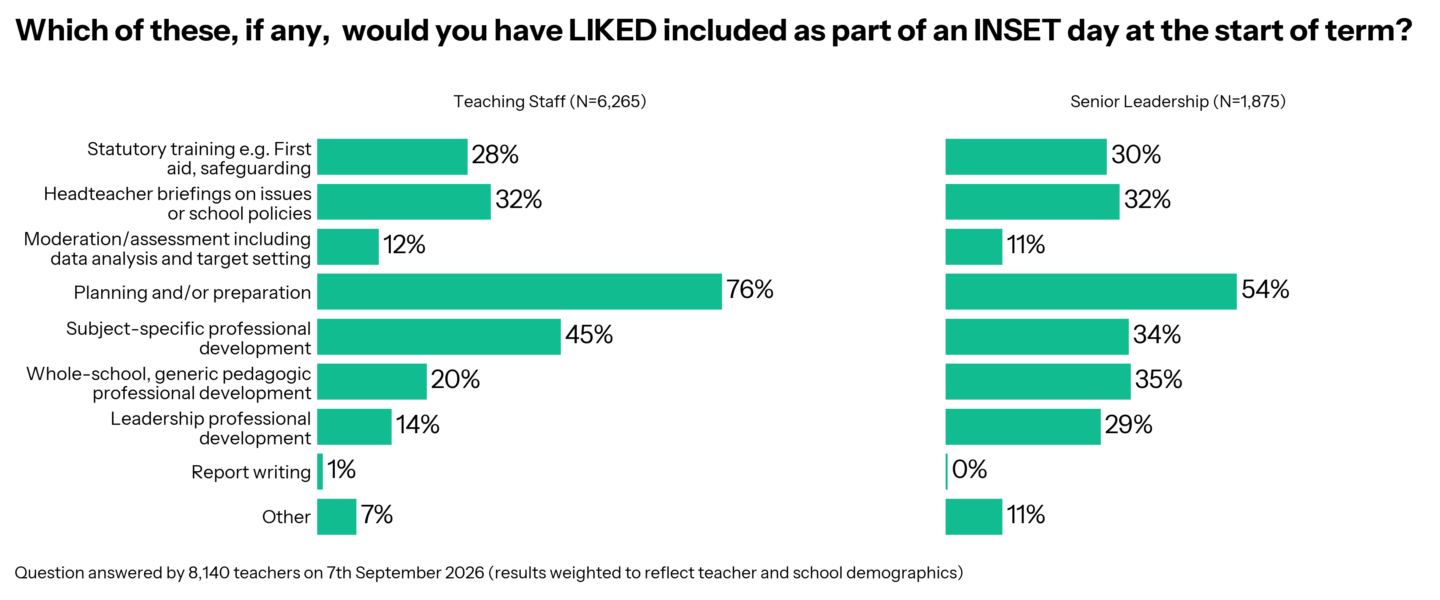
Does the content of the INSET sessions match what teachers would pick for themselves? Not exactly. There are a few notable differences:
- Statutory training: 28% of teachers and 30% of leaders want it vs 90% who got it.
- Headteacher briefings: 32% of teachers and leaders want it vs 90% who got it.
- Whole-school generic pedagogic CPD: 20% of teachers and 35% of leaders want it vs 55% who got it.
- Leaders wanting professional development: 29% of leaders want it vs 4% of leaders who got it.
Was it useful?
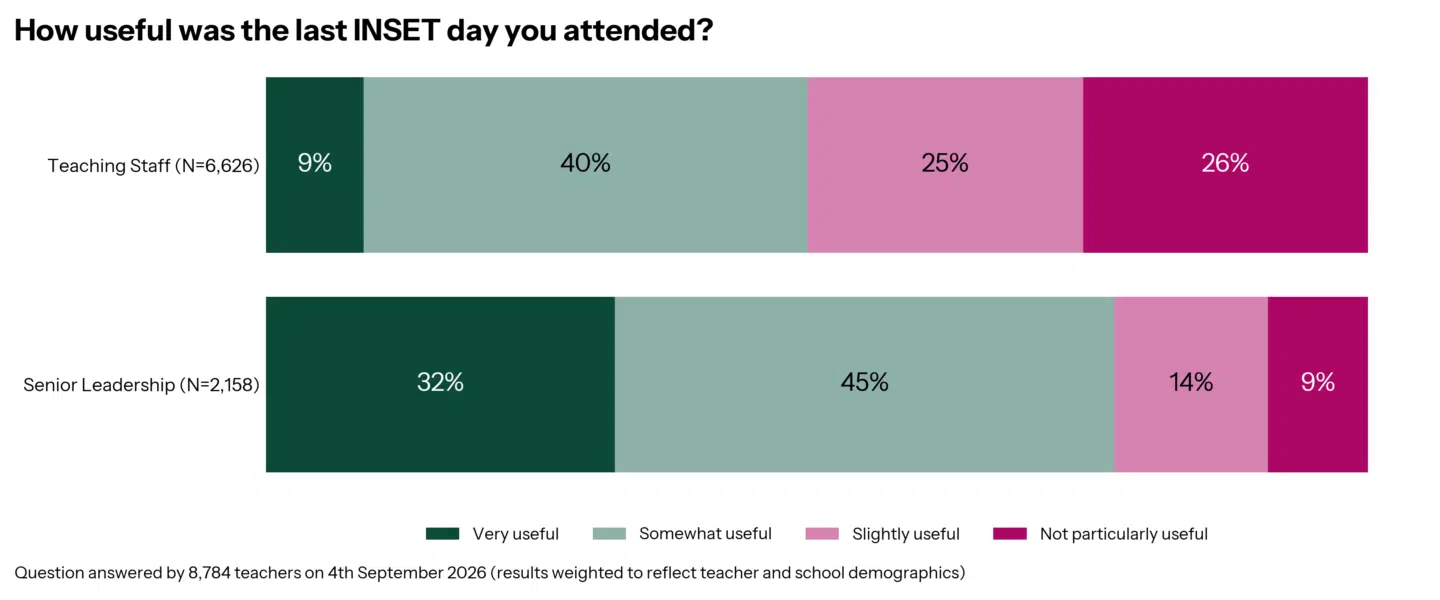
Even if the content of the INSET wasn’t exactly what you wanted, the most important question is: was it useful?
For teaching staff, just under half say yes (49%), and senior leaders are more positive, with 77% agreeing INSET was useful.
Perhaps even more useful than just asking about usefulness…what about the impact the INSET will have?
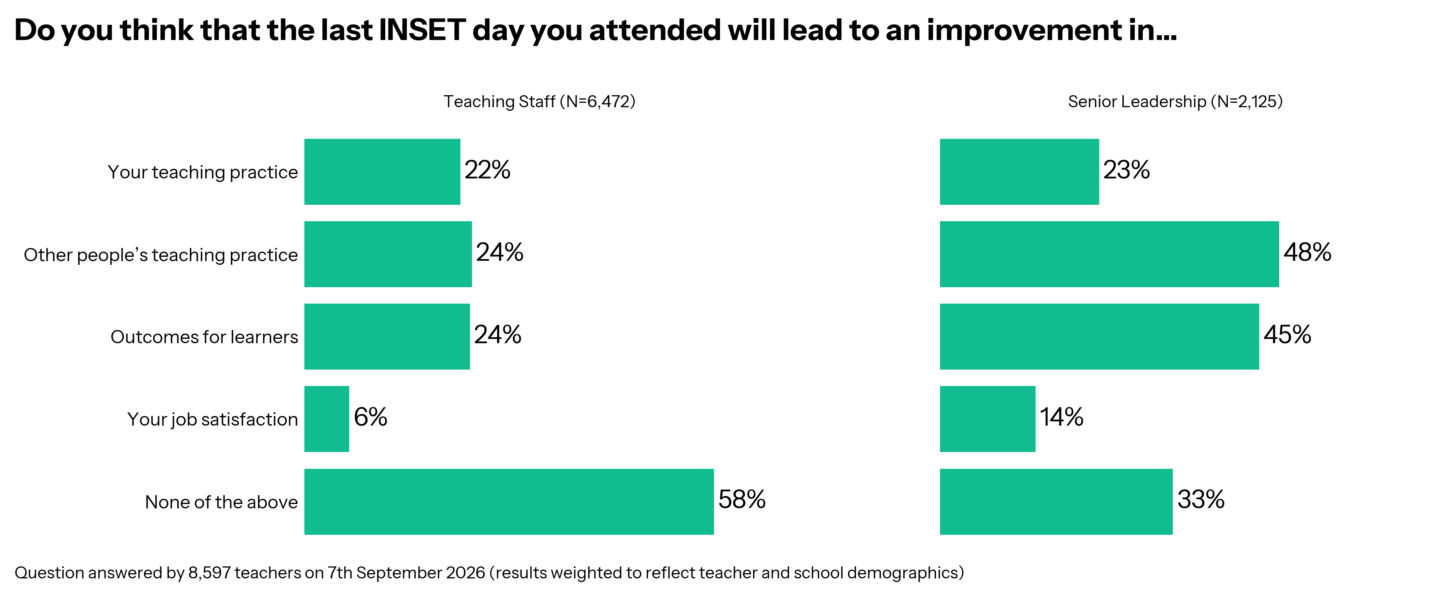
When asked if the last INSET will lead to an improvement in teaching practice, teachers and leaders shared a similar opinion (22% and 23%). Regarding the expectation that there will be an improvement in the teaching practice of others, leaders were more enthusiastic (24% among teachers vs 48% among leaders). Again, leaders are more likely to report they expect their last INSET to improve outcomes for learners (24% among teachers vs 45% among leaders).
Personal job satisfaction had the lowest prediction, with just 6% of teachers and 14% of leaders reporting that they expected their INSET would lead to an improvement in job satisfaction.
A massive 58% of teachers and 33% of leaders thought their last INSET wouldn’t improve their teaching practice, the teaching practice of others, outcomes for learners or their own job satisfaction. Ouch.
And what could you wear?
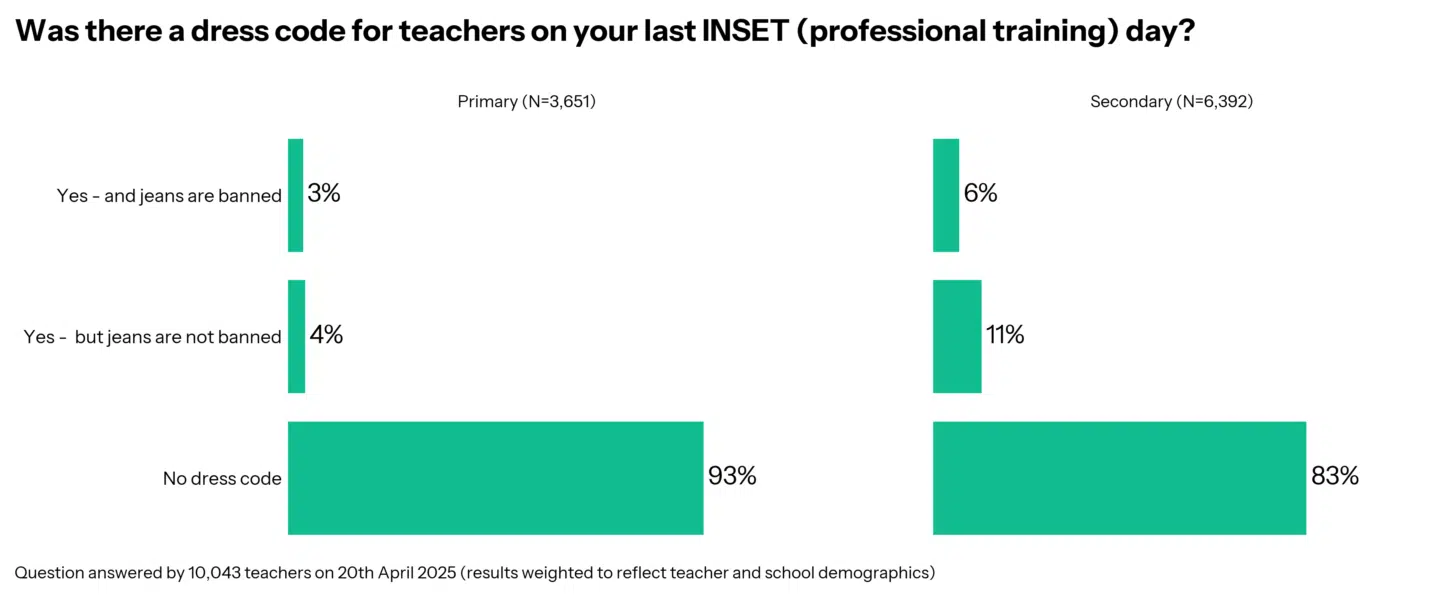
And onto the all-important sartorial questions: was there a dress code? And were jeans banned?
- 93% of primary and 83% of secondary teachers say their INSETs were dress-code-free.
- 3% of primary and 6% of secondary teachers say they had a dress code AND jeans were banned.
- 4% of primary and 11% of secondary teachers say they had a dress code – but jeans are allowed.
And what were you fed?
And finally, for some the most important question…is there a free lunch?
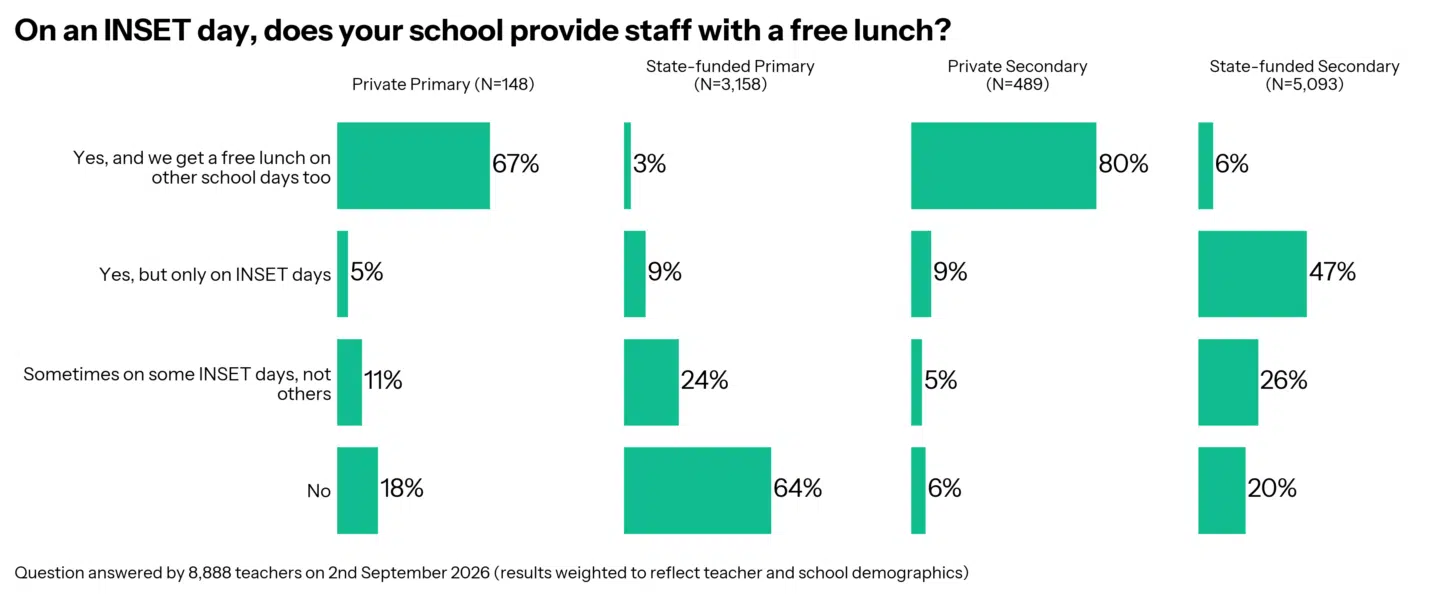
In state primary schools, 9% of teachers always have a free lunch on an INSET day, and 24% have a free lunch on some INSET days, but not all. 3% always have a free lunch (INSET or not), and 64% never have a free lunch.
In state secondary schools, free lunches are more common: 47% always have a free lunch on an INSET day, 26% have a free lunch on some INSET days, but not all. For 6% a free lunch is their standard every day, and 20% never have one.
In the private sector, free lunches tend to be the more standard practice: teachers told us the majority have them every day, regardless of INSET (67% in primary and 80% in secondary), with 16% of private primary teachers saying they have free lunches on some or all of their INSETs, and the same is true for 14% of private secondary teachers. And then the number never receiving a free lunch is small: 18% in primary and 6% in secondary.
How typical is my school, generally?
To learn how your school compares with others of a similar size and type, check out School Surveys, powered by Teacher Tapp. Using our great, tried-and-tested Teacher Tapp questions, you can get insights into how your school compares to others, and feedback to help you support your staff. Find out more here.
Next, we’ll look at briefings and meetings. Do you have another area you would like to see a Teacher Tapp blog? Let us know England@teachertapp.co.uk 📧.