Pride month happens in June, and schools can take the opportunity to hold special events to celebrate diversity in their school. Since 2018, Teacher Tapp has been asking schools about whether or not they hold events, what events they hold, and also about the sorts of comments they have heard from students about LGBT issues. Here is what we have learned…
1. The number of schools holding Pride events has increased over time
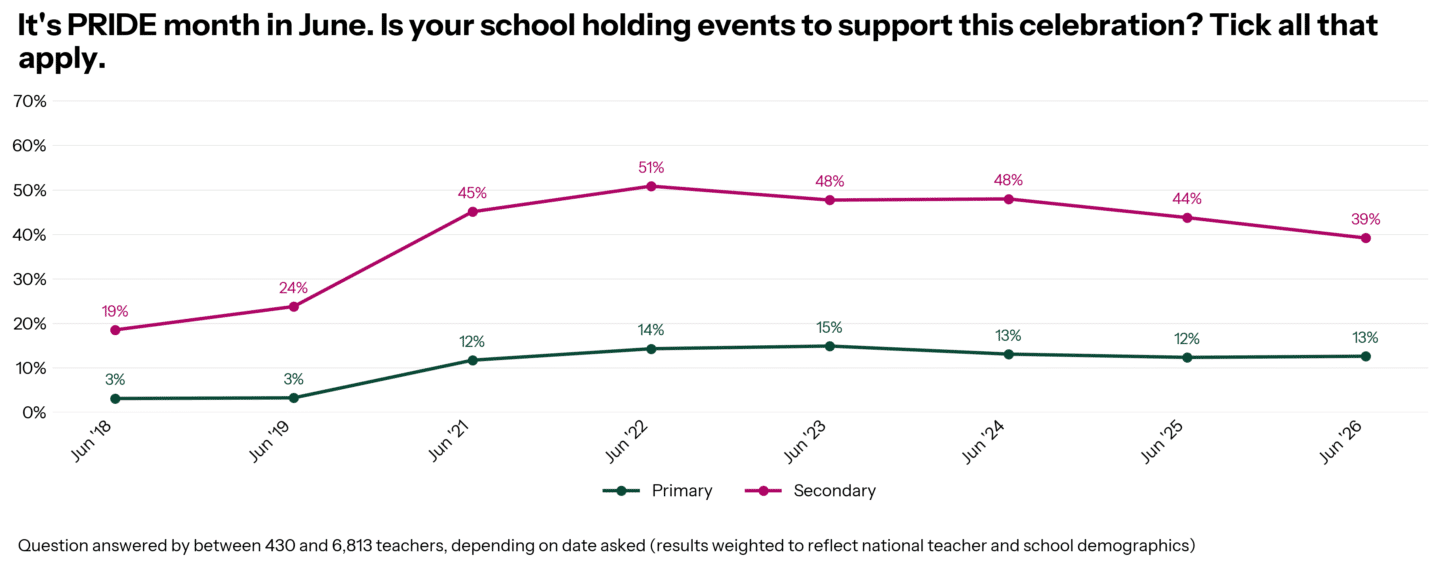
Since 2018, both primary and secondary schools have seen a sharp rise in the share of teachers reporting that their school holds Pride events — but both have since dipped from a recent peak.
In primary, the proportion grew from 3% in 2018 to 13% in 2026, down from a high of 16% in 2023.
Over in secondary the pattern is slightly more dramatic: up from 19% in 2018 to 47% in 2026, but down from a peak of 56% in 2022.
2. What sort of events do schools put on?
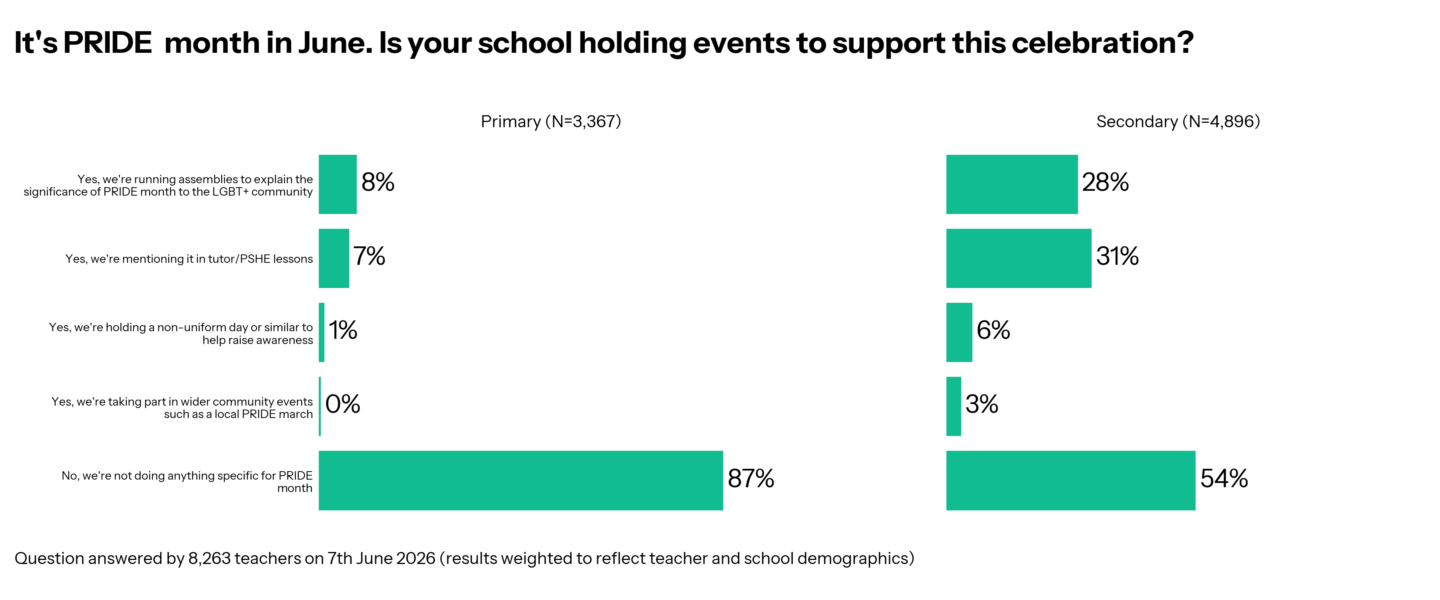
When it comes to the sorts of events schools are putting on, assemblies and PSHE lessons are the most commonly chosen activities (8% of primary and 28% of secondary school teachers say they run assemblies; 7% of primary and 31% of secondary teachers say their school cover it in tutor or PSHE).
A far smaller number report holding a non-uniform day (1% primary and 6% secondary) and an even smaller number take part in community events like marches (0% of primary 3% secondary).
3. Comments between students
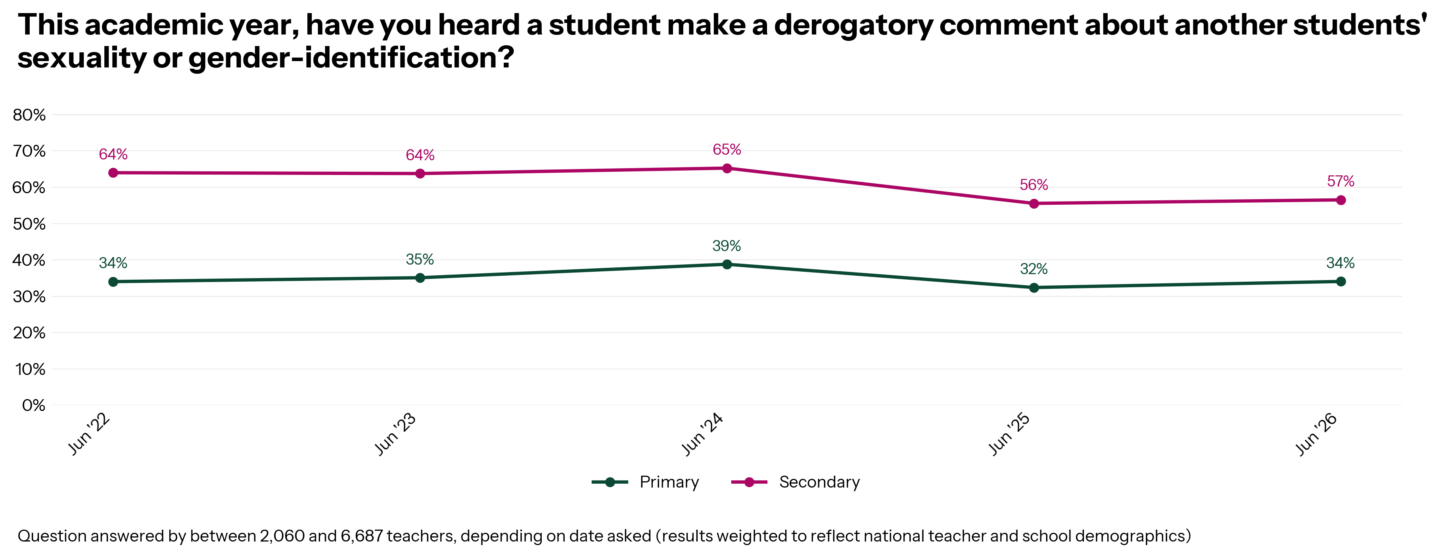
Over time, there has been a drop in the number of secondary teachers reporting they have heard students making derogatory comments about sexuality or gender-identification, 64% in 2022 to 57% in 2026. Primary teachers have had less change over time, increasing between 2022 and 2024 (34% to 39%) and then dropping to 34% again in 2026.
There has also been a drop in the number of teachers reporting to have heard kind comments shared between friends regarding LGBTQ+ issues. In 2022 75% of secondary and 36% of primary heard students making supportive comments; today that has dropped to 53% of secondary and 17% of primary.
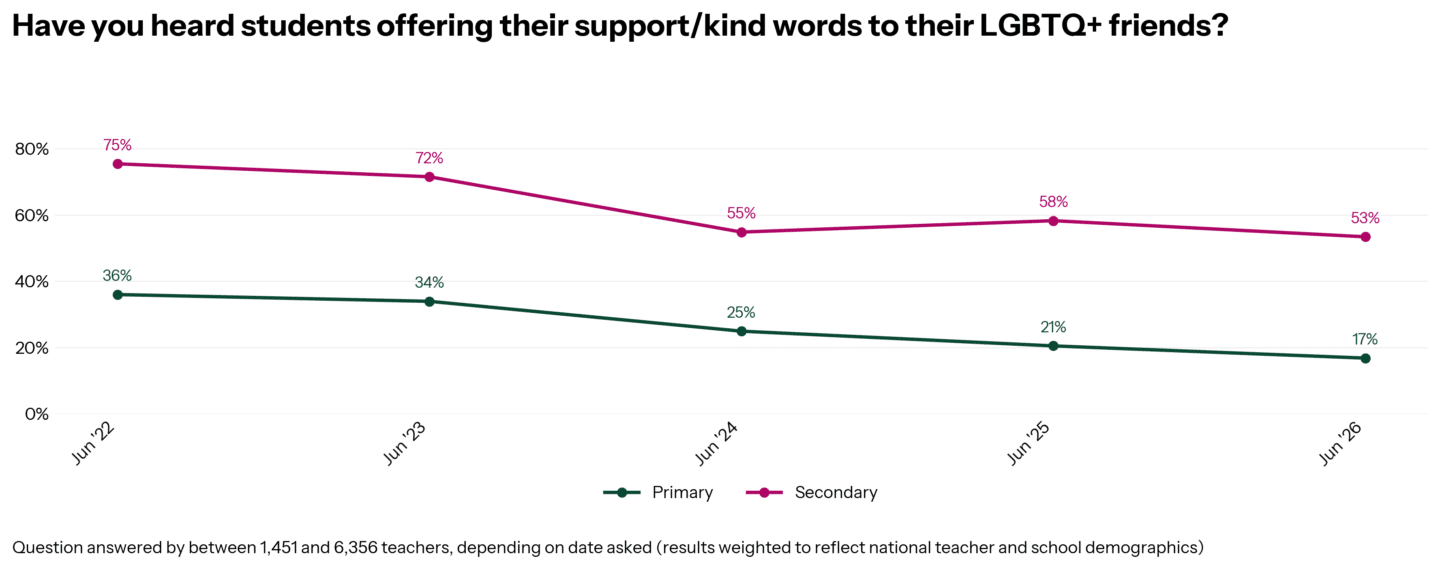
Of course one reason for the drop could be that there is less need for supportive comments to be said. To dig a little more into this, we crossed the responses to these two questions and discovered:
32% of primary teachers who reported they had NOT heard students making supportive comments about their LGBTQ+ friends heard students making derogatory comments about students’ sexuality or gender identity. However, this figure rises to 59% among teachers who HAVE heard supportive comments.
52% of secondary teachers who reported they had NOT heard students making supportive comments about their LGBTQ+ friends heard students making derogatory comments about students’ sexuality or gender identity. Again, this figure rises to 66% among teachers who HAVE heard supportive comments.
What might this tell us? Mainly, that supportive and derogatory comments tend to go together: teachers who hear one are more likely to hear the other.
This could mean support often emerges in response to negativity, but it could equally reflect schools where LGBT identity is simply discussed more openly, or differences in how much individual teachers notice and overhear. The data shows the two co-occur; it can’t tell us which is driving which.
4. Confidence is at an all-time high
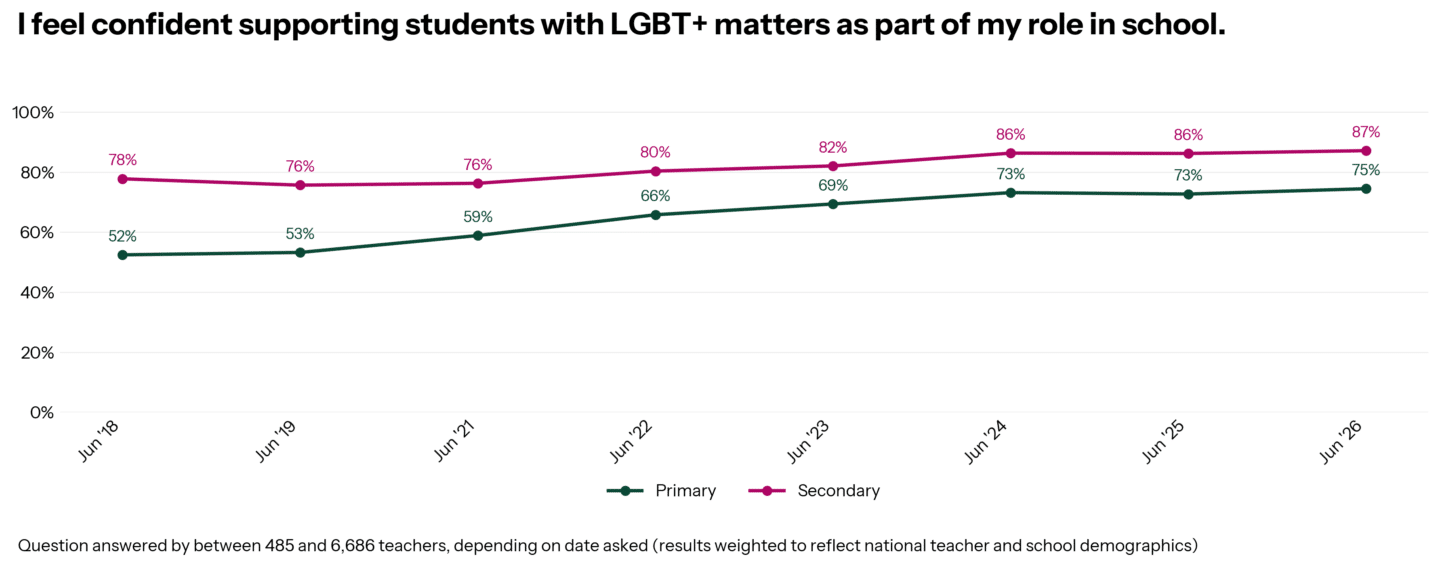
The good news is that the number of teachers reporting they feel confident supporting students with LGBT+ matters is at an all-time high.
87% of secondary teachers and 75% of primary teachers report feeling confident in 2026, rising from 79% and 59% in 2018.