Hey there Teacher Tappers!
Happy holidays! The summer break is finally here! Two-thirds of you had already broken up by last week, and the rest finally get to set your Out Of Office this week. Last year, 6% of Tappers told us they were going away with another teacher in their school – look out for more questions like this checking in to see what your plans are this year!
And here at Tapp we totally get that you might want a break from thinking about work, so our questions over the next few weeks will include a wider variety of topics and issues to give you some other interesting findings to ponder over. From the silly (battle of the tea bags) to the more serious (the cost of living), we hope there’s something for everyone to enjoy.
Prize draw holiday treat!
The last Teacher Tapp prize draw of this academic year, and we wanted to give you a prize that befitted the month! Therefore, one lucky Tapper is going to win £500 towards a summer break! To enter, just tapp between 8 July 2026 and 31 July 2026, and everyone who answers questions on Teacher Tapp, will be entered into the Teacher Tapp Prize Draw. You can read the full Ts and Cs here.
The winner will be alerted by a message in the app – so be sure to check in August to see if you scooped the prize!
The rise of evidence-based CPD
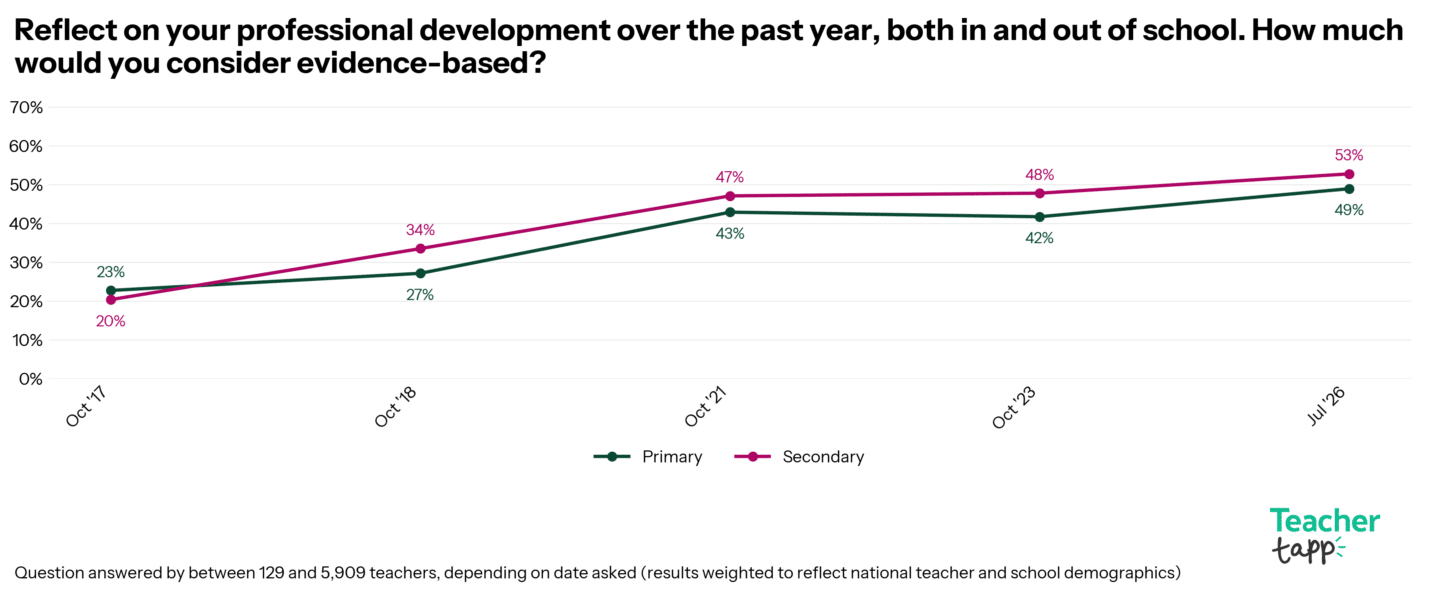
The year has come to an end, and as well as reflecting on classroom practice, you might have been thinking about the CPD you had this year: the good, the bad, and the ‘oh-my-gosh-it-changed-my-teaching’ and maybe the ‘oh-my-gosh-what-a-waste-of-time’.
But whatever you thought of its usefulness, how much of it was evidence-informed? Since we began asking this question in 2017, the percentage of teachers reporting that “all” or “more than half” of their professional development was evidence-based has doubled from 23% to 49% in primary, and from 20% to 53% in secondary.
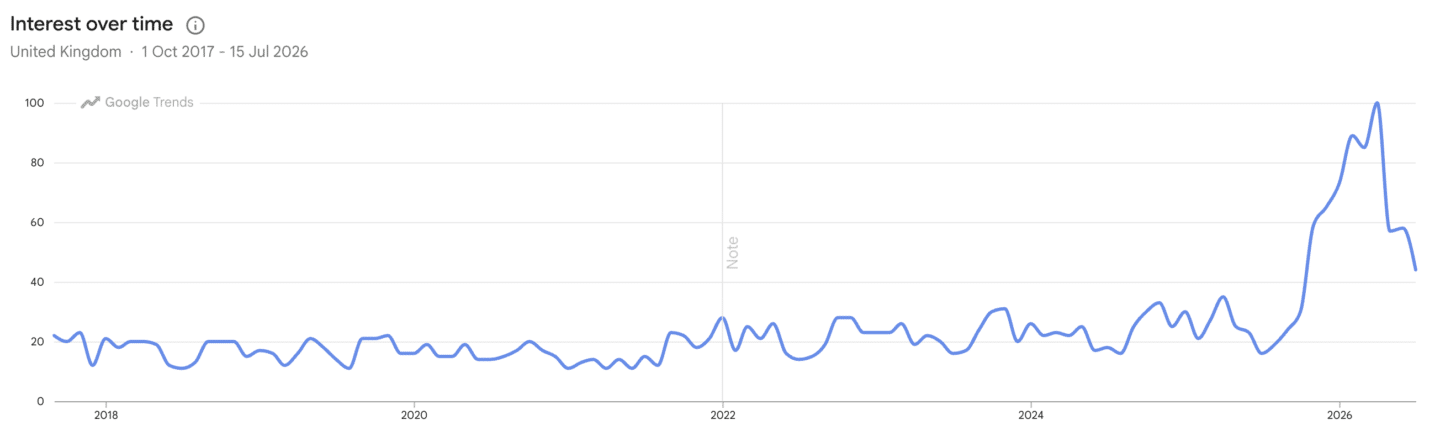
Another data point to track this against is the use of ‘cognitive science’. In October 2017, the education professional development space was a very different place. A quick check of Google Analytics shows the term ‘cognitive science’ has risen in popularity over time, and the graph below charts its rising use and interest over nine years.
If you’re interested in learning more about the origin of the terms “cognition” and “behaviour”, then this research article by Daniel Chaney An Overview of the First Use of the Terms Cognition and Behavior might come in handy!
Tapper’s theory on the primary – secondary contentment gap
Last week we shared our finding that showed primary school teachers reporting lower contentment when compared to secondary teachers, and invited Tappers to write in with their theories to explain why there was a difference.
To recap, the data on levels of contentment showed that, in previous years, primary and secondary teachers reported similar levels of contentment, but this year there was a marked difference between primary and secondary, with primary reporting lower levels of contentment.
One Tapper wrote in to offer her theory:
Pupil numbers dropping, due to birth rates falling and SEN children being off-rolled due to inadequate provision/support is hitting primary schools first – secondary will feel it given time. For our school, this reduced school funding due to fewer pupils has led to redundancies, all staff needing to prove why they shouldn’t get the axe – a very stressful term for every single member of staff. Also, there are major repairs outstanding, classes combined, under-staffing. The list goes on.
If you have your own theory – or questions you would like us to ask – please do get in touch! England@teachertapp.co.uk 📧
A Teacher Tapper asked…support plans
Last week, a Teacher Tapper got in touch to ask if we could find out about the use of support plans in schools, and specifically, whether or not they led to teachers leaving the school.
Of course, we were happy to help. We found out:
The number of teachers reporting they had been on a support plan was relatively small, with 2% telling us they had been on an informal support plan in the last year, and 12% had been in the past.
On the topic of whether or not the support plan led to teachers leaving the school, Tappers who had been on a support plan told us:
- 31% stayed at the school and are NOT looking for work elsewhere
- 7% stayed but are job hunting elsewhere
- 27% left because of the support plan
- 33% left, but not because of the support plan
- 2% felt it was too soon to say
Of course, our sample of teachers is skewed by those whose support plan has been ultimately successful in so much they didn’t leave teaching altogether – but when we asked if those who had experienced support plans had any other comments, more than 500 of Tappers wrote in to share their thoughts, and many of them picked up on what they saw as the flaws in the system:
Forced out, not helped: “It is a type of bullying used by SLT to get rid of teachers they do not like. There is no objective view on it – only their subjective view, which is difficult to fight. It was not supportive – it was threatening”. Another teacher described it bluntly: “It wasn’t supportive at all. It was a ‘we want you out’ plan”
No real support: “People just liked to keep saying I’ll observe you again, without actually providing tips on how to improve. They would say what they wanted to see, but not how to do it or why it should be done that way”
Health toll: “An awful experience designed to drive me out of the school I ended up with a bleeding ulcer and panic attacks”
Unions mattered: “I only survived because of excellent union support who tied them in knots and a member of SLT suddenly seeing what was happening to me and putting in a grievance”
ECTs/NQTs hit hardest: “I was an ECT & they hadn’t given me the proper induction process, decided I wasn’t meeting expectations & put me on their own support plan rather than doing anything in line with my ECT programme”
The good news is it wasn’t all bad – there were also some positive responses: “It was genuinely supportive & helpful. My mentor is still a close friend. I stayed at the school for another 9 years!”
Is there more Teacher Tapp should be asking about these sorts of plans? Perhaps you have been on the other side and have supported a member of staff on a support plan? Please suggest any questions you think we should ask: England@teachertapp.co.uk 📧
The Ups and Downs of…attitudes to mobile phones and staff
With the mobile phone statutory guidance now in place, we revisited our question on how teachers feel about being allowed their own mobile in the classroom. The new guidance from the Department for Education stating:
Staff should not use their own mobile phone for personal reasons in front of pupils throughout the school day. This will empower staff to better challenge pupils to meet the school expectations and effectively enforce the prohibition of mobile phones throughout the school day.
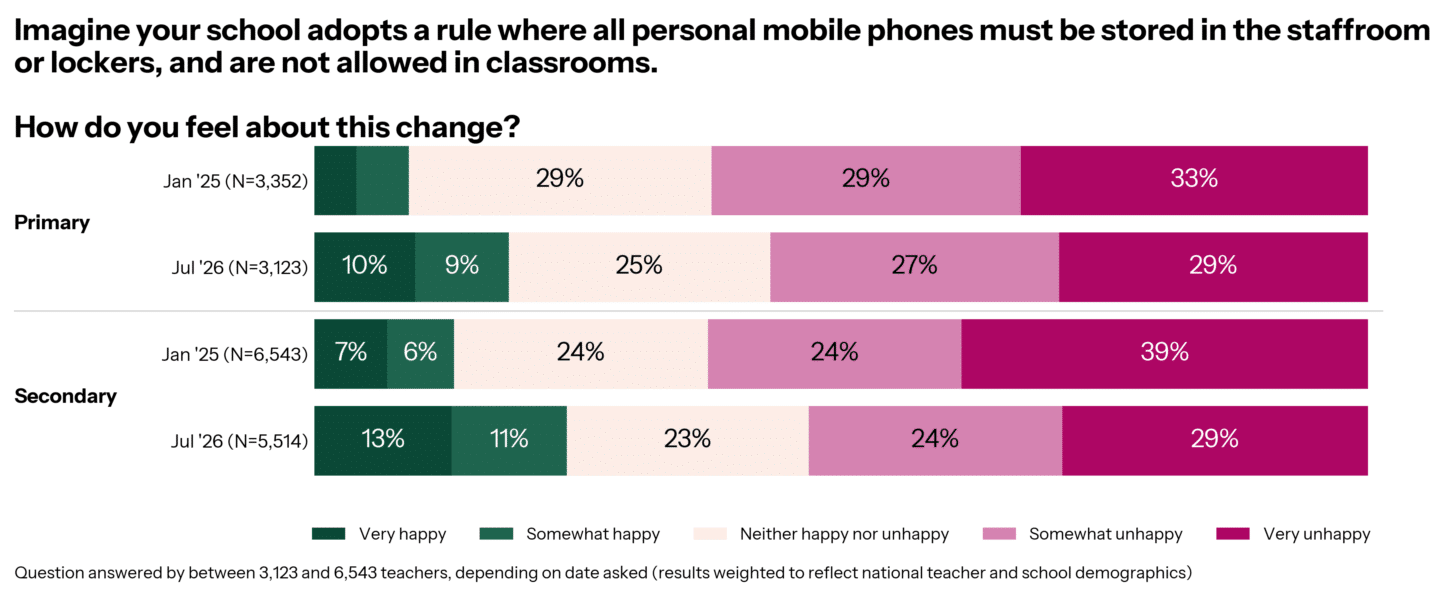
But how would staff feel about an instruction to store personal mobile phones in the staffroom? We compared this year’s responses to those in July 2025.
⬆️ The number of schools with this rule already in place are in the majority, but it has gone UP, with primary rising to 6% from 4% and secondary 4% from 1%.
⬇️ The number of secondary teachers who would be “very unhappy” has gone DOWN, 29% from 39% in 2025. Primary also went down, but by a smaller amount 29%, dropped from 33% in 2025.
⬆️ Both phases saw an increase in those who would be “very happy”: primary increased to 10% from 4%, and secondary 13% from 7%.
Daily Reads
The new guidance for September on Keeping Children Safe in Education (KCSIE) is out, and the most read article this week was the one from Tes where all the information was broken down for teachers: KCSIE what you need to know.
There are so many great blogs out there and we love featuring them on Teacher Tapp. If you have a blog you think we should feature, then please email us at england@teachertapp.co.uk and we will check it out!