Hey there Tappers
Judging by the messages from Tappers in our inbox, this is the busiest term of the year! So many of you have been writing in to request data for presentations and staff CPD, and we’re always thrilled to help. If you’d like to bring Teacher Tapp results into your school, just drop us a line with the topic of your talk, and we’ll do our very best to find something useful for you. Get in touch at england@teachertapp.co.uk 📧
Attendance awards
Attendance awards can be a contentious issue in schools: on the one hand, schools have a duty to encourage attendance, and on the other, for many students their attendance is out of their control.
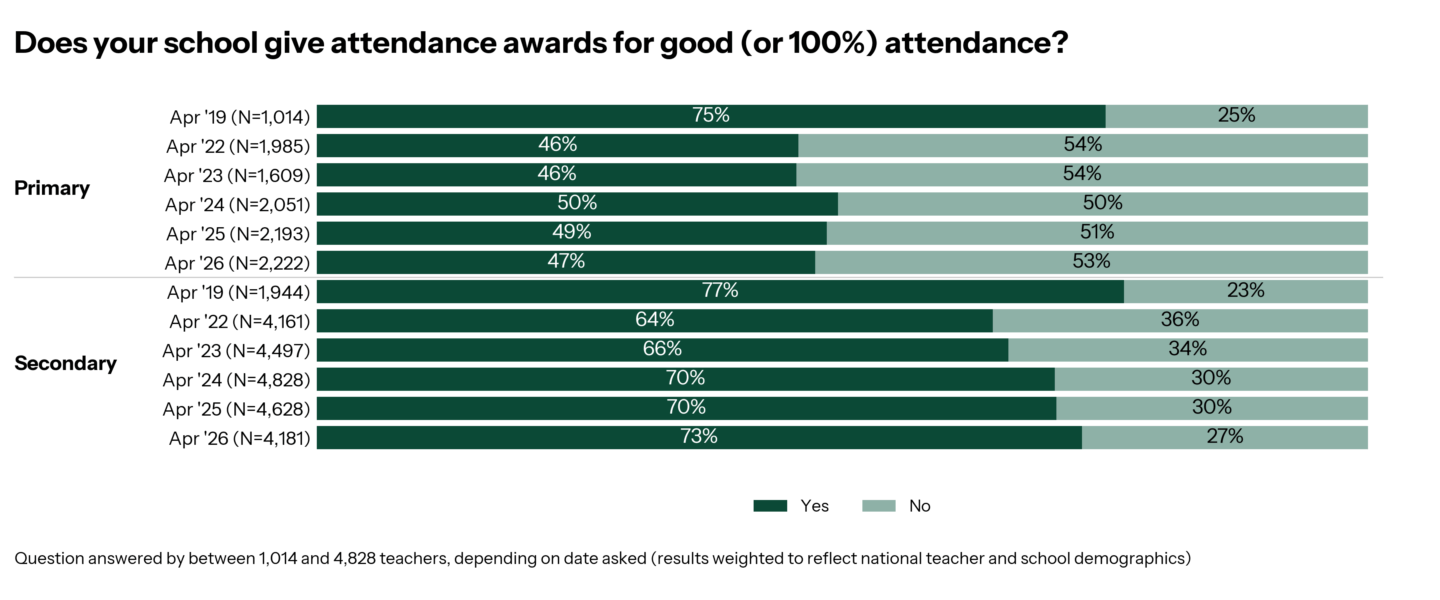
In 2019, the practice was more common with 75% of primary school teachers and 75% of secondary school teachers reporting they gave attendance awards.
By 2022, this figure had dropped to 46% among primary teachers, and another drop (but not quite as severe) among secondary teachers (64%).
Between 2022 and 2026, the figures stayed pretty steady in primary, and today, 47% of primary teachers report their school uses attendance awards. In secondary, there has been a slow but steady increase, and today 74% of secondary teachers say their school uses attendance awards.
However, this is far from the full picture.
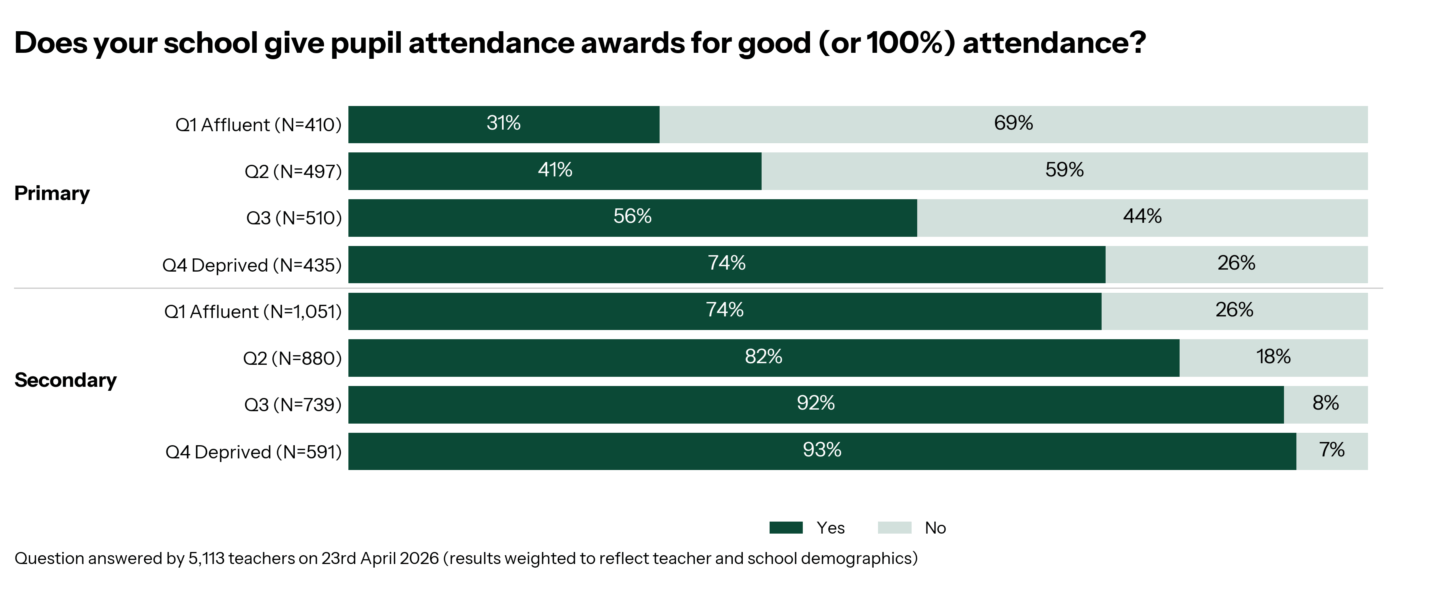
Comparing the responses of teachers in schools with the fewest students on Free School Meals (FSM) to teachers in schools with the highest percentage of students on FSM, there is a significant difference in approach to attendance certificates.
31% of primary teachers in the most affluent schools report use of attendance awards vs 74% in the most deprived schools.
Same pattern in secondary: 74% of secondary teachers in the most affluent schools say their school uses awards, vs 93% of secondary teachers in the most deprived areas.
And it seems like handing out certificates is much more common in state schools: just 11% of teachers in private schools told us they use attendance awards.
We know attendance is a top priority for the Department for Education; their recent report shared that there has been a rise in persistent absence, where students are missing more than 10% of the time.
“The number of children who are persistently absent has nearly doubled since the pandemic, although it is falling, from 21.2% in 2022/23 to 20% in 2023/24,” the report said.
It also noted that “severe absence – meaning missing more than half of school – has more than doubled from 0.8% to 2%“.
Are attendance certificates helping or hindering? Recent research from Harvard raises questions about their effectiveness. The research raises the point that they can be demotivating – especially after the reward has been given.
“Survey experiments probing the mechanisms suggest that awards may cause these unintended effects by inadvertently signaling that the target behavior (perfect attendance) is neither the social norm nor institutionally expected. In addition, receiving the retrospective award suggests to recipients that they have already outperformed the norm and what was expected of them, hence licensing them to miss school.”
What do you think? Let us know your thoughts england@teachertapp.co.uk.
Let’s talk about sex (and relationships education)
Now onto a very different topic: Relationships and Sex Education (RSE)!
Unfortunately, the bad news is that there has been a drop in the number of primary teachers reporting feeling confident in teaching sex education. 77% reported feeling ‘very’ or ‘quite’ confident, DOWN from 87% in 2023. This shift is really important to note, and something to flag to school leaders to check what support their teachers might need when delivering these lessons.
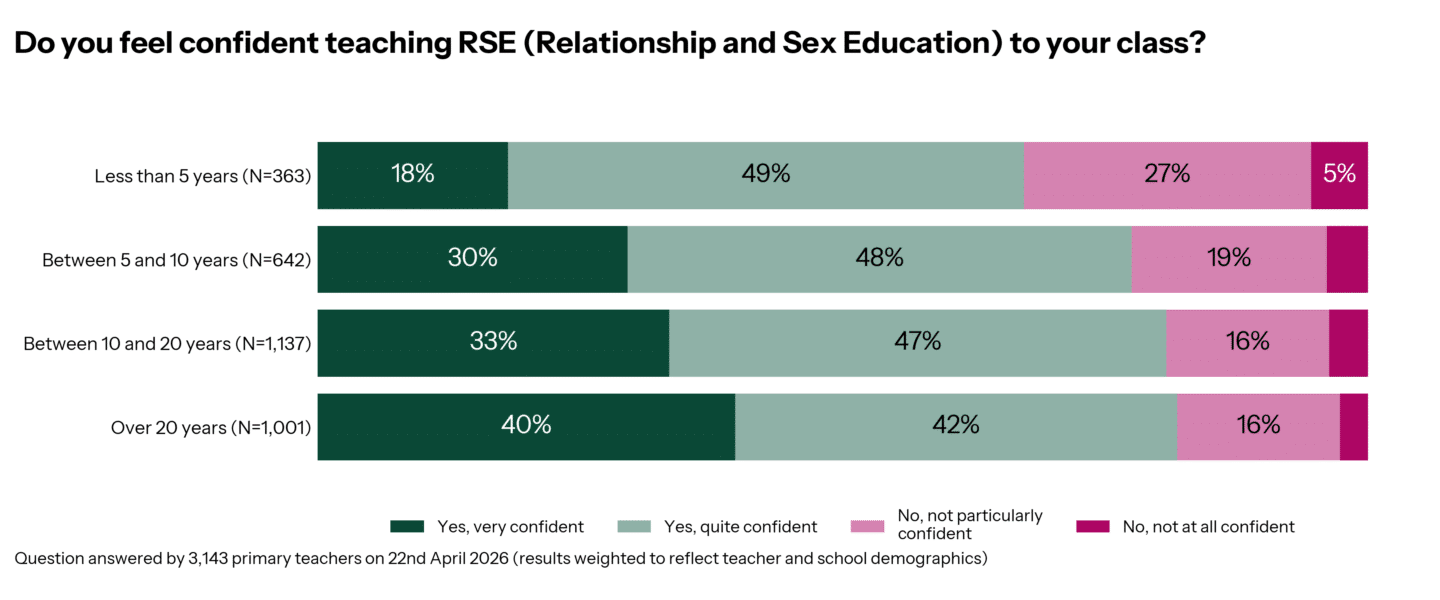
However, if you’re a teacher who is relatively new to the classroom and finding teaching sex education tough, be reassured that it does get better. Teachers with less than 5 years of experience were the least likely to describe themselves as ‘very confident’ (18%), compared to teachers with over 20 years of experience (40%).
When it comes to opinions on the content of sex education in their school, views differ between primary and secondary.
Most primary school teachers (65%) report that their sex education programme covers “everything or more” pupils need to know. Secondary teachers are less satisfied with fewer than half (47%) saying the same, suggesting that a majority believe teenagers are leaving school without adequate knowledge on the subject.
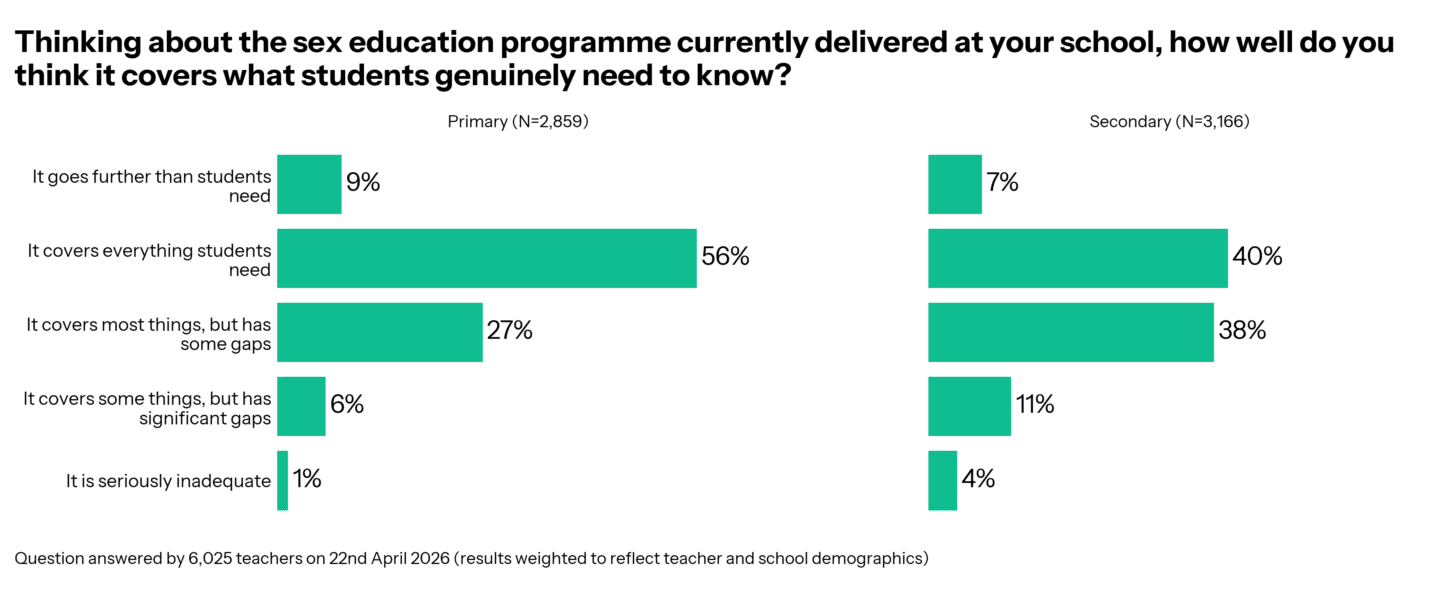
Are there more changes to RSE due to hit schools? Possibly. The new Curriculum and Assessment Review spoke of changes to the topics that will be covered in Sex Education content, specifically saying “Responsible technology use and awareness of online harms and safety should be addressed in RSHE, where young people explore the social, emotional and ethical dimensions of digital life” and that more guidance will be given about what topics should be covered and when.
However, because changes to RSE have only just come into effect in September 2025, the report also said the content of RSE was “outside of the scope” of the review, suggesting there aren’t big changes planned, but it would be wise to be prepared for future tweaks.
Teacher Tapper asked…AI for school work
A Teacher Tapper wrote in to ask about how many teachers were using AI for school work, and how many were still avoiding it altogether.
- Two years ago in April 2024, 41% of teachers had never used AI for school work ⛔️, and 20% had used it in the last week ✅.
- Two years later, just 8% have never used AI for school work ⛔️, and 61% used it in the last week ✅.
Big jumps compared to two years ago, but the rate at which teachers are adopting AI seems to be slowing down. Compared to the most recent ask in October 2025, both measures have only shifted three percentage points over six months: 58% ➡️ 61% reported using AI in the last week; 11% ➡️ 8% report they have never used it.
🔮 What might the results say when we ask again in October? Judging by the recent small increase…pretty similar to now. Unless there are big changes in the current offering of AI tools, the number of teachers using it weekly and the number not using it at all is likely to be similar to what we have today.
Behaviour tracker 📉
Summer term one, and in primary schools, preparations for statutory testing have really ramped up, whereas in secondaries, crunch time grows closer as the start of GCSEs and A-levels looms near.
But what does this mean for behaviour? The good news is fewer teachers in both primary and secondary reported that learning stopped due to behaviour: 40% of primary teachers DOWN from 44% in March; 31% of secondary teachers DOWN from 34% in March. These levels are the lowest levels of disruption primary teachers have reported this academic year, and the second lowest for secondary teachers.
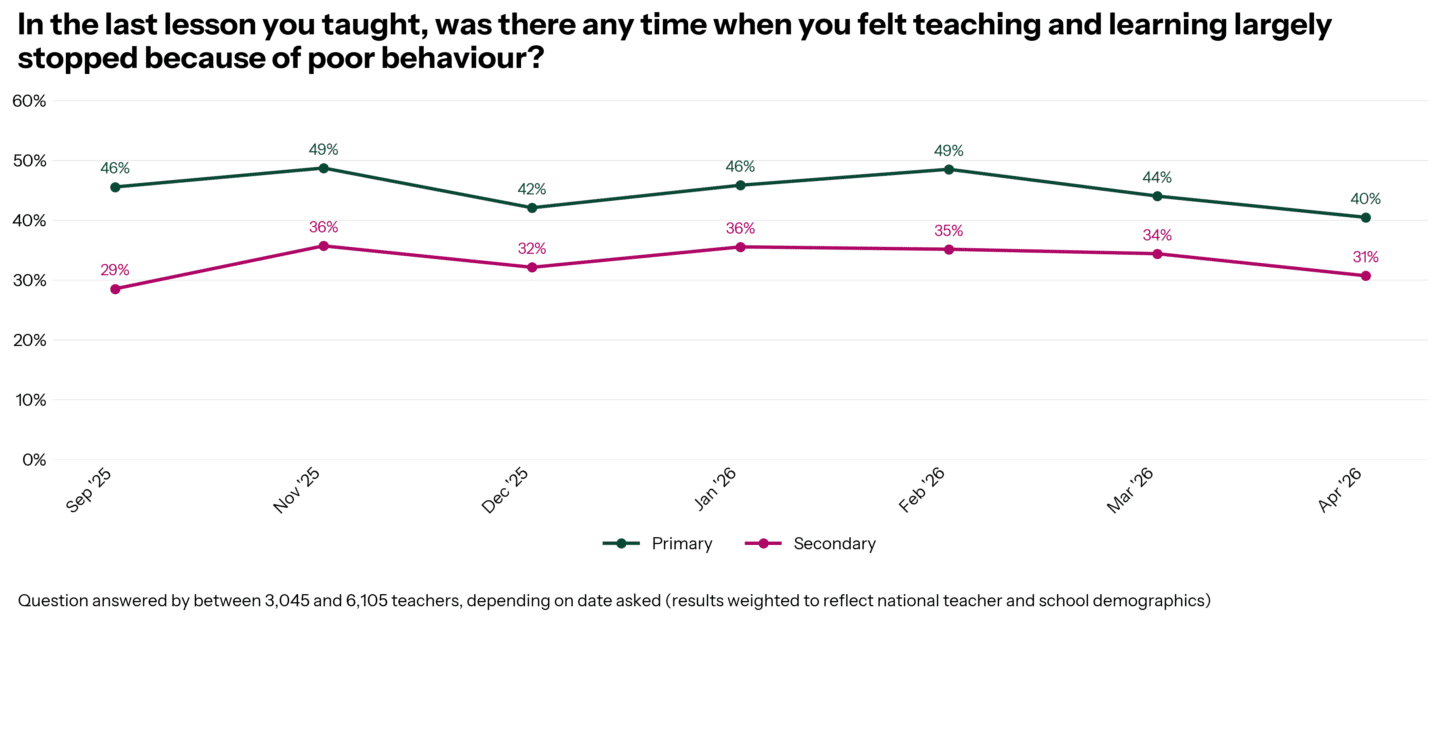
More good news – compared to previous years, the number of teachers reporting their lessons stopped due to behaviour has dropped compared to when we asked in March: 40% of primary, DOWN from 44% in March and 31% of secondary, DOWN from 34% in March, reported their lessons stopped.
Compared to previous Spring terms, behaviour appears to be slightly better: in April 2024, 47% primary teachers reported disrupted lessons and 38% secondary teachers reported disrupted lessons (both seven percentage points higher than in 2026).
Refer a teacher – get a gift card! 🤑
The final days of the referral incentive are here! There are just 122 £5 Amazon vouchers left…if you want to get involved, it’s really easy:
How it works
- Share your unique referral code with a colleague or teacher friend using the megaphone 📣 icon in the top right corner of the home screen.
- Your colleague or teacher friend must download the app, enter your referral code, enter their school name, and answer 10 questions to qualify.
- Once a referred teacher has met the criteria above, you will earn a £5 Amazon voucher. Vouchers are issued at the end of the campaign from the 5th May.
Every new sign-up you bring to the app will get you a £5 Amazon voucher, with a maximum of three per Tapper. We have a maximum of £1500 of gift cards to give out, and we’re already up to £890. So be quick! Ts and Cs are here.
Daily Reads
The number one blog last week dug into the data behind whether or not a knowledge-rich curriculum makes children miserable, from Daisy Christodoulou.
There are so many great blogs out there and we love featuring them on Teacher Tapp. If you have a blog you think we should feature, then please email us at england@teachertapp.co.uk and we will check it out!