If your staffroom feels a bit quieter on the recruitment front this year, you’re not imagining it.
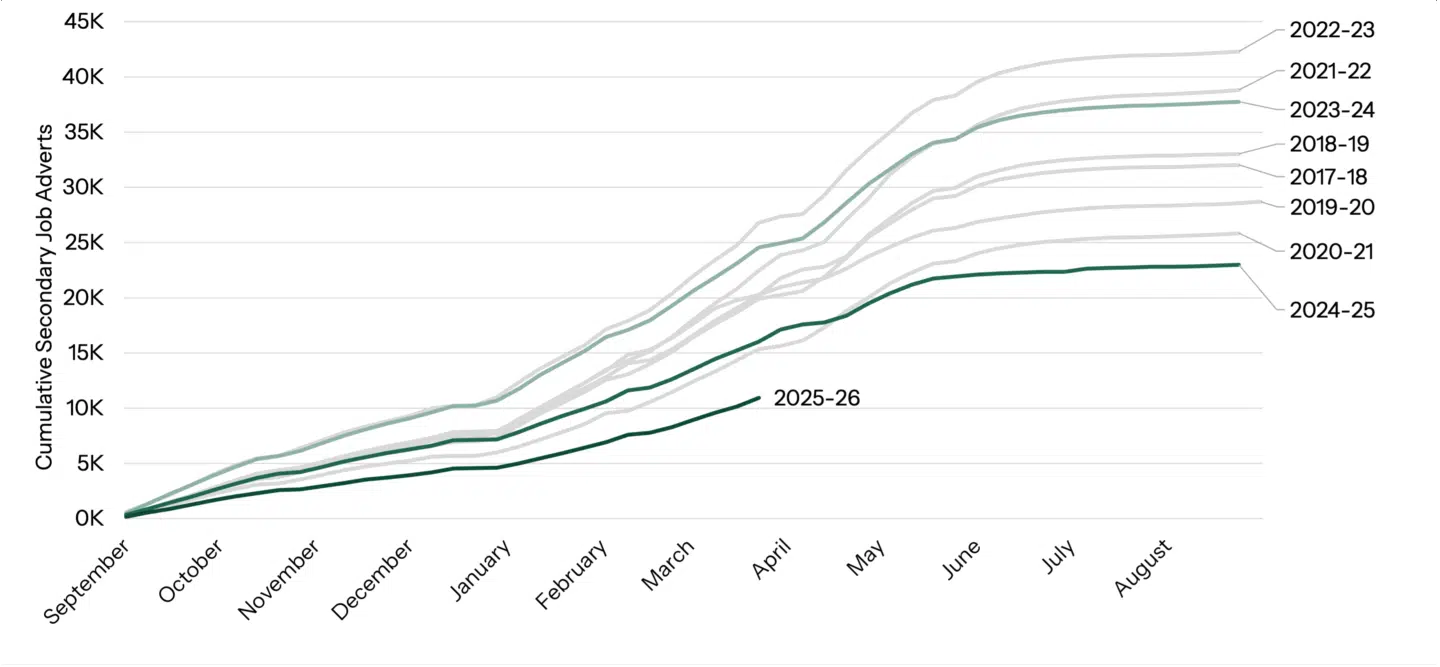
Job ads for secondary teaching posts are at their lowest level in nine years of data — down 32% on last year and 46% below pre-pandemic levels. Even in subjects that have historically been hard to fill, like maths and science, adverts are well down. And in primary, nearly half of teachers say their school haven’t advertised anything at all this season.
So what’s going on? Our 2026 Teacher Recruitment and Retention report — produced with SchoolDash and funded by the Gatsby Foundation — digs into exactly that question. Here’s what stood out.
🔍 Fewer ads doesn’t mean fewer problems
The most important thing to understand about the drop in job advertisements is what it doesn’t mean. It doesn’t mean schools have enough teachers.
In primary, 21% of teachers now say their school is inadequately staffed with suitably qualified people — up from 16% in each of the two previous years. More than half report that non-teachers cover their PPA time. Schools are quietly absorbing staffing gaps rather than advertising their way out of them, and teachers are feeling the effects.
There are a few reasons advertisements have fallen: secondary pupil rolls are beginning to plateau and decline, the wider job market has softened so fewer teachers are moving, and school budgets are tight enough that some leaders are choosing not to replace leavers. None of those things make the underlying staffing picture easier.
💬 How are teachers thinking about the future?
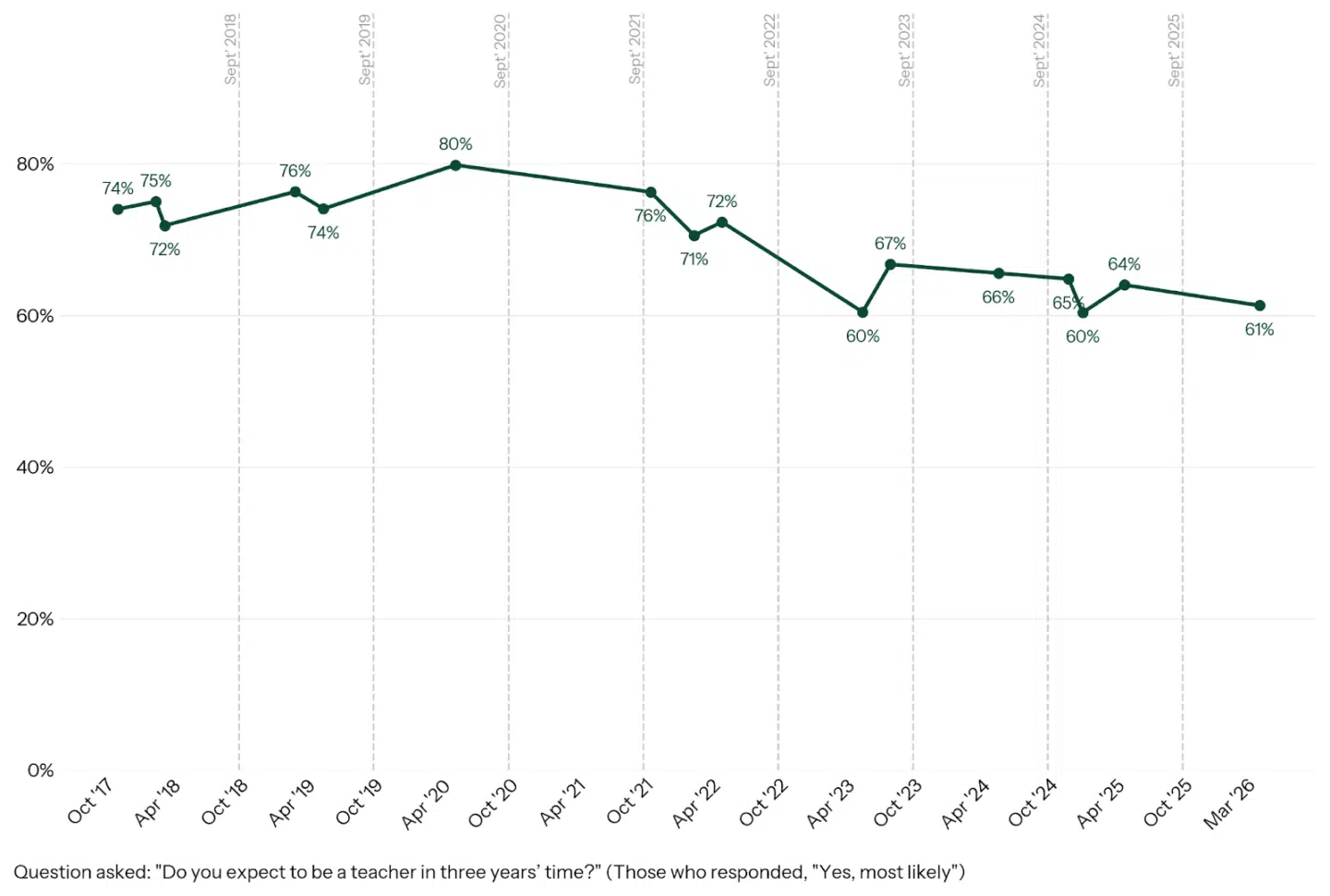
Since 2017, we’ve asked teachers regularly whether they expect to still be teaching in three years. Before the pandemic, around 75% said yes. The most recent data, from March 2026, puts that at 61% — a figure that has been broadly stable since 2022, but hasn’t recovered toward pre-pandemic levels.
Teachers point to a few things: the challenges of managing pupil behaviour, growing pastoral responsibilities, and the fact that other careers now offer more flexibility. We know that 4 in 10 teachers find work-from-home contracts in other sectors genuinely attractive — something that simply wasn’t as relevant to the conversation a decade ago.
The stabilisation is worth acknowledging. Things haven’t got worse in the last couple of years. But the gap between where we are and where we were before the pandemic reflects something that hasn’t been fully addressed yet.
🏫 The leadership picture
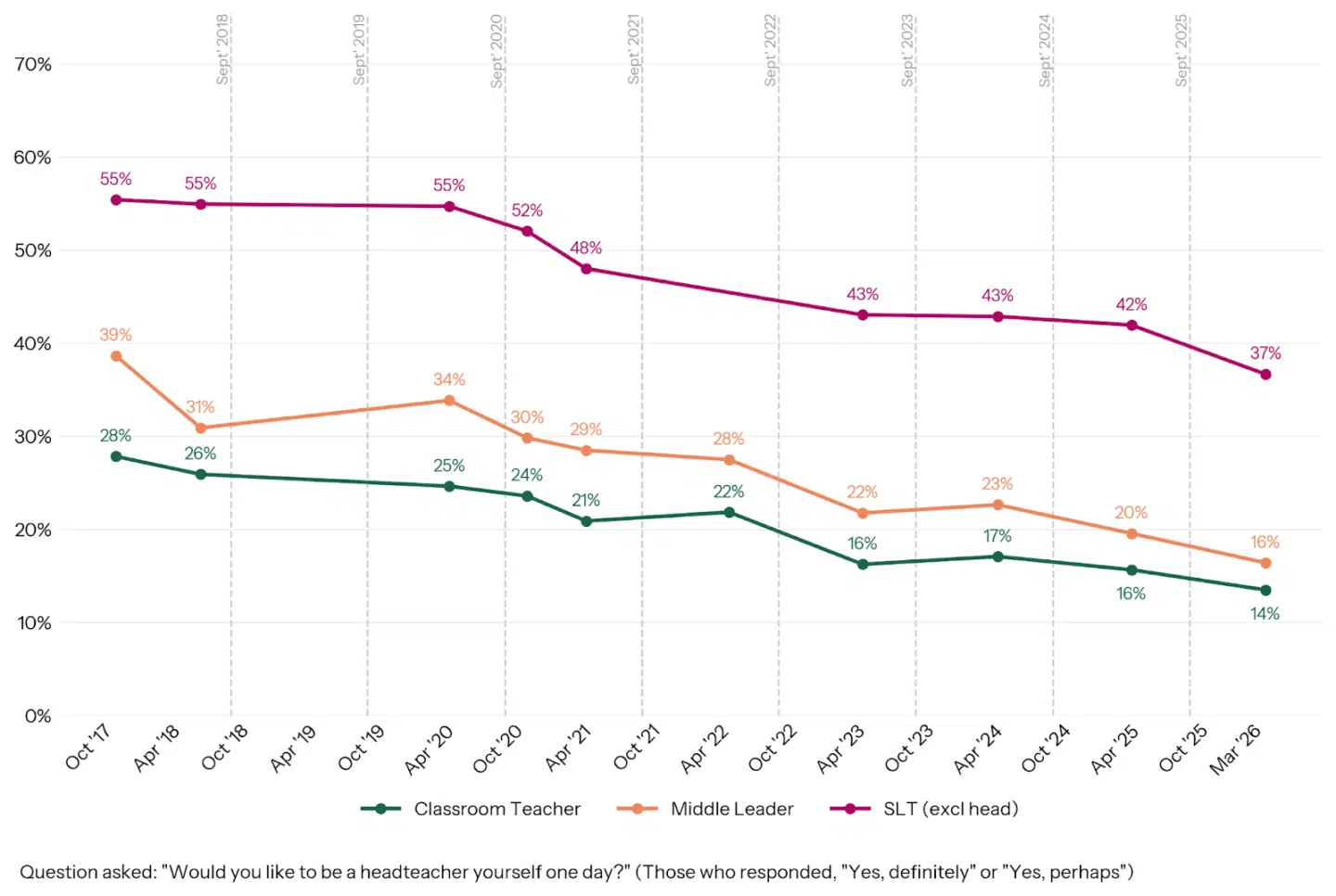
One finding that deserves more attention than it usually gets: the proportion of deputy and assistant headteachers who say they want to become a headteacher one day has fallen from 55% in 2017 to 37% today.
That’s a meaningful shift over nearly a decade, and it’s been steady rather than sudden. It’s not a crisis in the making so much as a gradual narrowing of the pool from which future headteachers are drawn. Headteacher turnover in secondary is also lower than usual this year, which provides some short-term continuity — but it also means fewer opportunities for senior leaders to step up and test their readiness for the role.
It’s worth understanding what’s putting people off, and whether anything about the headteacher role — its scope, its support, its flexibility — could be reshaped to make it more appealing to the people who are currently looking at it and deciding it’s not for them.
🙏 Thank you, as always
Every number in this report is built from your answers — tapped in at 3:30pm, often at the end of a long day. That adds up to something genuinely useful, and we’re grateful for it.
Read the full report here:
👉 Teacher Recruitment and Retention in 2026
Keep tapping. It really does make a difference.