Hey there Tappers
We’re all back at work now…The summer term has begun!
The good news is that only 2% of Tappers predicted April would be the hardest month, though perhaps that’s a decision some are reconsidering now. Among primary teachers, 25% chose summer term months as their toughest, while secondary teachers were less likely to be anticipating difficulties: just 9% said the same.
New referral incentive 🤑
Lots of Tappers have been making the most of our incentive referral – £680 of Amazon vouchers will be sent out in May to those who have referred a teacher-friend.
It’s easy to get involved, and by sharing your referral code you can help bring new Tappers to the fun of daily questions and edu-data.
How it works
- Share your unique referral code with a colleague or teacher friend using the megaphone 📣 icon in the top right corner of the home screen.
- Your colleague or teacher friend must download the app, enter your referral code, enter their school name, and answer 10 questions to qualify.
- Once a referred teacher has met the criteria above, you will earn a £5 Amazon voucher. Vouchers are issued at the end of the campaign from the 5th May.
Every new sign-up you bring to the app will get you a £5 Amazon voucher, with a maximum of three per Tapper. We have a maximum of £1500 of gift cards to give out, and we’re already up to £680. So be quick! Ts and Cs are here.

Fewer than four in ten senior leaders aspire to headship
Right – into the data, and we’re starting with a big one. This week you might have spotted our big report on recruitment was released (you can read more here). One of our findings showed that the proportion of teachers who say they would like to become a headteacher one day has fallen steadily across all seniority groups since we began tracking this question in 2017.
The worst bit of this news is that the most significant trend is among deputy and assistant headteachers, i.e. the group from whom the next generation of headteachers will be drawn: just 37% of these senior leaders now express an aspiration to headship, down from 55% in 2017.
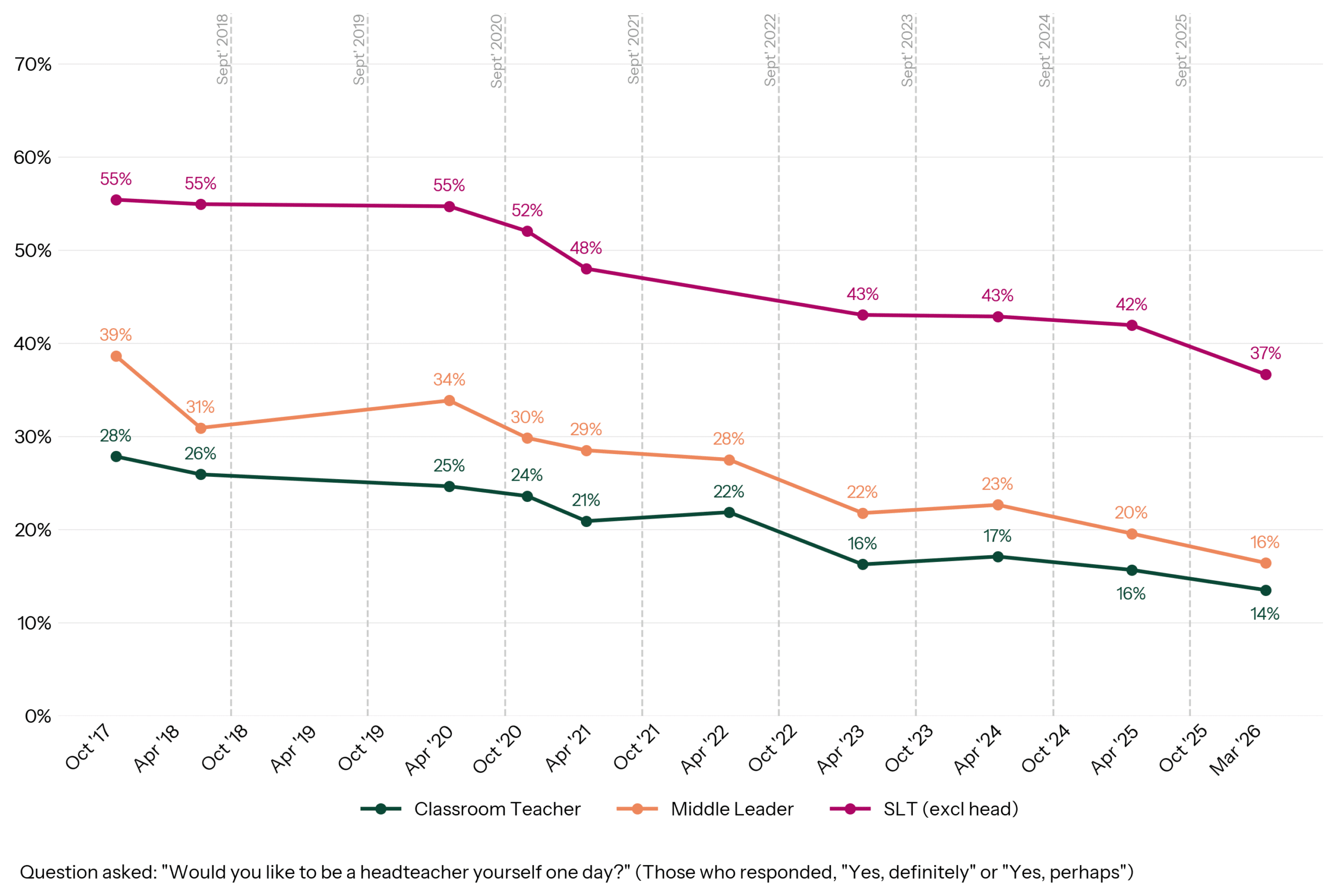
If nothing changes and this trend continues, schools will face even greater difficulty filling headteacher posts. What puts people off? And are schools doing enough to develop assistant and deputy heads to prepare them for headship? Let us know your thoughts by emailing england@teachertapp.co.uk.
AI use for planning lessons
Next up, we have some more findings on what some would want to tell you is the future saviour of the recruitment crisis: AI.
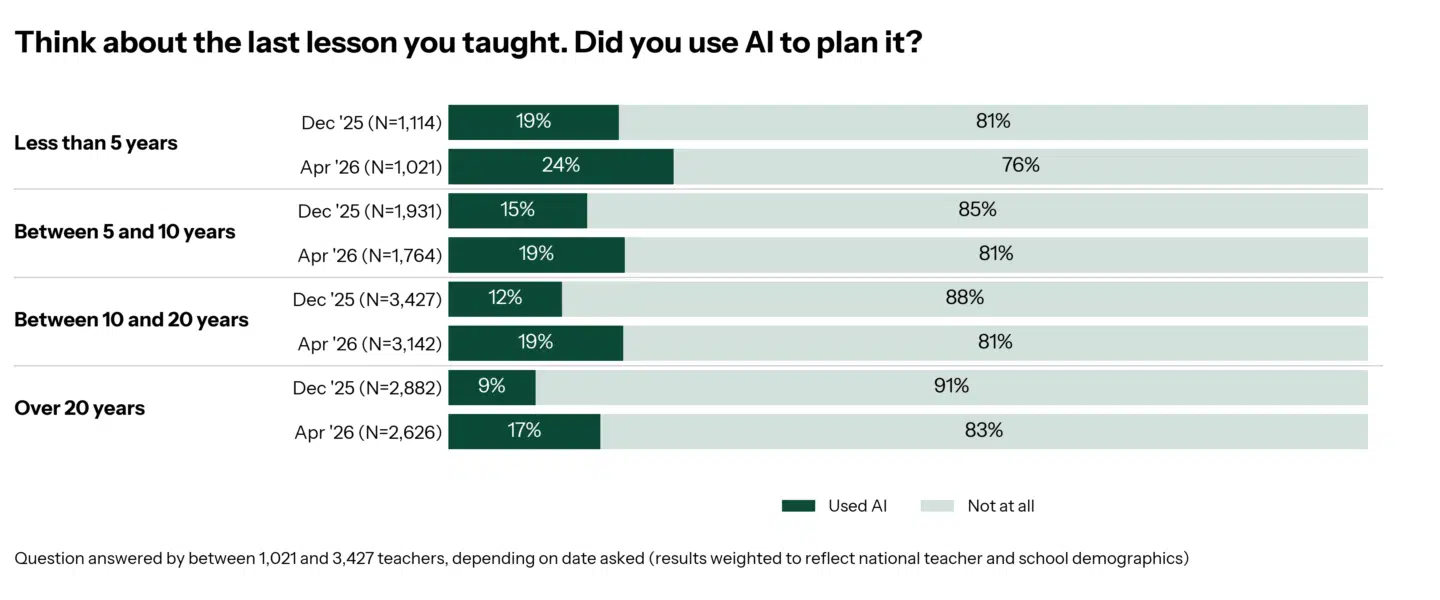
In December this year, we asked if your last lesson had been planned using AI. This week, the question was asked again, and there has been an increase, moving from 14% to 20%.
- The subject with the biggest jump was English, moving from 16% to 26%.
- Maths had the smallest change, 4% to 6%.
- In primary, EYFS/KS1 teachers made the biggest change from 9% to 18%, whereas KS2 changes had a much smaller shift (19% to 24%).
Teachers who are newer to the classroom are more likely to report they are using AI for planning (24%, up from 19% in December), but it’s teachers with over 20 years of experience who have increased the most, having started from the lowest point (17% UP from 9%).
Writing in, one Tapper shared with us her concerns about newer teachers using AI, as they are missing out on the important “thinking” time.
“Conversations in our staff room have then moved onto ‘Is AI making us better or worse teachers?’ We don’t feel our trainees are understanding how to plan, how topics fit together, or the skills needed as prerequisites to topics, because they aren’t designing or thinking through their own lessons in the way we did when we trained.”
What do you think? Is using AI to plan leading to a worse experience for newer teachers? Carry on the conversation and let us know!
TLR updates
We continue our quest to find out the answers to your TLR questions, and this week we can report that we discovered:
- In secondary schools, teachers who have a pastoral TLR (such as head of year) are more likely to have more free periods than an academic TLR (such as head of department). 41% reported that pastoral middle leaders had more non-contact time than academic pastoral leaders.
- Male teachers are 60% more likely to be paid a TLR 1, compared to female teachers (11% vs 18%).
- 23% of primary schools currently have NO teachers on TLRs, and 9% of those have NEVER used TLRs.
We still have more number crunching to do and questions to ask! If you’re interested in TLRs and would like to see us put these results together in one blog, please do write in and let us know!
No change in TA support despite rise in SEND
Now, moving away from pay and conditions, and onto a different workload issue: support in classrooms.
The rise in the number of students with additional needs has been well documented using the official Department for Education data. Teachers also report an increasing number of students starting school requiring extra support in speech and language.
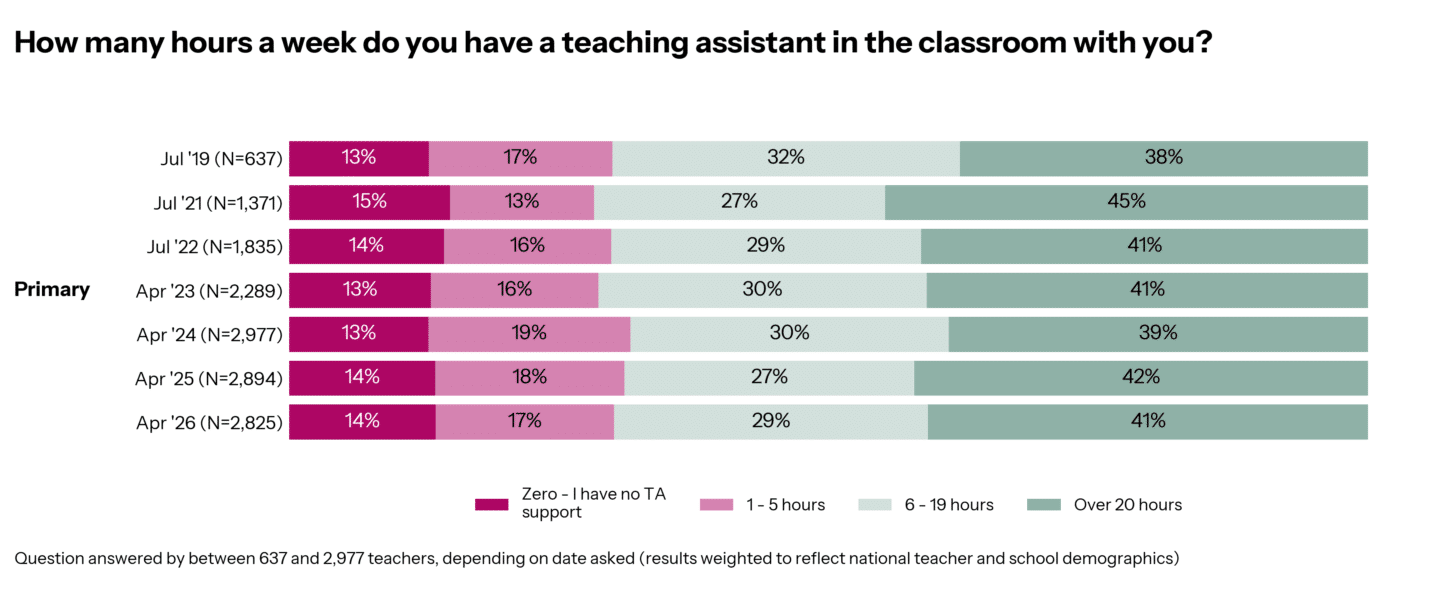
Yet, despite this increase in need, the number of primary teachers reporting hours of TA or LSA support in the classroom has been largely unchanged since we started asking in 2019. In 2019, 13% reported no TA support, today it is 14%. In 2019, 17% reported receiving 1-5 hours of TA support over a week; today, that figure is the same. 32% had 6-19 hours in 2019, today it is 29%. 38% reported they had over 20 hours in 2019; today, that figure is 41%.
Teacher Tapper asked…are conspiracy theories on the rise?
Next up, we have what might be some positive edu-news…
The number of teachers reporting they have heard students discussing conspiracy theories in the past two years has dropped compared to previous years.
- Secondary teachers reporting hearing students discuss conspiracy theories has dropped to 49% from 59% in 2024, and 63% in 2022.
- The pattern is similar among primary teachers, dropping from 31% in 2022 to 19% this year.
Although there is still a significant number of students who are discussing conspiracy theories, teachers might see this news as a positive reaction to the increased awareness of conspiracy theories and the explicit teaching of misinformation online that is part of the National Curriculum.
Zoom in on … flexi-schooling
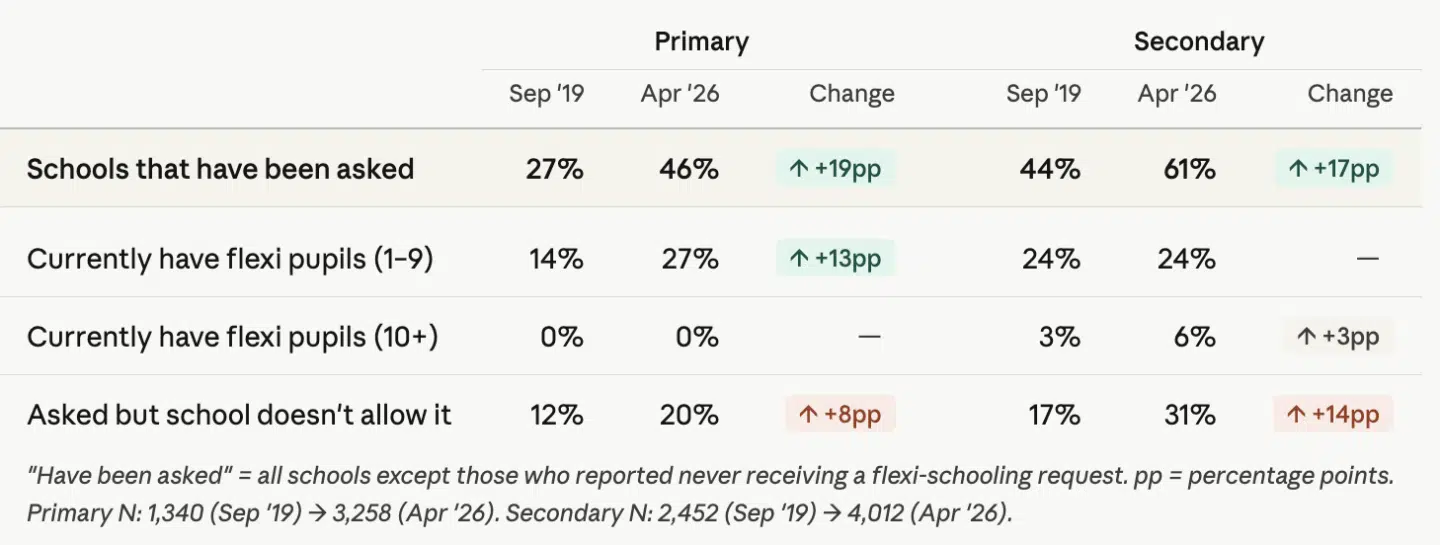
Flexi-schooling, where a student is part-time home-educated, is an option for students who struggle to be in school full-time. We have been asking about flexi-schooling since 2019, and compared to when we first asked, there have been some changes:
Primary schools
- Biggest shift in the number of students who are being flexi-schooled, up from 14% to 27%.
- More schools are receiving requests, 27% in 2019, UP to 46% this week.
- More ruling it out (likely linked to the fact more are being asked about it) was 12% in 2019, now UP to 20%.
Secondary schools
- Small shift in the number of students who are being flexi-schooled, up from 27% to 30%.
- More schools are receiving requests, 44% in 2019, UP to 61% this week.
- More ruling it out (likely linked to the fact more are being asked about it) was 17% in 2019, now UP to 31%.
Daily Reads
Our blog summing up the big findings from the Gatsby Recruitment and Retention report was in the number one spot this week! Read it here.
There are so many great blogs out there and we love featuring them on Teacher Tapp. If you have a blog you think we should feature, then please email us at england@teachertapp.co.uk and we will check it out!