Hey there Teacher Tappers!
The next heatwave has started (did we even get over the last one?!) and those important last jobs of the year start to be ticked off. For some of you, term has ended already (woohoo!) but for others, the last bell is still waiting to be rung. Whatever stage of end of term you’re at, everyone at Teacher Tapp sends best wishes and calming thoughts!
Read more about our findings in today’s blog… but FIRST! Update on our special giveaway…
Prize draw finishes this week!
Congratulations to the Teacher Tapper who won the iPad Air! Ms P has a 775 day streak, and since downloading the app has answered 3017 questions 😲.
She says: It feels amazing to win! I’ve been tapping for over 2 years now and love the daily questions. It really helps me reflect on my practice and see trends across the country. I’ve tried lots of new platforms and listened to lots of new podcasts because of Teacher Tapp.
We have a new prize draw coming… keep your eyes peeled for an announcement email and a message in the app tomorrow!
Teacher Pay Deal
Last week, the Department for Education announced a 3.5% pay increase for teachers, but only 1.7% of it would be funded. So obviously, Teacher Tapp dug into the data…
First impressions:
- 23% think a partially funded 3.5% increase is the right amount
- 61% think it’s not enough
- 1% think it’s too much
- 16% don’t know yet
Not overwhelmingly enthusiastic, but at this point in the term, when everyone’s this worn out, that’s perhaps a given.
So we turned to a trickier question: if this is all the money on the table, what would teachers actually prefer it was spent on?
This matters because funding is the real sticking point for many teachers – especially those balancing the budget. After all, some would argue that any pay increase without funding just becomes cuts elsewhere.
Given the choice, teachers would prefer:
6% – give the school the 1.7% and let it decide how to spend it
45% – a fully funded 1.7% increase instead
37% – the current offer (3.5%, partially funded)
11% – no preference.
Given they have to wrangle the budget, you might have thought senior leaders would be the most likely to want the smaller pay rise, but in fact, when we checked the breakdowns there was very little difference between the opinions of classroom teachers and senior leaders: similar numbers opted for a 3.5% rise (37% classroom teachers vs 38% senior leaders) and the same pattern for 1.7% fully-funded rise (45% classroom teachers vs 47% senior leaders).
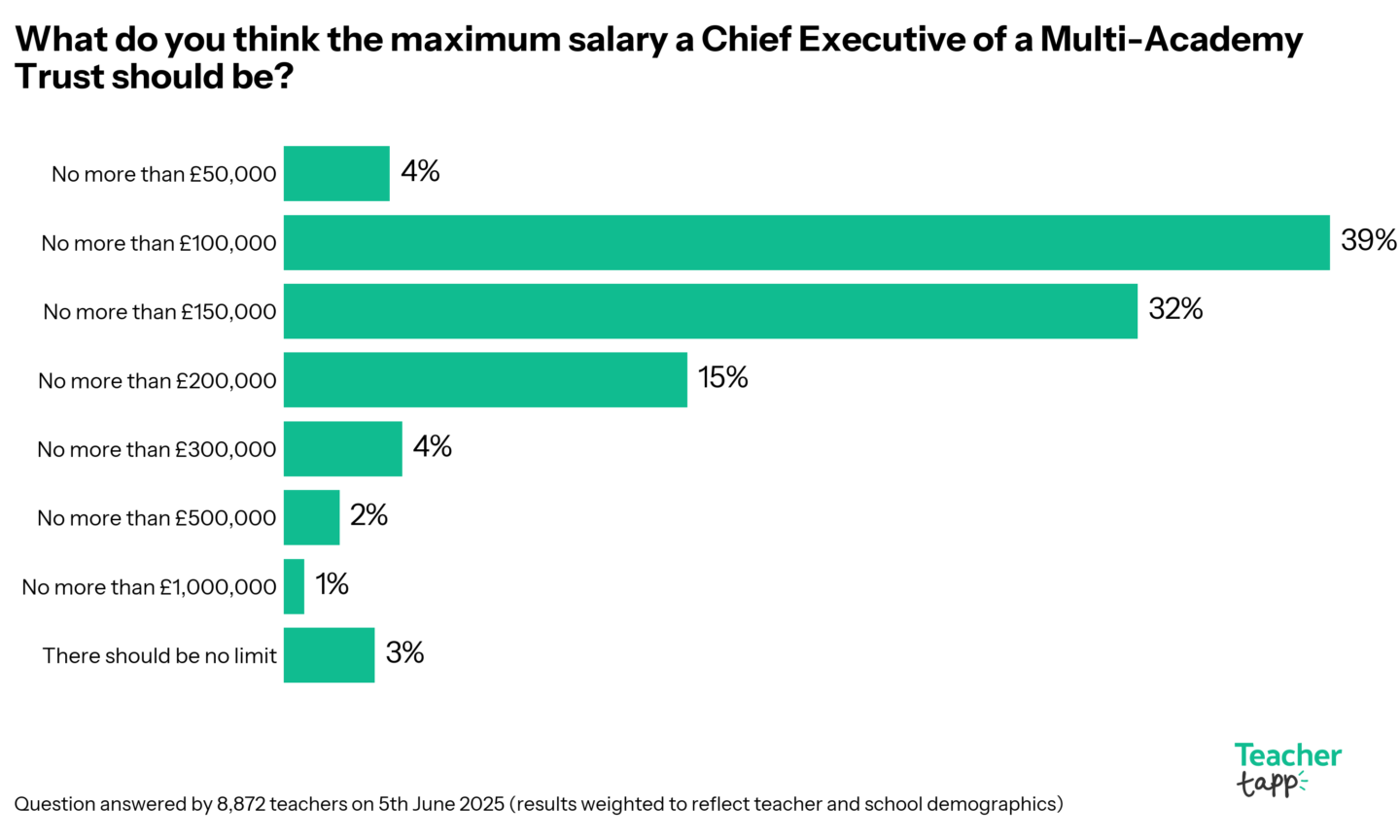
Another announcement included in the pay rise was that the maximum salary for trust CEOs will be capped at £170,000. This is a topic we have asked about many times in the past, with the most recent findings reporting that 39% of teachers believe the cap should be £100,000, and 32% feel it should be no more than £150,000.
With unions now announcing polling for strike action to open in the Autumn term, this is a topic we will be following closely. Send in your question suggestions if you have an idea of what we should ask next!
One thing to improve Ofsted
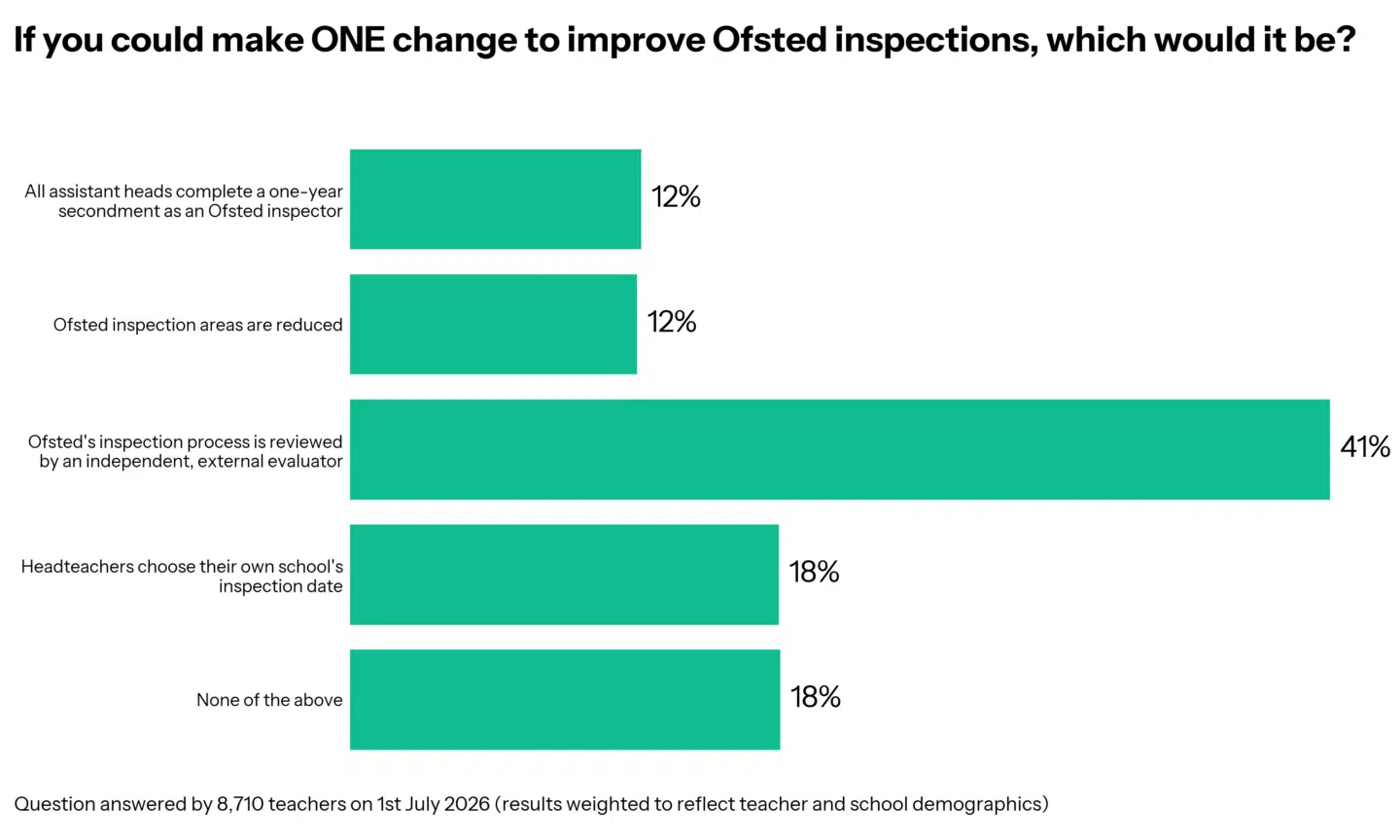
It’s a five-word horror story: we are due an Ofsted … but does this have to be the case? If we accept that Ofsted inspections HAVE to happen, what ONE change could improve them?
This was the task set by Teacher Tapp to the members of the panel for this year’s Festival of Education.
The panel was made up of:
- Mark Lehain, headteacher and former Special Advisor. His suggestion was all senior leaders have a one year secondment to Ofsted.
- Manny Botwe, headteacher and former president of ASCL. He wanted to reduce the number of inspection areas.
- Mary Bousted, former general secretary of the NEU. Her suggestion was to create an external evaluator for Ofsted.
- Dylan Price, one-half of the Teach, Sleep Repeat podcast and a primary teacher. His idea was to give schools more control over their inspection date.
Both in-person AND through the Teacher Tapp app, Mary Bousted’s proposal to “check the checkers” was the most popular option (41%). If you’re interested in finding out more about the ideas in the panel, keep your eyes peeled on our socials as some clips from the event will be shared soon! If you don’t follow us already, you can find us on TikTok @Teachertapp, and on Instagram @Teachertapp and on YouTube @Teachertapp.
A Teacher Tapper asked…who is exam marking?
Last month, a Teacher Tapper wrote in, telling us she was taking a break from marking her maths GCSE scripts and wanted to know how many other teachers were in the same position, and of those marking, who was allowed to use their PPA time to mark.
She felt the expertise she gained from marking benefited not just her personally, but the students she taught and the wider department. Therefore, when she was told she could NOT mark during her PPA, she felt unsupported. She wanted to know how common this was and whether she had a good case for asking her head of department to reconsider their stance.
24% of secondary teachers and 3% of primary teachers told us they were being paid to mark exams, and of those marking, 10% have used their PPA to mark (with permission), and 13% are marking in PPAs (but haven’t sought permission).
If you have a question you would like to have answered to help you with a problem in school, please do get in touch! England@teachertapp.co.uk 📧.
Football World Cup in the classroom
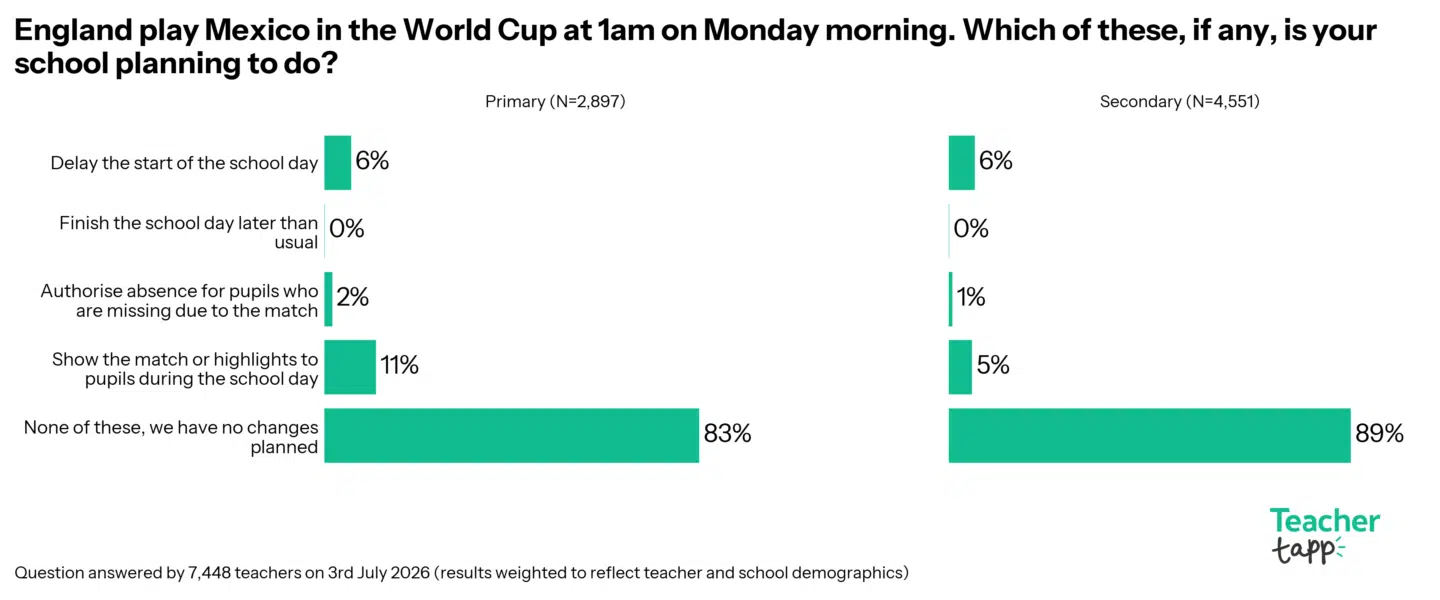
Last week, you told us how the World Cup had been featured in your classrooms – but with the controversial early morning England vs Mexico match, and the England Manager encouraging children to stay up and watch it and “write an excuse to the school, let them watch football.” We wanted to check in to see how schools were coping with the potential disruption.
6% of primaries and secondaries were offering a delayed start to the school day, 2% of primaries and 1% of secondaries had planned to authorise the absence of students who missed school after staying up to watch the match, more primaries than secondaries planned to show the game (11% vs 5%).
I think Teacher Tapp can speak on behalf of teachers everywhere, when we say everybody is thrilled the next match is on a Saturday night!
Shrinking schools?
The recent reports from the Office for National Statistics on population growth make for sombre reading: “Deaths are projected to exceed births in the UK from mid-2026 onwards. There are projected to be around 450,000 more deaths than births between mid-2024 to mid-2034.” You can read the report in full here.
But what do these changes mean for schools? One change is the reduction in the number of pupils, and as funding is based “per-pupil”, the knock-on effect will be school closures or mergers in areas where schools become too small to be financially viable.
Primary schools will be the first hit by these changes, and 33% of primary leaders told us their pupil numbers will drop in September, but the same is also true for 21% of secondary leaders.
Among those schools with falling rolls, leaders told us…
- 54% of primary and 63% of secondary senior leaders have reduced staff
- 33% of secondary leaders have increased class sizes, compared with just 13% in primary.
- 29% of primary leaders have combined classes
A smaller number reported needing to investigate closing or mergers (3% in primary and 5% in secondary), a figure we will keep a close eye on over the next few years.
Daily Reads
It was money money money last week: almost one in five Tappers read the Tes blog on pay scales.
There are so many great blogs out there and we love featuring them on Teacher Tapp. If you have a blog you think we should feature, then please email us at england@teachertapp.co.uk and we will check it out!