Hey there Teacher Tappers!
“swampy” 🥵 “excruciating” 🔥 “a hot mess” 🤪
👆 These are just a few examples of how many of you summed up your experience teaching in the extreme weather last week. 5% of teachers recorded classroom temperatures of over 40 degrees centigrade 😳 it’s no wonder one teacher wrote in to say that “my ducks are not in a row; they’re not even in the pond because that’s evaporated in the heat.”
Read more about our findings in today’s blog…but FIRST! Update on our special giveaway…
Prize draw finishes this week!
Here at Teacher Tapp we are incredibly grateful for all of the Tapps you give us. Last week, you might have spotted familiar questions being repeated in the National press as part of our longitudinal data project with Gatsby on teacher recruitment. You can read more here.
But we could only do that because of YOU. Therefore, we feel it is only right that we regularly say THANK YOU, and this month one lucky Tapper will win an iPad! It’s easy to enter – you just have to Tapp in June! Check out the full Ts and Cs here.
Now, onto the new edu-findings…
Hot teaching
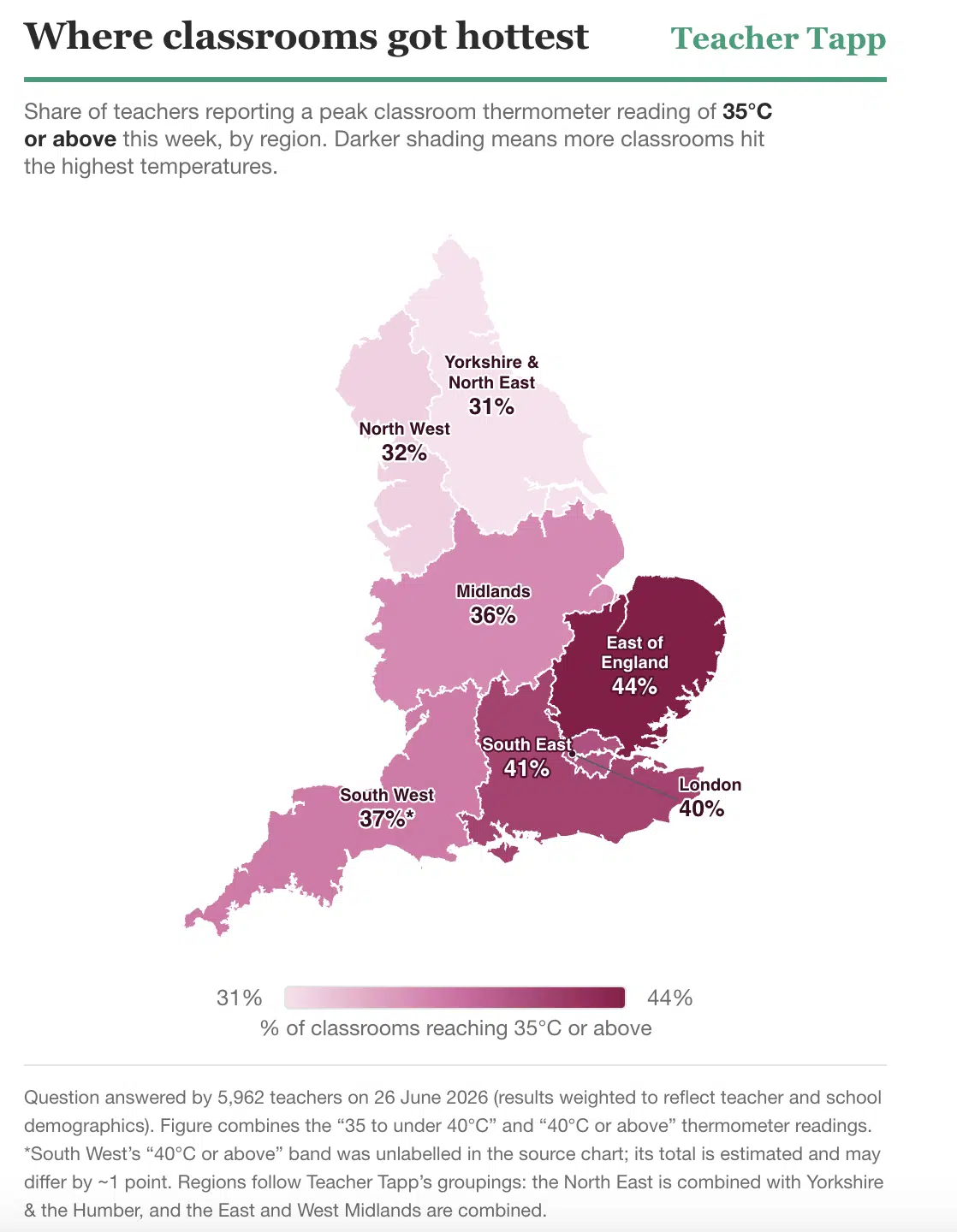
Teacher Tappers told us about their hot classrooms this week, and the three regions with teachers reporting the hottest temperatures of 35 degrees or higher were: East of England (44% ), London (40%), and the South East (41% ).
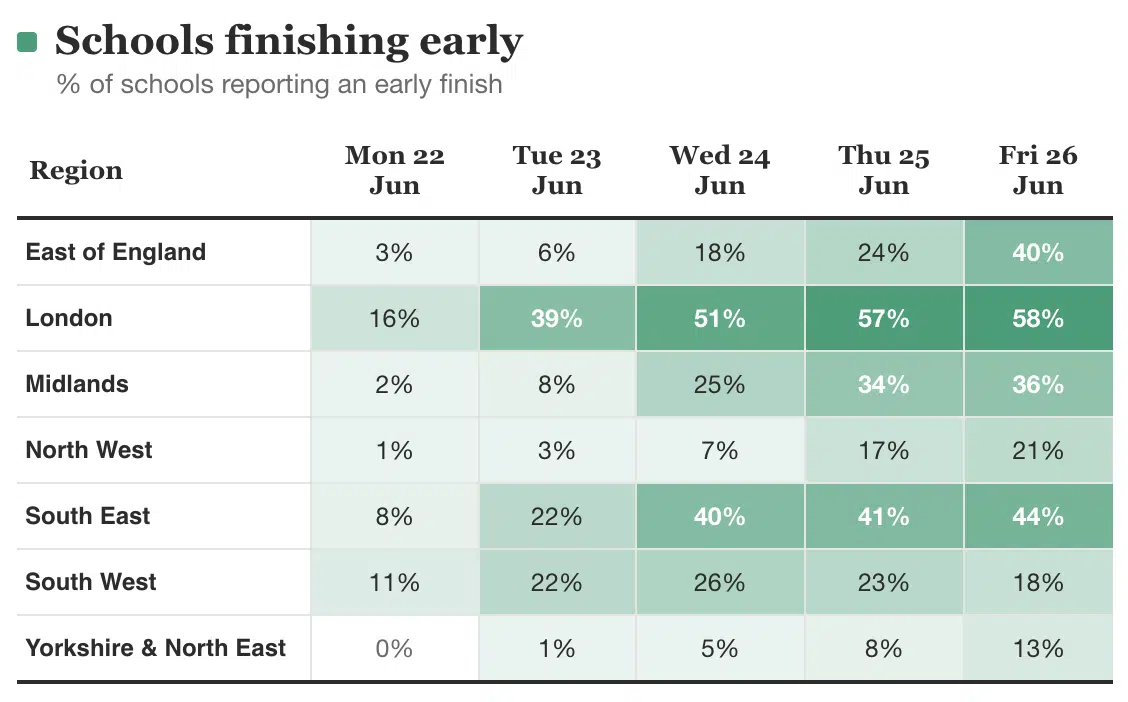
The weather led some schools to close early – but when we look at regional breakdowns, it’s clear that the numbers closing rolled south-to-north as the heat spread.
- It rolled south-to-north as the heat spread. Teachers in London reported 16% closing early on Monday, while the North West (1%) and Yorkshire & North East (0%) barely registered; by Friday, those northern regions had climbed to 21% and 13%, tracking the heat moving across the country.
- London led but hit a ceiling. It climbed 16% → 39% → 51% → 57% → 58%, with the daily rise shrinking to just +1 by Friday.
- The South West broke the pattern. It peaked at 26% on Wednesday, then fell to 23% and 18%, while every other region kept rising (East of England went 18% → 24% → 40% over the same days).
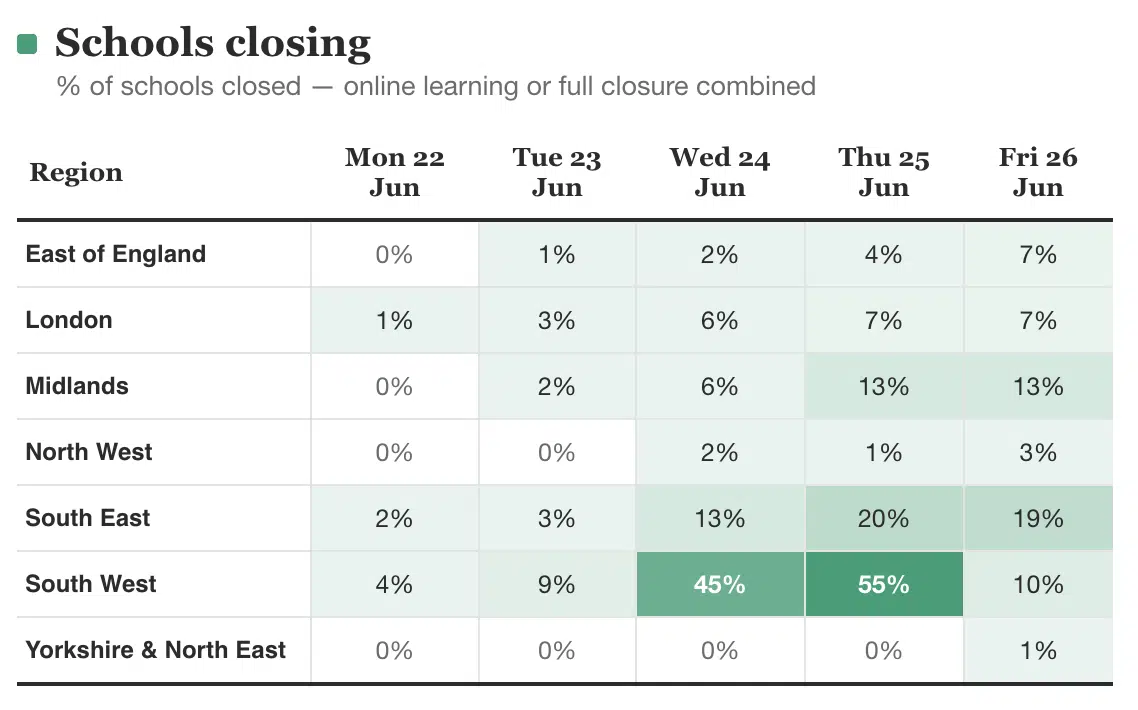
Schools closing altogether was far less common: the South West saw the highest number of teachers reporting their school had closed: 45% on Wednesday and 55% on Thursday. Yorkshire and the North East faced the least disruption, with no closures reported until Friday, when just 1% reported their school had closed.
Problems from the hot weather
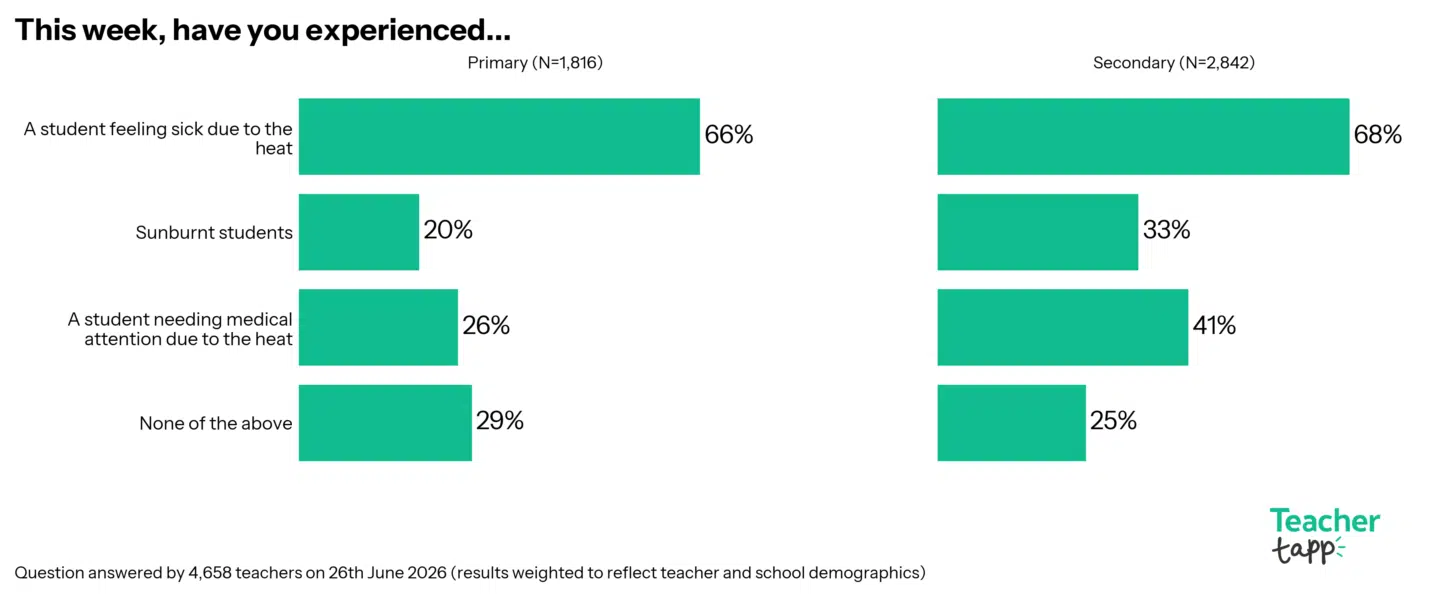
Students have struggled in the heat too, with 66% of primary and 68% of secondary teachers reporting that students have felt sick due to the heat, 20% of primary and 33% of secondary teachers say students have been sunburnt this week, and 26% of primary and 41% of secondary teachers say that a student has needed medical attention due to the heat this week.
97% of primary teachers have made a change to the way students use outdoor space this week, with 80% cancelling or changing PE lessons; 63% holding indoor break or lunch; 81% kept students in the shade, and 15% used extra supervision when students were outside.
Two-thirds of secondary teachers also reported making changes: half said PE was cancelled or changed; 21% had an indoor break or lunch; 42% kept students in the shade, and 13% had extra outdoor supervision.
How do we ensure schools are ready for hot summers?
If what we’ve seen this year is going to be the new normal, what needs to happen to make sure schools can better cope with the higher temperatures?
- 94% feel investment in adaptations to classrooms, for example air conditioning or fans, is necessary.
- 74% say there needs to be a maximum temperature for classrooms.
- 69% want there to be changes to building regulations (e.g. solar glass windows, ventilation) for schools.
- A smaller number wanted operational changes, 17% would like adjustments to the school calendar, and 18% want earlier start times in the Summer term.
Senior leadership and subject specialism
Last week, a Tapper wrote in to ask about the representation of subject specialism among senior leaders and headteachers. He felt some subjects were underrepresented and wondered if this spoke to a problem within schools when identifying and developing future leaders.
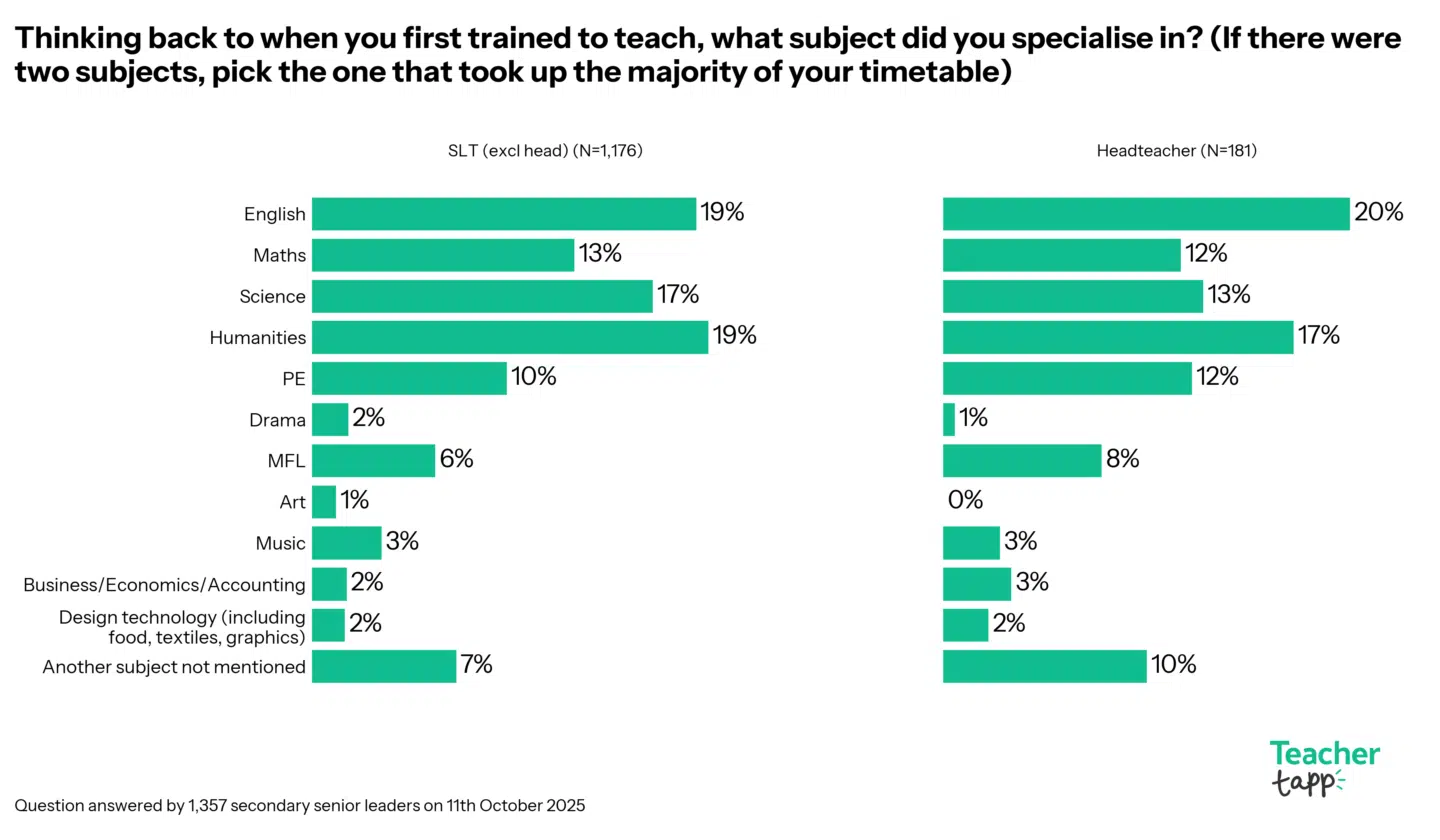
Given the headteacher shortage (and you can read more about the current state of recruitment and retention in our special Teacher Tapp report here), we thought this was worth a closer look, and found two useful data points to consider when thinking about this problem. The first is the subject specialisms of current leaders: despite English, maths and science making up similar proportions of the workforce, headteachers are more likely to be English subject specialists (20% English headteachers, vs 12% maths and 13% science).
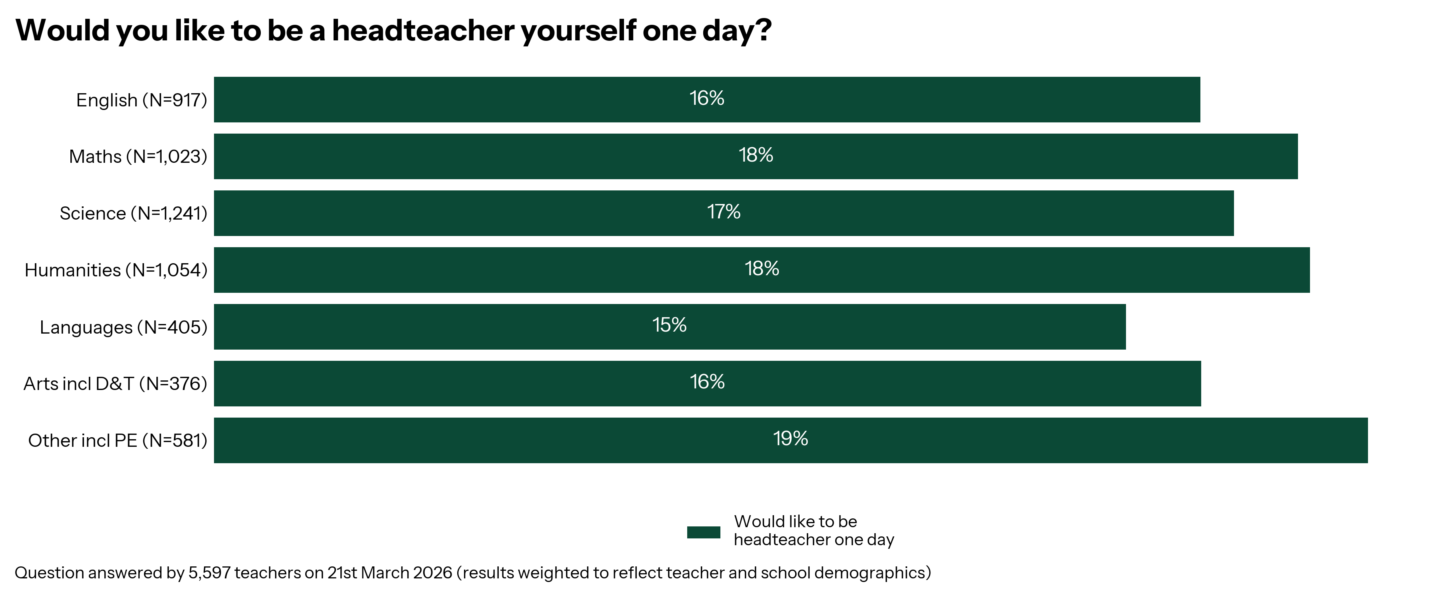
Our second data point is the subject specialism of aspirational headteachers, and rather than finding English teachers are the most likely to want to be headteachers, the numbers suggest that teachers of all subjects are equally ambitious. Teachers of English, maths and science are all similarly represented in the group: 16% English teachers, 18% maths teachers, 17% science teachers say they would like to be a headteacher one day.
Have you ever wondered whether a pattern in your school can be found elsewhere? Please do send all your edu-wonderings in to us, and we will do our best to answer them! England@teachertapp.co.uk 📧.
Football World Cup in the classroom
A summer of sport is underway, with big events like Wimbledon, the athletics Diamond League, Cricket T20 world cup all taking place in June and July.
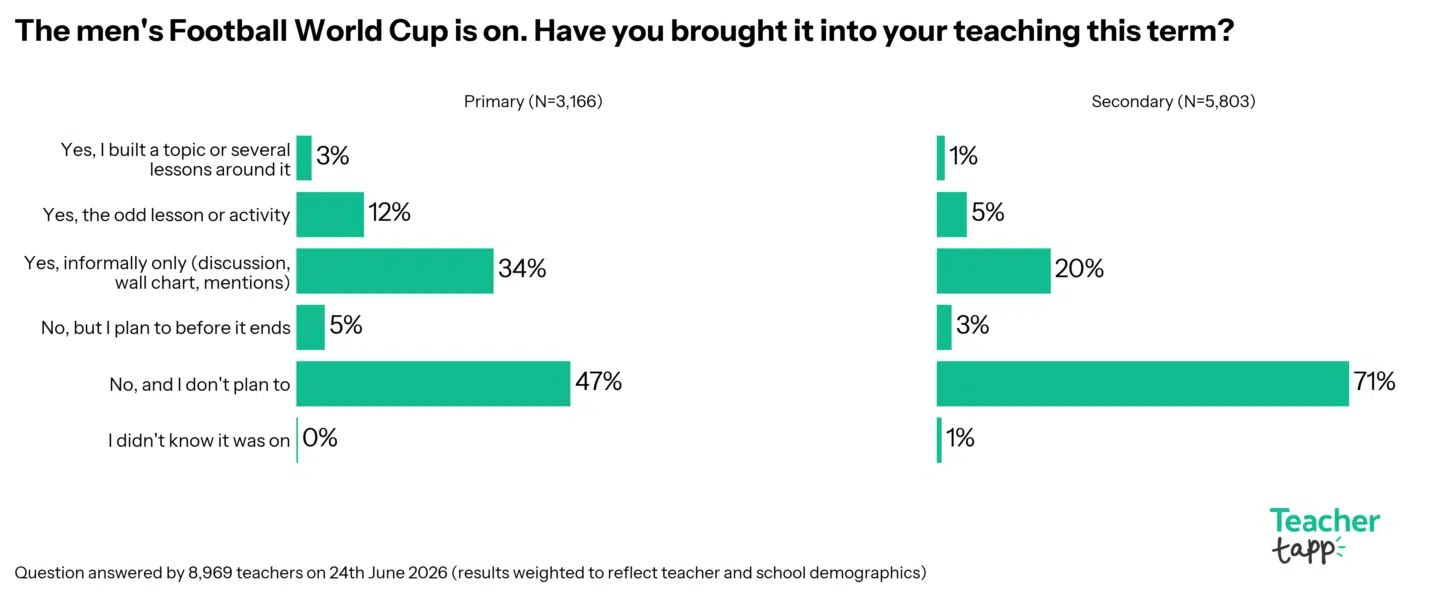
The men’s Football World Cup has begun, but how many teachers are using it in their lessons?
A tiny number (3% of primary and 1% of secondary teachers) have built it into their lessons, a slightly larger number have done the odd lesson or activity (12% of primary and 5% of secondary teachers). It’s more common to say you’ve been informally chatting about it (34% primary and 20% secondary teachers), but the majority say they haven’t, and have no plans to (47% primary and 71% secondary teachers).
Daily Reads
Unsurprisingly, it’s the blog advising on teaching in the heat that came out top! 12% of Tappers read it this week.
There are so many great blogs out there and we love featuring them on Teacher Tapp. If you have a blog you think we should feature, then please email us at england@teachertapp.co.uk and we will check it out!