Hello Tappers!
We are halfway through November, and the nights are drawing in. Leaving for work before sunrise and getting home after sunset can have a negative impact on your wellbeing. If you’re finding the lack of sunlight tough, this article from Oxford University’s Institute of Ageing might be useful.
Last week has been a busy one for edu-news, so here are some of the most pertinent findings from last week…
Mobile phone rules change
Last week, the Department for Education announced a tightening of the guidance around mobile phones that was only updated earlier this year. The update now specifically rules out “not seen, not heard” policies.
In reference to the update, the Department for Education says: “The strengthened guidance will make clear that schools should go beyond ‘not seen, not heard’ – where phones may remain in pupils’ bags – and adopt whole-school strategies that keep phones out of use and inaccessible throughout the school day.“
But how many schools currently have policies that will need to change?
We checked in again to see what current rules were in place, and secondary senior leaders told us:
- 5% ban phones from the school site
- 44% collect phones in, use pouches or lockers (of that 7% use lockers; 34% collect in phones; 57% use pouches; and 1% do something else)
- 45% tell students to keep them out of sight all day
- 1% allow them at break and lunch, but not in lessons
- 4% have them out of sight all day, and in lessons when directed by a teacher
- 1% allow them at break and lunch, and in lessons when directed by a teacher
- Fewer than 1% allow students to have phones at all times
This means 49% of secondary leaders say their schools comply with the new, tightened-up rules, leaving 51% who currently don’t.
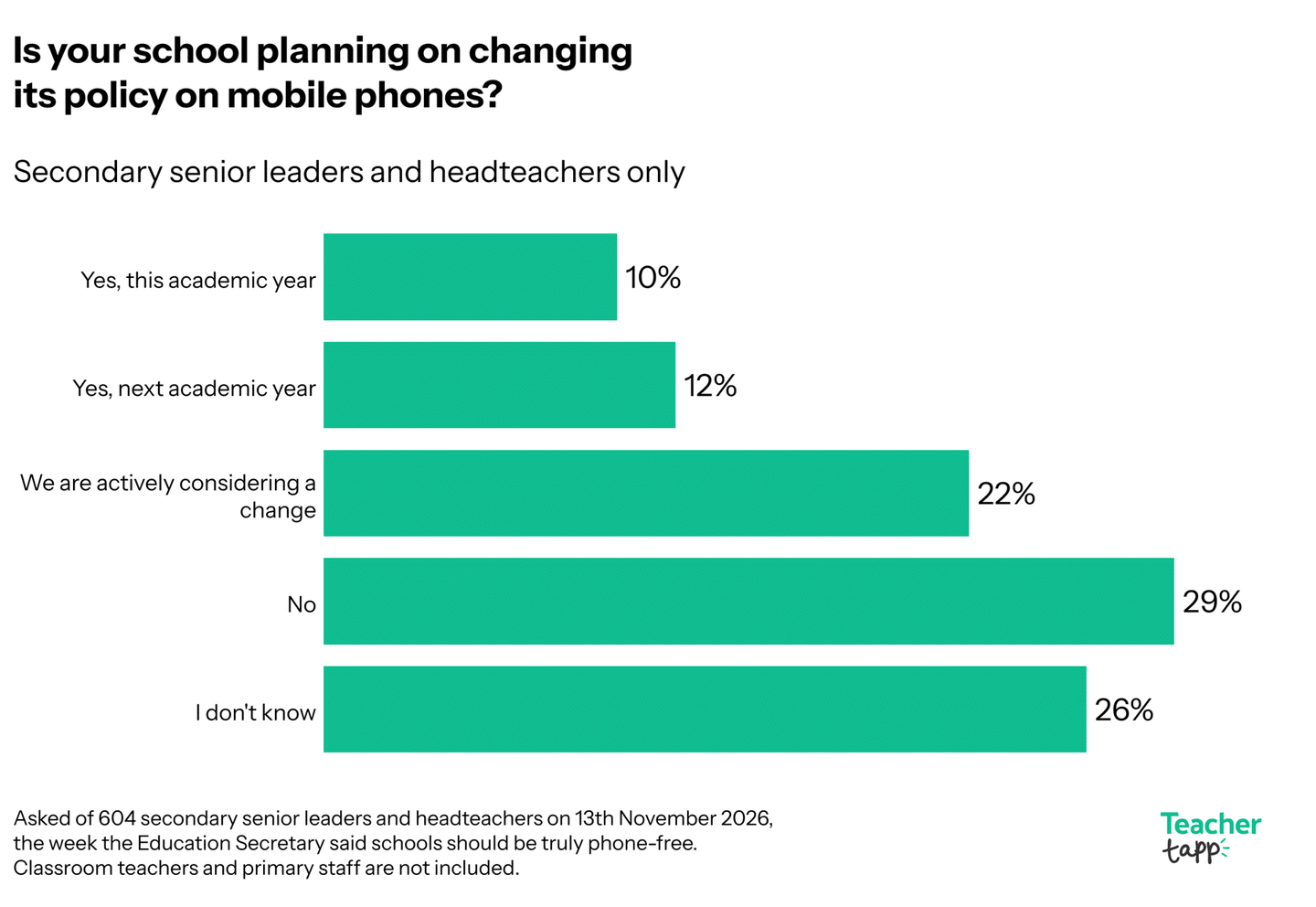
We then asked those leaders in schools where their phone policy doesn’t currently comply if there were plans to change the rules, following the announcement:
10% intend to make changes this academic year; 12% have plans to do it for 2027/28; 22% are actively considering what change to make; 29% have no plans to change, and 26% don’t know what is going to happen.
We’ll be checking back in later in the year to see if more plans have been made – plus, how the costs of new phone policies are affecting school budgets!
GCSEs over 2 or 3 years
The 3-year GCSE has also made edu-news this week, with the announcement that schools should stop teaching GCSEs before Year 10.
But how many schools would need to change their current approach?
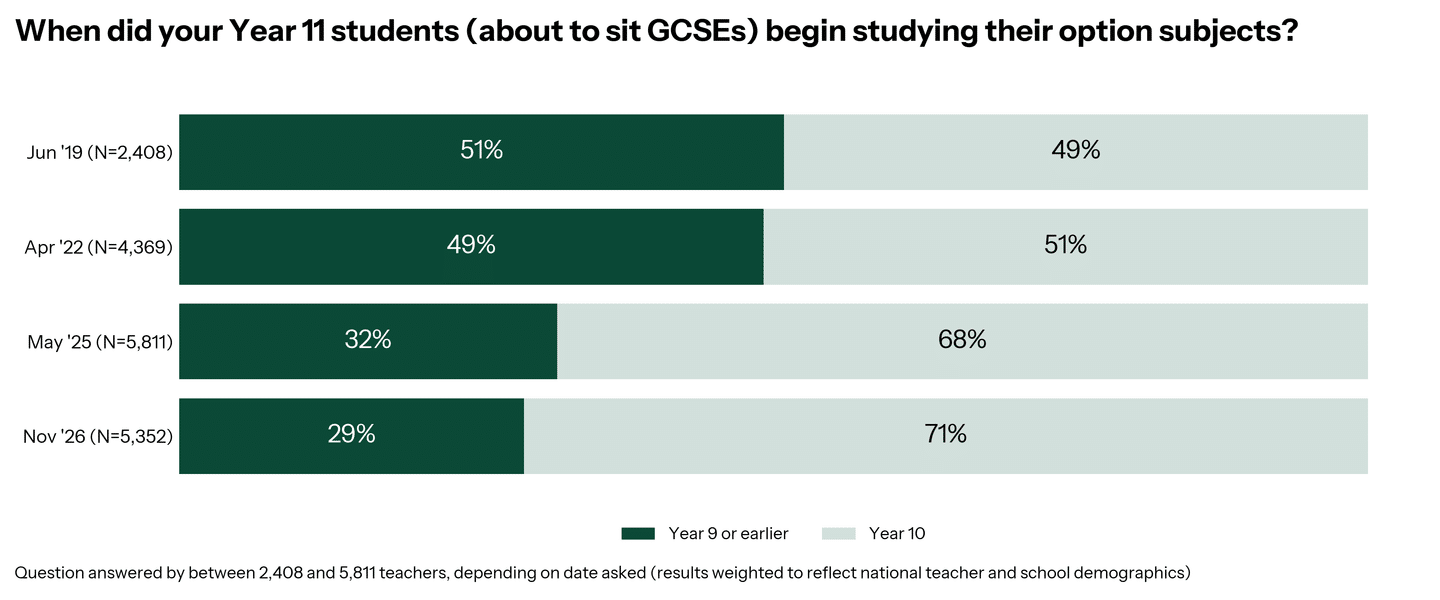
In 2019, 51% of teachers said their school started GCSE options in Year 9, but in 2026, this has dropped, and just 29% of teachers say the same.
Microsoft outage
If the school day wasn’t hectic enough, the cyber-gods conspired against teachers last week, and a Microsoft outage hit Friday morning. But how many teachers were affected?
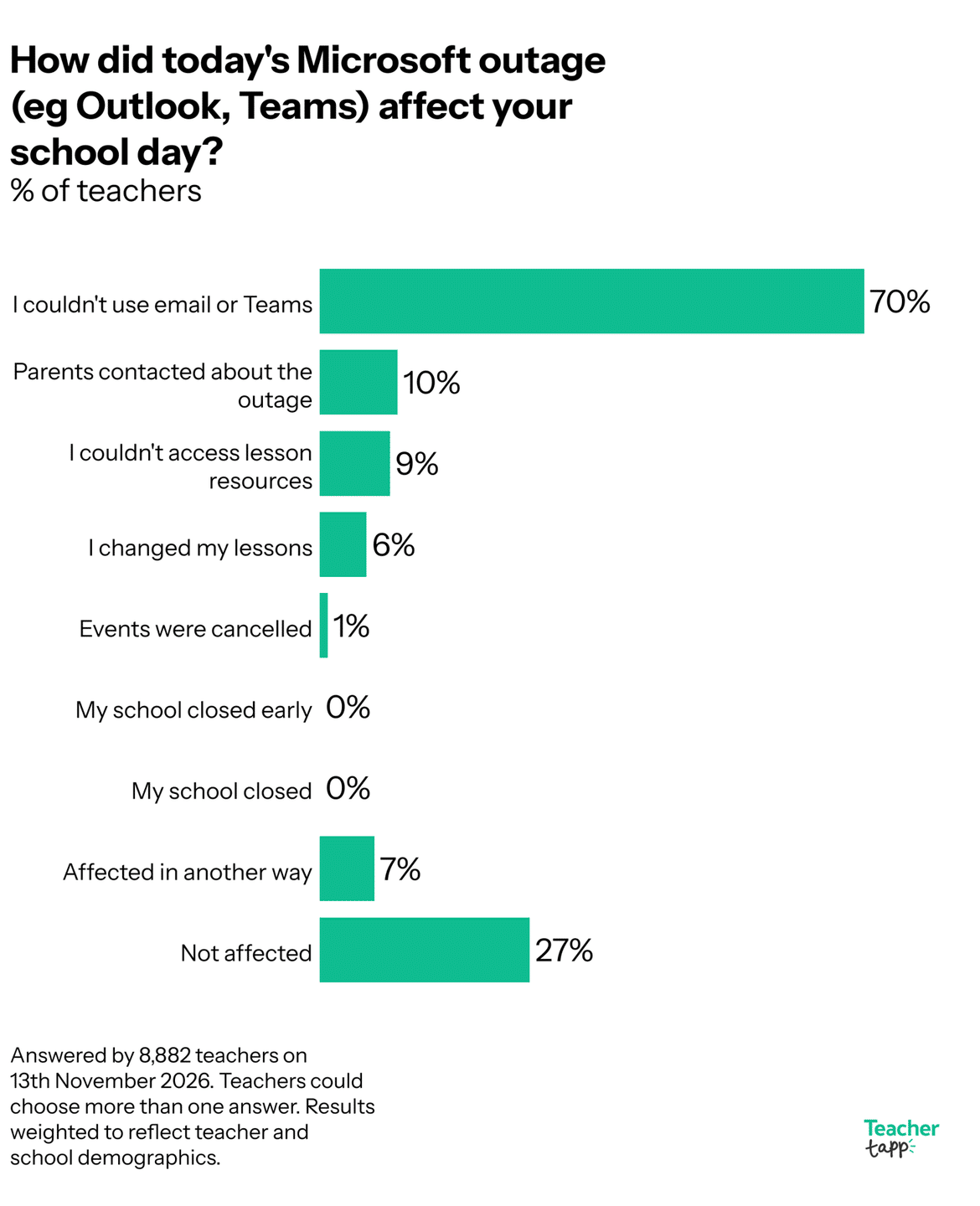
Just 27% of teachers reported not being affected by the outage, leaving around three-quarters of schools experiencing some difficulties as a result of the problems at Microsoft.
70% couldn’t use email or Teams, 10% said parents were contacted about the outage, 9% couldn’t access lesson resources, 6% changed their lessons, 1% cancelled events, and 7% reported being affected in another way.
The Government has recently published its “Be Ready” advice on preparing for emergencies. That raises the question of whether schools have also thought about what they’d do in the event of severe weather or an extended power cut. Is this something your school is planning for? Let us know at England@teachertapp.co.uk 📧.
Walliams books in schools
In a very different story, schools have been left wondering what to do with books by David Walliams, one of the most popular authors among primary-aged children.
The Metropolitan Police have launched a criminal investigation into the comedian and author following allegations of sexual misconduct, which he denies. ASCL plans to ask the Department for Education for guidance on what schools should do with copies of his novels in classrooms and libraries.
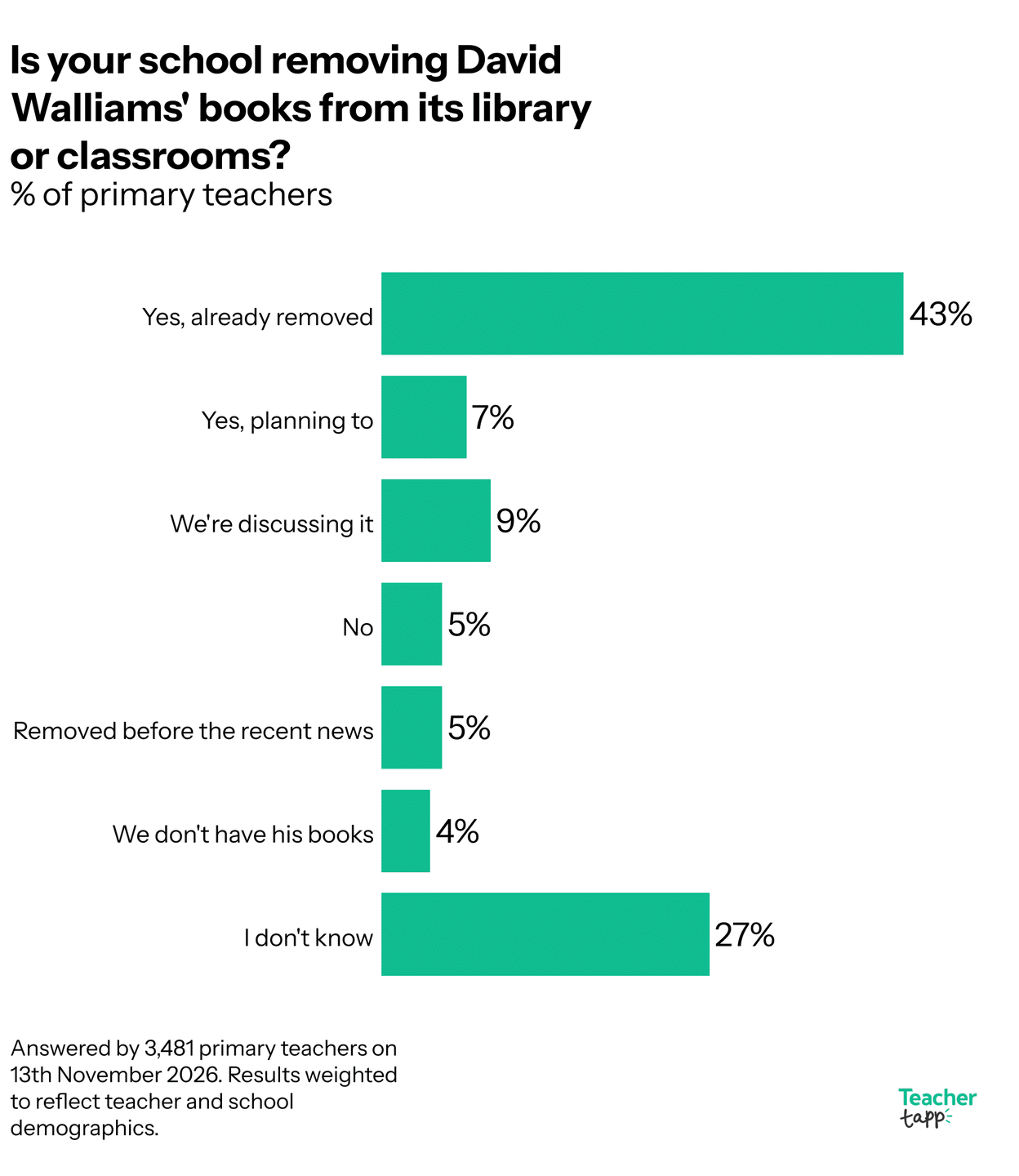
We asked primary school teachers what their plans were, and discovered:
- 5% had already removed the books before the recent news coverage. 4% never had his books.
- 43% of primary teachers say they have already removed David Walliams’ books following the recent news.
- 7% plan to remove them, and 9% have been discussing whether they will or not.
- 5% are not planning on removing them.
- 27% don’t know what will happen with the books.
Disruption to learning
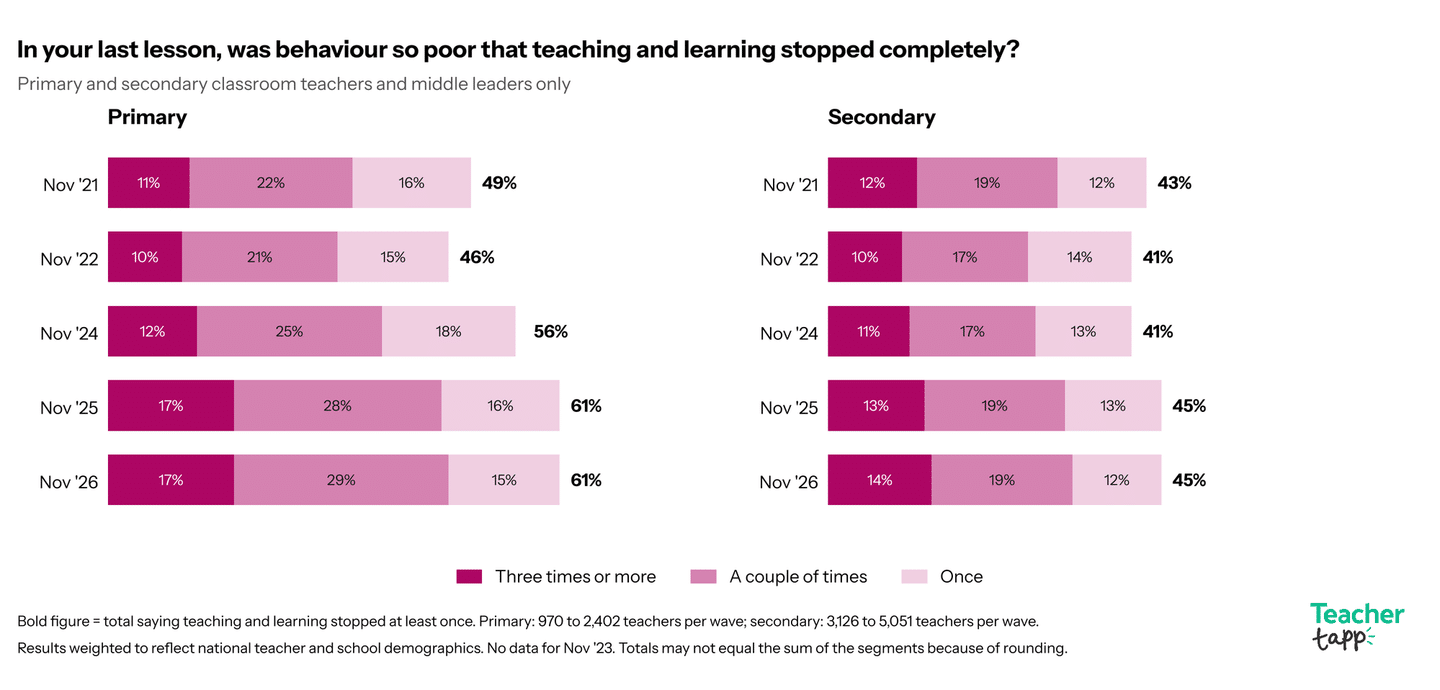
Back to our classroom stats, last week we looked at when poor behaviour led to learning disruptions in a single lesson, and how this has changed over time and varies between primary and secondary. When analysing this data, we exclude senior leaders and headteachers, looking only at the responses of classroom teachers and middle leaders.
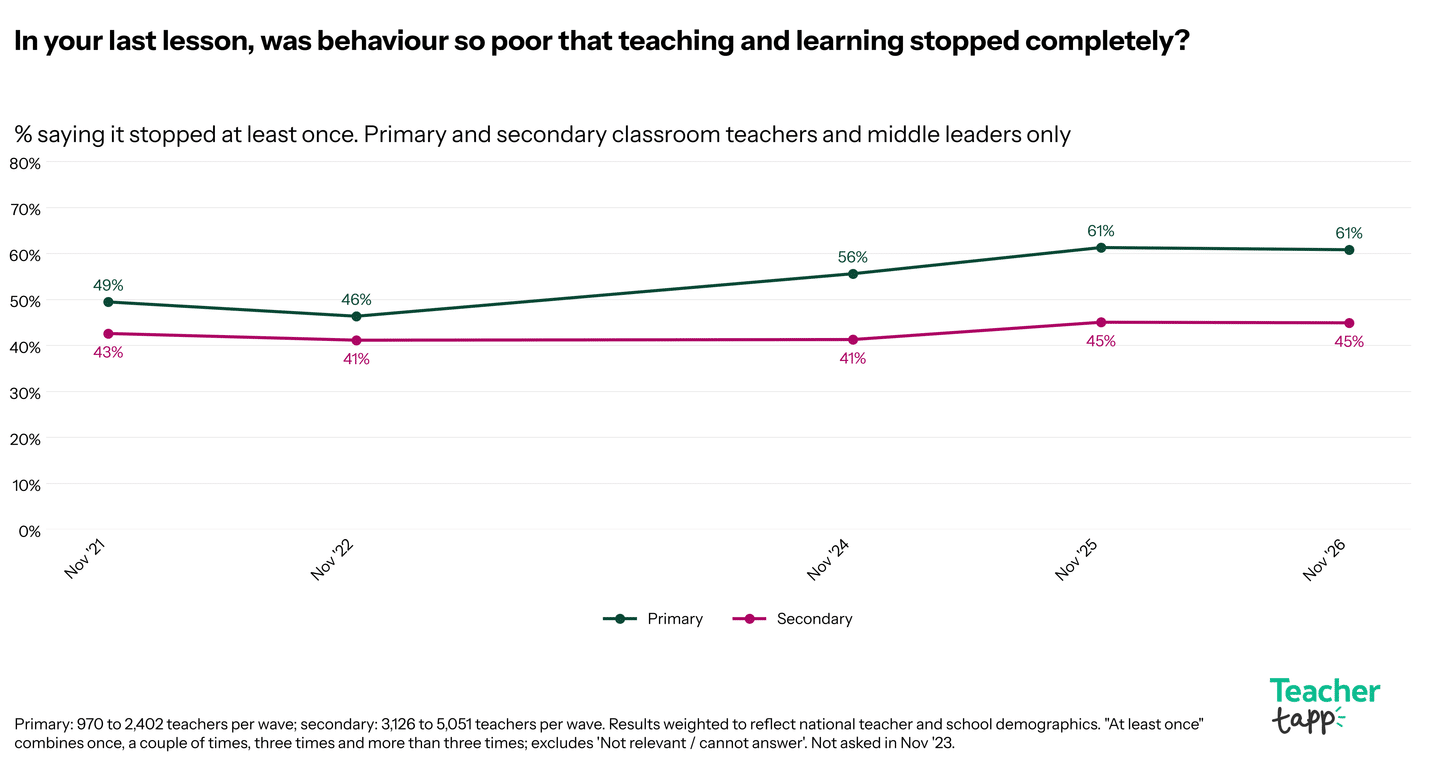
In 2021, 49% of primary and 43% of secondary school teachers experienced at least one disruption that caused teaching and learning to stop completely. Since 2021, the percentage of primary teachers reporting at least one disruption has risen to 61%; but secondary teachers have seen a much smaller rise to 45%.
There has also been an increase in the percentage of teachers reporting multiple disruptions: in 2021, 11% of primary and 12% of secondary school teachers experienced three or more disruptions that caused teaching and learning to stop completely. Since 2021, the percentage of primary teachers reporting three or more disruptions has risen to 17%; but secondary teachers have seen a much smaller rise to 14%.
The gap has widened since 2022: 6 pp in 2021, 5 pp in 2022, 15 pp in 2024, and 16 pp in both 2025 and 2026.
What might explain this gap?
Behaviour Tsar, Tom Bennett, says it is also important to keep in mind that the data covers “self-reported experiences of disruption, rather than an objective measure of pupil behaviour” and warns that “we need to be careful about what conclusions we draw.”
As for the reasons for the gap, Bennett says there could be several explanations. One reason could be the impact of lockdown on children before starting school.
“One possibility is that we’re seeing the effects of a pandemic cohort moving through primary schools, with some children having missed important opportunities to develop the social skills, habits and self-regulation that make classroom learning possible,” he says.
Bennett says primary schools possibly are finding it harder to deal with these “challenges” and that secondaries have “more developed behaviour response systems, like centralised support, removal mechanisms and clearer escalation procedures” whereas primary teachers “can often be expected to manage significant disruption largely on their own.”
Another explanation offered by Bennett is that in secondary, behaviour management has improved, and that would account for why their reported disruption “hasn’t risen in the same way”. But ultimately, Bennett says the data sets “tell us something important about teachers’ experiences, but not necessarily why those experiences are changing. We need to investigate that a bit more.”
What do you think explains the difference? Write in and share your thoughts England@teachertapp.co.uk 📧.
A Teacher Tapper asked… flags in the community
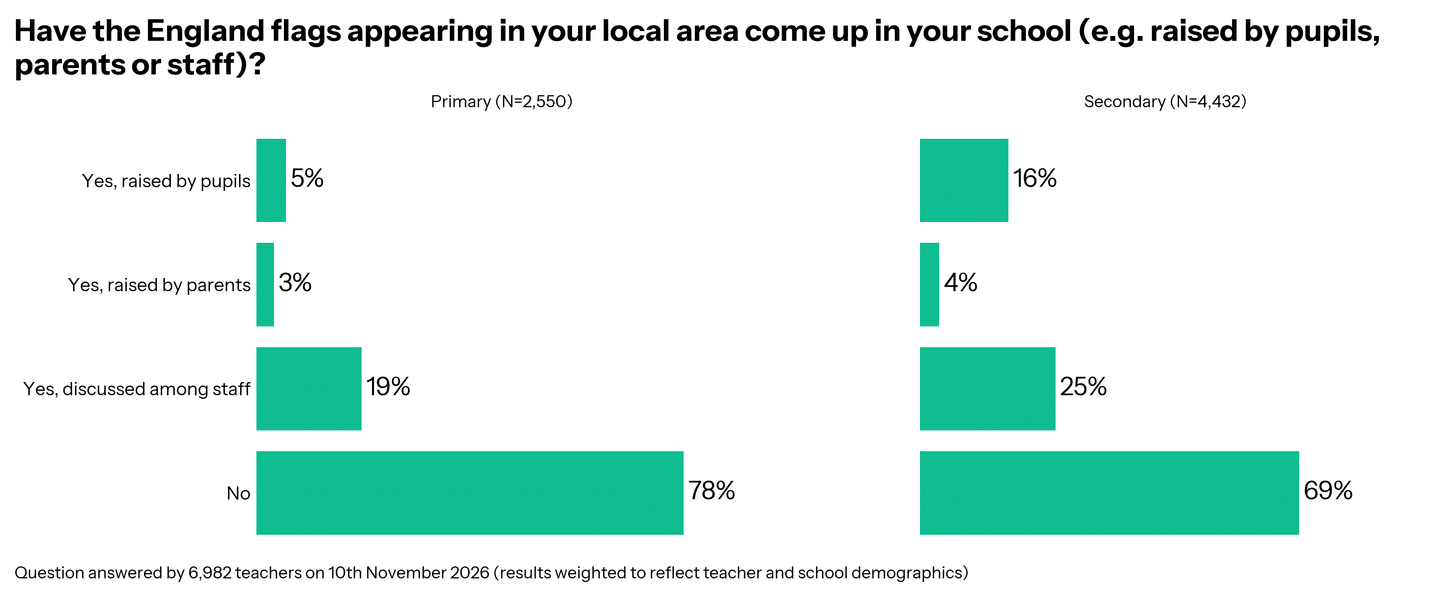
A Teacher Tapper got in touch following an incident at his school regarding flags that had been displayed in the local area. He asked us to find out how common this problem was for schools, and whether it was pupils, parents or staff who were discussing it.
For some teachers, this isn’t an issue: 26% of teachers say there are no flags up in their local area.
Looking just at the remaining three-quarters of teachers who are working in areas where flags have been put up, we found:
5% of primary teachers and 16% of secondary teachers report that pupils have brought the topic up, and 3% of primary and 4% of secondary say it’s been parents who have brought the topic up.
Colleagues talking about the flags is a more common occurrence, with 19% of primary and 25% of secondary teachers saying it’s been a topic of discussion among staff.
However, 78% of primary and 69% of secondary say it hasn’t come up at all.
If you have a topic you would like us to ask about, please do let us know! Write to England@teachertapp.co.uk 📧.
Daily Reads
The most-read tip was all about the October half-term. Don’t worry if you missed it, because you can still read it here: October half-term.
There are so many great blogs out there, and we love featuring them on Teacher Tapp. If you have a blog you think we should feature, please email us at England@teachertapp.co.uk, and we will check it out!