Hey there, Teacher Tappers!
Every school has a behaviour policy, and every behaviour policy has sanctions. But who gets to hand them out, what they look like, and how often they’re used varies hugely from school to school. We’ve pulled together our best sanctions questions so you can see whether your school’s approach puts you in the majority, the minority… or somewhere in between!
What sanctions can classroom teachers use?
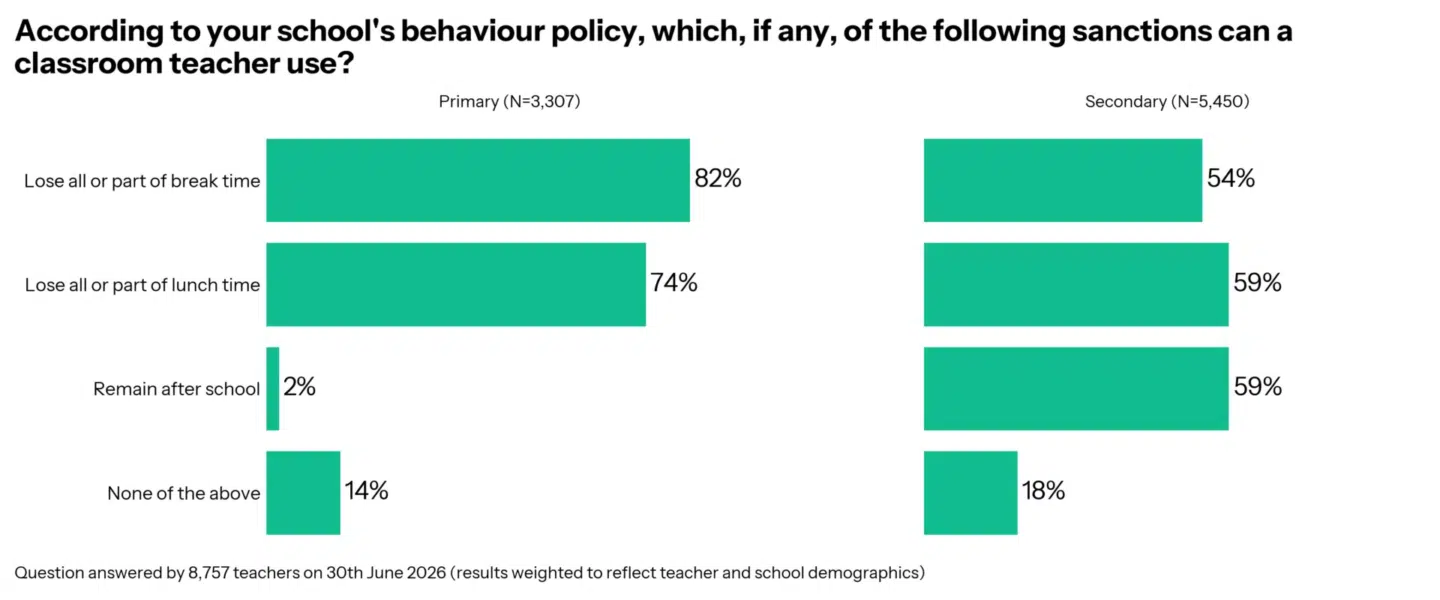
In most schools, yes – but what kind of detention depends a lot on phase. Primary teachers are far more likely to be able to take away break time (82% vs 54% in secondary) and lunch time (74% vs 59%). Keeping pupils after school, on the other hand, is almost exclusively a secondary sanction (59% vs 2%).
And in a minority of schools, classroom teachers can’t use any of these: 14% of primary and 18% of secondary teachers.
Who runs the detentions?
If you’re a secondary teacher who still has to sit with every pupil you put in detention, you’re now in the minority. In schools that use detentions, just under a third (30%) of secondary teachers say they oversee detentions, while 70% work in schools where all detentions are centralised, and 31% never have to supervise them at all.
Centralised detentions have been on the rise. In 2018, 48% of secondary teachers said their school had some form of centralised detention, growing to 70% in 2026.
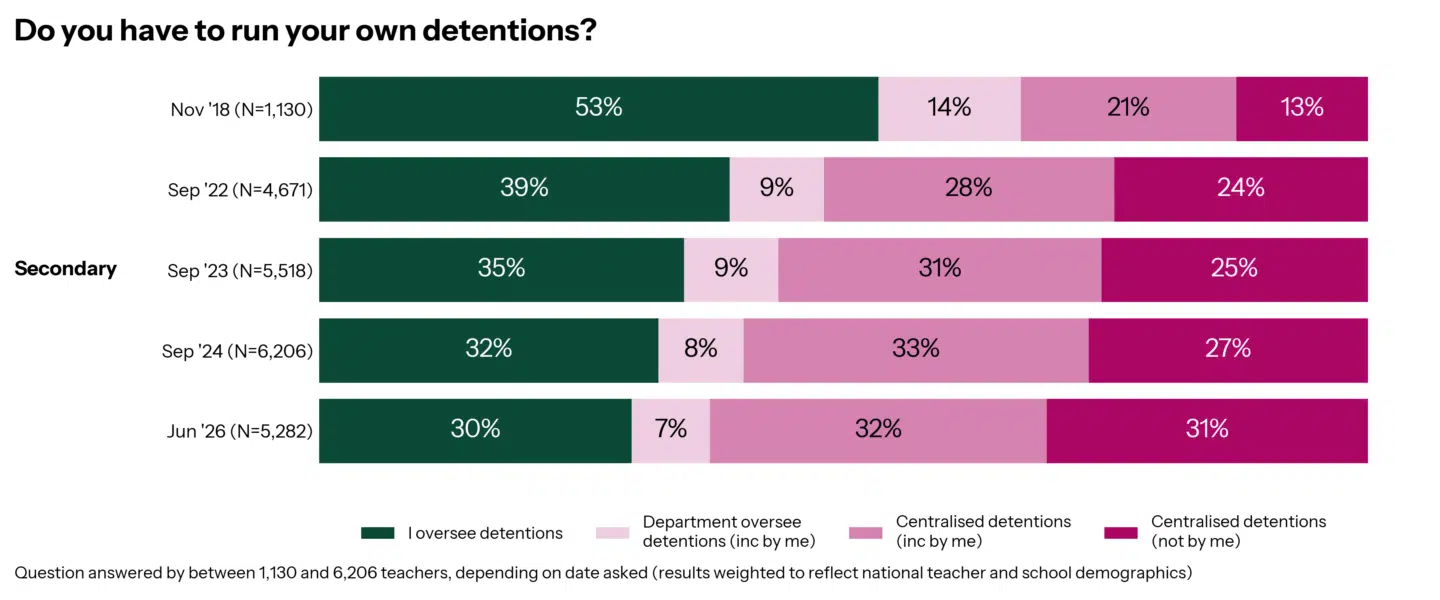
Schools that do not run detentions have always been in the minority; just 9% of secondary teachers say they don’t use detentions, and this is slightly up from 7% in 2022.
Missing break or lunch
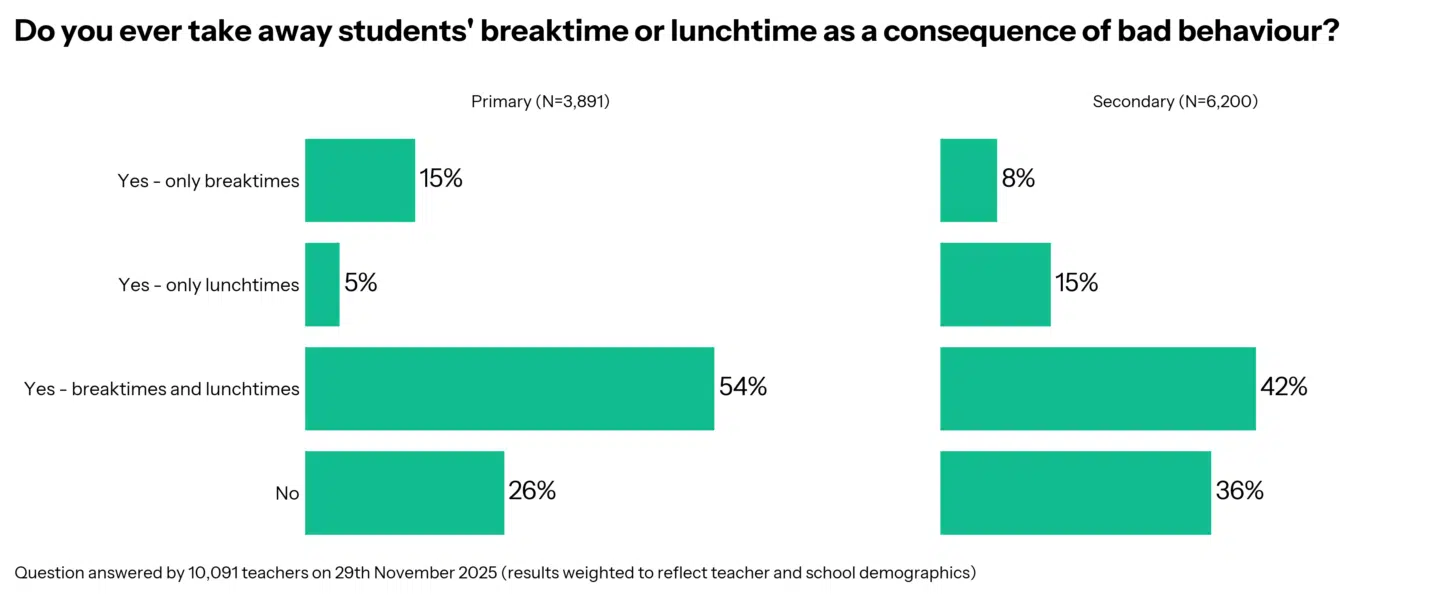
Now, looking at both primary and secondary, we find that taking away break time remains a staple of behaviour management.
74% of primary teachers say they use the removal of break time, lunch time, or both following bad behaviour. In secondary, it’s 64%.
How often do teachers actually use sanctions?
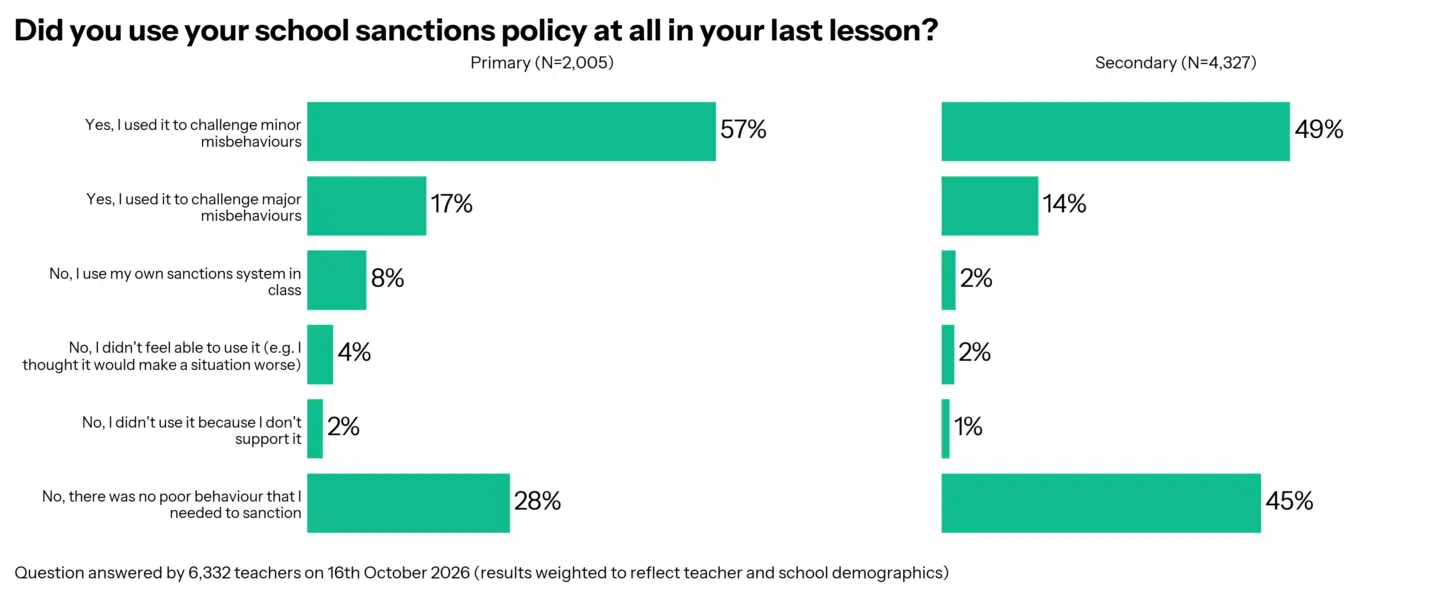
We asked classroom teachers whether they used their school’s sanctions policy in their last lesson. Around half did: 57% of primary and 49% of secondary teachers used it to challenge minor misbehaviour, and 17% and 14% for major misbehaviour.
Secondary teachers were much more likely to say there wasn’t any poor behaviour that needed sanctioning (45% vs 28% in primary).
Very few teachers deliberately avoid the policy: just 4% in primary and 2% in secondary said they didn’t feel able to use it.
And on a typical day? When we asked secondary teachers at the end of September how many detentions they’d given out in their lessons that day, 27% of teachers in schools with detentions had given at least one – and just 2% had given more than five.
What was the last sanction for?
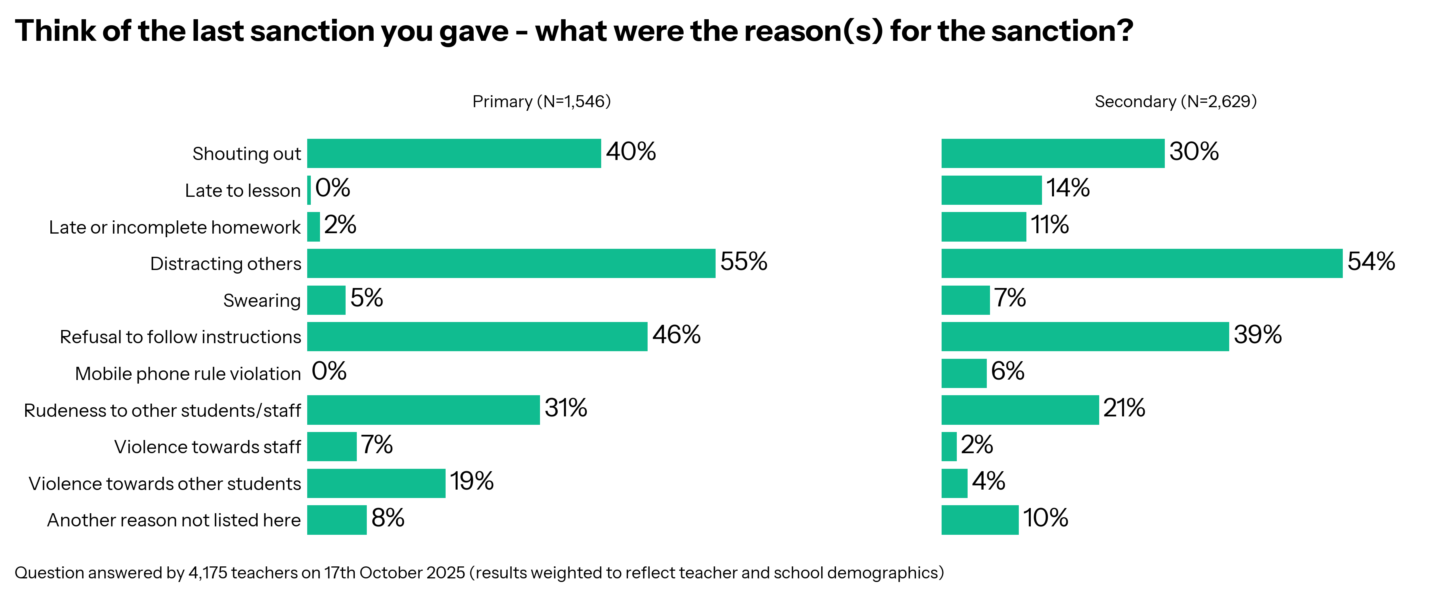
Classroom teachers were asked about the reason for the last sanction. This was a multi-select question (of course, so often there is more than one thing a pupil has done…).
The single most common reason for a teacher’s last sanction was the same in both phases: distracting others (55% for primary classroom teachers, 54% for secondary classroom teachers). Refusal to follow instructions came next (46% for primary, 39% for secondary), followed by shouting out (40% and 30%).
There are some big phase differences, though. Primary teachers were five times as likely as secondary teachers to say their last sanction was for violence towards other pupils (19% vs 4%), while lateness, homework and phones barely register in primary but prove to be issues in secondary.
Isolation and removal rooms
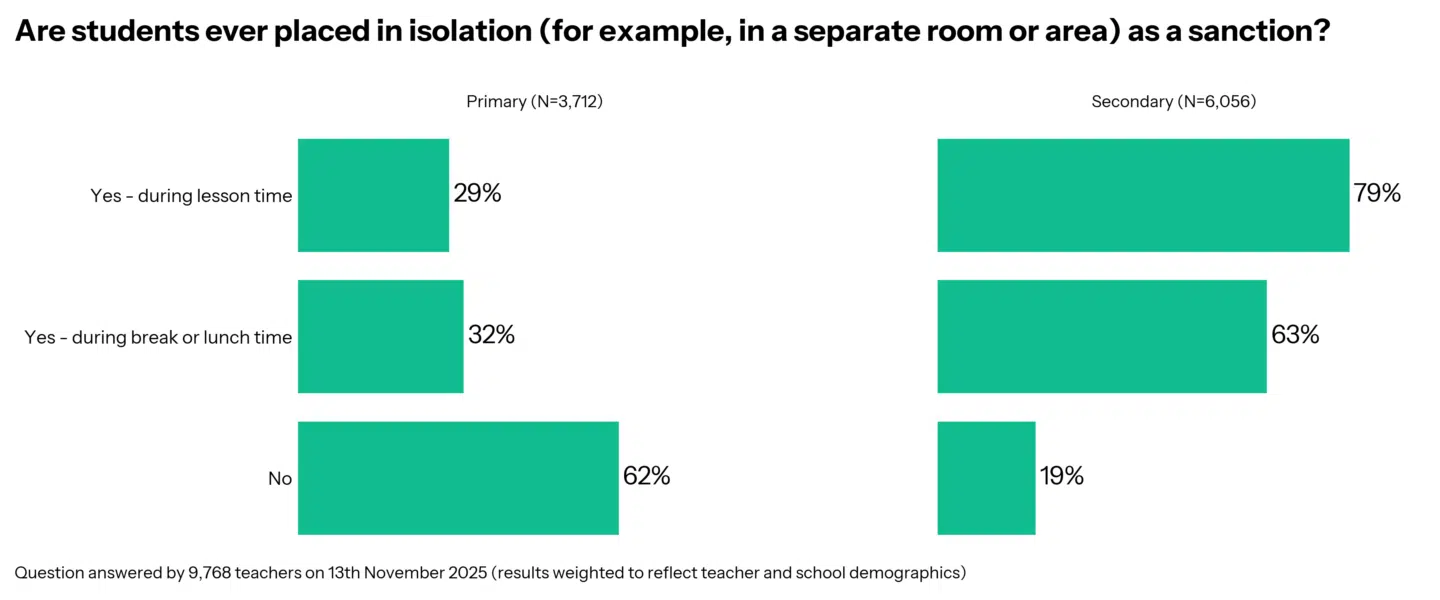
Isolation – placing a pupil in a separate room or area as a sanction – is more common in secondary than in primary, with 19% of secondary teachers saying their school doesn’t use it as a sanction, compared to 62% of primary teachers.
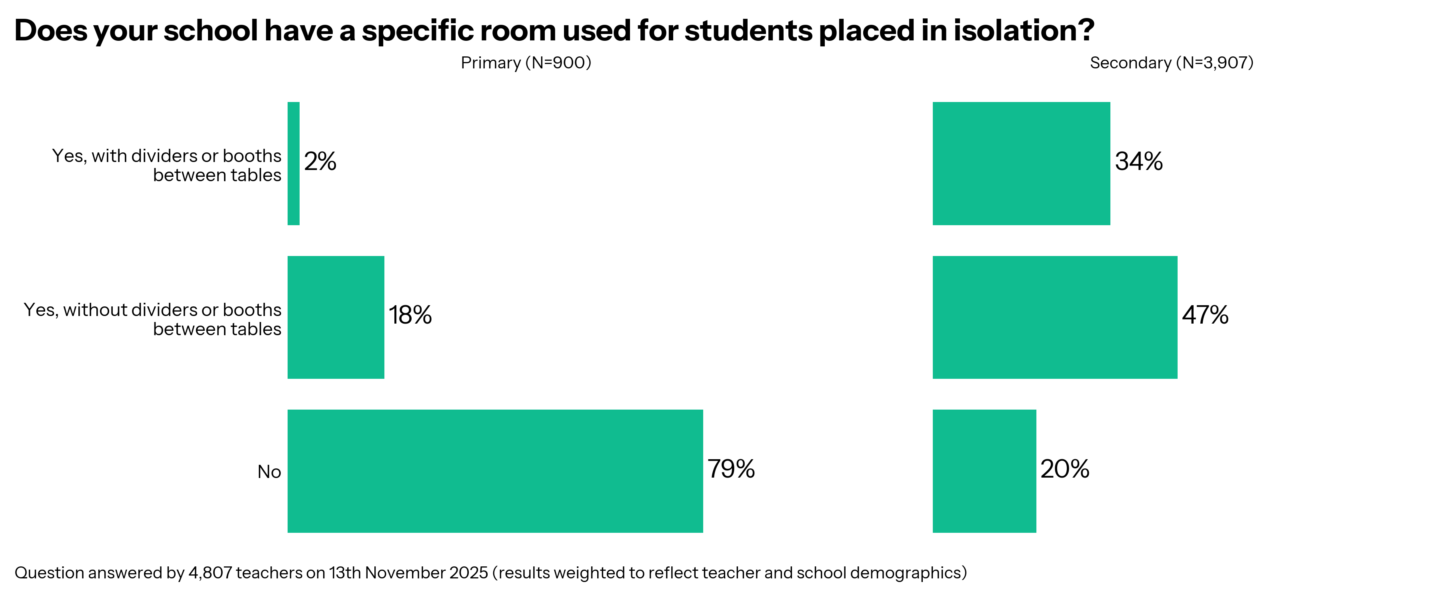
The room itself is also very different in primary vs secondary. Looking just at schools where students are placed in isolation:
- Using dividers or booths are reported by more secondary teachers (34% vs 2%).
- Specific rooms without dividers or booths are also more common in secondary (47% vs 18%).
- And 79% of primary teachers say they have no specific room, vs 20% of secondary teachers saying the same.
Phones: what happens on the first offence?
With phone bans now widespread, we asked what a school’s behaviour policy says should happen the first time a pupil uses a phone when they’re not allowed to. In secondary, there’s a clear standard: confiscation until the end of the day (71%). A further 8% of secondary teachers say phones are taken until at least the end of the week and 6% start with a verbal warning.
In primary, end-of-day confiscation is also the most common answer (49%) – but more than one in four primary teachers (26%) don’t know what their policy says, which perhaps reflects how rarely the issue comes up.
Whole-class punishments
Keeping the whole class in because a few misbehaved – is that allowed at your school? For most teachers, the honest answer is that the policy doesn’t say (70% primary, 67% secondary). Where it does, it’s far more likely to ban them (12% primary, 17% secondary) than allow them (6% and 2%).
Restorative approaches
Sanctions don’t always mean detentions. Most teachers say restorative justice or restorative conversations are mentioned in their school’s behaviour policy – 69% in primary and 58% in secondary – though around one in seven don’t know.
When parents push back
Around three in ten teachers (30% primary, 30% secondary) say a parent has done something to undermine a sanction they’d given in the past week. And 21% of primary and 24% of secondary teachers had received at least one parental complaint about a sanction in the past week.
And how do teachers feel about it?
Sanctioning a pupil isn’t always easy. In October 2024, over half of primary teachers (52%) say they often or sometimes feel guilty about sanctioning a pupil, compared with 39% of secondary teachers.
And policy and practice don’t always line up. In March 2025, 43% of secondary teachers said there had been an occasion that week when they chose not to give a detention even though the policy said they should. The most common specific reasons? For secondary teachers, it was wanting to avoid conflict (16%) and the pupil generally being a good student (13%).
For more on what teachers believe about detentions – and whether those who believe in them use them more – see our earlier post, Sanctions in schools.
How typical is my school, generally?
To learn how your school compares with others of a similar size and type, check out School Surveys, powered by Teacher Tapp. Using our tried-and-tested Teacher Tapp questions, you can get insights into how your school compares to others, and feedback to help you support your staff.
Is there another area you’d like to see a Teacher Tapp blog on? Let us know at England@teachertapp.co.uk.