Hey there Teacher Tappers!
A level results day is out of the way, and now GCSE results are next on the summer calendar. 99% of Teacher Tappers can remember what they got in their GCSEs or equivalents, but only 77% can remember exactly what they achieved in each subject – the rest say their memory is a little fuzzy.
Results day might be pulling some teachers back to school before the holidays are over, but how many know what or who they’re teaching next year? 67% of Tappers have received their final draft of their timetable, with the rest waiting to hear the details.
When those timetables do arrive, we hope you are in the rooms you want. Last year, science teachers were the most likely to report being in a room not designed for their subject (51%), with maths least likely to be displaced (just 30%). Fingers crossed that those rooming displacements are better this year than last year!
Prize draw!
This month’s prize draw is a sartorial one 👚 🧢 👖. Everyone who answers questions between 7 August 2026 and 31 August 2026 will be entered into a prize draw to win a £500 gift card to a clothes shop of their choice. Read the full Ts and Cs here, and good luck to all you Tappers!
Right – onto this week’s findings!
Schools are changing mobile phone policies
On the 29th June, new mobile phone guidance for schools came into force, outlining how all schools should be “mobile phone-free environments by default” and that “anything other than this should be by exception only”. So what might this mean for schools?
Current state of play
When we last asked about mobile phone policies in September 2025, primary teachers told us in their school: 15% were banned from the school site, 69% were collected in or in pouches, 14% could be on the student but out of sight all day, and 1% allowed the student to use them when directed by a teacher. Just under 1% either allow them at break or lunch, or allowed at all times.
In secondary, 5% of teachers report they are banned from school site; 18% say they are collected in or in pouches, 56% say they can be on the student, but they are out of sight all day, 8% allow them at break or lunch, and 13% say they are out of sight all day unless directed by a teacher.
When it comes to sanctions for phone misuse, secondary teachers told us their school policy for sanctions for phone misuse on the first offence in secondary varies from verbal warning (8%), phone taken until the end of the lesson (4%), phone taken until the end of the day (72%), phone taken for longer than a day (10%), and then 6% have a different consequence for phone misuse.
But is that all about to change? 13% of primary and 41% of secondary teachers say their school is changing its mobile phone policy, and a smaller number (5% primary, 6% secondary) say they are actively considering a change.
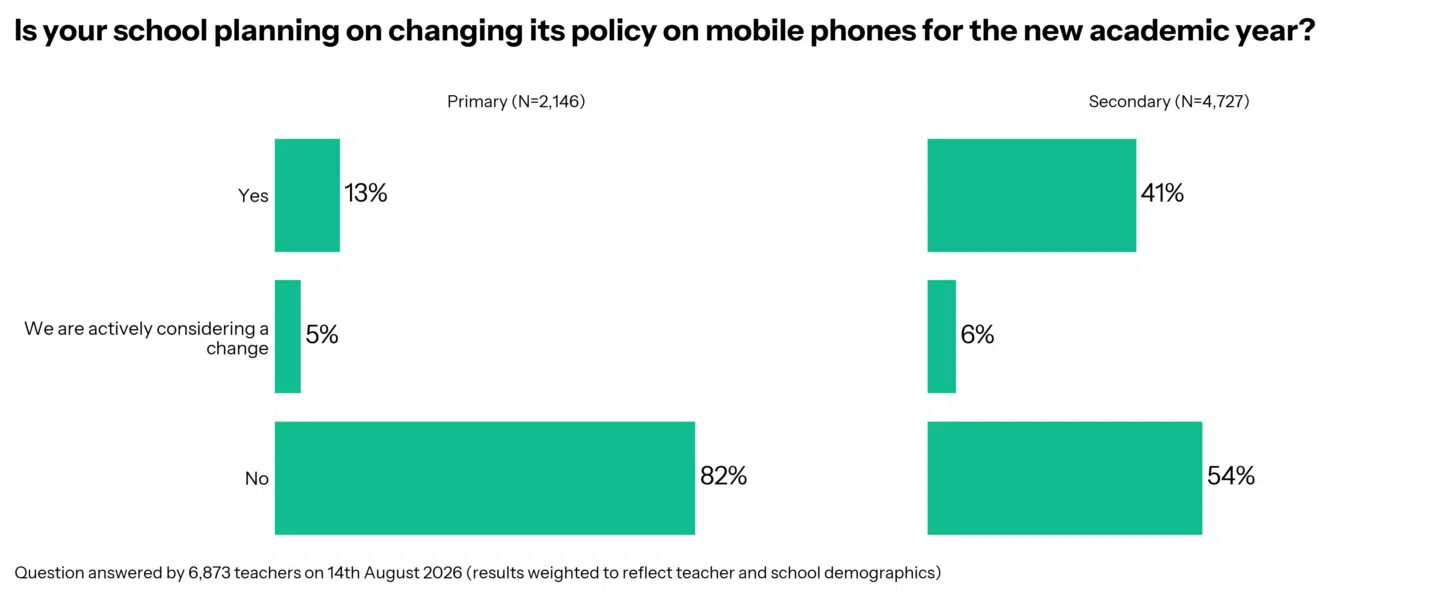
Which schools are most likely to report making a change? Of the 13% of secondary teachers who say their rule is to keep phones out of sight all day unless directed by a teacher, 57% say they have a policy change coming. However, if we take the 18% of teachers who say their school rule is to use pouches or have phones collected, just 16% of that group say they are considering a policy change.
Sorry, I’m late, alien spiders trapped me in the toilet
Almost 1,000 teachers wrote in to share strange reasons students have given for being late.
Animals were mentioned 207 times overall, and that included seagulls, which appeared 13 times; pigeons were cited 11 times; dogs featured in 27 excuses, and cats 13 times!
Food was given as a reason 54 times, only slightly more than the number of times toilet-activity featured (52 times!). Police and the law appeared in 14 separate excuses recalled by Tappers. Other regular themes included tractors (8 times) and spiders (5 times)…and somewhat confusingly, aliens (5 times)!
To read some of the more amusing reasons, check out the special late excuses blog here.
Missing the classroom
Some senior leaders might think classroom life (late excuses and everything) has a lot more appeal than the weight of responsibility of being a senior leader. And it seems those who do are far from unusual: 63% of primary and 54% of secondary senior leaders told us they have wished they were back in the classroom in the past twelve months, with 17% of primary leaders and 11% of secondary leaders reporting they “often” feel like this.
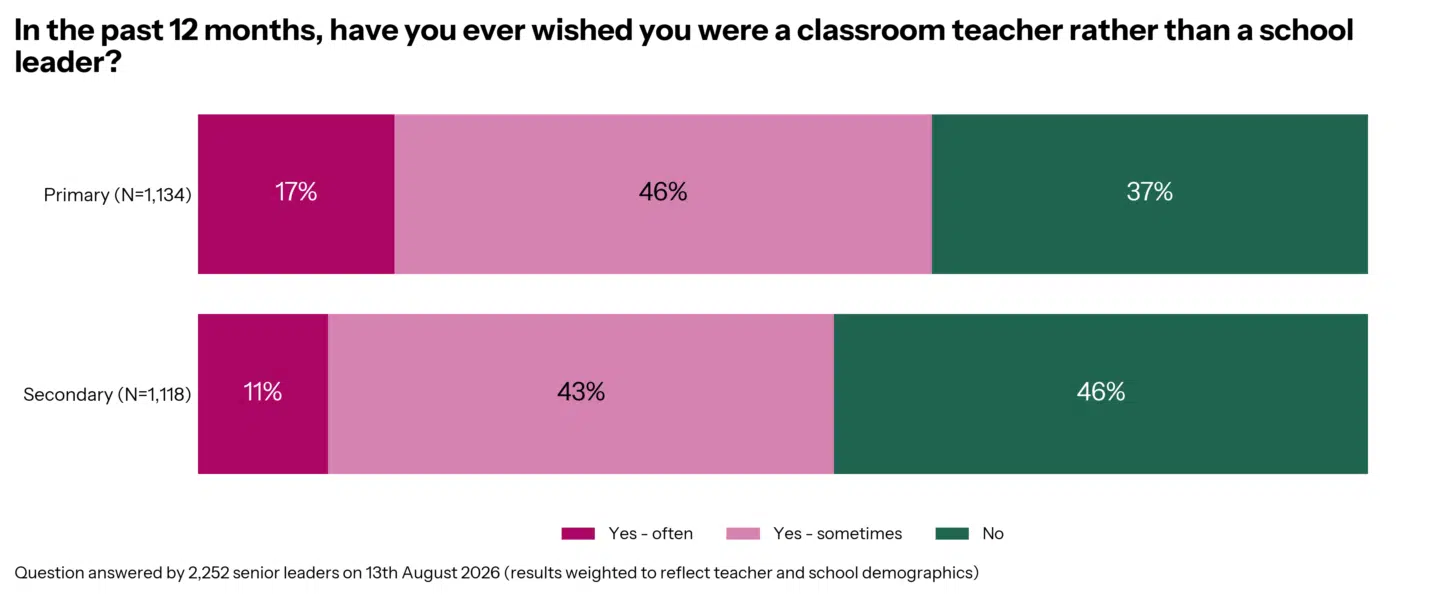
This is more common among senior leaders with a specialism in EYFS/KS1, where 68% of leaders report missing the classroom, and English teachers are the least likely to say they feel this way, with just 45% telling us they have wished they were a classroom teacher in the last 12 months.
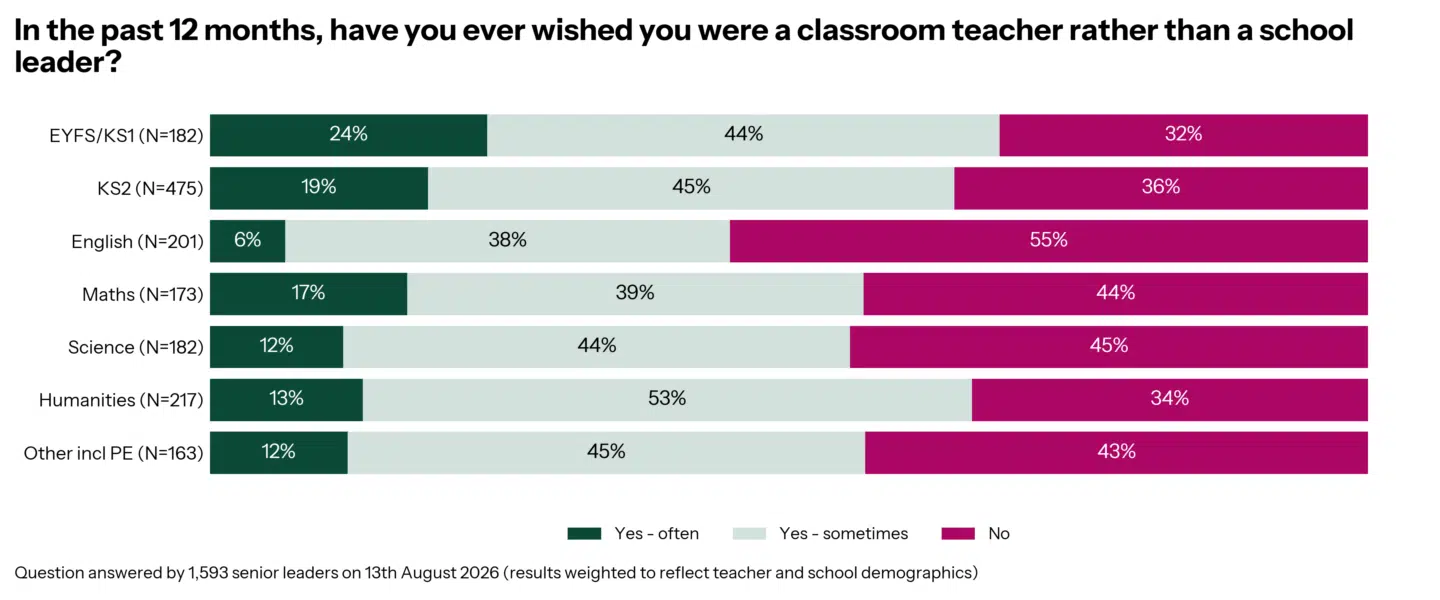
Are senior leaders more or less likely to answer yes to this question compared to previous years? There has actually been no significant change in this data since we first asked the question in 2021!
A Teacher Tapper asked…NPQs
A Teacher Tapper (who is the proud owner of no less than 4 NPQs!) got in touch to ask how many other teachers have NPQs, and which ones were the most common to hold.
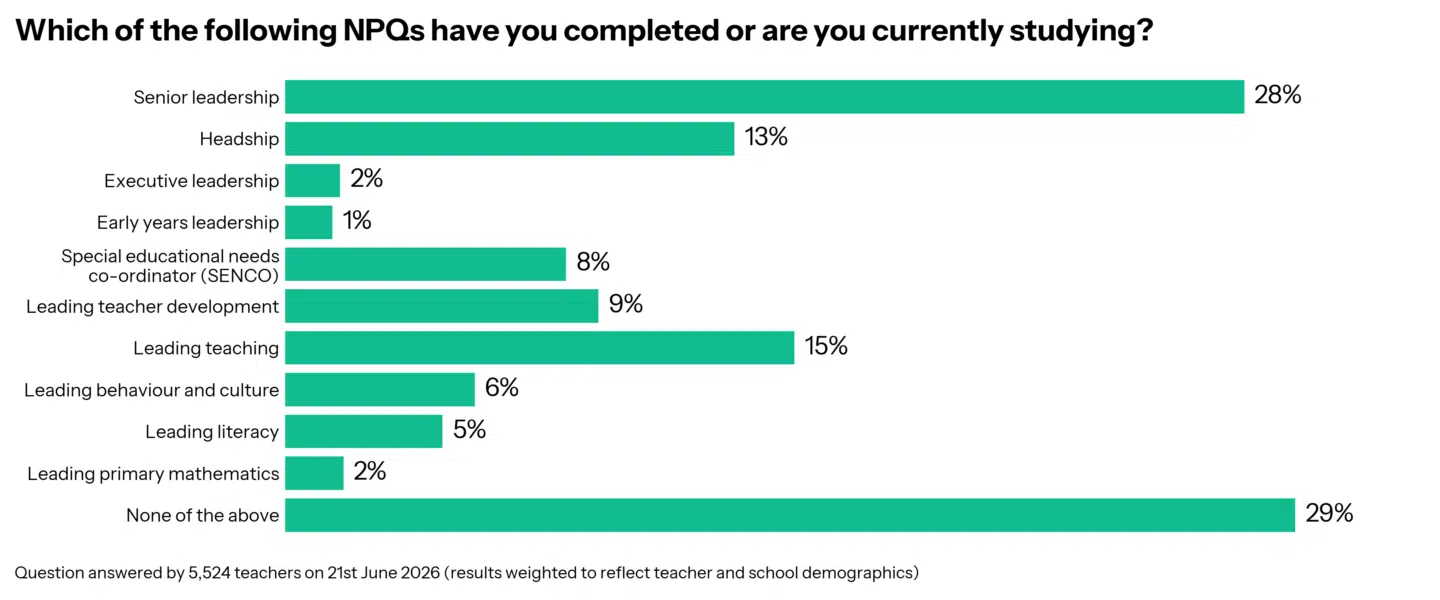
45% of Teacher Tappers told us they haven’t done an NPQ (yet!), but among the 55% who have, 18% have done more than one NPQ.
Some NPQs are more popular than others, with 28% of Tappers telling us they have completed an NPQ in senior leadership, 15% have done one in leading teaching, and 13% have a headship NPQ. 29% have completed NPQs that aren’t on our list, as they have now been replaced with other titles.
If you have a question you would like Teacher Tapp to check, get in touch and let us know! England@teachertapp.co.uk 📧.
The reading habits of teachers
You might have spotted a lot of the questions in the last week started with ‘A Teacher Tapper would like to know…’. This influx is partly down to the number of teachers who requested findings for their September INSET. The most requested topic was reading, and one teacher wanted to know how the reading habits of teachers compared to those of their students.
If this is something you’re also interested in, here is the Teacher Tapp panel’s reading habits so far this holiday!
78% have read a fiction book, 35% a non-fiction book, 4% a graphic novel, 19% a physical magazine, 12% a physical newspaper, 13% an online magazine, 35% an online newspaper. 10% haven’t read any of the formats in the list.
Teachers’ ages reveal very different reading preferences when it comes to newspapers and magazines: teachers in their 50s+ are much more likely than teachers in their 20s to have read a newspaper both physically (20% vs 6%) and online (41% vs 28%). It’s a similar pattern for magazines, with teachers in their 50s+ more likely than teachers in their 20s to have read a magazine both physically (28% vs 11%) and online (15% vs 11%).
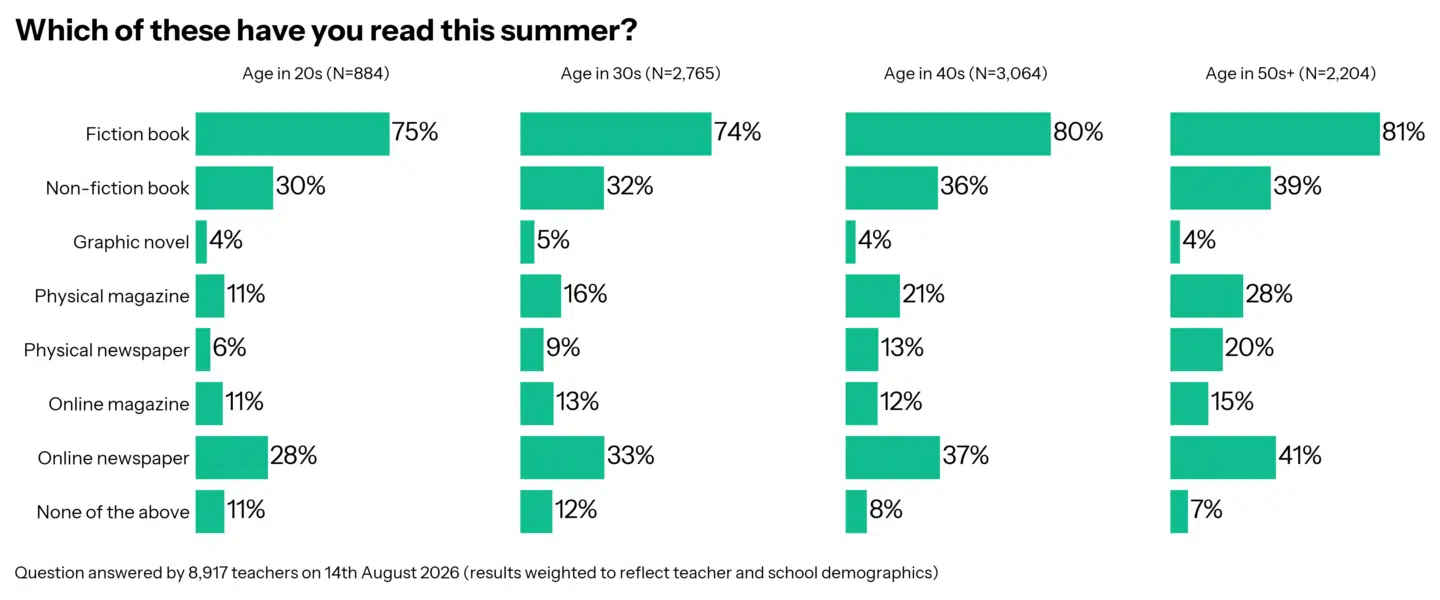
When we break the results down by gender, we also find men are more likely than women to read non-fiction (47% vs 30%), and this doesn’t change when we adjust for age.
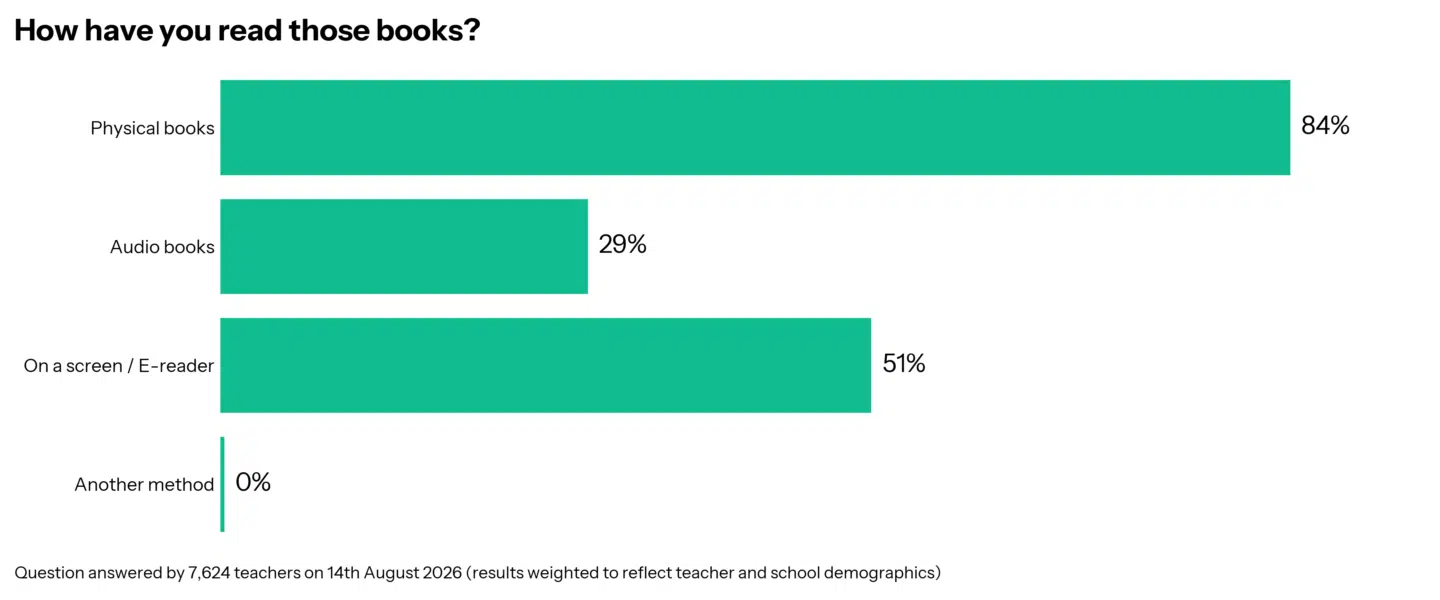
The traditional book is still the most favoured way to read a book, with teachers who told us they had read books this summer most likely to say they read physical books (84%), then e-readers (51%) and then audiobooks (29%).
Ups and Downs of…drinking on school trips
The number of teachers avoiding alcohol on residential school trips has gone UP 51% in 2026, from 43% in 2019.
Over time, the number of teachers who think drinking on a school trip is okay has gone DOWN to 45% in 2026, from 63% in 2019.
Although secondary has more teachers who agree drinking on a school trip is okay overall, this year (55% secondary vs 33% primary), the change in attitude towards alcohol has seen a bigger drop among primary teachers compared to secondary teachers: 33% from 53% for primary teachers vs 55% from 74% for secondary.
Daily Reads
The most-read tip was a controversial take on “turn and talk” that you can read here.
There are so many great blogs out there, and we love featuring them on Teacher Tapp. If you have a blog you think we should feature, please email us at england@teachertapp.co.uk, and we will check it out!