Hey there Tappers
It’s the final run-up to the half-term, but things are still super busy: SATs are over, but preparation for the writing moderation has begun, and GCSEs, A-levels and other external exams continue.
The good news is that we are running a new prize draw (see more details on this at the end of the blog), AND we have plans to share more treats with Tappers at the Festival of Education July 2nd and 3rd! If you’re planning on attending, make sure you come and swing by and collect your special Teacher Tapp merch!
KS2 Sats round-up
We’ve given extra space this week to our KS2 Sats questions – if primary assessments aren’t of interest to you, jump to the next section ⏭️.
Before Sats tests began, we checked in with year six teachers to see if they had completed all their work during timetabled lessons: 15% of year six teachers had “comfortably” completed all the work for SATs during timetabled lessons, 54% had “just about” squeezed it in, and 31% didn’t.
Unsurprisingly, whether or not you’ve covered the content appears to have an impact on your wellbeing: teachers who hadn’t covered all the SAT content were almost twice as likely as teachers who had covered the content to report feeling under strain “all of the time” (16% vs 9%).
And it’s not just the year six teachers and senior leaders who are feeling the impact of Sats: over half of teachers reported losing a teaching assistant or learning support assistant because of the tests (59%).
Maladministration ⛔️
Although the rules around taking KS2 Sats are relatively relaxed when compared to exams taken by older pupils, there are rules about what teachers can and can’t do. We checked to see how many teachers involved in the tests have done things that would count as maladministration, or have been encouraged to do them.
The good news: most teachers (85%) have NEVER done or been encouraged to engage in practice that would count as maladministration.
Of the 15% of HAVE, reports of maladministration included:
- 46% Using a reader or a scribe when that isn’t their normal classroom practice
- 27% Gave extra time
- 26% Sounded spellings in a helpful way (e.g. ex-tin-gu-ish)
- 48% Pointed out an incorrect answer
- 5% Gave an answer to a pupil, and 1% amended papers after they had been completed
- 25% Another type of maladministration
Secondary teachers told us they hear about maladministration via the students, with about a third reporting that a student has told them about teachers breaking the rules: 7% have heard reports of extra time; 26% heard students say a teacher told them the right answer; 24% heard of another incident that counts as maladministration if it were true.
Student distress 😢
Sadly, a large number of teachers once again reported that students reacted badly to the SATs. Overall, more than two-thirds (68%) of primary teachers saw students showing signs of upset or distress because of the tests. This is a similar level to 2025 when it was 66%, but an improvement on 2024, when it was 81%.
Teachers in schools with the most pupils eligible for Free School Meals (FSM) were more likely to report seeing distressed students than those in the least deprived schools (74% vs 59%).
Teachers in schools that ran extra SATs preparation sessions were also more likely to report student distress than those in schools that didn’t (76% vs 68%).
This raises an obvious question: are those extra sessions simply more common in deprived schools, which already show higher distress? The data suggests not. Even among schools with the highest FSM levels, teachers in schools running extra sessions were still more likely to report distressed students than those in schools that didn’t (82% vs 71%).
KS2 Sats and attendance ❎
One big worry for teachers is attendance during the Sats – but how common is it for parents to keep children at home?
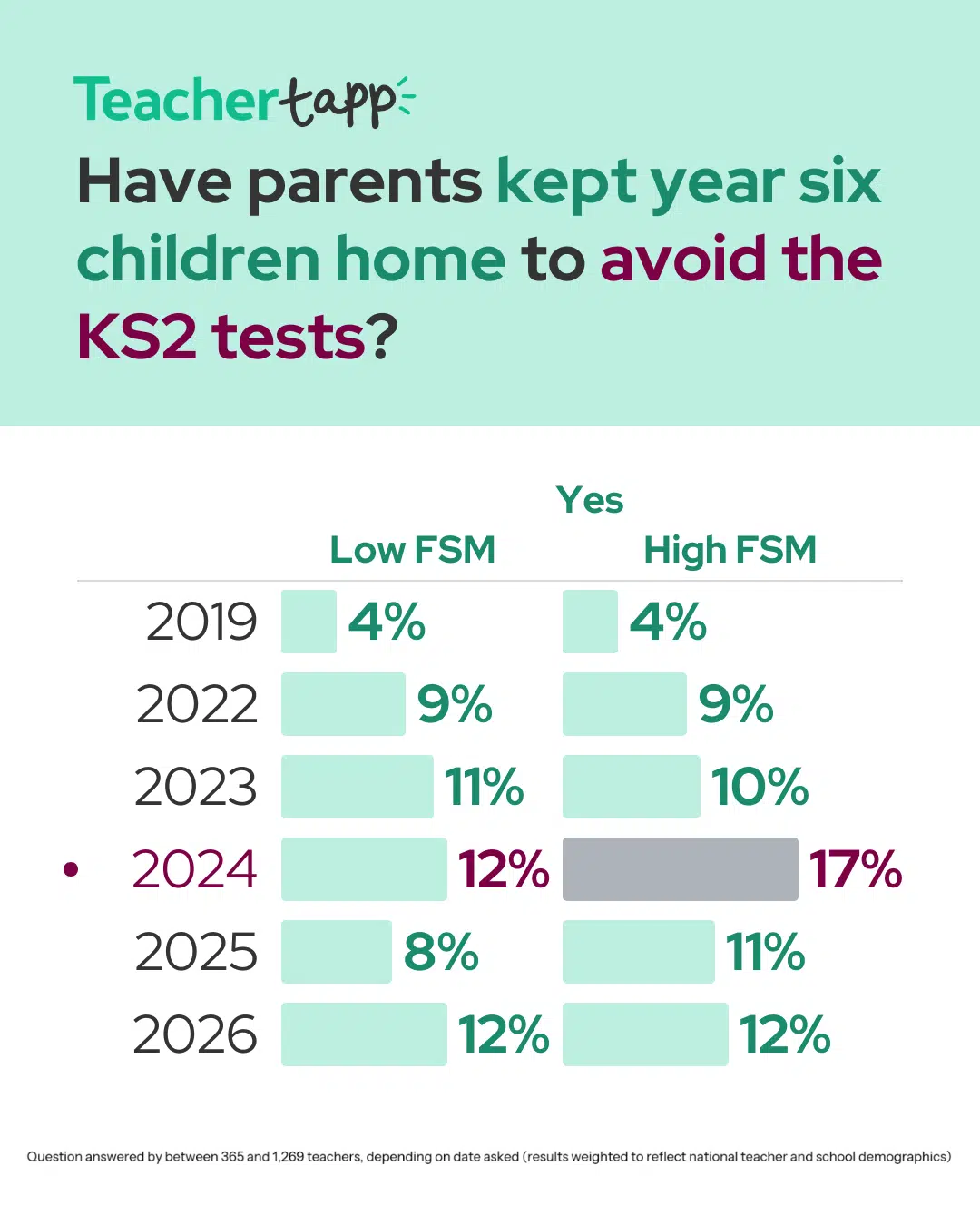
It’s unfortunately relatively common, with over one in ten teachers reporting being aware of students who had been kept home because of the KS2 tests. This is a question we have been tracking pre- and post-pandemic. In 2019, the number of teachers reporting that students had been kept home was much lower, at 4%. After the return, it slowly increased: 9% in 2022; 11% in 2023; 15% in 2024; 10% in 2025; and 12% in 2026.
These figures track with the data from the Department for Education tracking attendance in primary both pre- and post- pandemic. In 2018/19, overall absence in primary was 4.03%, and then after the pandemic rose to 6.26% in 2022/23, and the most recent figures show it to be 5.20% in 2024/25. This speaks to a much larger issue of attendance in school, rather than being isolated to just the KS2 tests.
Between 2019 and 2023, the experience of student absence reported by teachers in schools with lower numbers of students on FSM was very similar to that of teachers in schools with higher numbers of students on FSM. However, in 2024 and 2025, the numbers reporting student absence changed, with teachers in schools with higher levels of FSM becoming more likely to report absence (12% vs 17% in 2024, 8% vs 11% in 2025). However, this year, levels have once again come in line with one another.
A Teacher Tapper asked…have parents voiced screen time concerns?
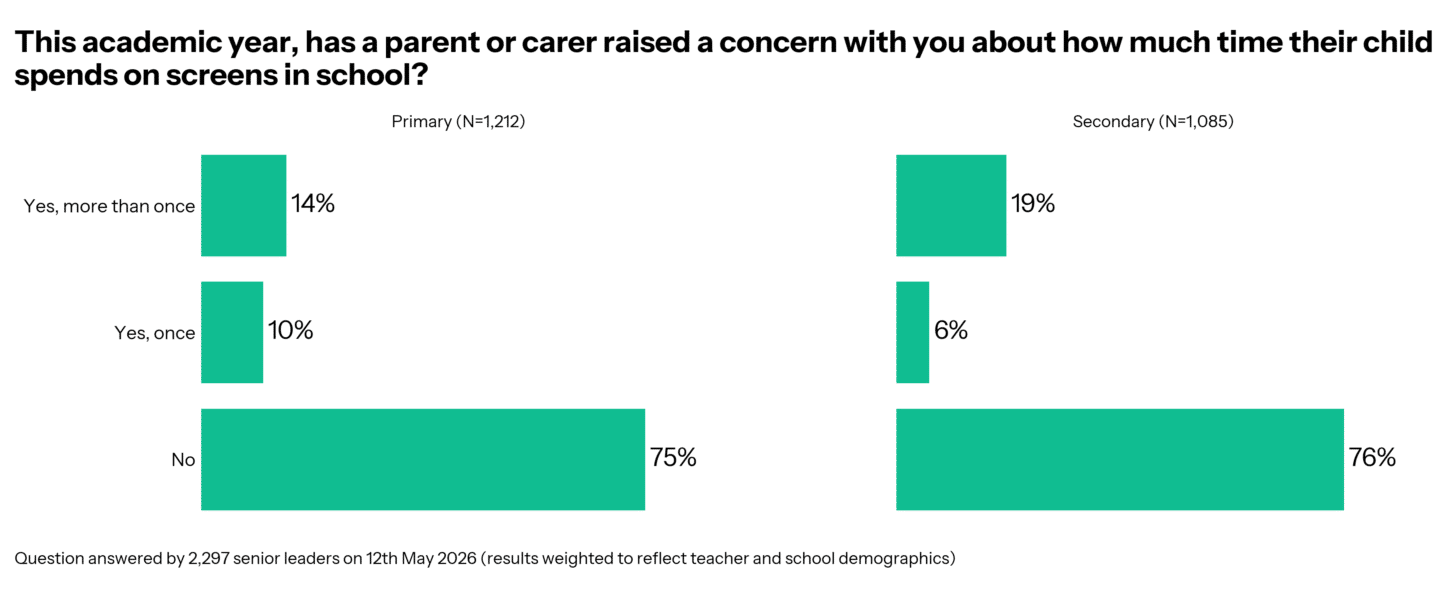
A few teachers have got in touch to ask about parental complaints or concerns regarding the time students are spending on screens at school. All of those who got in touch worked in the primary sector – so initially we were expecting to see a difference between the phases – but the results surprised us!
24% of primary and 25% of secondary leaders reported parents have raised a concern about screen time in school this academic year.
But how much screen time are students getting?
16% of primary and 28% of secondary teachers told us they didn’t use screens AT ALL in their lessons on Tuesday.
Among those teachers who did use screens,
- Almost all teachers reported using projection screens (e.g. IWBs), with EFYS/KS1 teachers the most likely to report using them (92%) and ‘other including PE’ teachers are the lowest (48%).
- EYFS/KS1 teachers were the LEAST likely to report students using 1:1 devices (11%) and this time, ‘other including PE’ is the highest (45%).
- Why is ‘other including PE’ low for projectors but high for 1:1 devices? This is probably because it includes PE teachers AND computing teachers – two groups who behave very differently around technology!
It’s also worth noting there is the usual big divide in state and private experience here: 73% of teachers in private schools used 1:1 devices on Tuesday, but just 26% of state school teachers said the same.
Do you also have concerns about screen time in school? Is there a ‘type’ of screen time you think schools should avoid? Do on-screen assessments like the MTC in primary make it harder to reduce screen time in the classroom? Let us know your thoughts! Email 📧 England@teachertapp.co.uk.
Inappropriate comments
Indulging in a bit of screen time ourselves, we were scrolling through TikTok, and found a video of a teacher giving advice on how to handle inappropriate comments.
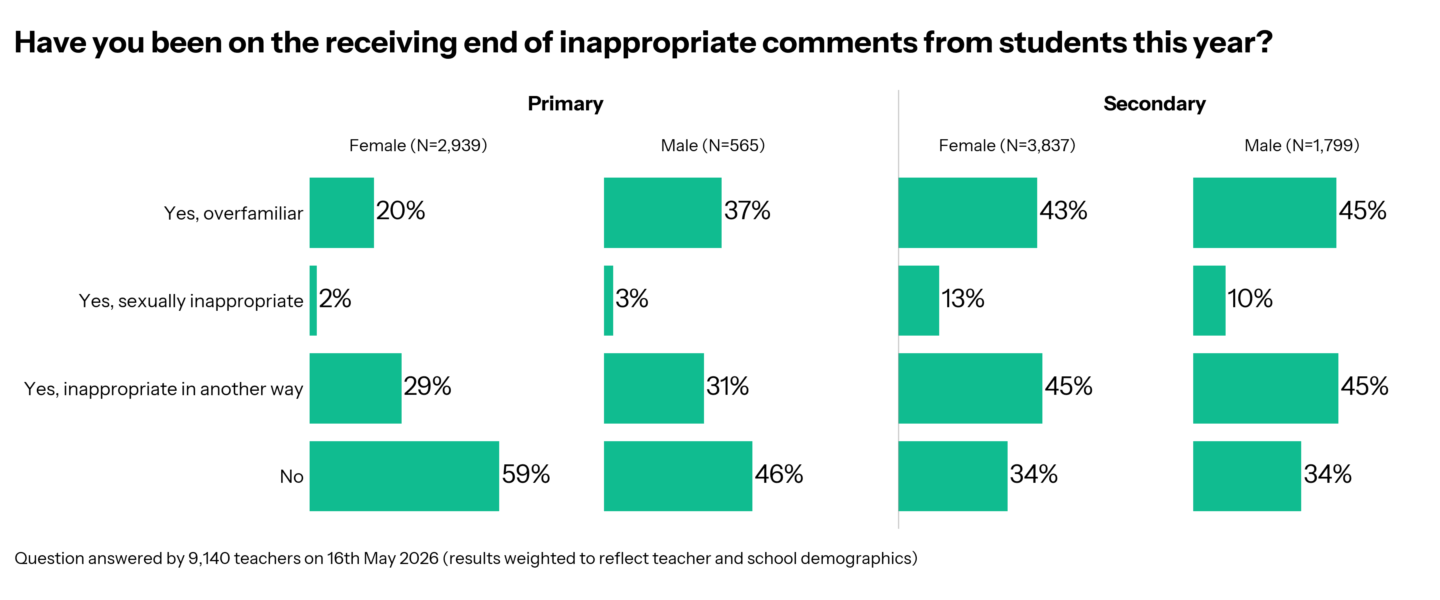
But how many teachers receive these kinds of comments? 55% of teachers have been on the receiving end of inappropriate comments this year, 34% have had over-familiar comments, 7% have been sexually inappropriate, and 37% have been inappropriate in another way.
But is this somewhere that primary and secondary have different experiences? And does being a female teacher make you more, or less likely, to be on the receiving end of these sorts of remarks? In short, yes:
Primary
- 41% of female and 54% of male teachers have received inappropriate comments this year.
- 2% of female and 3% of male teachers say they have had sexually inappropriate comments.
Secondary
- 66% of female and male teachers have had inappropriate comments this year.
- 13% of female and 10% of male teachers say they have had sexually inappropriate comments.
Are there any other groups that appear to experience these sorts of comments more than others? ECTs are TWICE as likely to say they’ve received sexually inappropriate comments, compared to non-ECT classroom teachers (14% vs 7%).
How many teachers report these sexually inappropriate comments? Not everyone: more than four in ten teachers (43%) didn’t report every sexually inappropriate comment they have had this year.
Meeting end time
Another Teacher Tapper question (and one that almost immediately had Tappers jumping into our inbox to ask more questions…) what time do whole staff meetings finish?
Most schools run a whole staff meeting, with just 2% of primary and 8% of secondary teachers telling us they NEVER hold whole staff meetings. Everyone else, in primary, 6% of teachers said they finished at 4 pm or before; 41% reported a 4:30 pm finish time and 43% a 5 pm finish time, and 9% reported 5:30 pm or later.
In secondary, the picture was a little different: 14% reported meetings finished before 4 pm, 15% finished at 4 pm, 44% finished at 4:30 pm, 19% finished at 5 pm, 8% finished at 5:30 pm or later.
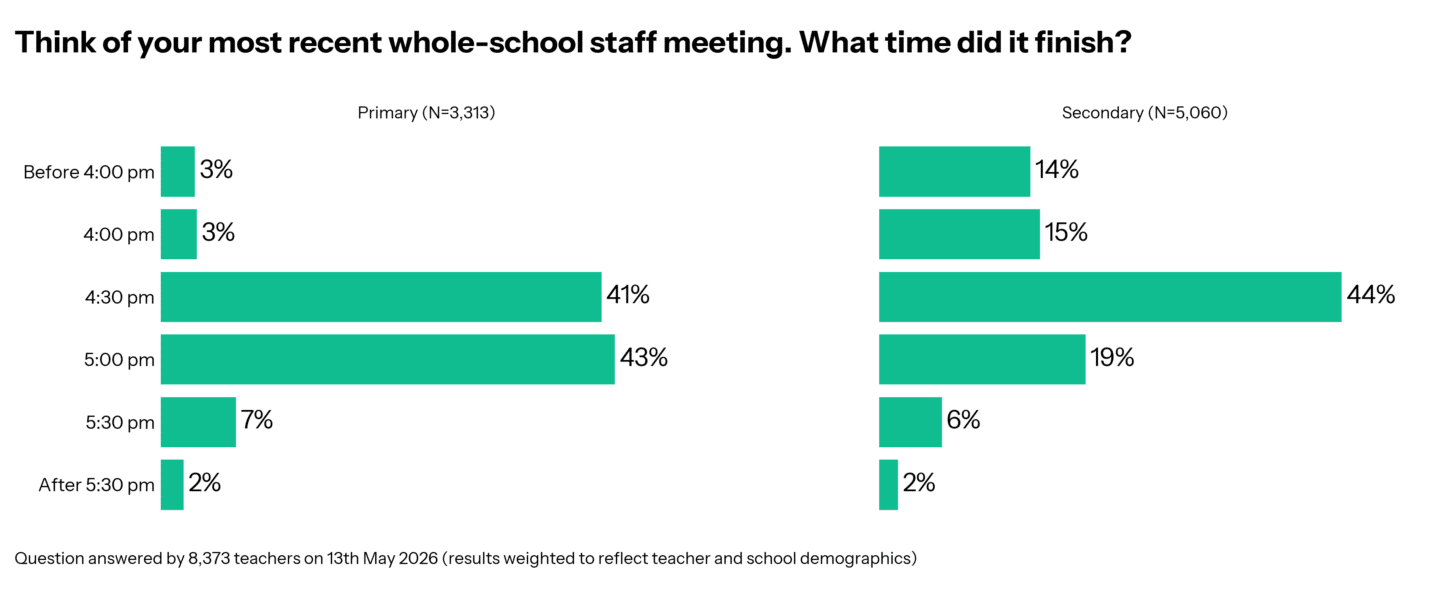
The next question to answer is about the frequency of meetings – are those having earlier finishes meeting more regularly, or does the early finish speak to a commitment from leaders to reduce meeting time? Expect more meeting questions to pop up over the next few weeks…
Return of the prize draw 🤑
🎉 As we mentioned at the start, our prize draw is back for May – and once again, there are no ticket codes to worry about!
If you tap at least once between 1 – 31 May, you’ll automatically be entered. The winner will see a message in the app from 2 June.
And there’s more: any Teacher Tappers who have the same school listed in their profile as the winner, and who also tapped between 1–31 May, will receive gift cards too.
Will we see even more winners this month? 🤞 You can check the full terms and conditions here.
Daily Reads
Top blog this week was all about feedback! 11% of ECTs and 8% of non-ECTs gave it a read 💚.
There are so many great blogs out there and we love featuring them on Teacher Tapp. If you have a blog you think we should feature, then please email us at england@teachertapp.co.uk and we will check it out!