Hey there Teacher Tappers!
Happy holidays! A third of Tappers told us they have already bumped into students while out and about, and of that third, 80% said hello, 7% avoided speaking to them, and 13% did a mixture of the two.
Prize draw winner time!
The winning Tapper has a message in their app alerting them to their prize! Be sure to open your app and check if it’s you! You can read the full Ts and Cs here.
Not the lucky one this time? Don’t worry! We have a new prize draw coming soon…
Education vocational shake-up
Education is all over the news following the government’s announcement that vocational qualifications will be reformed.
The plans don’t have many details so far, but the idea is that from Year 10, students will have the option to study vocational qualifications alongside GCSEs in English and maths. Part of the push behind these plans is to tackle the high number of young people who are not in education, employment or training (NEETs). Data published this year showed more than one million young people across the UK fall into this category, the highest level in more than 12 years.
How do teachers feel about this announcement? 24% said they hadn’t yet seen the plans, but among those who had, 67% felt positive, 23% felt neutral, and 10% felt negatively about the plans.
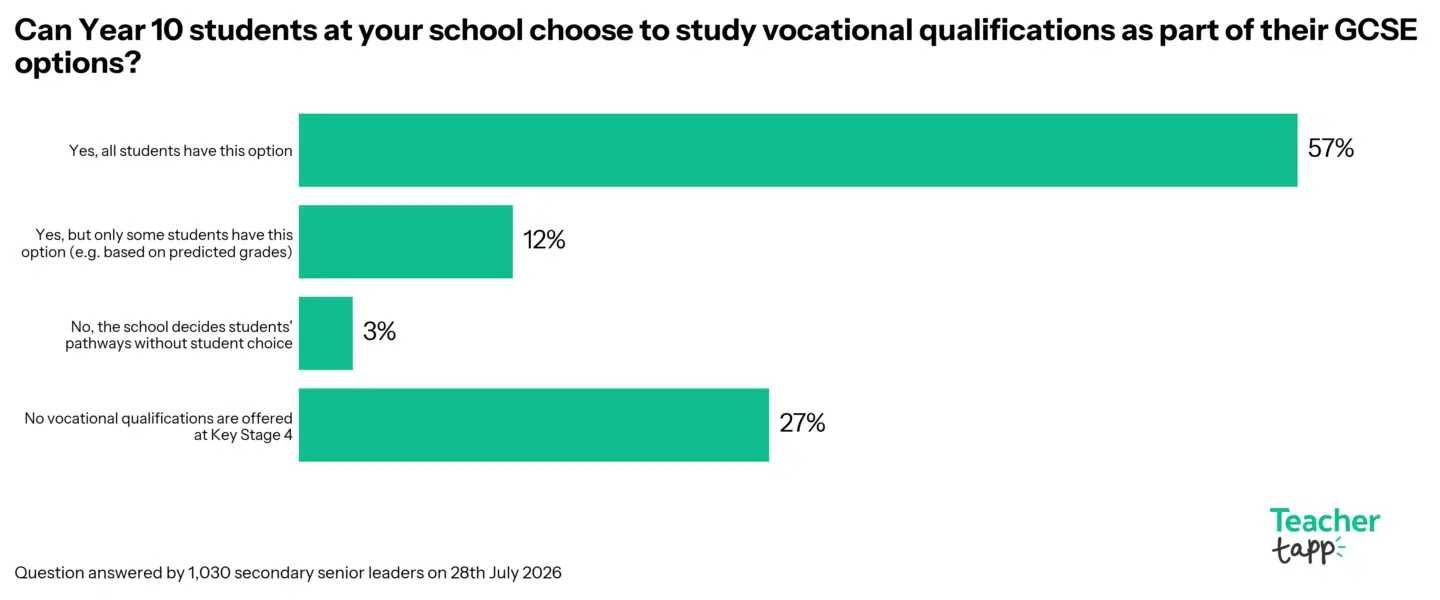
How many students currently have the option to choose vocational qualifications in Year 10? 57% of secondary leaders reported that this is the arrangement at their school. 12% only give this option to certain students, and a further 3% restrict it further by selecting students themselves to study these qualifications. However, for some, there is no option at all, with 27% of secondary leaders saying they have no vocational qualifications offered at Key Stage 4.
The next questions are for the Department for Education to answer: how will these courses be delivered? And what might it mean for the teachers of subjects other than English and maths? If you think of a question you would like Teacher Tapp to put to its teachers, please get in touch England@teachertapp.co.uk 📧.
Is evidence-based CPD perceived to be more useful?
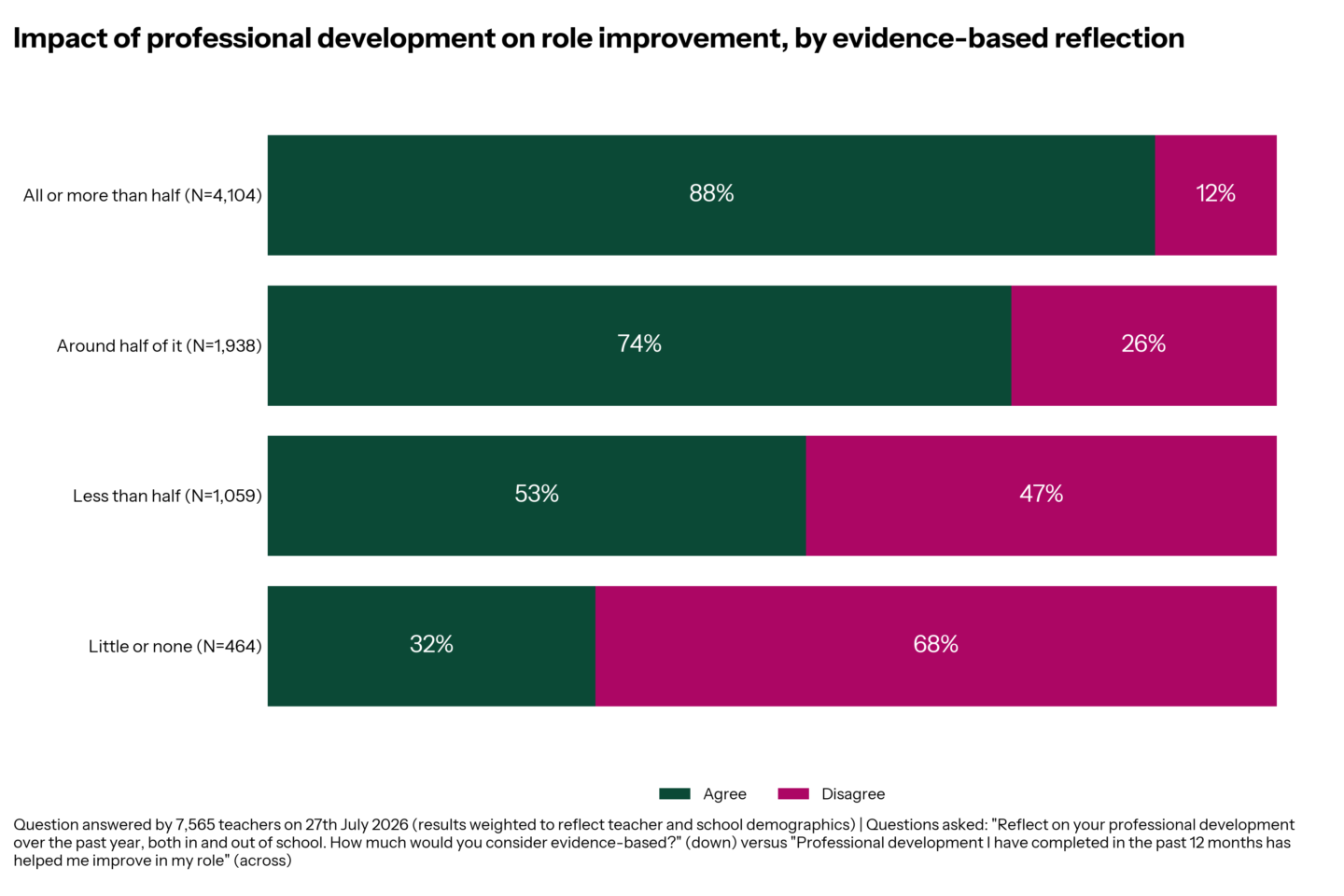
Two weeks ago, we shared the finding that more teachers reported either “all” or “more than half” of their CPD that year had been evidence-based. Since we began asking this question in 2017, the percentage of teachers reporting that “all” or “more than half” of their professional development was evidence-based has doubled from 23% to 49% in primary, and from 20% to 53% in secondary.
On social media, this provoked some discussions about the quality of the CPD, and whether or not teachers had found their CPD useful for their role.
Every year, we have also asked teachers if they have found their CPD useful for their role, and the not-so-great news is that since Teacher Tapp first asked the question in 2021, the percentage of teachers telling us their CPD has been useful has dropped from 87% in 2021, to 76% in 2026.
But what is the link between those teachers who say their CPD was evidence-based and those who say they found it useful?
The good news is that teachers who say their CPD this year has been evidence-based are much more likely to say their CPD was useful for their role, when compared to teachers who say only “little or none” of their CPD was evidence-based (88% vs 32%).
A Teacher Tapper asked…girls playing cricket
Last week we shared our Teacher Tapper data on girls playing football – and a sharp eyed Tapper pointed out we had missed cricket off our list of sports!
We have lots of cricket fans here at Team Tapp, so we decided to deep dive into this topic! 🏏
First off: are there school cricket teams for girls and boys to play on?
In primary, the numbers are pretty similar: 22% of primary teachers told us their school had a team for boys to play on, and a similar number (20%) said the same was true for girls.
When we get to secondary, things change. Here, 55% of teachers say their school has a team boys can play on, but just 33% said their school had a team girls could play on.
Playing cricket at lunch
When we asked if teachers saw boys playing cricket at lunchtime, 24% of primary teachers told us they saw them playing (from ‘sometimes’ to ‘every day’); secondary teachers were less likely to say this happened at their school, with 19% giving the same response.
When we asked about girls playing cricket, 17% of primary teachers reported they saw girls playing (from ‘sometimes’ to ‘every day’); again, this was much less common in secondary, when just 7% of teachers reported the same observation.
Does having a team make a difference?
Do teachers in schools WITH cricket teams see a difference in whether or not the game is played in the pupils’ free time? The answer appears to be, a hard yes.
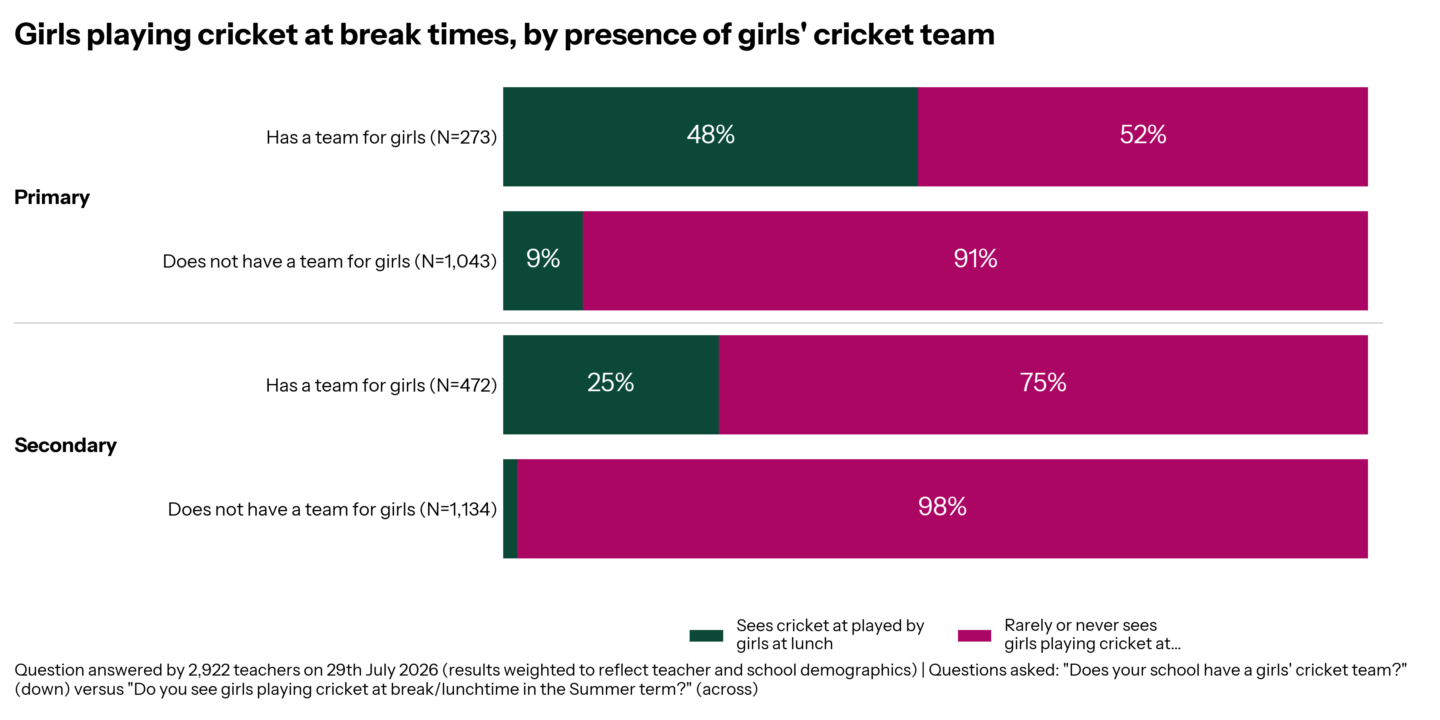
In primary schools with a cricket team for girls, 48% of teachers say they see cricket being played by girls at lunchtime. This drops to just 8% in schools without a team for girls.
In secondary schools, 25% of teachers in schools with a cricket team for girls say they see cricket being played by girls at lunchtime. This drops to 1% in schools without a team for girls.
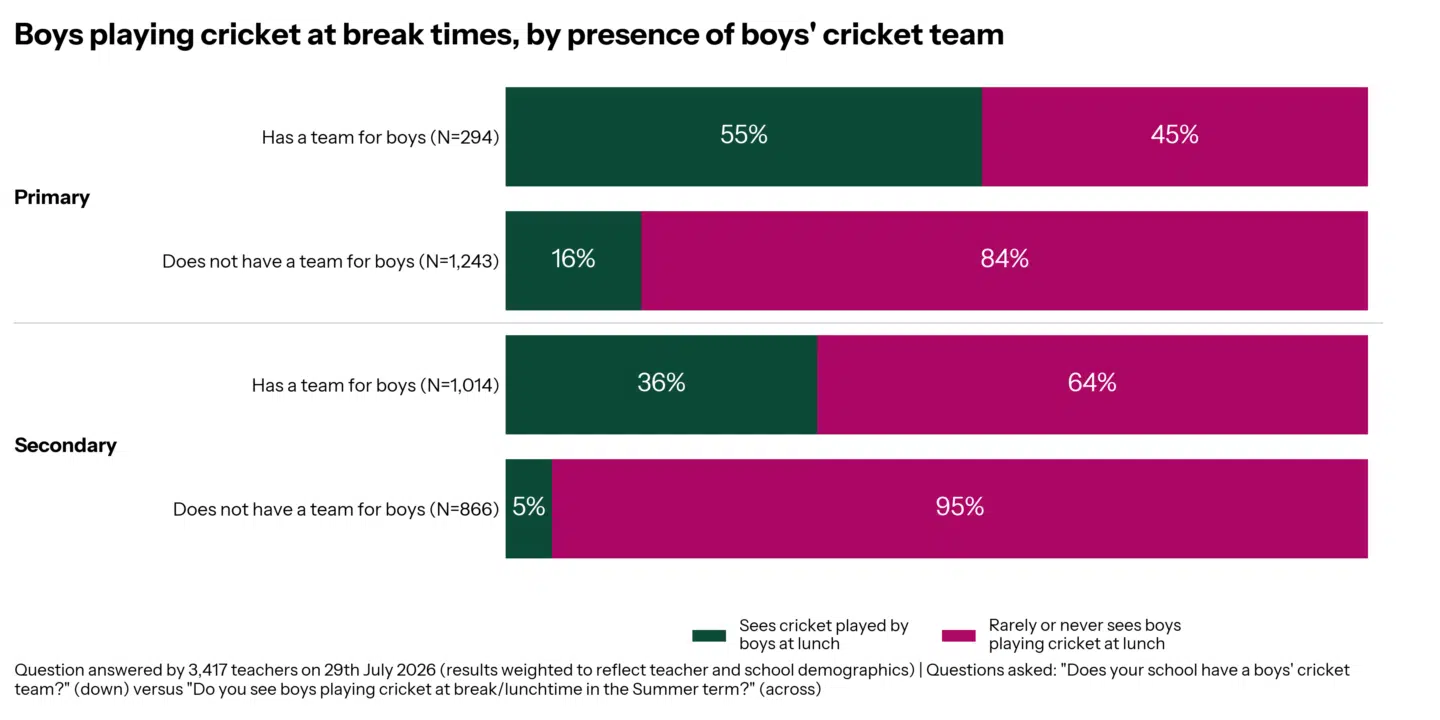
Boys see a similar pattern: 55% of teachers in primary schools WITH a team see boys playing cricket, but in schools without a team it’s just 16%.
In secondary, 37% of teachers in secondary schools WITH a team see boys playing cricket, but in schools without a team it’s just 5%.
Negativity about male primary school teachers
When Teacher Tapp has been out and about at summer teaching conferences, we have been playing our ‘Higher or Lower’ game, using our Teacher Tapp stats. One finding has prompted strong reactions: male primary school teachers who have had negative comments about being a male primary school teacher. We thought it was worth digging a bit more into the data:
Male primary Tappers were asked:
- Have you had negative comments about being a male primary school teacher?
- Have you had someone assume a female colleague was more senior to you?
And female primary Tappers were asked:
- Have you had someone assume a male colleague was more senior to you?
- Have you had negative comments about being a female primary school teacher?
17% of male primary school teachers had negative comments this last academic year, and 25% have had comments in previous years. This is in line ↔️ with what was reported last year, when 18% said they had negative comments in the 2024/25 academic year.
For female primary teachers it was much less common, with 8% reporting negative comments this year, and 12% in previous years.
When it comes to assuming a colleague is more senior, 13% of male primary teachers had experienced someone assuming a female colleague was more senior, however 28% of female primary teachers had experienced someone assuming a male colleague was more senior. This is UP ⬆️ from 20% when we asked last year.
Sharing personal information with colleagues
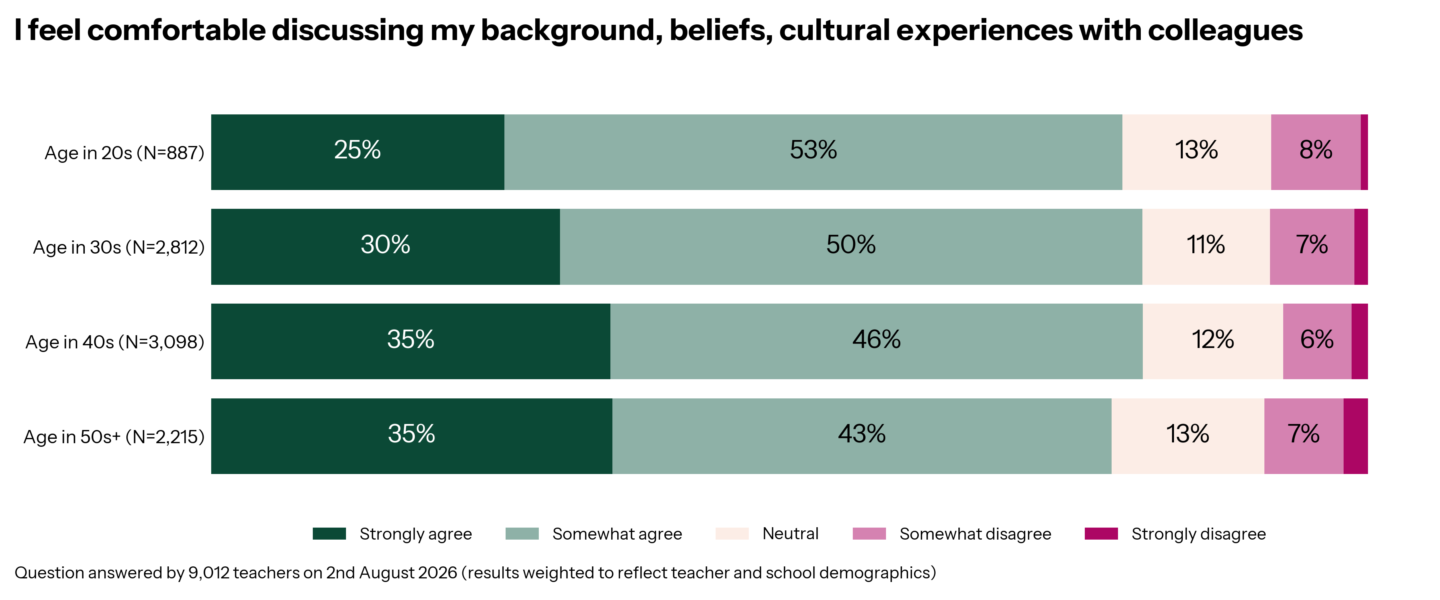
This week, a Tapper wrote in to ask if older teachers were less likely to feel comfortable discussing their background, beliefs and cultural experiences with colleagues. Her theory was that as people got older, they felt more “circumspect” about opening up.
78% of teachers in their 20s strongly agree, compared to 80% of teachers in their 30s and 81% in their 40s. When teachers hit their 50s, the steady increases halt, and drops to 78%.
Do you have a different theory to explain this difference? And do you think the workplace is somewhere people should be sharing lots of personal information? Does it matter to you if you work somewhere where these conversations are had, or do you prefer to keep things professional – even at social times? Let us know by writing to England@teachertapp.co.uk 📧 or finding us on TikTok or Instagram @TeacherTapp 📱.
Daily Reads
The most-read tip was all about summer reads! I’ve already added lots to my reading list – it’s a great compilation
There are so many great blogs out there and we love featuring them on Teacher Tapp. If you have a blog you think we should feature, then please email us at england@teachertapp.co.uk and we will check it out!