Hey there, Teacher Tappers!
For some Tappers, this week marks the start of Christmas prep: nativities, carols, productions, crafting days… there is a LOT to pack in before the end of term. If you’re a lover of the festive season, then perhaps this is the best part of the year for you; if not, then we send our sympathies.
This week’s blog is PACKED – so we will jump straight to the breakdowns:
Disruption to learning
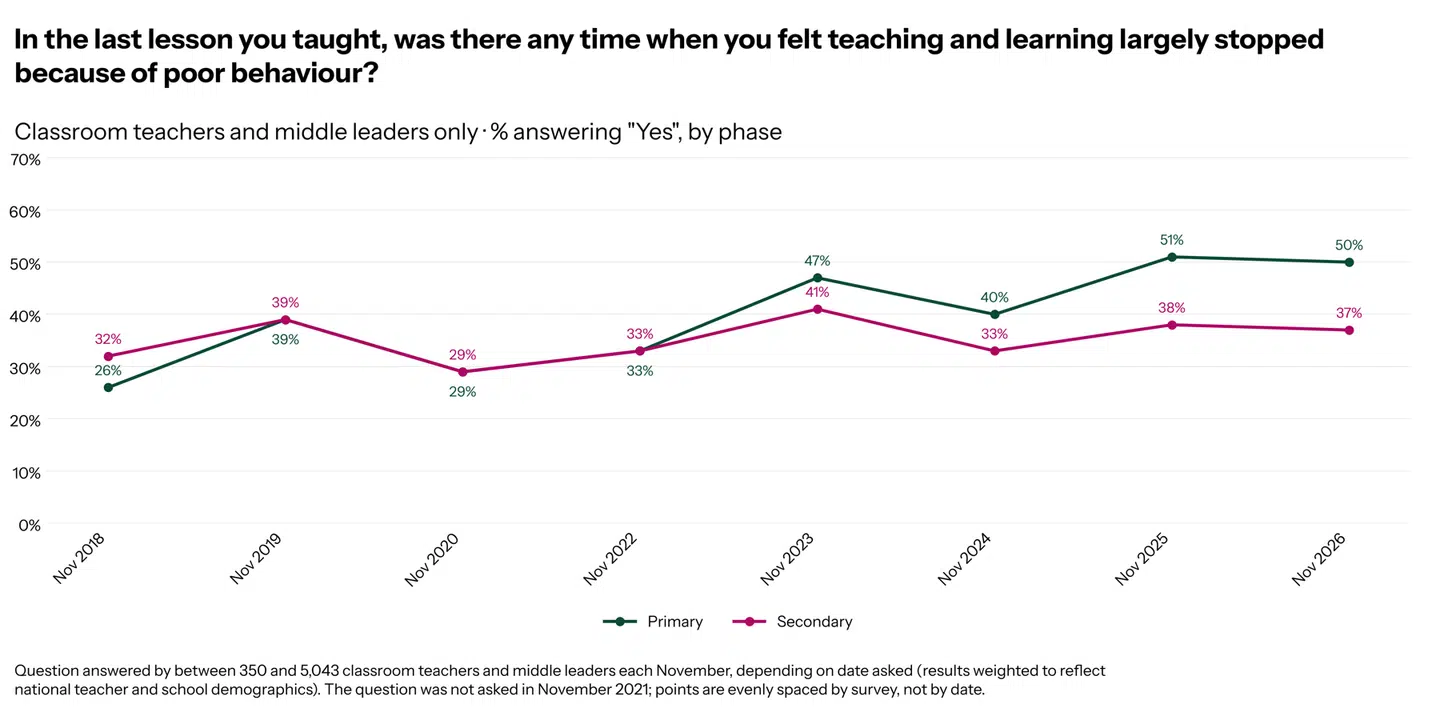
It’s that time of the month again: did teaching and learning stop altogether because of poor behaviour? Looking just at classroom teachers and middle leaders, 50% of primary teachers reported lesson-stopping disruptions, and 37% of secondary teachers said the same. This is broadly in line with November 2025, when it was 51% and 38%, respectively.
Last year, there had been a dramatic rise compared to the previous November, when 40% of primary teachers and 33% of secondary teachers said the same, a rise of 11 percentage points, or a 28% increase among primary teachers, and a rise of 5 percentage points, or a 17% increase among secondary teachers.
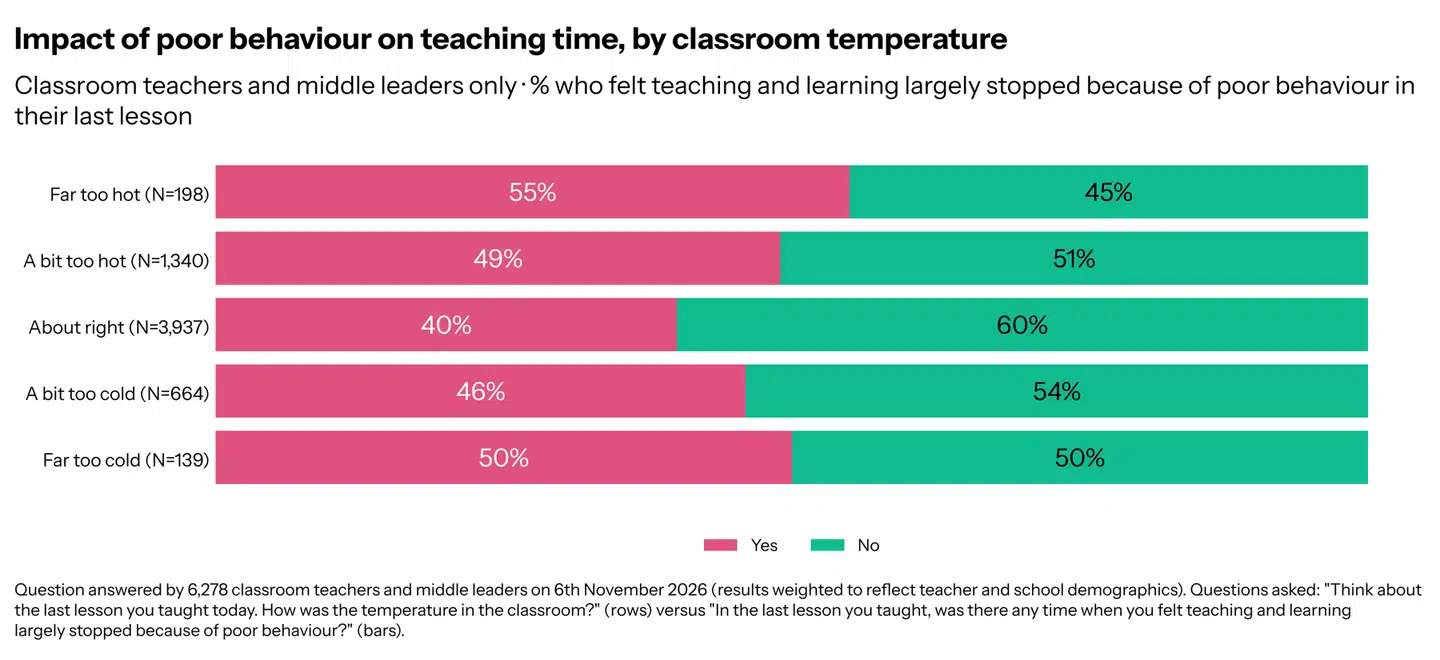
Looking just at November 2026, we continue our attempt to track whether classroom temperature impacts classroom behaviour. Classroom teachers and middle leaders in classrooms they describe as “far too hot” are much more likely to report disruption when compared to those in rooms that are “about right” (55% vs 40%). Similarly, teachers in classrooms that are “far too cold” are also more likely to report poor behaviour compared to the “about right” teachers (50% vs 40%).
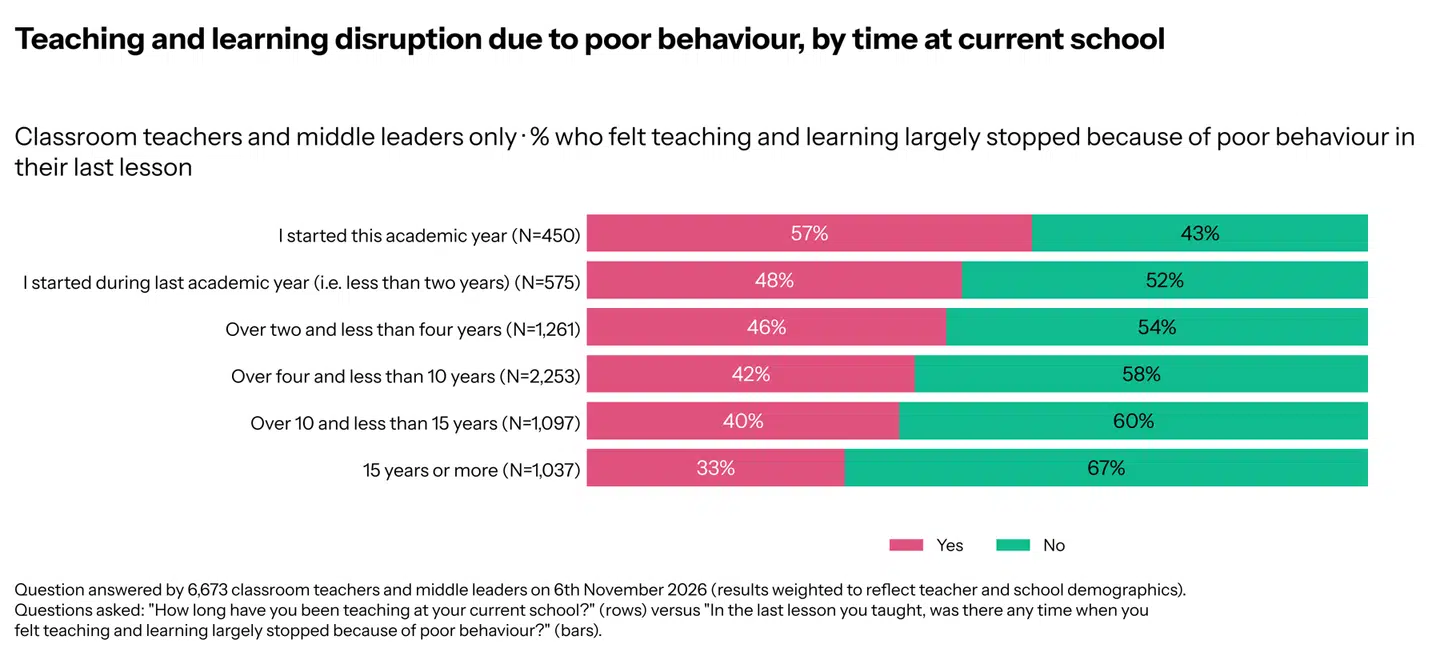
Temperature is one thing, but what about how long you have been teaching at a school? Unsurprisingly, the longer you have been teaching at a school, the less likely you are to experience poor behaviour. The really interesting part of this finding is that this isn’t just true for teachers with extra seniority in a school: the chart below is made up of just classroom teachers and middle leaders. Of the teachers who started at their school this academic year, 57% experienced disruption; of the teachers who started during the last academic year, 48% experienced disruption, and things are much better for those with 15 years or more of experience at their current school, as only 33% experienced disruption.
Screen time in schools
Once again, screen time and schools have been making headlines – but really how much time do students spend on screens in school?
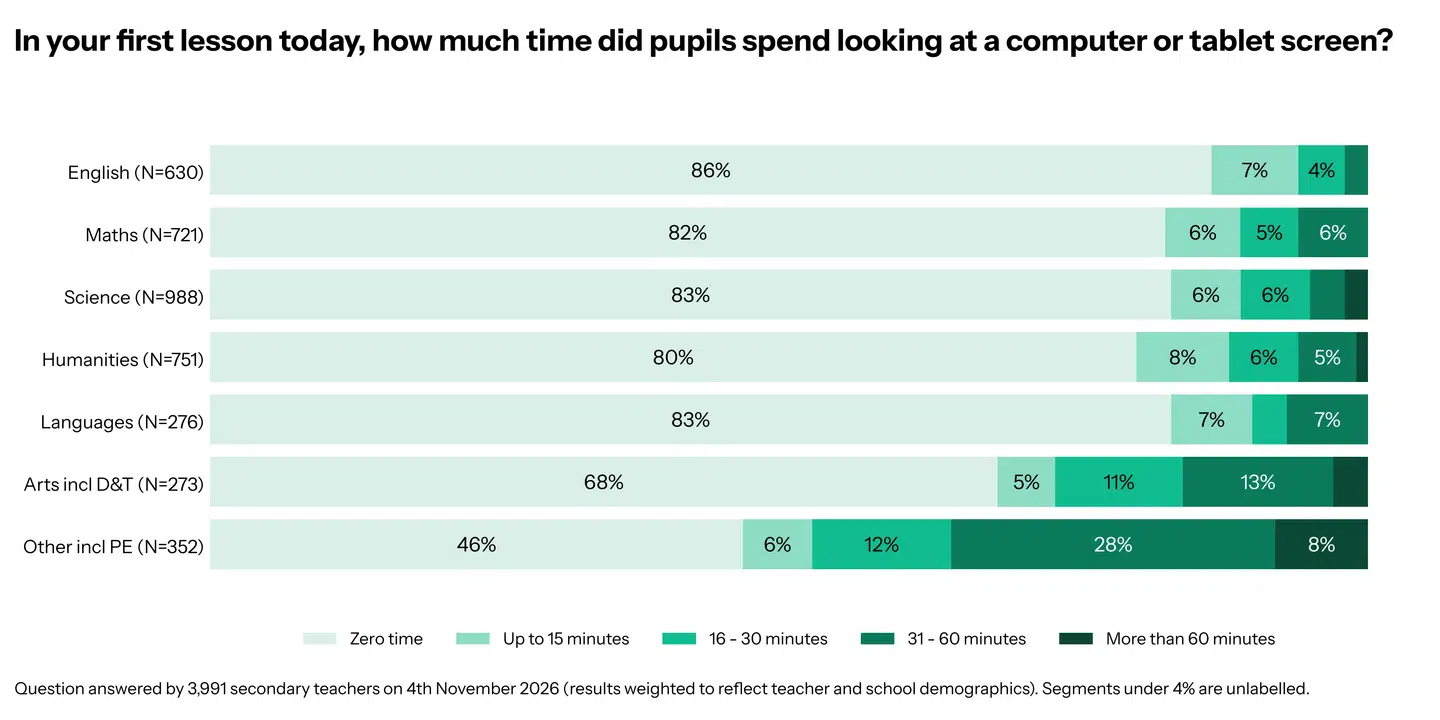
Most secondary school teachers (excluding senior leaders and headteachers) reported no screen time at all in their first lesson. 86% of English teachers reported zero hours, as did 82% of maths teachers, 83% of science teachers, 80% of humanities teachers, 83% of languages teachers, 68% arts (inc D&T) teachers and 46% of other inc PE teachers.
Using these figures and making a really rough guess – an average secondary school student has around 20-50 minutes of computer or tablet time a day (with lots of caveats: we only asked about the first lesson, and the ‘Other inc PE’ includes computing teachers, so whether or not PE or computing falls on that day makes a big difference).
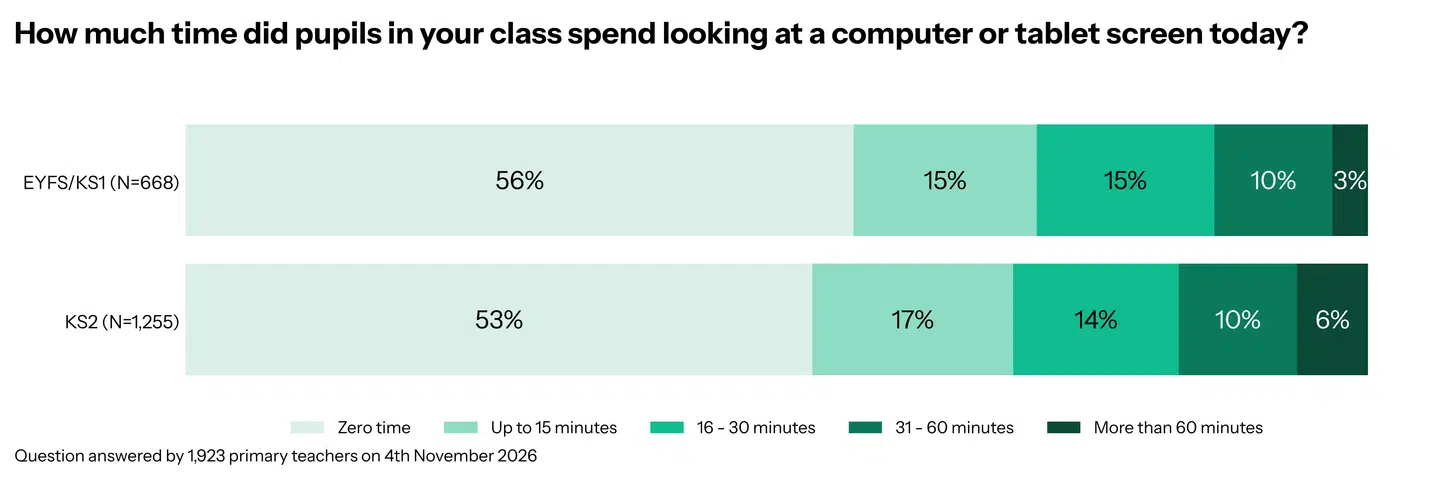
When we asked primary teachers, we posed the question so it asked about computer or tablet use across a whole day. And, like their secondary counterparts, most teachers reported that their students have no time on screens (56% in EYFS/KS1 and 53% in KS2).
15% of EYFS/KS1 teachers said their pupils had up to 15 minutes across the day, 15% between 16 and 30 minutes, 10% between 31 and 60 minutes, and only 3% more than 60 minutes.
17% of KS2 teachers said their pupils had up to 15 minutes across the day, 14% between 16 and 30 minutes, 10% between 31 and 60 minutes, and only 6% more than 60 minutes.
Homework on devices
From screen time at school to screen time at home…
When it comes to completing homework, there can be all kinds of excuses for why it hasn’t been done. But is internet access one of them?
First off – not everyone is setting homework that requires a device or internet: 45% of primary teachers and 12% of secondary teachers reported that in the last month, they have not set homework that required a device or internet access at home.
Among those who do set homework that required either a device or internet access, we found:
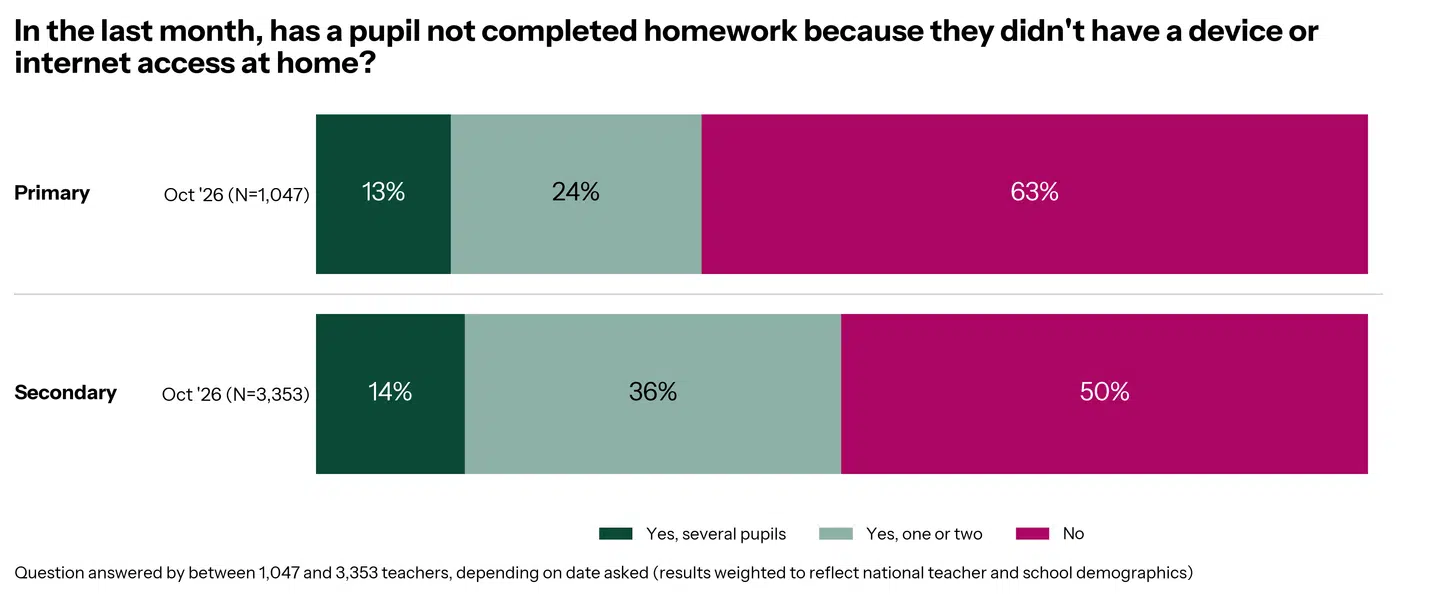
- 37% of primary teachers and 50% of secondary teachers reported that at least one student hasn’t completed homework due to a lack of access to a device or internet access at home.
- 13% of primary and 14% of secondary teachers said this had happened for multiple students.
Unsurprisingly, if we break this down to look at the differences in responses by the proportion of pupils on Free School Meals in that school, we find:
19% of primary teachers in schools with the highest levels of deprivation report that multiple students have been unable to complete homework due to a lack of internet or device access, vs 6% reported by teachers in the most affluent schools.
In secondary, the gap is even wider: 31% of secondary teachers in schools with the highest levels of deprivation report that multiple students have been unable to complete homework due to a lack of internet or device access, vs 7% reported by teachers in the most affluent schools.
Parent notifications
A quarter of leaders in schools told us they require parents to use 3 or more apps or platforms for their communications and notifications, 42% require 2, 30% say parents only need one, and just 3% say none are needed.
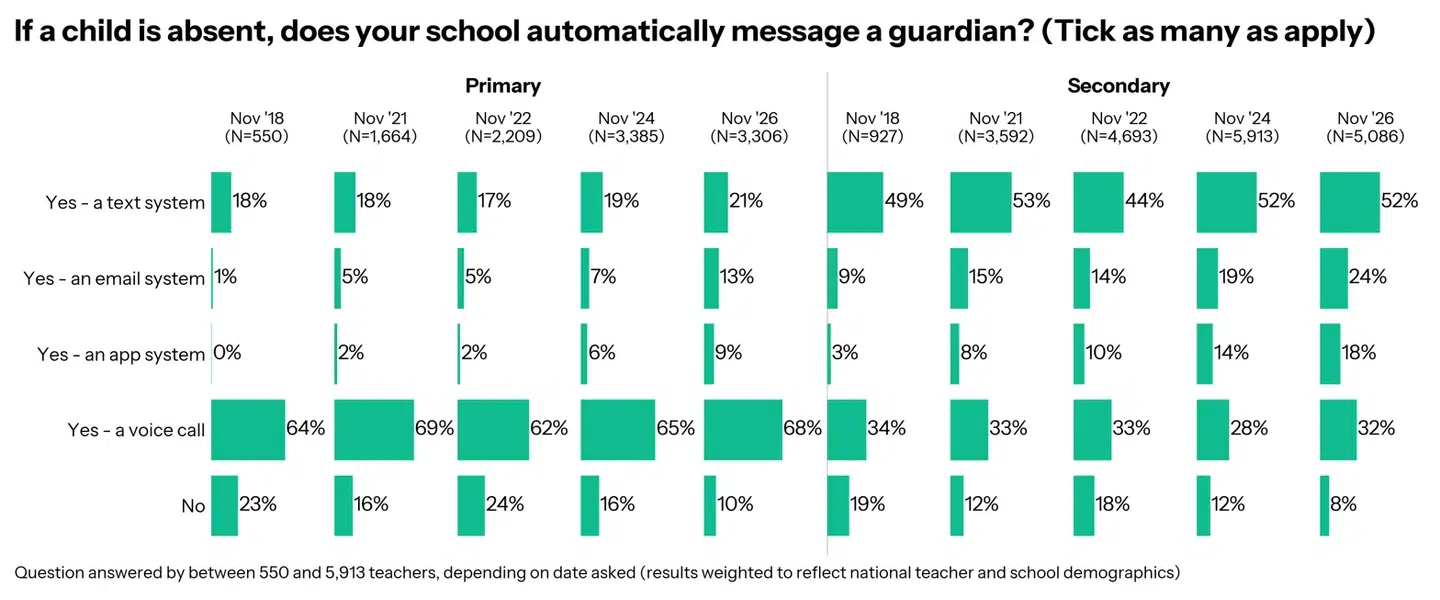
One use of these apps is to send notifications if a pupil is absent. 9% of primary teachers say their school uses an app to notify parents, up from 0% in November 2018. 18% of secondary teachers say their school has an app notification for absence, up from 3% in 2018.
Technology for communication in schools seems to be changing all the time, and we have had a few requests for questions about how AI is being used for parent communications. If you have suggestions for others, please email England@teachertapp.co.uk.
Friendships at work are great, but…
Friendships at work can make a tough day bearable. They lift you up when your workload is getting you down; they can be the person you need to bounce ideas off; sharing teaching ideas can help cut planning but also genuinely improve your own teaching practice. Really, I cannot say enough about how great it is to work in a school with people whom you also like and respect and want to spend time with.
However. When it comes to morale in school, friendships are nice, but leaders who listen are even better.
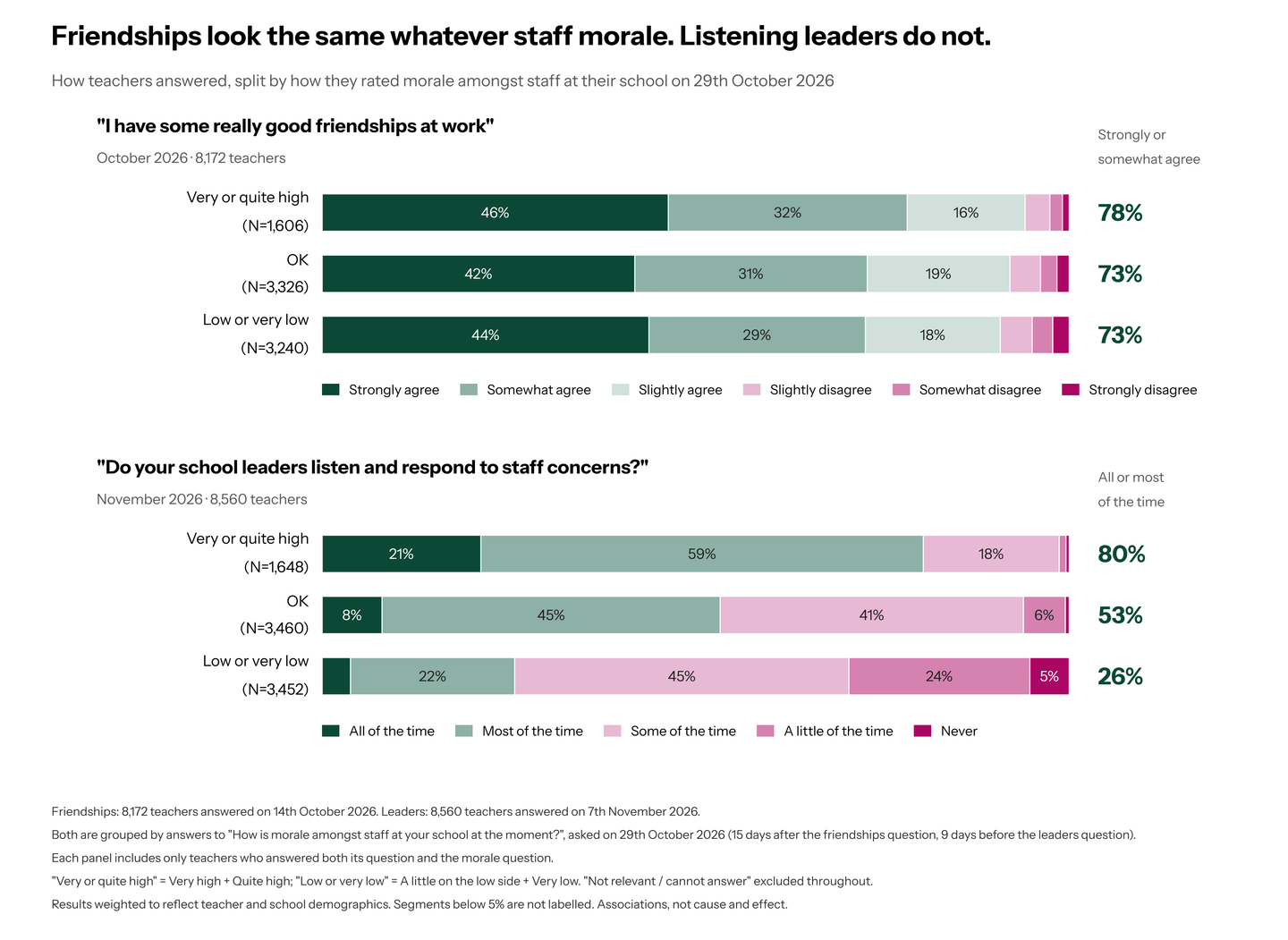
We have three questions we looked at to analyse how much of a difference friendships make to morale, compared to those who feel their leaders listen: one question on friendships at work, one question on leaders who listen, and a final question asking about morale in school at the moment. All of these questions were posed in October and November 2026, so we can be sure we’re talking about the same leaders and the same school.
78% of teachers who described the morale as “very or quite high” said they “strongly or somewhat” agreed that they had some really good friendships at work. 73% of teachers who described the morale as “OK” also “strongly or somewhat” agreed that they had good friendships at work. 73% of teachers who described the morale as “low or very low” also “strongly or somewhat” agreed that they had good friendships at work.
This gives a 5-percentage-point gap between those with “very or quite high” morale and those with “okay” and “low or very low”. It makes a difference, just not a huge difference.
Now looking at the question about listening leaders:
80% of teachers who describe the morale as “very or quite high” said leaders listened “all or most” of the time. 53% of teachers who described the morale as “OK”, said leaders listened “all or most” of the time. 26% of teachers who describe the morale as “low or very low”, said leaders listened “all or most” of the time.
Comparing these responses, we see a 27-percentage-point gap between those with “very or quite high” morale and those with “OK”, and a 54-percentage-point gap between those with “very or quite high” morale and “low or very low” morale.
Of course, correlation is not causation. But it is probably worth remembering that friendships are nice; if leaders want morale to improve, one way to move the needle might be to ensure teachers feel their leaders are listening and responding to concerns.
A Teacher Tapper asked…do you have signs warning parents against using abusive language towards staff?
Friend of Teacher Tapp, Lee Parkinson (AKA Mr P ICT, one half of the Two Mr Ps in a Pod podcast), got in touch to ask about posters warning parents that abuse would not be tolerated.
Happy to oblige, we popped the question in, and discovered:
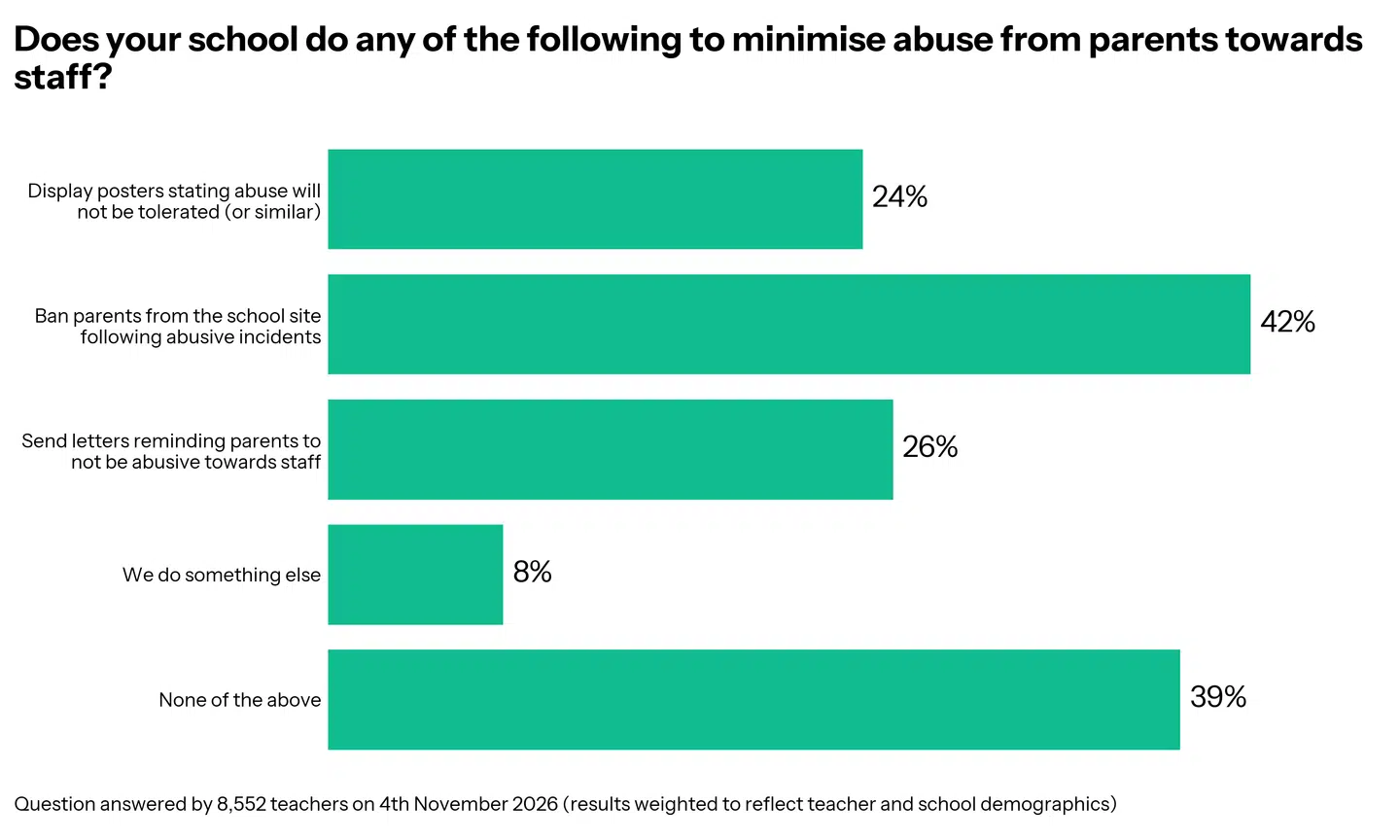
- 24% of teachers say their school displays posters stating abuse will not be tolerated.
- 42% of teachers say their school will ban parents from the school site following abusive incidents.
- 26% of teachers say their school sends letters reminding parents to not be abusive to staff.
- 8% say they have a different system in place, and 39% say they don’t do any of the above.
If you have a question you would like Teacher Tapp to check, get in touch and let us know! England@teachertapp.co.uk 📧
Daily Reads
The most-read tip was a super-short whiz through the best advice when you have to call in sick. More than 1,000 of you read it! I hope you all stay well, and if you do need the advice, you get better quickly 🤒.
There are so many great blogs out there, and we love featuring them on Teacher Tapp. If you have a blog you think we should feature, please email us at England@teachertapp.co.uk, and we will check it out!