Teacher Tapper 🔎 research on incivility in emails
The move to emails has made it easier than ever to send messages within a school – but despite an email being simpler to send compared to a letter, in many ways, digital notes end up being more complicated than ever. Especially when the tone in the message overspills into incivility.
An expert in this area, Dr. Emma Russell, from the University of Sussex, specialises in research on workplace email behaviour, specifically focusing on “incivility” in digital communication.
But what actually counts as ‘incivility’ when it comes to emails? In her paper, ‘Why do people send rude work emails?‘ Russell says work email incivility “involves violating social norms…by being disrespectful, discourteous or insensitive towards others”.
Russell makes the case that these sorts of messages can have a big impact on employees, and says “work-email incivility is pernicious and problematic in digital working life” and that sending these sorts of emails can have “negative repercussions” for those on the receiving end, and that this can be seen in their “well-being and work performance indicators”.
Last week, Russell appeared on the Radio 4 programme ‘All in the Mind’ discussing the impact of incivility in emails – and this gave us an idea for some Teacher Tapp questions.
Before we get into the findings, it’s important to note that Russell makes the distinction that incivility is not the same as bullying – “a much more intense and long-term problem – that requires different consideration and action”.
The Teacher Tapp findings…
What did we find out? First off, we asked teachers to think of the most recent time this academic year when they received an email from a teaching colleague that made them feel uncomfortable or frustrated.
The results told us there is a fortunate group who have not had a badly worded email from a colleague land in their inbox: 44% primary teachers, 30% secondary teachers; 30% of primary leaders, and 19% of secondary leaders have NOT received an internal email that made them feel uncomfortable or frustrated.
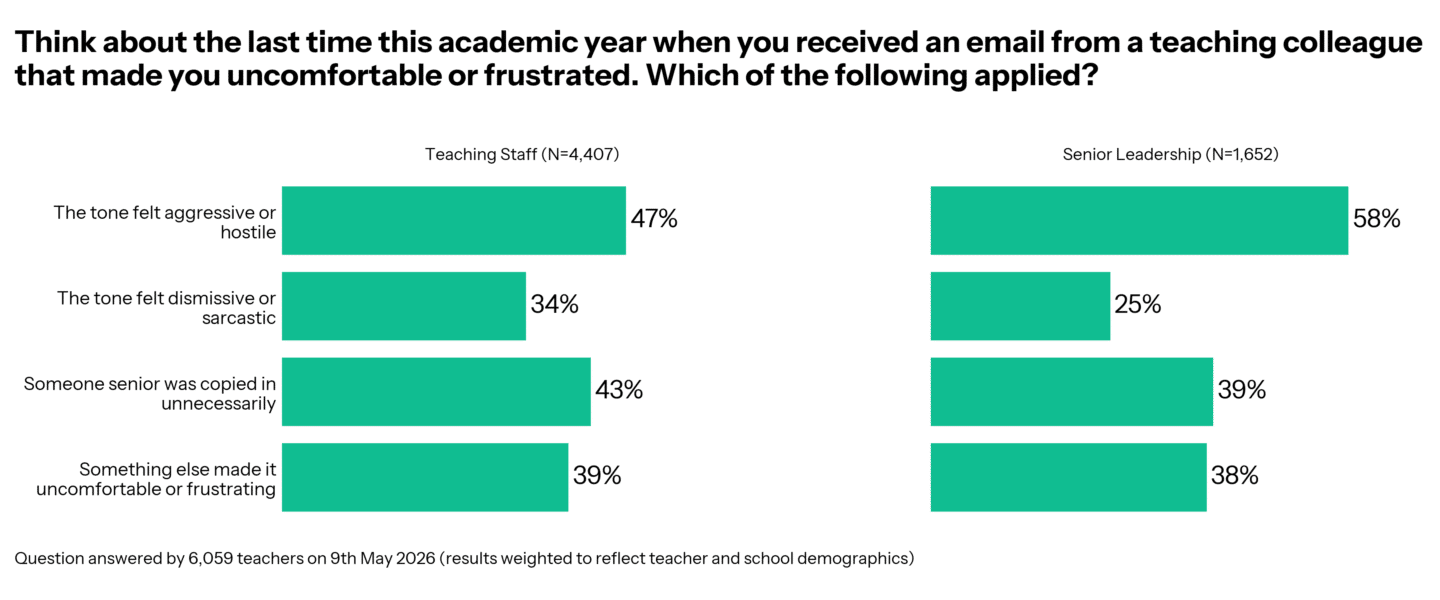
For the rest, experiences between primary and secondary were broadly similar, but seniority made a bigger difference. Thinking just of their most recent email that made them feel uncomfortable or frustrated:
- 47% of teaching staff and 58% of senior leaders thought the email had an aggressive or hostile tone;
- 34% of teachers and 25% of senior leaders thought the tone was dismissive or sarcastic;
- 43% of teachers and 39% of senior leaders thought the sender had committed the cardinal sin of copying in someone senior unnecessarily.
Internal emails policies
When it comes to policies about internal emails, 21% of primary senior leaders report they have a policy, but these are much more common in secondary schools with 40% of leaders reporting they have a policy.
There does appear to be a knowledge gap between what policies exist and staff awareness: 24% of primary teachers and 23% of secondary teachers didn’t know if their school had a policy, and 11% of primary teachers and 16% of secondary teachers said they had a policy but didn’t know what it said.
Who is sending these emails?
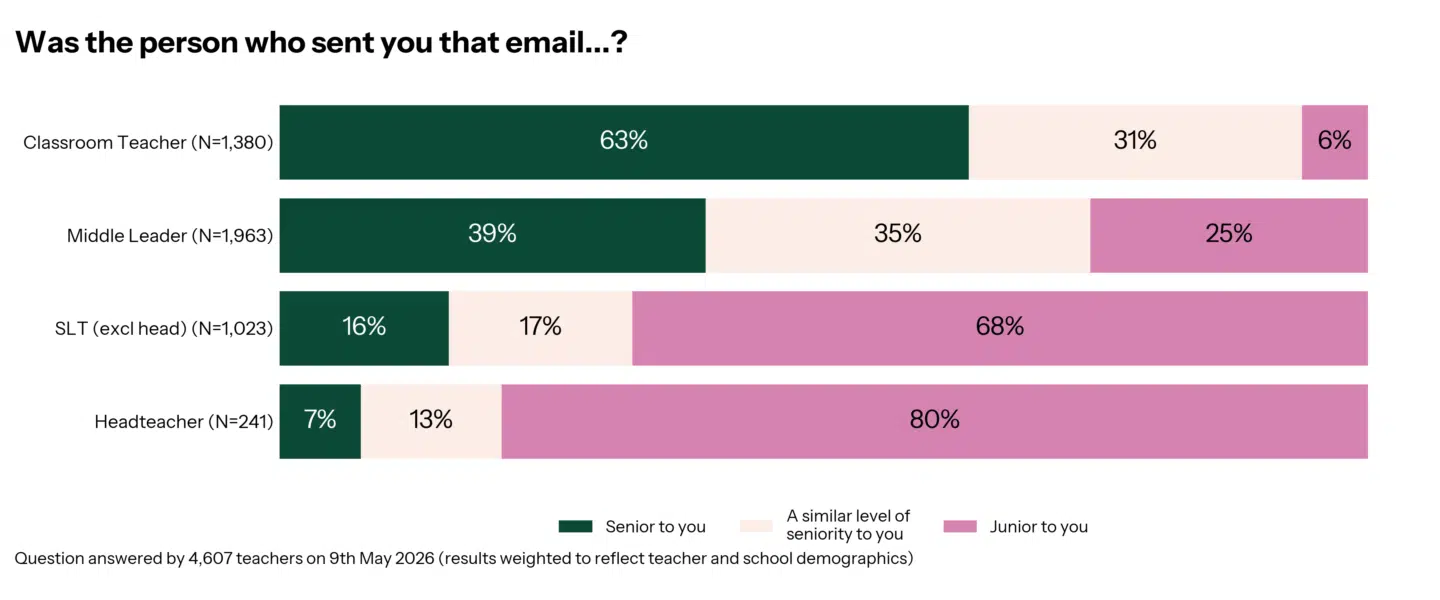
Are emails that make you feel uncomfortable or frustrated more likely to be sent by people senior to you? Not necessarily. Although senior leaders and headteachers were more likely to report the last email they were sent that made them feel uncomfortable or frustrated was junior to them (68% and 80% vs 25% and 6% for middle leaders and classroom teachers), this could be explained by the fact they have more junior people in the organisation that they are in contact with.
When we take middle leaders, a group where there is likely to be an even number of people senior and junior to them, there appears to be a more even split of senders who are senior (39%), a similar level of seniority (35%) and junior (25%).
What impact do these emails have on wellbeing?
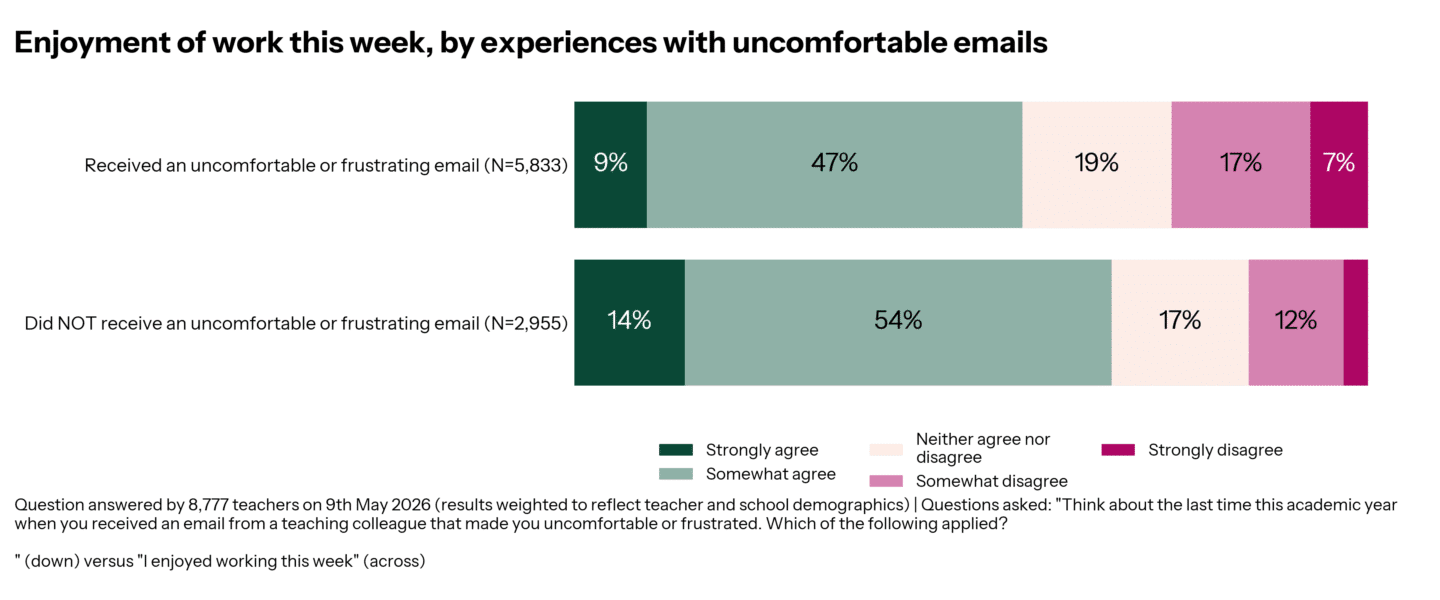
Finally, does whether or not you are one of those people who have been on the receiving end of an uncomfortable email this academic year make a difference in whether or not you enjoyed work this week? Maybe! 68% of those who didn’t receive an uncomfortable email said they enjoyed work compared to 56% who DID have a horrid email land in their inbox. But of course, this doesn’t mean there is a direct correlation between the two. However, to be safe, could we all try to be a little more polite in our emails?
What do the findings tell us?
Teacher Tapp got in touch with Dr Russell and shared our findings, and she noted that these sorts of levels of incivility in emails weren’t a surprise, and that “People often lash out or ignore others in email exchanges when work is getting on top of them.”
On the issue of providing a policy, she said that “Clear guidance can help people to understand which behaviours are acceptable and which are not.”
However, her advice for those who find themselves looking at an email they find frustrating or uncomfortable, you should ask yourself a few questions before you hit the ‘reply’ button.
“If you receive an uncivil email, that goes against normal expectations and character, then this might mean that your colleague is struggling and needs support. Equally, if you are struggling and need support, always take a pause before you engage in an email exchange, as this is when you are most at risk of being uncivil”.
If you are interested in learning more, there is a YouTube video on this topic here.