
Hey there, Teacher Tappers!
Easter holiday is on the horizon for many of you now, but exactly how long you have to wait before your break begins varies around the country.
For the vast majority of teachers in London, East of England, South East and the Midlands, holidays begin on March 30th. However, more than a quarter of teachers in the North West, South West, North East and Yorkshire will be waiting for the following week to turn on their Out of Office.
Prize draw – but ticket codes are gone!
🎉 Our March Prize Draw has come to an end, and we will be announcing the winner soon – and this time there will be no ticket codes to worry about!
If you have tapped at least once between 6–31 March, you’ll have automatically been entered. The winner will see a message in the app from 2 April. And there’s more: any Teacher Tappers who have the same school listed in their profile as the winner, and who also tapped between 6–31 March, will receive gift cards too.
In February, three extra Tappers scooped prizes. Will we see even more winners this month?! Get your whole workroom signed up and tapping! You can check the full terms and conditions here.
TLR time on time table
Onto some edu-data analysis! And we’re kicking off with the question that led to the Teacher Tapp inbox filling up with responses: TLR timetable time. Teaching and Learning Responsibilities give classroom teachers an extra payment in their pay packet, but don’t always come with time on the timetable.
Whether or not you get additional time alongside the salary bump seems to depend on the age of the children you teach. 57% of primary teachers don’t have any time, whereas just 21% of secondary teachers said the same.
One quarter of primary teachers had one or two hours, the most common response after ‘zero’. 32% of secondary teachers also said they had one or two hours.
23% of secondary teachers have more than 6 hours a fortnight, whereas the same is true for just 7% of primary teachers.
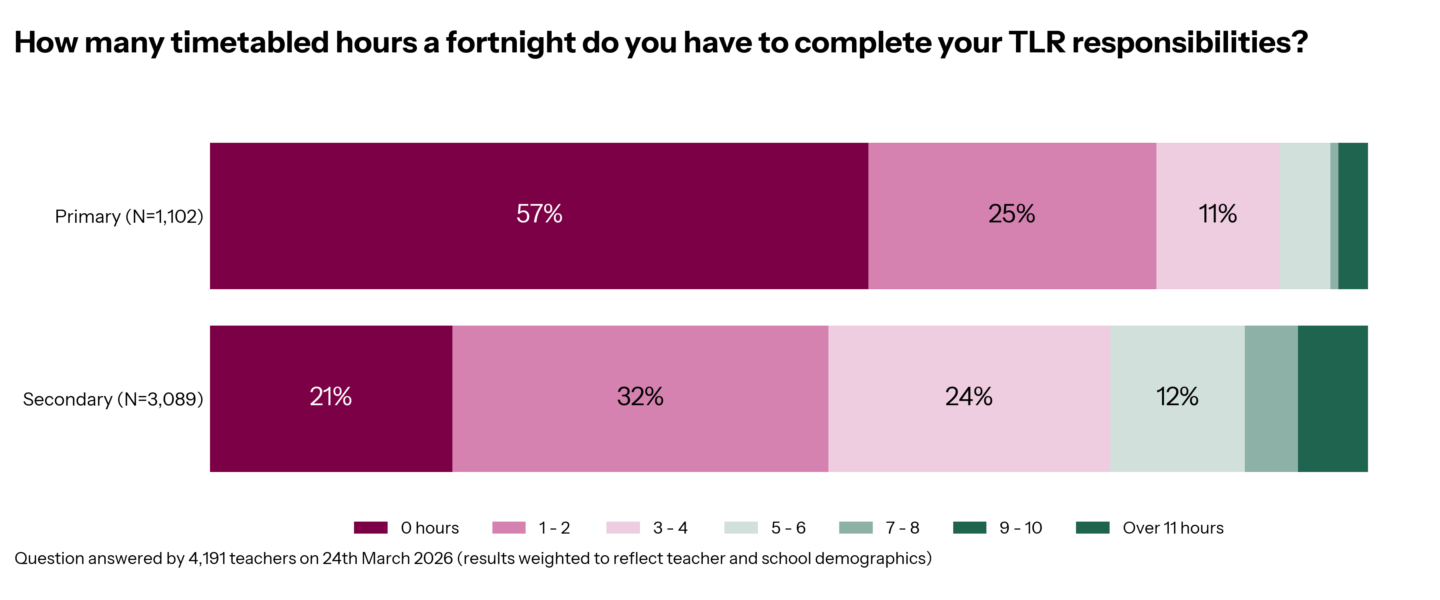
In secondary schools, does the subject you teach make a difference to how likely you are to get protected time for your TLR? Apparently not.
The distribution of hours teachers have for their TLR is consistent across all subjects, with no subject standing out as more likely to have more time to complete their duties.
Who gets 0 hours?
So what type of TLR posts are given no time on the timetable for their role? Primary teachers with 0 time told us they were subject leads – often in multiple subjects, along with other posts such as EYFS lead or ECT or ITT coordinator. Several Tappers wrote in to tell us how tough they found this, one saying “small school, fewer staff to share the load – I end up doing everything and feeling burnt out!”. 😢
Is the pay worth it?
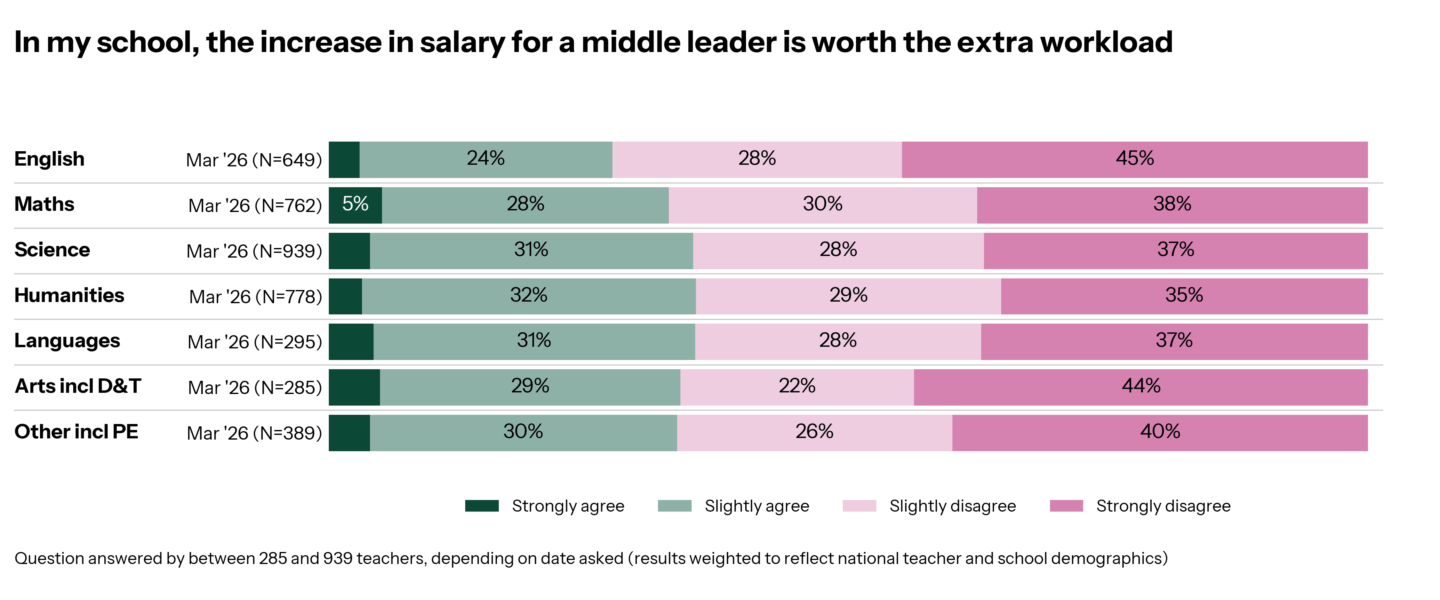
Do teachers think the pay increase for taking on a TLR is worth the extra workload it entails? Feelings were mixed, with the majority saying “no”.
The fact that primary teachers are more likely to have zero time for their TLR explains why they are less likely compared to secondary teachers to report that in their school, a TLR is worth the increase in salary vs the workload payoff. (22% primary teachers agree, vs 33% of secondary).
Over in secondary, feelings were still pretty negative, but there was a little bit of variation between subjects.
The highest dissatisfaction was among English teachers (73% disagree), compared to the lowest among MFL teachers (65% disagree).
What next for our TLR questions?
With such low enthusiasm for middle leadership pay rewards, could this be contributing to the sluggish classroom teacher to headteacher pipeline? We plan to ask more questions to find out.
In secondary, we will be digging into the pastoral vs academic divide, and in primary, we will be finding out more about the way TLRs are used after we had Tappers write in to tell us their school had a policy of never paying TLRs. What else should we ask? Suggest some questions england@teachertapp.co.uk 📧
Year six residential trips
The year six residential trip is considered by many as a rite of passage for primary school students. And with 94% of teachers in mainstream schools telling us they put one on for their pupils, it appears to be a standard feature of the majority of primary calendars.
How long the trip lasts varies between state and private: in state schools, a two-night trip is the most common (42%), but in private schools, four nights is the most common (53%).
Costs also vary, with just a a tiny number not charging students (1%), but among those who do: state school primary teachers reported the most common price bracket as £251-300 (17%), whereas private school teachers reported higher costs, with 30% telling us their trip cost £600 or more.
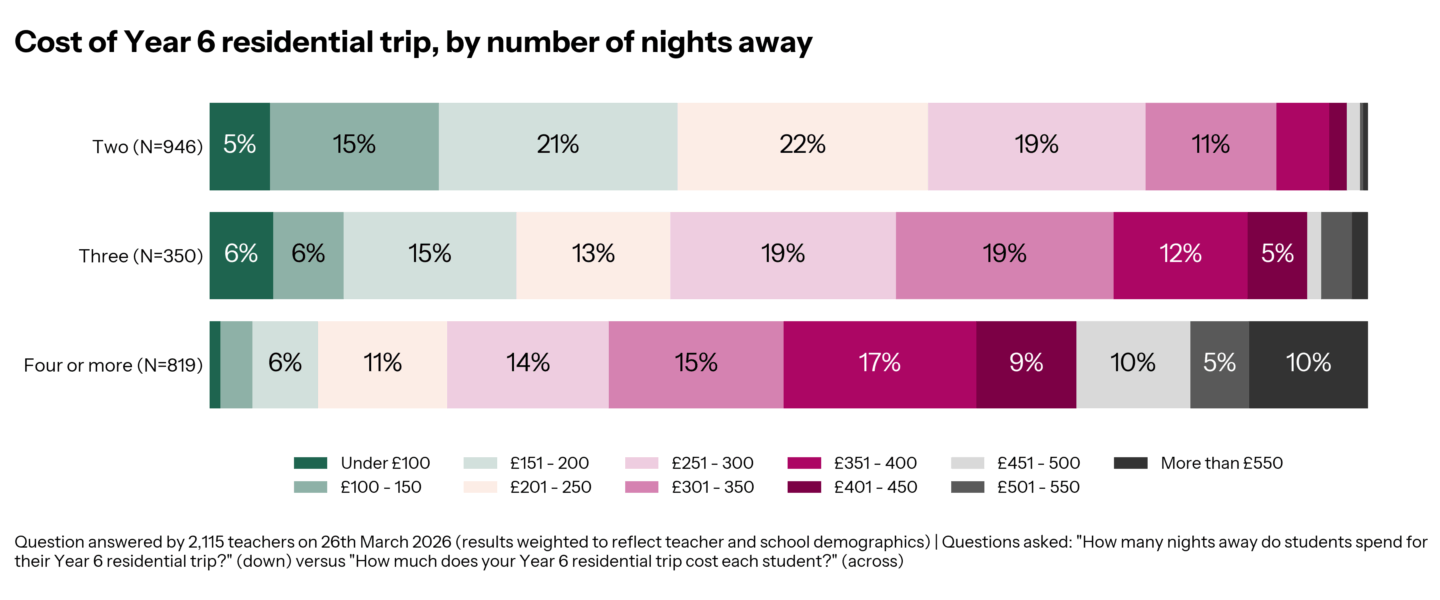
Looking at both private and state, for trips that last two nights or more:
- Two-night trips are the cheapest, with around 62% of respondents concentrated in the £151–£300 range.
- Four or more night trips are the most expensive, with roughly a quarter costing over £400.
- Despite the extra night, three-night and four-or-more-night trips have surprisingly similar cost profiles in the mid-ranges, suggesting costs don’t simply rise in step with each additional night.
Excluding those who don’t charge, and only go for one night:
With costs varying so much, what are your best tips for getting a value-for-money trip? We would love to hear your best tips – send in your advice for planning cost effective tips and we will collate and share: england@teachertapp.co.uk 📧.
The above data is for mainstream schools, but what are residential trips like in special schools? Although fewer special school teachers told us their school ran them (60% have residential trips), about half of those running trips go for two nights.
Teacher Tapper asked…parent phone calls
A Teacher Tapper at the end of their tether got in touch via Instagram to ask: How much time are teachers spending on phone calls? So we set about finding out the answer.
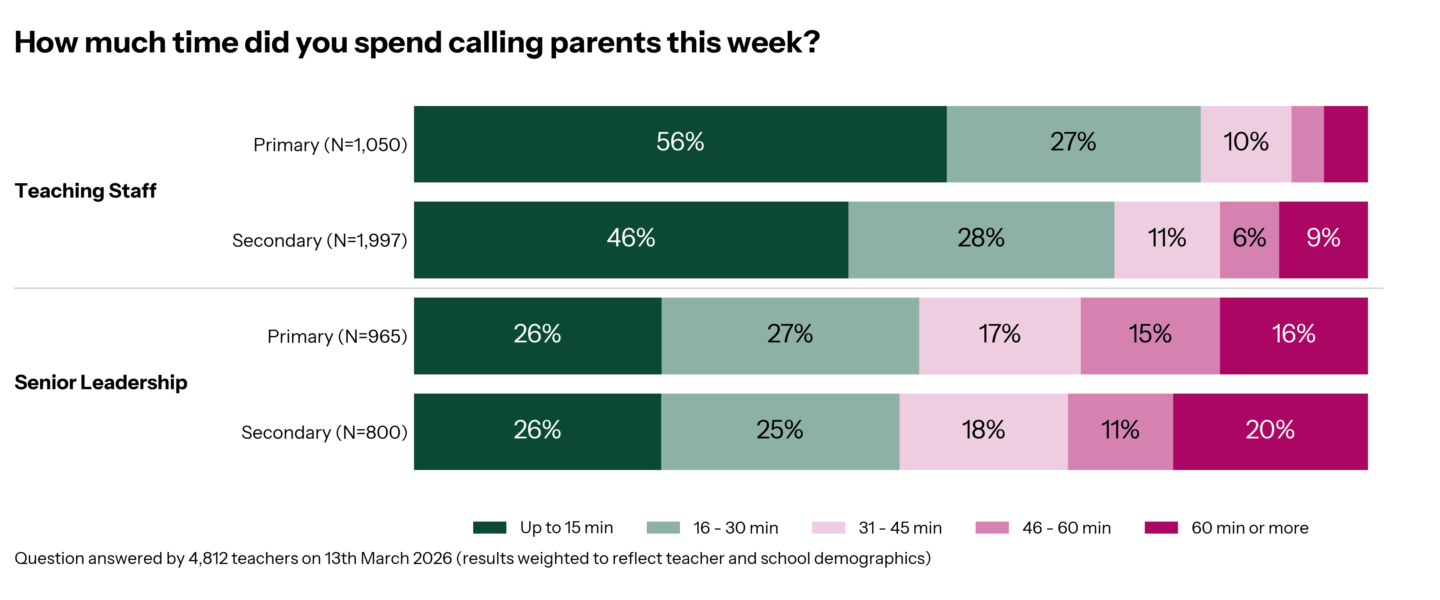
In short: quite a lot of time! First off, we discovered that about half of the teachers were calling home (49%), and among those teachers making calls, the length of time spent on calls varied depending on whether you were a classroom teacher or a senior leader.
Secondary classroom teachers are making longer calls compared to primary classroom teachers (54% vs 44% spent longer than 15 minutes on the phone).
Senior leaders in secondary schools clocked up the most minutes calling parents (20% spent more than an hour), and primary senior leaders weren’t far behind (16% spent more than an hour).
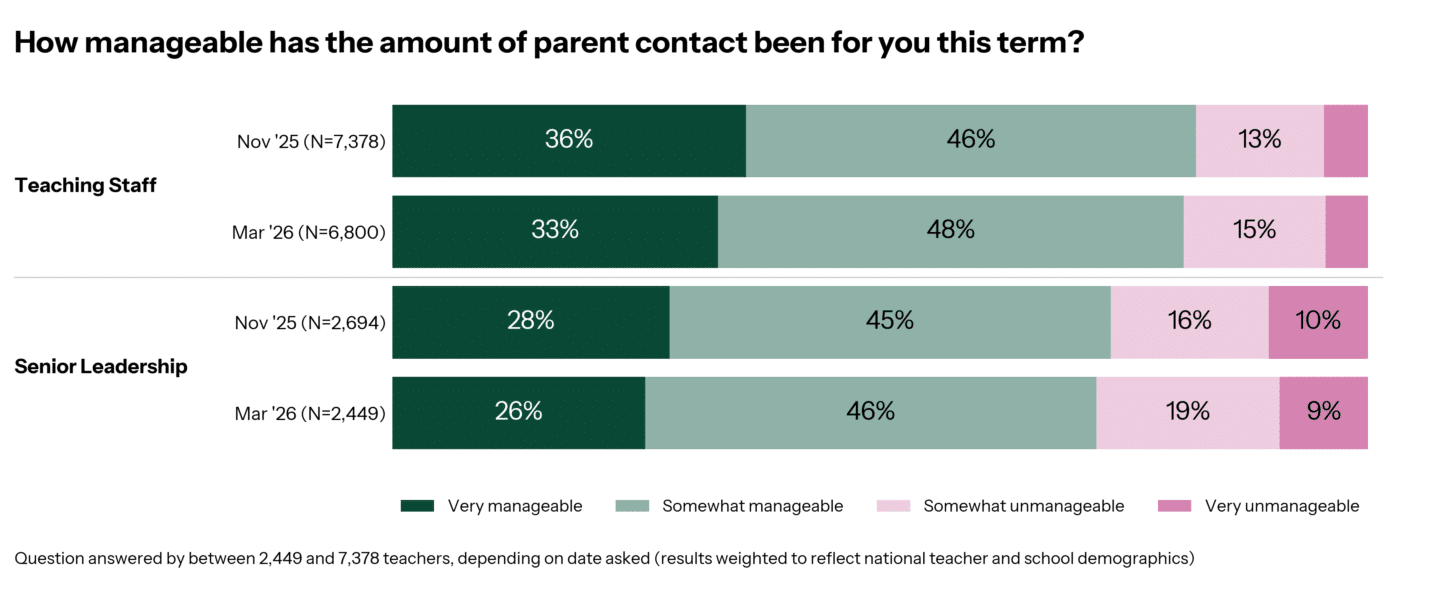
Zoom in on … managing parent contact
- 📈 Parent contact is getting harder to manage over time — for both teaching staff and senior leaders, the proportion finding it unmanageable crept up between November 2025 and March 2026. It’s a small shift, but a consistent one in the wrong direction! Teaching staff reporting contact is ‘very manageable’ is down to 33% from 36%. Similarly, senior leaders dropped from 28% to 26%.
- 👔 Senior leaders are feeling the pressure more than teaching staff — nearly 3 in 10 senior leaders found parent contact unmanageable in March 2026, compared to fewer than 2 in 10 teaching staff. Not surprising given how much parent contact lands on their desks!
- 🌤️ The good news? Most teachers are coping with the majority across both groups, describing parent contact as manageable. But with only around a quarter of senior leaders saying it feels very manageable, there’s clearly still a lot of strain bubbling under the surface.
Behaviour tracker
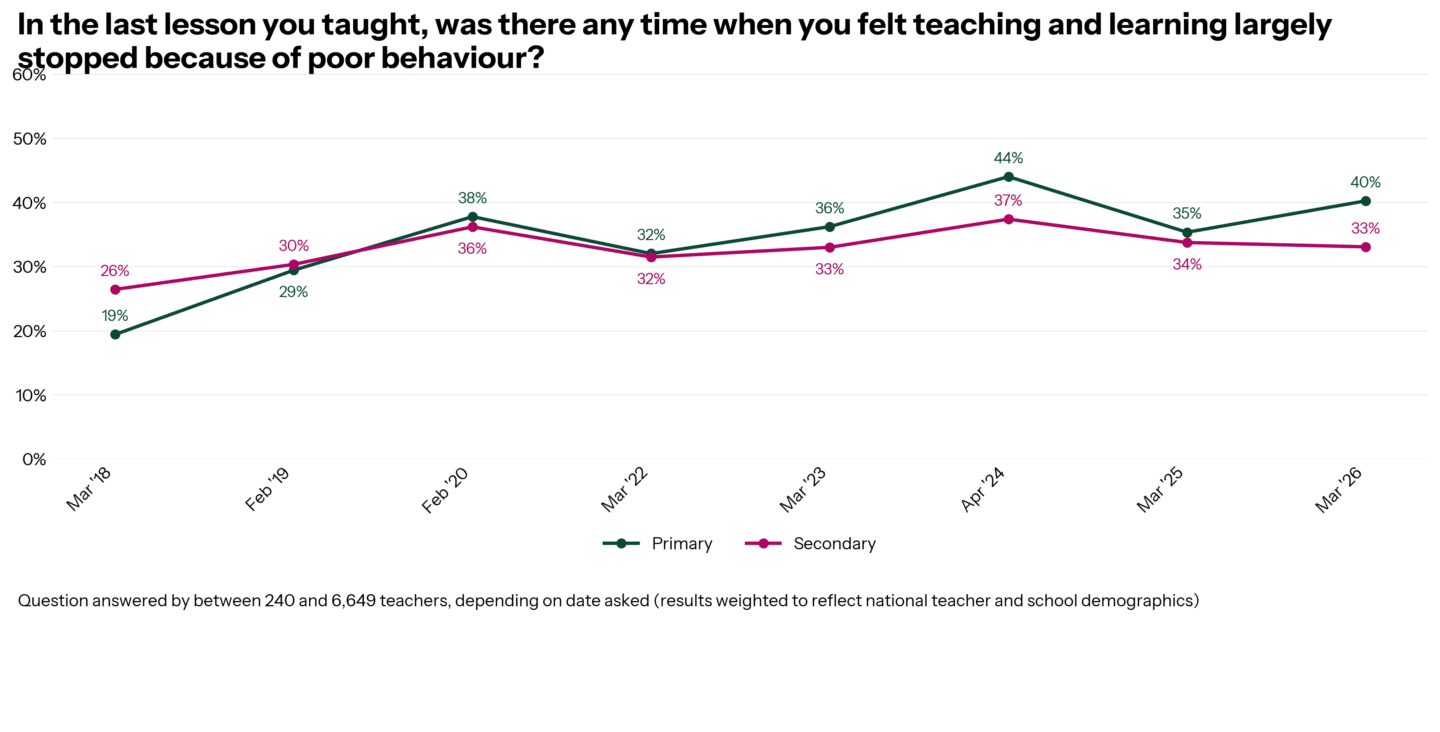
Time for our regular behaviour check-in, and if you’re feeling a little more frazzled than last year, then you’re not alone – it seems that things have ramped up compared to the previous academic year.
Spring term behaviour looks like secondary is very similar to previous years, but primary classrooms have seen more disruptions compared to last year (40% vs 35%), but not as high as Spring term 2024 (44%).
Daily Reads
The most-read blog last week was a data-rich one! From the FFT, it tracked the journey of students who leave primary without yet hitting the ‘working at standard’.
There are so many great blogs out there and we love featuring them on Teacher Tapp. If you have a blog you think we should feature, then please email us at england@teachertapp.co.uk and we will check it out!