The end of term is almost here for 90% of tappers in state schools! Friday the 19th of December is the most popular day for schools to wave goodbye to their students and begin the Christmas break, whereas in private schools, 54% stopped last Friday. Wherever you are in the run up to your Christmas break – from everyone at Teacher Tapp, we send festive greetings and hope your holiday is relaxing and free of marking!
This is our last blog of 2025! But before we say goodbye to the year, we have just enough time to squeeze in one final prize draw…
Win an iPad!
There are just days to go before a winner claims their iPad – will you be the Tapper who scoops the prize?
Entering is easy – all you have to do is ‘tapp’, and every ten questions gets you ONE ticket in the draw. We will pick the winner on the 18th of December, so keep an eye on your emails, and you can watch your tickets grow in the app! Check the Ts and Cs here.
Now, onto the final edu-data round up of 2025…
Nativity performance
Across the country, tea-towels were placed on heads, tinsel wound around wrists, and teachers stood at the back of school halls directing, dancing, and prompting those inevitable forgotten lines.
Watching your child in their first nativity is considered something of a rite of passage for parents, but how easy is it for teachers to get to their own child’s nativity?
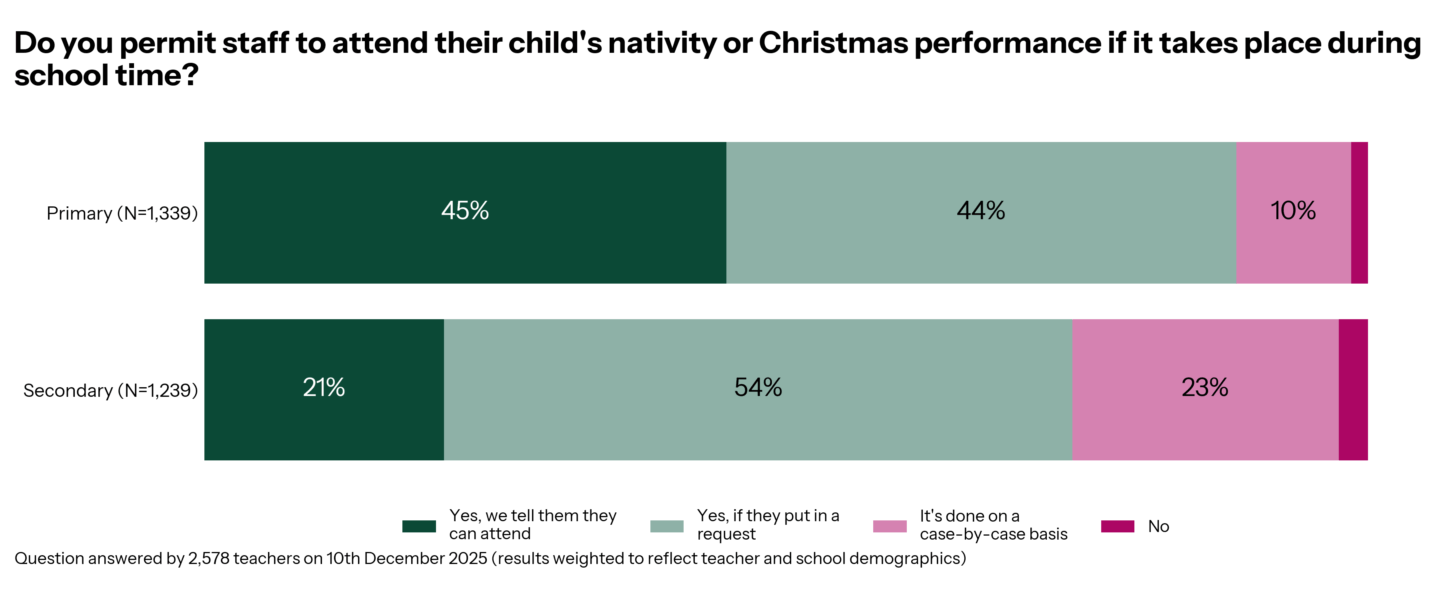
Primary leaders are more likely than secondary leaders to tell their teacher-parents they can attend their son or daughter’s nativity or Christmas performance (45% vs 21%). Even if not many secondary leaders are telling teachers explicitly that they can attend their child’s Christmas show, 54% of secondary say yes if a teacher puts in a request, but 23% will take each one on a case-by-case basis. In primaries, 44% will give an automatic yes if the teacher asks, and just 10% consider it case-by-case. 1% of primaries don’t allow teachers to attend nativity or Christmas shows, and the same is true for 2% of secondaries.
Of course, evening performances can make it easier for parents to attend – but it’s tricky to get students to come back after school, plus very tired and excited children on stage isn’t always a good combination.
In primary schools:
- 88% have day time performances
- 24% have evening performances
- 67% have daytime ONLY performances
- 9% don’t have a Christmas show for families at all
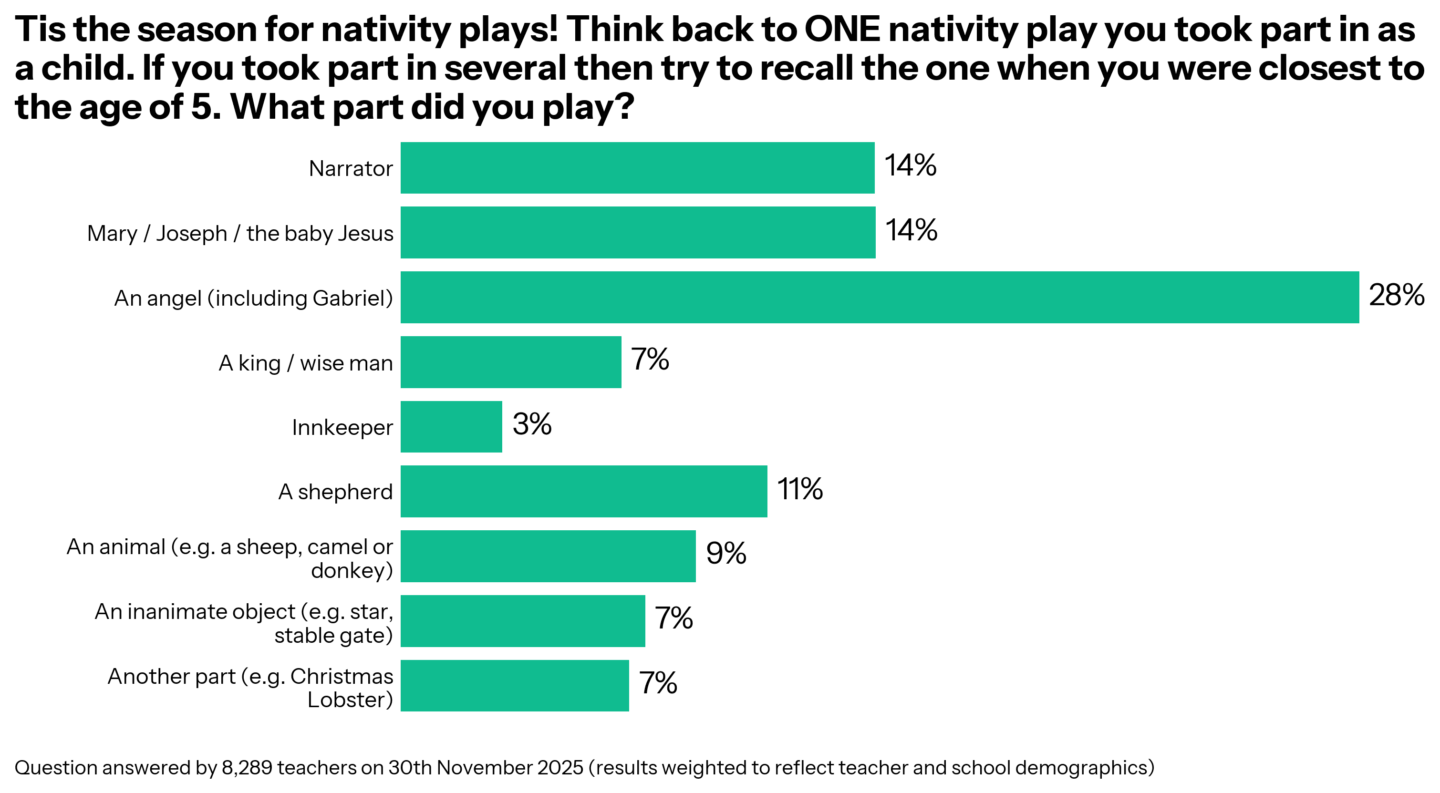
Once upon a time, of course, teachers were small, excitable children on stage and performing. But what part is a teacher most likely to play? 16% can’t remember, but among those who do: 28% of teachers played angels, 14% were the narrator, and 14% had a starring role of Mary, Joseph or the baby Jesus.
And finally, in our Christmas question round-up, the December school calendar can make teaching feel extra tough – extra assemblies, performances and trips can make finishing the term near-impossible. But despite the chaos, do teachers feel it is worth it?
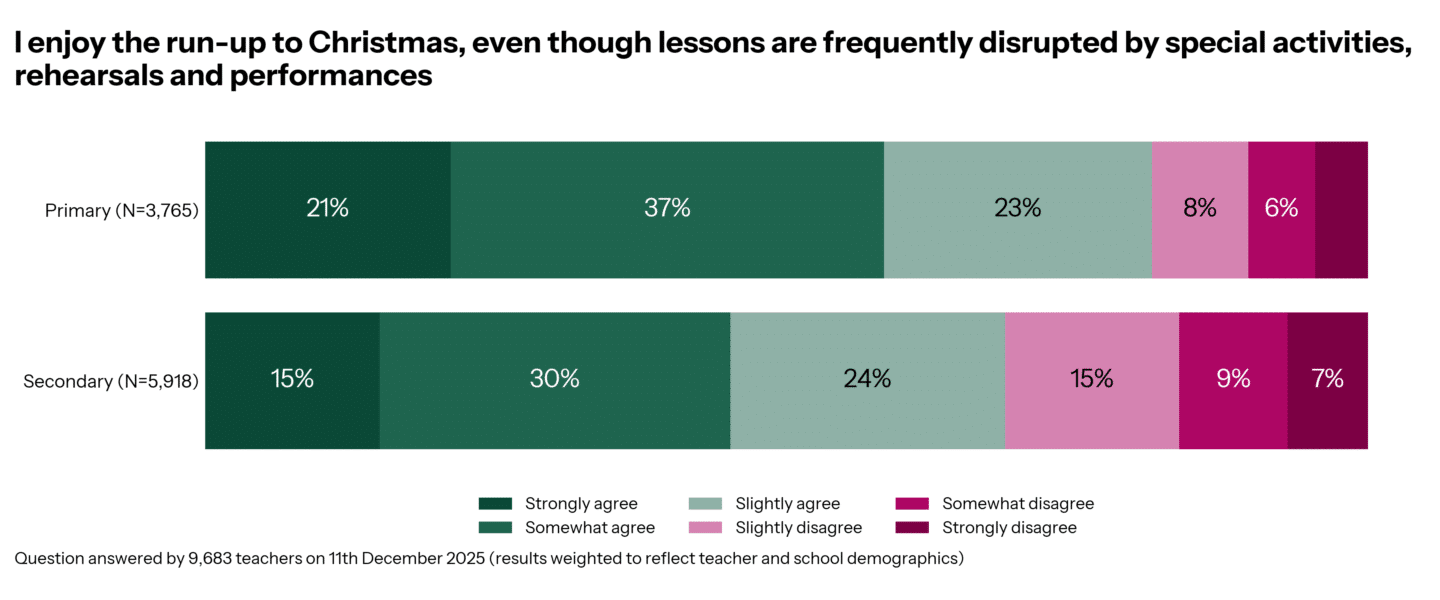
Overall, primary teachers feel they gain more than the pain, with 81% agreeing they enjoy the run-up to Christmas; most secondary teachers also agree, just not as strongly ( 69%).
Does this Christmas feel more hectic than usual? Have we missed anything important? It’s not too late to send in your suggestions! We love to hear them – drop us a message england@teachertapp.co.uk.
Sick teachers
One thing that is sure to throw a spanner in your Christmas show plans is a sickness bug in the class. Last week, 42% of teachers sent a child to the office because the student felt unwell, and the good news is that this is the lowest rate outside of the 2020 COVID year (you can read the full details here).
But for teachers, things aren’t so great. Compared to pre-covid, slightly more teachers have been unwell with 15% having to take time off work due to a cold, cough or flu UP from 10% in 2018, and 13% in 2019. 49% were unwell with cold, coughs and flu, but didn’t take time off, also UP from 46% in 2018 and 52% in 2019.
But it’s not all bad news – compared to 2023, things do seem a little better: in 2023 29% reported not having cold, coughs or flu, this year that has improved to 37%.
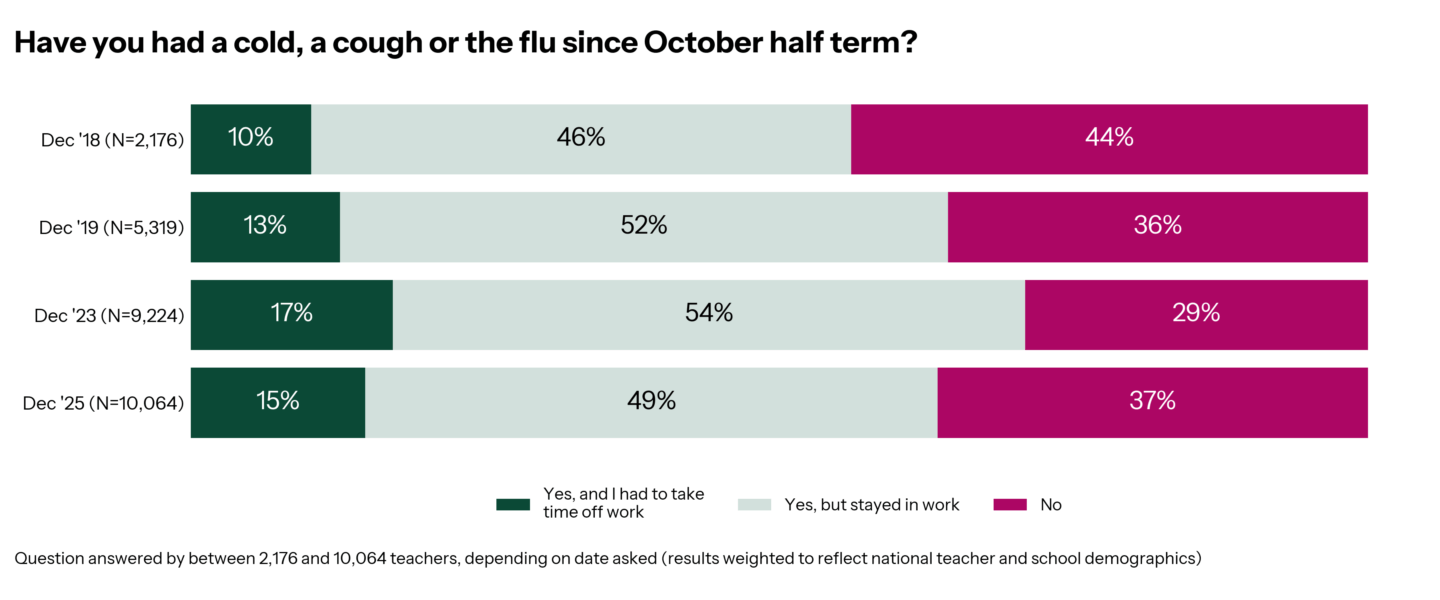
However, a closer look at the numbers reveals that it seems to be secondary, rather than primary, who has struggled to return to pre-pandemic levels.
This year, 17% of secondary teachers have taken time off due to colds, coughs, or flu, compared to 13% of primary teachers. In 2018, primary and secondary schools reported similar levels of absence (9% and 10%, respectively).
Of course, the tricky thing as a teacher when you take time off is that your students are still there, and your workload can actually increase if you are still expected to set the work. More secondary teachers than primary teachers say they would feel ‘dissatisfied’ with the cover given to their class (34% vs 30%).
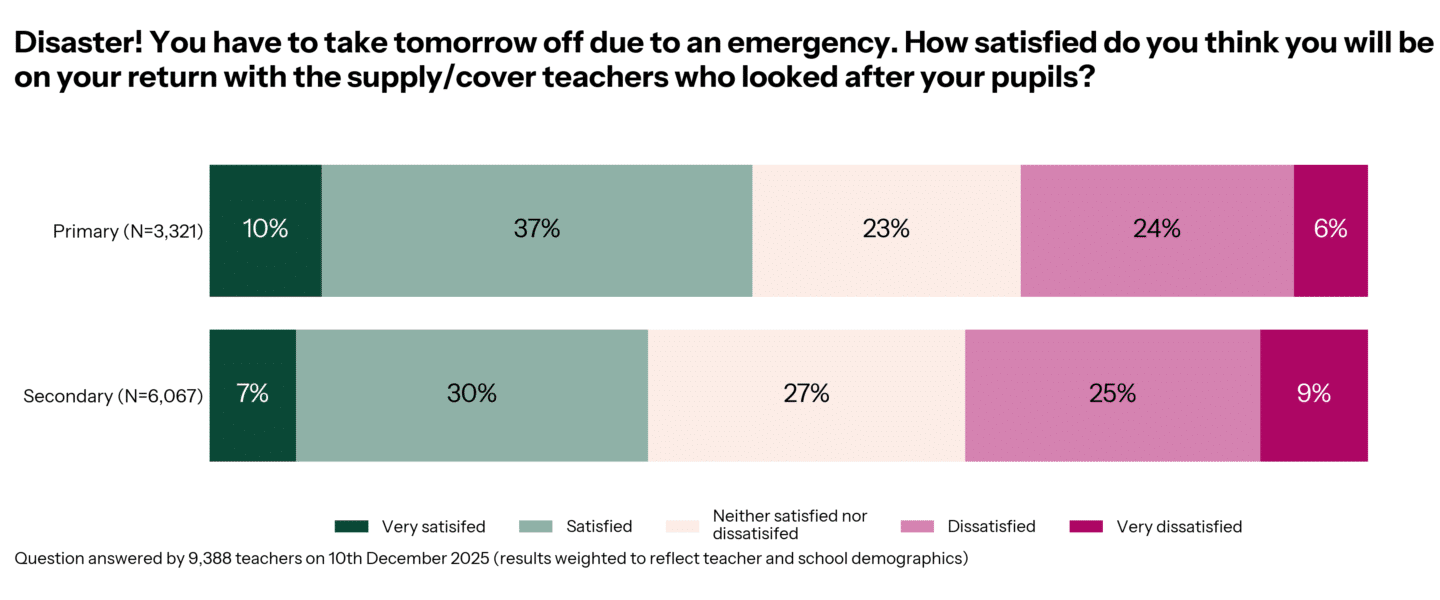
Digging a bit more into the data, we find that in primary schools, the level of deprivation around the school doesn’t significantly change the levels of expected dissatisfaction about the quality of cover (10% expect to be very satisfied in the least deprived areas, and 9% in the most deprived areas) whereas in secondaries, there is a bigger difference (7% expect to be very satisfied in the least deprived areas, whereas the same is only true in 4% in the most deprived areas).
What makes a difference to how optimistic you feel about the quality of cover? Teacher Tappers, tell us! Send us your thoughts about the best systems your school uses to arrange cover (or – your cover disaster stories!) england@teachertapp.co.uk.
Mobile phones – does it matter how long you confiscate?
Now, onto something that teachers might also feel sick of, just in a different way: mobile phones used in class.
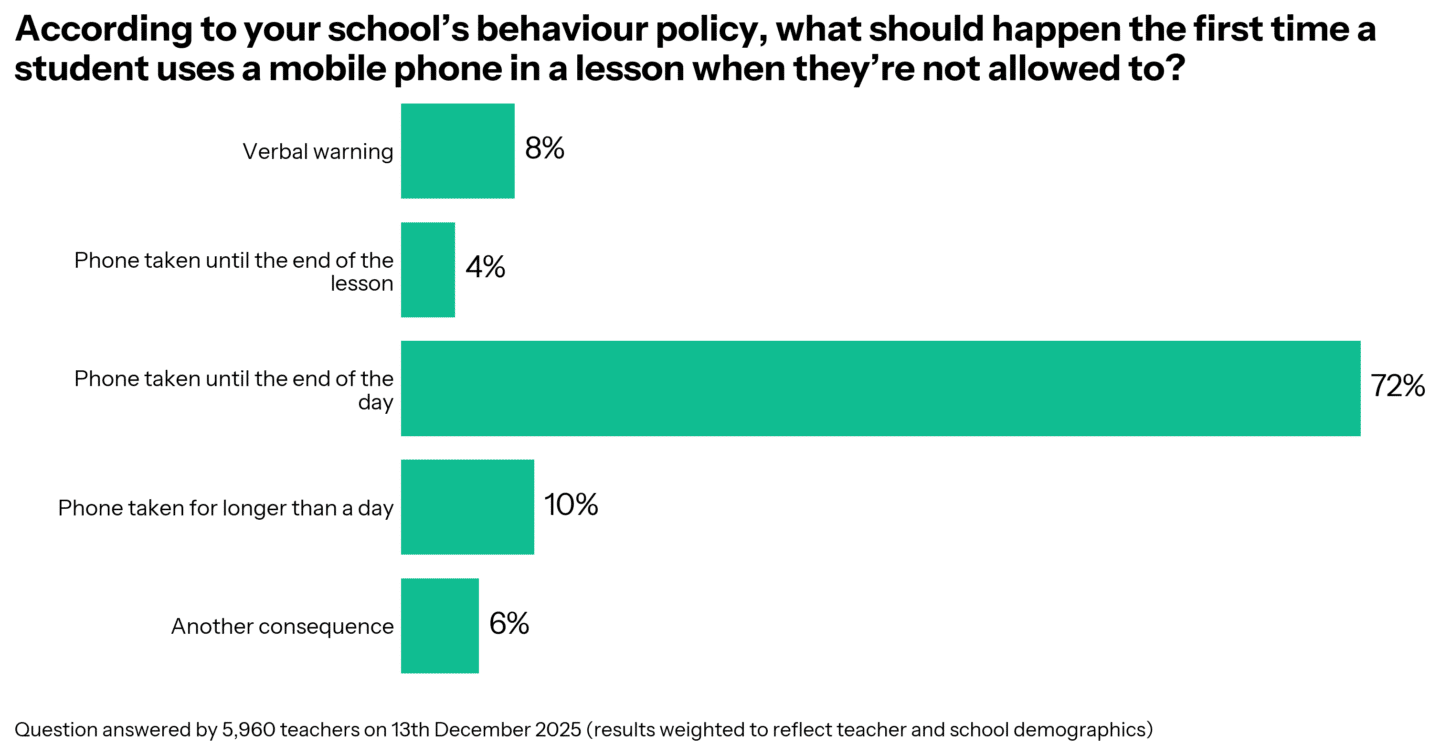
A phone appears in a lesson – but what does the school policy say the sanction should be? The most common punishment when a phone appears in the first instance is for the phone to be taken until the end of the day (69%), with one in ten schools going for longer confiscations.
We dug back into our filing cabinet of findings to find out what the connection was between a school phone policy and consequences for a phone out in class: schools that allow phones at break and lunch are much more likely to just give a verbal warning if a phone comes out in a lesson, compared to schools that have a policy of phones out of sight all day (44% vs 4%).
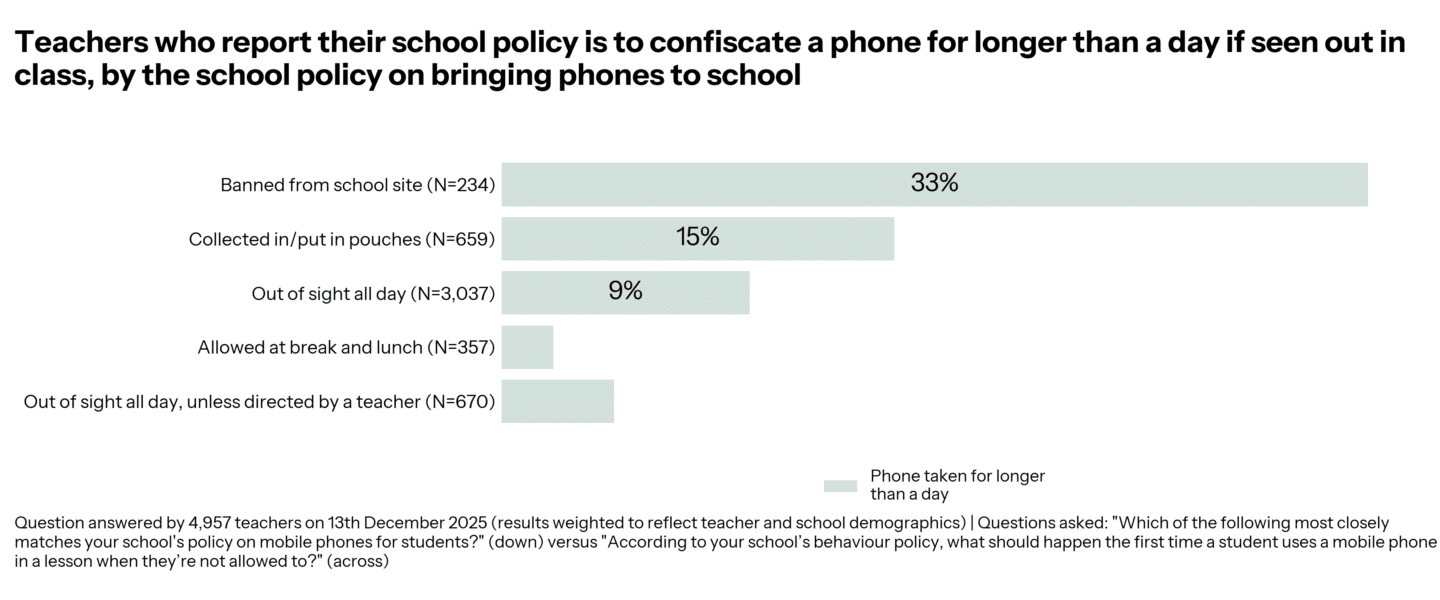
The 10% of schools where a phone is confiscated for longer than a day were more likely to be schools with stricter mobile phone policies. Schools where phones are banned from the school site were the most likely to confiscate for longer than a day (33%), whereas schools where phones are allowed at break and lunch were the least likely (2%).
Does confiscation policy deter phone use?
Most importantly, perhaps – does the policy on what happens when a phone comes out, make a difference to whether or not a teacher has to deal with a phone in a lesson?
When we look at the policy for confiscation, teachers in schools that take phones until the end of the day, 3% had a phone out in the last lesson, compared to 12% in schools where the phone is taken until the end of the day, and 25% where a verbal warning is given.
However, when we look at overall mobile phone policy, teachers in schools that collect in or use pouches, 2% had a phone out in the last lesson, compared to 7% who have the rule ‘out of sight all day’, and 24% where phones are allowed at break and lunch.
The answer? It’s likely to be a combination of the two, and with schools that have stricter phone policies also more likely to have stricter confiscation rules, it’s hard to split the two. However, there is clearly a correlation between stricter rules and the likelihood that a phone appears when it shouldn’t.
For more mobile phone data, check out our Teacher Tapp insights special on mobile phones.
AI planning
The number of teachers using AI for school work has been rising over the last few years – but just how many are using it to plan their lessons?
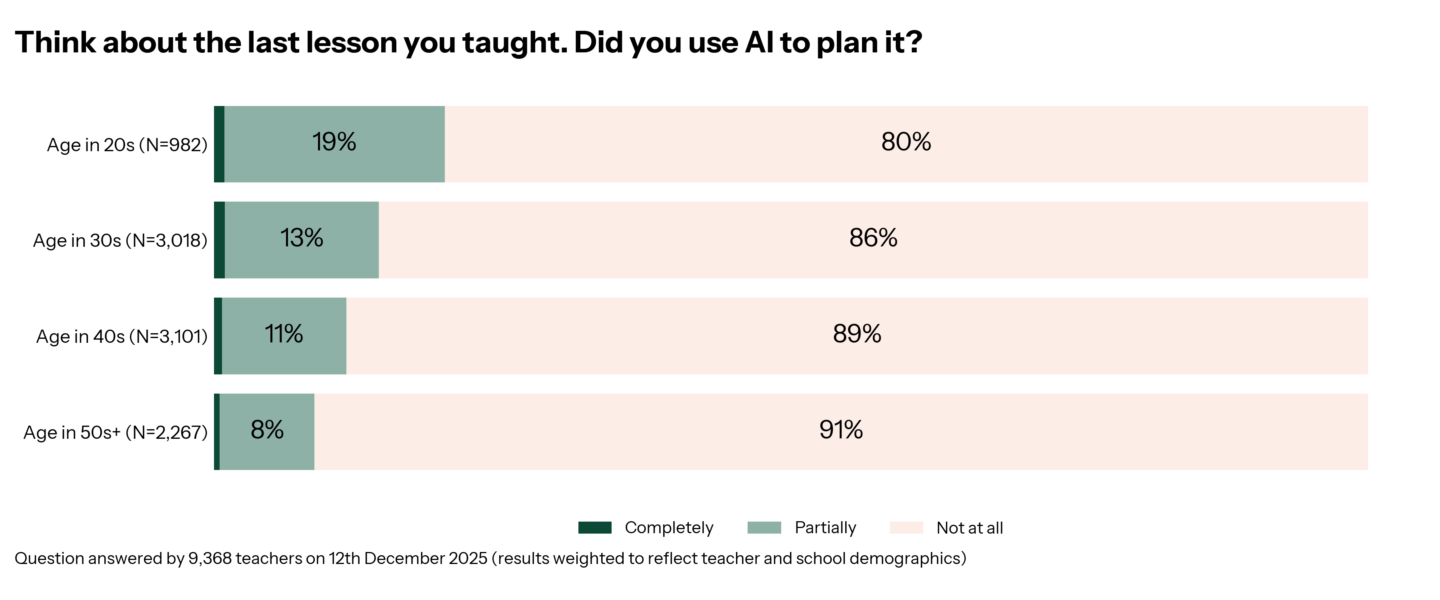
The answer might depend on the age of the teacher. 20% of teachers in their 20s used AI to plan their last lesson, but the same is true for just 9% of teachers 50 or over.
The subject you teach also seems to make a difference, with KS2 teachers being the most likely to have used AI for their planning with 20% using it in some capacity for their most recent lesson, and maths teachers were the least likely to have had any AI input in their lesson, with just 4% using any AI to plan their lesson.
Daily Reads
The top read this week from The Guardian on the dangers of burnout if you don’t switch off over Christmas – 13% of leaders read it this week!
Got a blog you think we should feature? Email us at england@teachertapp.co.uk and we will check it out!