Hey there, Teacher Tappers!
Easter holiday is on the horizon for many of you now, but exactly how long you have to wait before your break begins varies around the country.
For the vast majority of teachers in London, East of England, South East and the Midlands, holidays begin on March 30th. However, more than a quarter of teachers in the North West, South West, North East and Yorkshire will be waiting for the following week to turn on their Out of Office.
New prize draw – but ticket codes are gone!
🎉 Our March prize draw is back – and this time there are no ticket codes to worry about!
If you tap at least once between 6–31 March, you’ll automatically be entered. The winner will see a message in the app from 2 April. And there’s more: any Teacher Tappers who have the same school listed in their profile as the winner, and who also tapped between 6–31 March, will receive gift cards too.
Last month, three extra Tappers scooped prizes. Will we see even more winners this month?! Get your whole workroom signed up and tapping! You can check the full terms and conditions here.
Residential trips
Residential trips are common in both primary and secondary with just 4% of primary and 3% of secondary teachers reporting their school didn’t run them.
Among teachers in schools where they are run, 27% of primary teachers and 22% of secondary teachers have gone on a trip this year, with some going on more than one trip (3% of primary and 6% of secondary teachers).
Although students get lots out of residential trips, for staff, it’s a slightly different story. Although many enjoy running trips, the time away from home and the responsibility for so many young people (not to mention the paperwork…) make trips a hard sell for some senior leaders.
Just 4% of primary and 1% of secondary teachers say their school expects staff to run residential trips, but in primary 50% of teachers say trips are “sometimes” voluntary and “expected in certain year groups”. The same is true for 22% of secondary teachers.
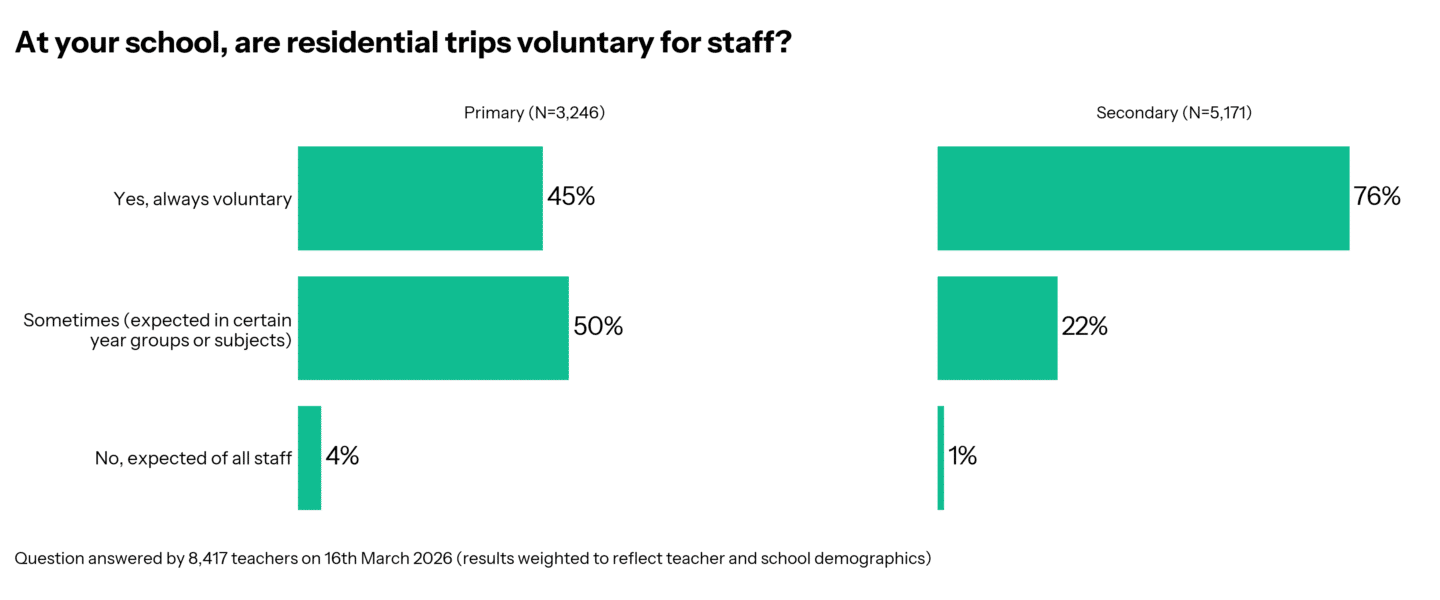
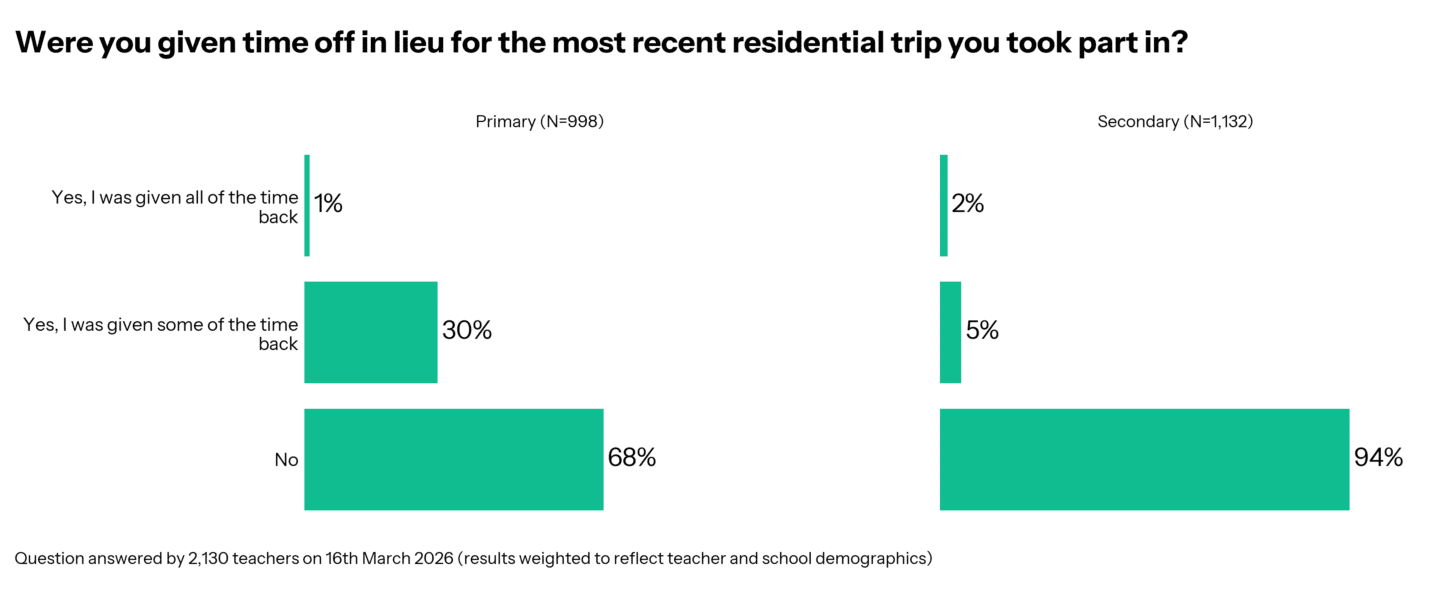
One way to make residential tips more appealing to staff is to offer staff time back in lieu, but how common is it for teachers to get time back? In primary schools, giving teachers time back is far more common, with 30% of teachers reporting they got some of the time back after their most recent residential, and a tiny 1% say they had all of the time back. Over in secondary, this scenario is far less common, with just 7% reporting they had any time back, and 2% saying they had it all back.
Is it more common to get time back if you are in a school where trips are expected of certain year groups? Apparently not. 39% of teachers in schools where trips are entirely voluntary reported they had time back after their last residential trip, compared to 26% of teachers in schools where trips are expected of staff in certain year groups.
Time off for medical appointments
Unfortunately, booking medical appointments around the school day can be tricky, and teachers will often have very little say over when they are seen.
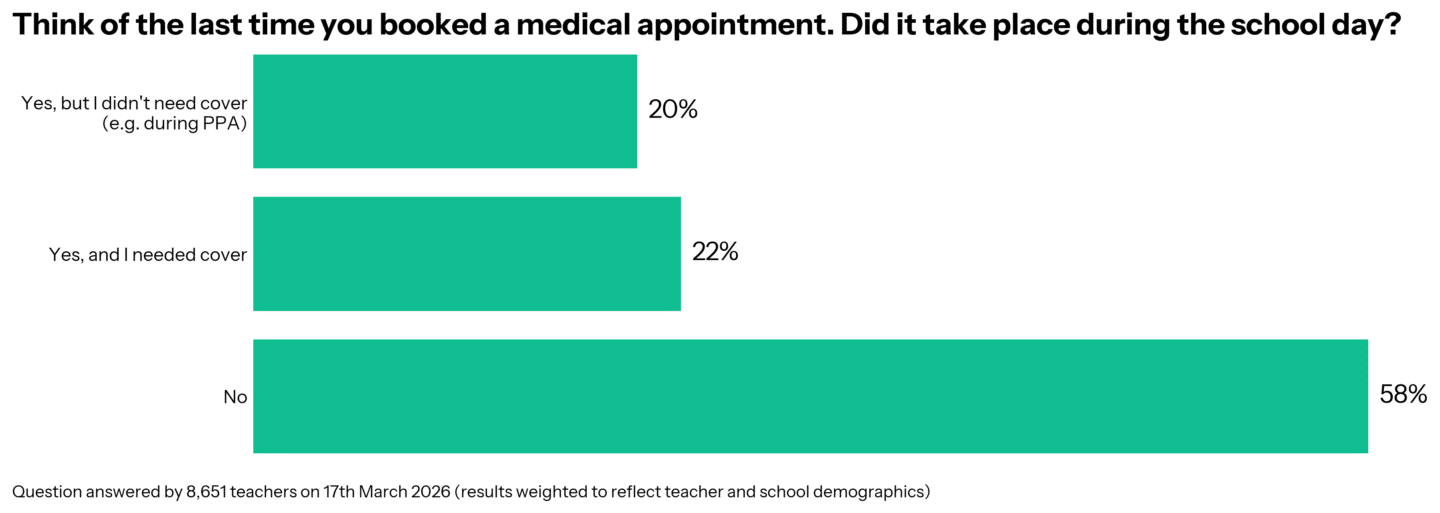
42% of teachers reported booking their last medical appointment during the school day, with 22% needing to be covered to allow them to attend.
Paid for appointments?
Over the last few months, there has been a flurry of messages in our Teacher Tapp inbox, sharing frustrations about access to medical appointments. “No one seems to understand that teachers can’t be available for a phone call or appointments during the school day,” wrote one teacher.
Classroom teachers are more likely to have been unpaid for their appointment compared to senior leaders (7% vs 2%).
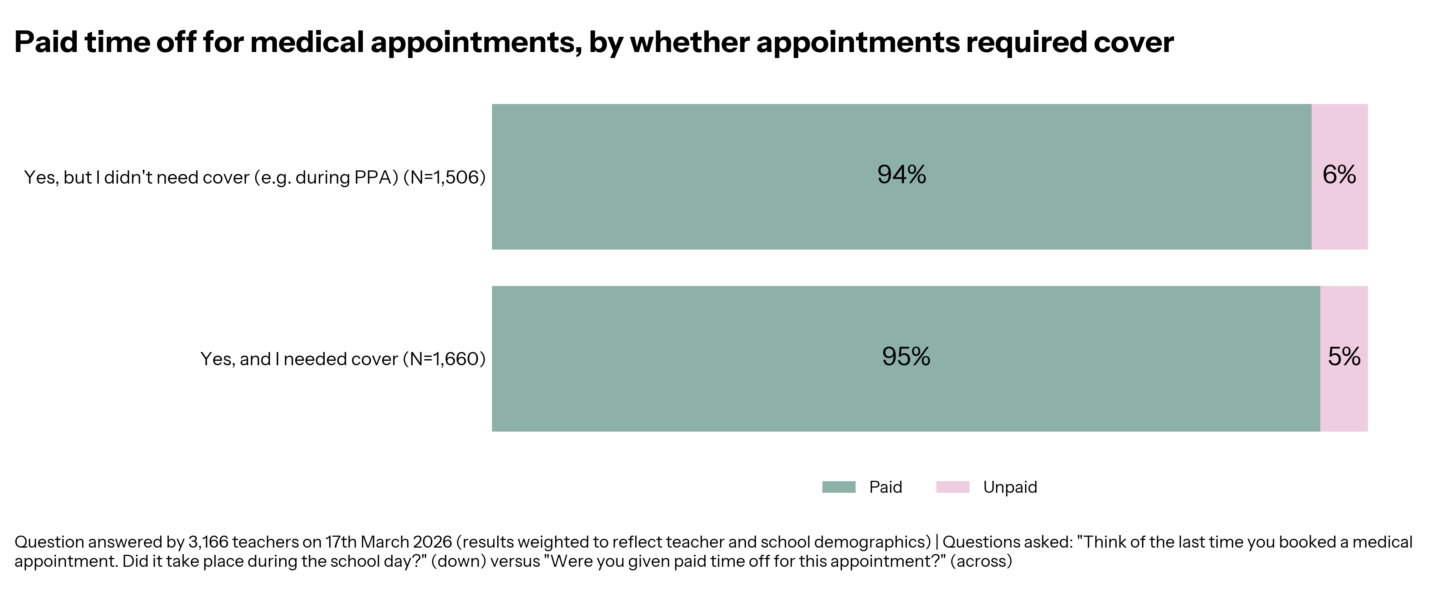
Whether or not the medical appointment meant the teacher needed cover didn’t seem to change the likelihood of being given paid time off.
94% of teachers who didn’t need cover received paid time off, and 95% of teachers who did need cover had paid time off. This seems to suggest it’s more down to school policy on medical appointments than whether or not the appointment creates cover.
Senior leaders – is this an issue you struggle to manage in your schools? Do you have any tips on how to manage the cover created by medical appointments? One leader got in touch to report that their school provides free access to a ‘virtual GP’ to help circumvent the tricky booking challenges teachers face. Write in and tell us what we should ask next! England@teachertapp.co.uk 📧
Zoom in on … pay negotiations
Recently, we have been asking about pay and negotiating. Here is what we found out!
- ⛔️ 78% of teachers did not negotiate pay when they accepted their current job offer.
- 🫤 But of those that didn’t try and negotiate, about one in ten wished they had!
- 💰 Men were more likely than women to negotiate their pay (18% vs 13%)
- 📈 Secondary teachers are more likely to try and negotiate than primary (10% vs 18%)
Teacher Tapper asked…why don’t people negotiate?
If people want to negotiate, but don’t…what holds them back?
The most common reason was thinking they couldn’t be negotiated (71%), followed by worrying about making a bad impression (42%) and not feeling it would be appropriate (37%).
A third of teachers felt too nervous, but female teachers were more likely to say they felt like this compared to male (36% vs 27%).
Does it matter? Maybe. When we checked, teachers who negotiated their pay were much more likely to say they think they are paid fairly for the role they do, compared to teachers who did not negotiate (51% vs 37%).
Keep an eye out for more information about negotiations (and what works!) coming up over the Easter break…
Daily Reads
The most-read blog last week was all about that teacher-nightmare: cheating!
There are so many great blogs out there and we love featuring them on Teacher Tapp. If you have a blog you think we should feature, then please email us at england@teachertapp.co.uk and we will check it out!