Hey there, Teacher Tappers!
For most of you, this week is your first week back and the start of the Spring term! We hope that all of you managed to get a bit of relaxation during your break and have returned ready for the new Spring term… or at the very least, slightly less frazzled than you felt before the holiday!
New prize draw continues
This month, our prize draw has a little difference…and it could result in some Tappers winning BIG!
Every 15 questions you answer earns you a ticket in the Teacher Tapp Prize Draw. When one ticket is drawn at the end of the month, that Tapper wins a £100 Amazon gift card (so far, so normal) BUT, here is the twist…this month every other Tapper at the same school (with the same URN in their profile) who has at least one ticket also wins £100.
To give you an example…Mr Tappy answers 45 questions on Teacher Tapp during February. That earns him 3 tickets in the prize draw. At the end of the month, one ticket is randomly selected – and it’s one of Mr Tappy’s – woohoo! He wins a £100 Amazon gift card. But because Mr Tappy isn’t the only Teacher Tapper at his school, Miss Owen and Mr Smith are also Teacher Tappers who have at least one ticket in the prize draw and have the same school URN in their profile as Mr Tappy. So they also win a £100 Amazon gift card! Woohoo!
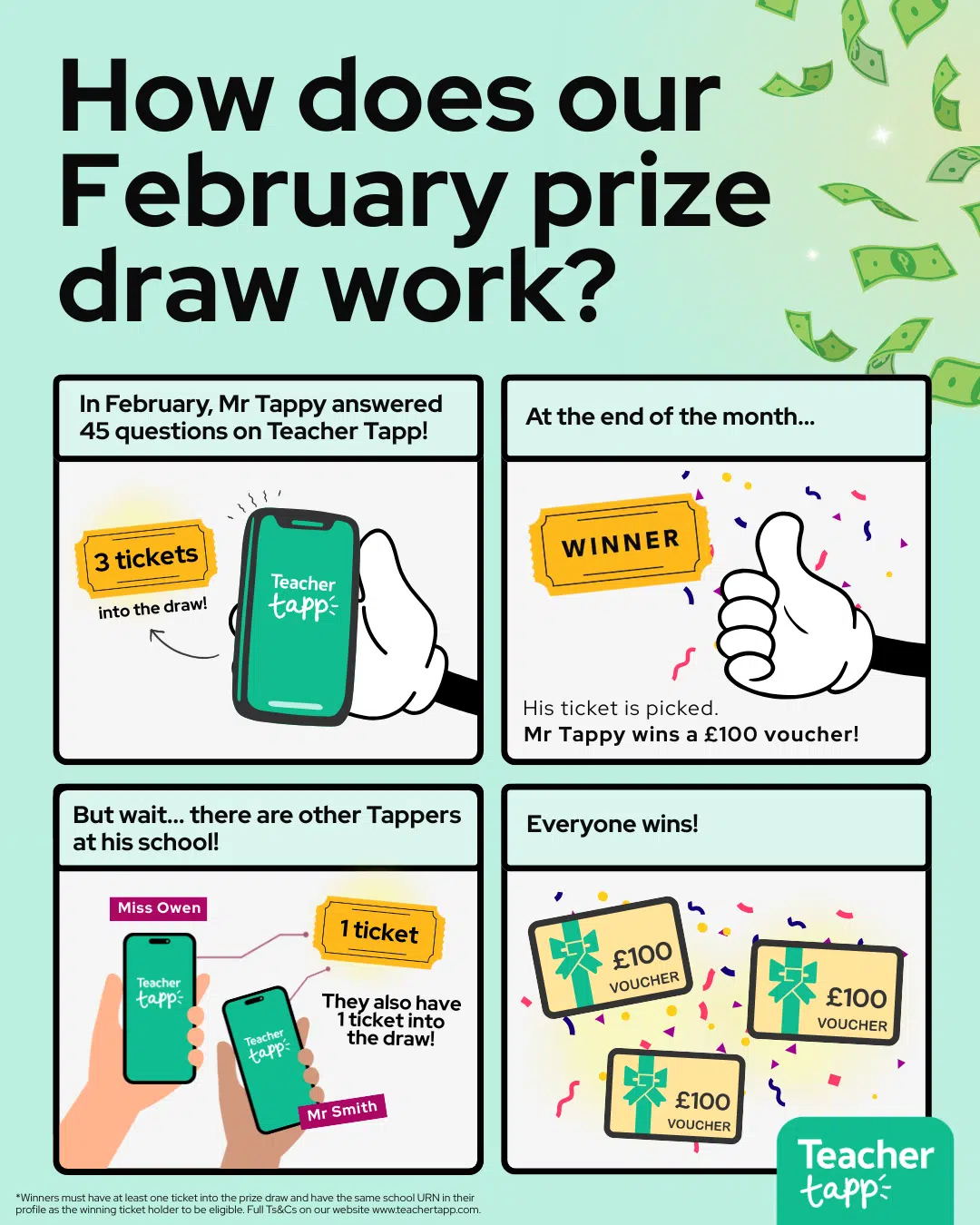
Don’t worry about having to round up all the Tappers in your school; we will make sure everyone who has won a gift card gets one. But if you want to encourage others to sign up, don’t forget you’ve got the refer button in the app to share your code.
If you’ve earned at least one ticket, you’re in – and the more tickets you earn, the more chances you have to win. You can read the full terms and conditions here.
Weather and behaviour
At the start of this month, we reported that classroom teachers told us behaviour in February was the most disruptive since we started recording in 2019.
54% of primary classroom teachers and 43% of secondary classroom teachers reported that students’ behaviour disrupted their last lesson to the point that teaching and learning stopped.
But it isn’t just behaviour that has been breaking records – the weather has been some of the worst recorded too. And bad weather usually means…disrupted break times!
95% of primary teachers told us their schools have rules about weather and keeping students indoors (that’s right – 5% go outdoors in all weathers!) But what sort of provisions do schools have to cope with bad weather?
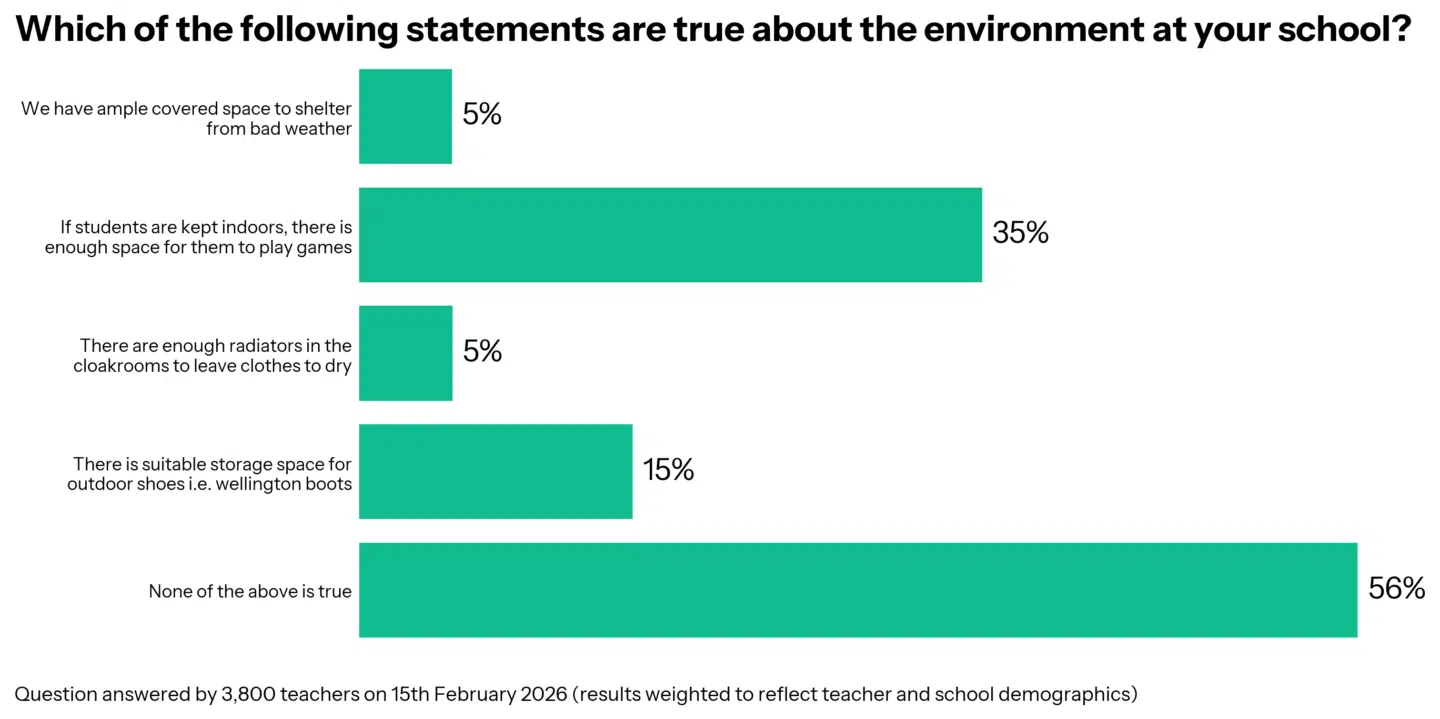
To find out, we asked about the practical things that make outdoor play easier in bad weather: ample sheltered outdoor space, indoor space for games, radiators in cloakrooms to dry wet clothes, and storage for outdoor shoes.
Over half of primary teachers (56%) told us they have none of these. In the most disadvantaged areas, this rises to nearly two-thirds (64%).
Which sort of break time produces more disruptive behaviour when the weather is bad: indoor break time, or outdoor break time?
To find out, we split the panel into two, and half of the teachers were asked about behaviour following bad weather and outdoor play, and the other half indoor play.
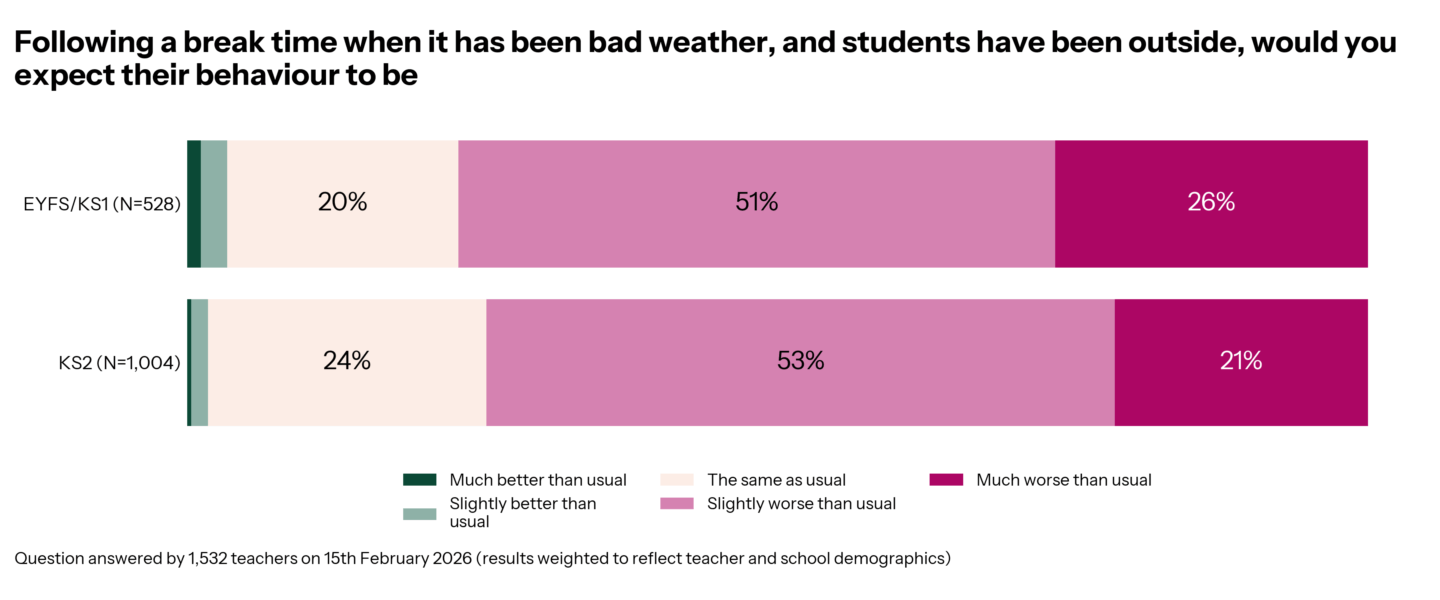
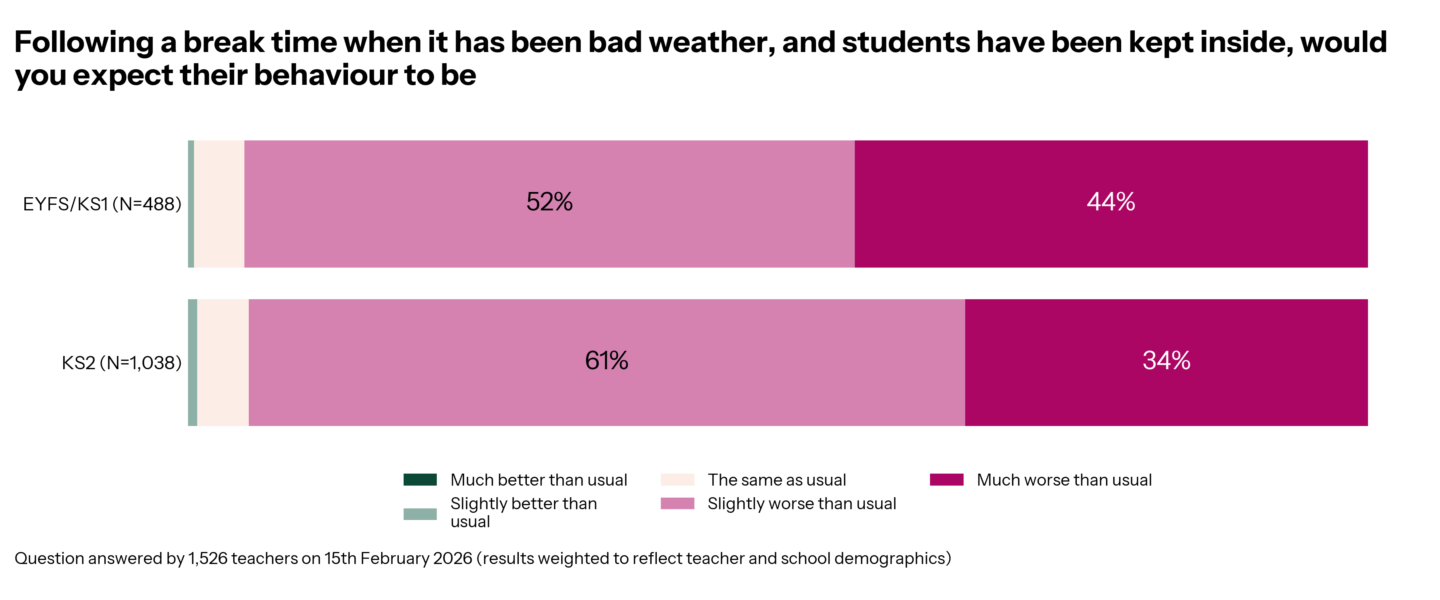
More teachers expected behaviour to be much worse than usual after indoor play, in bad weather, compared to outdoor play in bad weather (37% vs 21%).
We also discovered that the age of the student made a difference when it came to behaviour following indoor play when the weather is bad, but outdoor play was less significant.
The strength of feeling that student behaviour after outdoor play in bad weather will be poor doesn’t vary much between EYFS/KS1 and KS2: 26% of EYFS and KS1 teachers and 21% of KS2 teachers would anticipate “much worse” behaviour after outdoor play. This is a gap of just four percentage points.
This gap jumps to ten percentage points when we ask about behaviour following bad weather and indoor play: 44% of EYFS and KS1 and 34% of KS2 teachers say the same following indoor play.
Staff relationships
Meeting a romantic partner in the workplace is pretty common – in fact, a poll by TUC found that one in five people married or in a civil partnership met at work. But are schools following the trend seen in other sectors of introducing rules about workplace relationships?
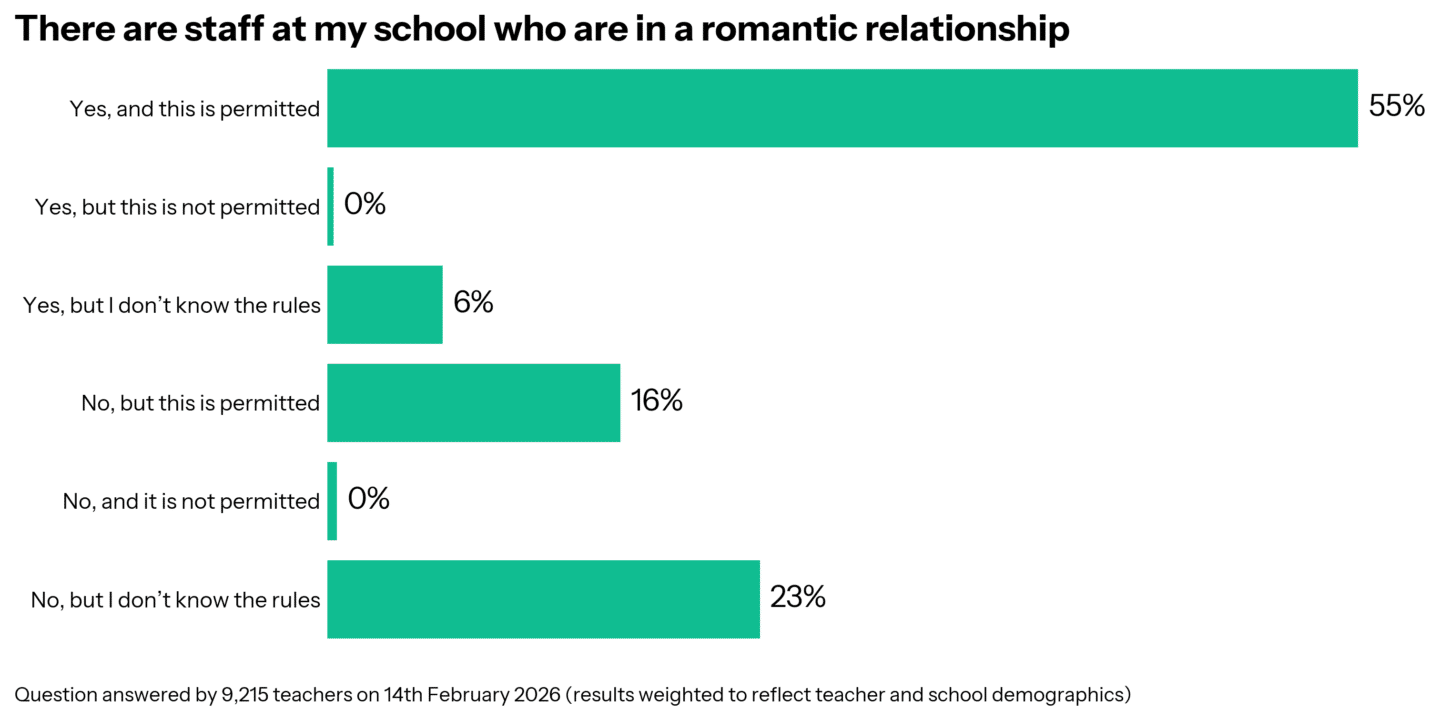
61% of teachers told us there were staff at their school in a romantic relationship, and that this was allowed for 55%; 6% didn’t know the rules.
However, the real division came when we asked about opinions on whether or not romantic relationships should be allowed in schools. 43% think they should be allowed, and 43% think they should be allowed in some circumstances, for example, when neither partner is managing the other. Just 1% thought they should not be allowed, and 13% didn’t have an opinion.
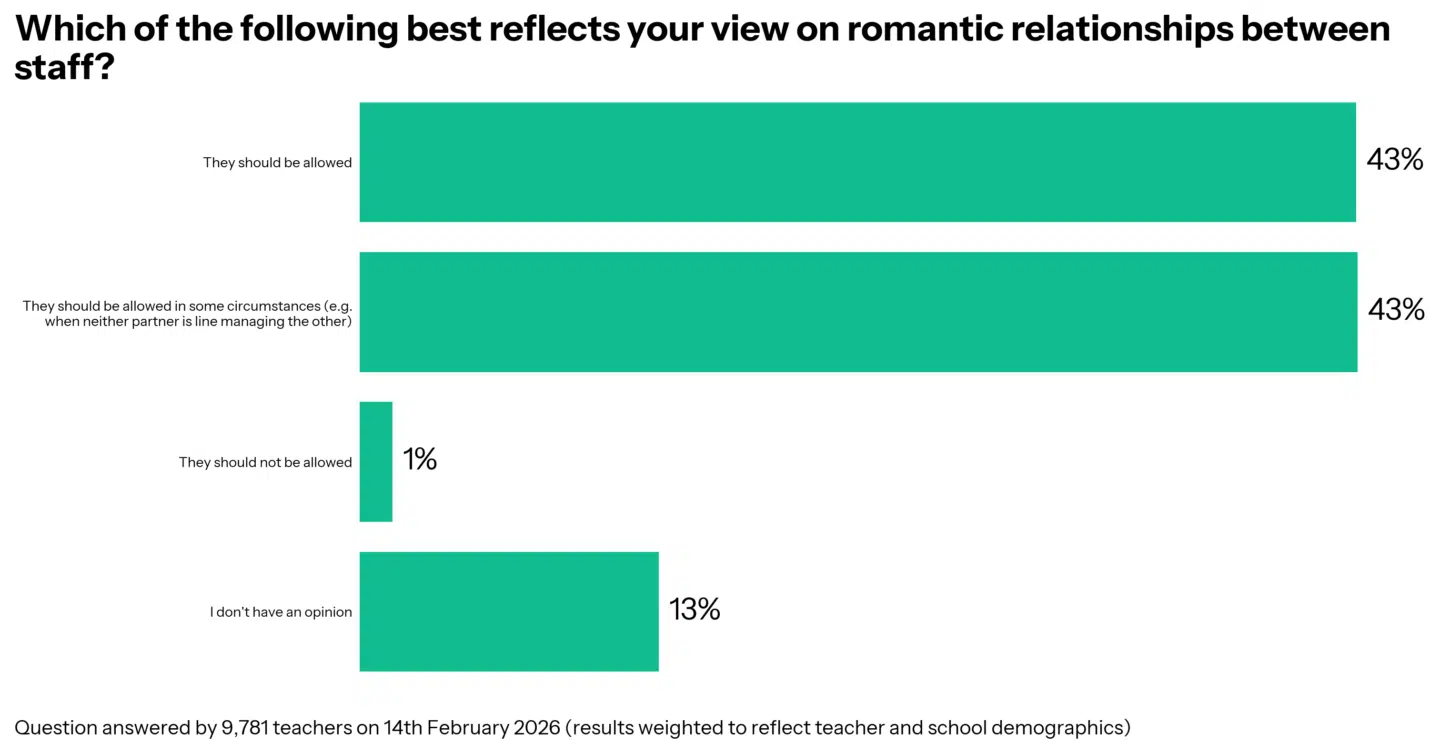
Opinions on whether or not relationships should be allowed doesn’t significantly change when adjusting for job role or phase – but we do see a shift when we look at whether or not a teacher works in a school with teachers in a relationship. Teachers who currently work in schools where there are staff in a relationship are much more likely to say they think it should be allowed, compared to teachers in schools where there are no staff in romantic relationships (51% vs 32%).
AI attendance targets
Back in November, the Department for Education told schools they were going to receive new attendance targets, created using AI to take into account the student demographic. The plan claimed that “children stand to gain millions more days of learning” as a result of setting “every school an individual minimum attendance improvement target”. These plans formed “part of an urgent drive to restore absence to pre-pandemic levels”.
Now it’s February, how many schools have had their target levels from the Department of Education? 63% have had their targets, but more than a third are still waiting.
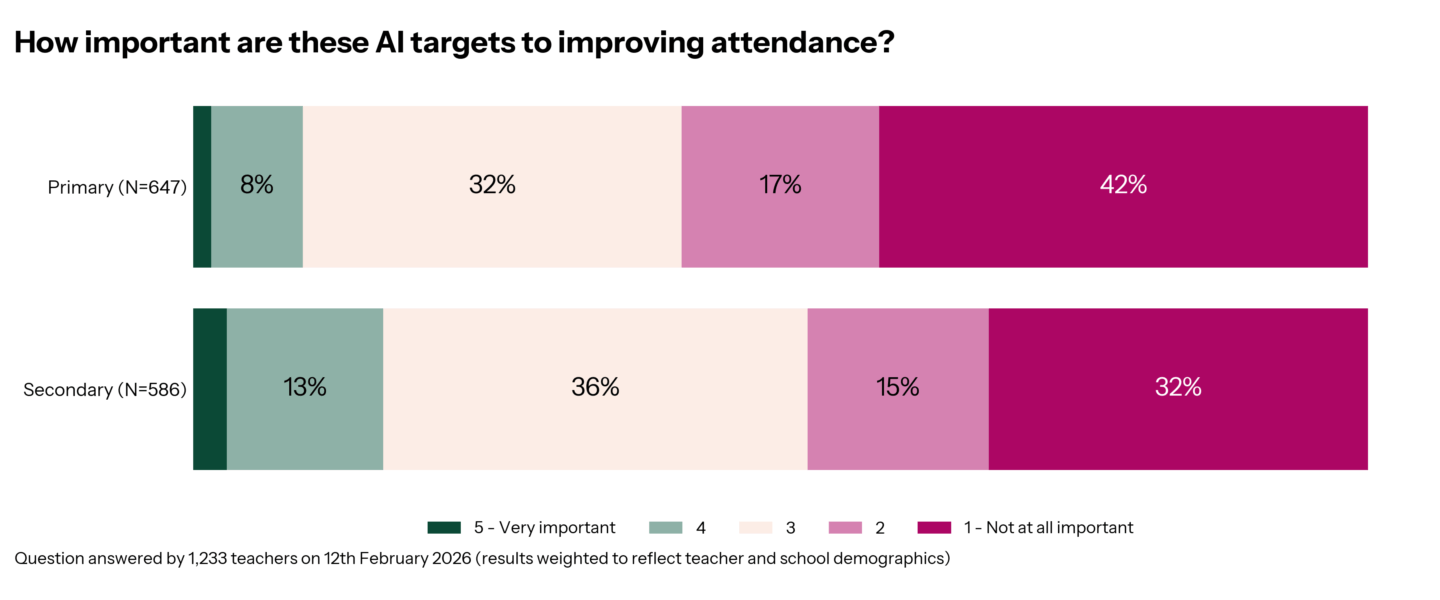
However, not many leaders feel optimistic about the difference the targets will make. 42% of primary leaders say the targets are “not at all important” for improving attendance, and 32% of secondary leaders feel the same.
You can read more about these targets and their rollout here.
Ups ⬆️ and ups ⬇️
⬆️ More classroom teachers say they can do PPA at home ☕️ 28% UP from 19% in February 2022.
🔄 Middle leaders who say they were asked to do a task without reasonable warning during the past half term has stayed the same: 77% in 2023 AND in 2026.
⬆️ More secondary teachers report their school locks toilets during lesson times, compared to 2018 🔐 26% UP from 17%.
Daily Reads
The most read blog last week was ‘What has changed in Keeping Children Safe In Education (KCSIE) and what do teachers need to know?’
Got a blog you think we should feature? Email us at england@teachertapp.co.uk and we will check it out!