It’s beginning to look a lot like Christmas! In the classrooms, it’s the primary teachers who are getting festive with the tinsel, and 70% have decorations up, secondary classrooms are less likely to be bedecked, but 26% have some decorations on the walls.
And that’s not just in the classrooms, 69% of teachers who plan to decorate have put their Christmas decorations up at home🎄.
And soon people will be home and enjoying the holidays, the 19th December is the last working day for most state-school Teacher Tappers (90%) and in private schools, 54% stop this Friday, not long to go now…
Win an iPad!
The race to win the iPad continues – but there can only be one winner! All you have to do is ‘tapp’, and every ten questions gets you ONE ticket in the draw. We will pick the winner on the 18th of December, so keep an eye on your emails, and you can watch your tickets grow in the app! Check the Ts and Cs here.
PPA preferences
Last week, we asked about flexible working preferences, and working from home was a popular choice (read more here). The option to work from home has also been floated by the Department for Education as a way to help encourage more teachers into the profession – and they have even extended their flexible working ambassadors programme this year.
But how common is it for teachers to do their PPA at home? And do they want to be home when doing their PPA?
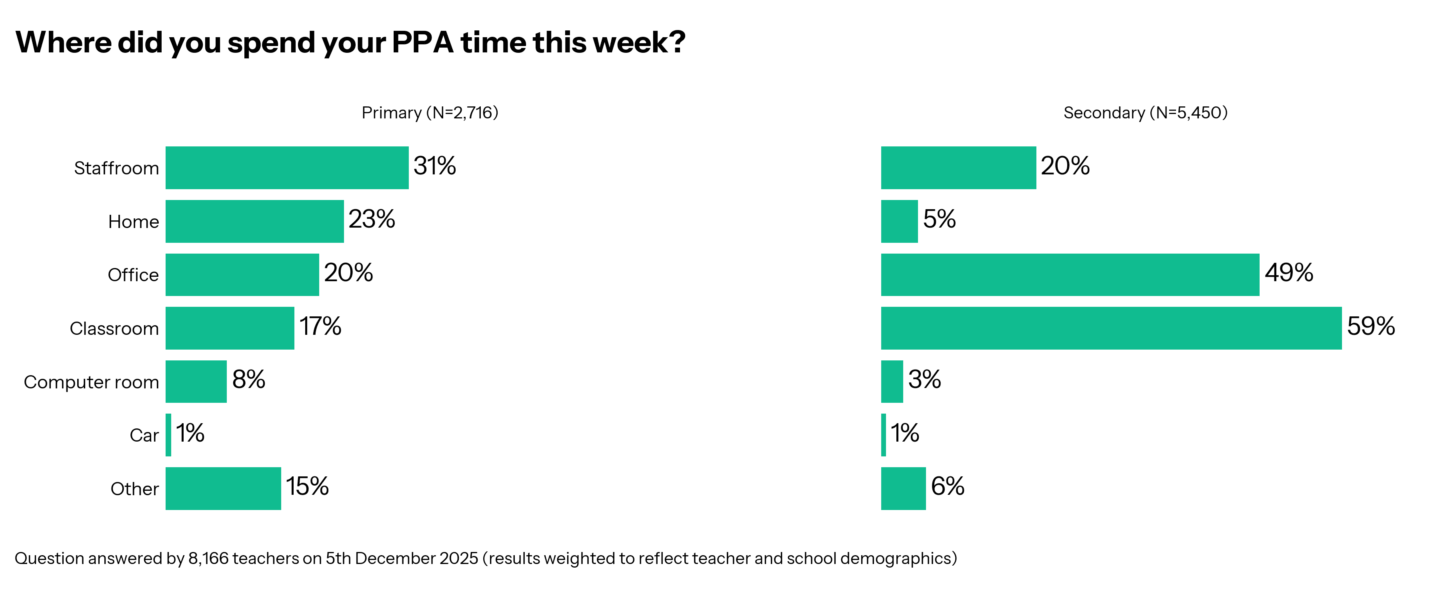
In primary schools, the staffroom is the most common place for teachers to do their PPA (31%) whereas in secondary, doing it in a classroom is the most common location (59%). Working from home happened for 23% of primary teachers and 5% of secondary teachers – and this was very similar to previous years.
Now, to find out what teachers want and how many are happy with what they have got, we compare the reality with where teachers would choose to do their PPA if they had the freedom to go anywhere.
Primary teachers were most satisfied when they were able to complete their PPA at home, with almost all (96%) saying they would choose the same location again. Teachers doing their PPA in their office were reasonably content too, with around half preferring to stay where they were.
It’s not all good news: satisfaction dropped sharply among teachers who did their PPA in their classroom or computer room: only a third of those working in these two places would choose to repeat that arrangement. The staffroom is the least ideal of all, with 27% saying they would choose to work there if they had other options.
Overall, primary teachers clearly favour quieter, more private spaces for PPA – especially home – over the shared or busy spaces inside the school building where many currently work.
Primary teachers
- 96% did their PPA at home would choose home again.
- Only 46% of the teachers did their PPA in the office would choose the office again, with 55% choosing home.
- Only 38% of the teachers who did their PPA in a computer room would choose the computer room again, with 58% choosing home.
- Just 27% of the teachers who did their PPA in a staffroom would choose a staffroom again, with 62% preferring home.
- 34% of the teachers who did their PPA in a classroom would choose a classroom again, with 57% picking home.
Secondary and primary teachers are pretty similar – and those working at home are the happiest by a clear margin, with 87% wanting to repeat that choice.
However, compared to primary teachers, secondary teachers appear much more content with school-based locations. Over half of secondary teachers who used the office would choose it again, and a striking 61% of those who worked in their classroom were happy with that arrangement — nearly double the primary figure.
The staffroom remains the least satisfying option in both phases, with only around a quarter of teachers preferring to return there. Overall, while home was a popular choice with both phases, it’s the secondary teachers who seem happier doing their PPA on-site, compared to primary teachers.
Secondary teachers
- 87% did their PPA at home would choose home again.
- Only 54% who did their PPA in an office would choose an office again, with 45% picking home.
- Only 26% of those who did PPA in a computer room would pick a computer room if they could choose, and 47% would pick home.
- Just 24% who worked their PPA in a staffroom would choose the staffroom, 49% would rather work in the classroom.
- 61% who worked in a classroom for their PPA would choose the classroom again, and 43% would choose home.
If you’re interested in how flexible working might make your school a more attractive place to work, check out our research piece we did together with the EEF,
Sick children
Now, moving away from your time outside of classroom planning what to do, back to inside and faced with what most teachers fear most…the unwell child.
Sick children: if you’re lucky, you send them off while they look pale and sweaty, if you’re unlucky, you might catch it too late 🤢
Last week, 42% of teachers sent a child to the office because the student felt unwell, and the good news is that this is the lowest rate outside of the 2020 COVID year.

It’s slightly more common to send students to the office when they’re feeling unwell in primary schools compared to secondary schools (43% vs 40%). However, English teachers seem to get more poorly children compared to other subjects, with 47% reporting they had a sick child in their class. Teachers of PE appear to get the least amount of unwell students, with just 33% reporting a student had to be sent elsewhere during their lesson. Is this just chance, or do you think certain subjects are more likely to get unwell students than others? Here in the Teacher Tapp offices, we are split – do get in touch and weigh in on the debate!
Some schools have been in the headlines due to very high numbers of students and teachers catching illnesses – is this something your school has had to do? Get in touch if you have suggestions for questions about illness or sickness england@teachertapp.co.uk.
Confidence speaking in meetings
Staff meetings can be perceived as something of a necessary evil. We know we have to have them, but that doesn’t mean we have to like them. And they receive a fair bit of criticism: they’re too long, too boring, too technical, too focused on one particular subject or year phase.
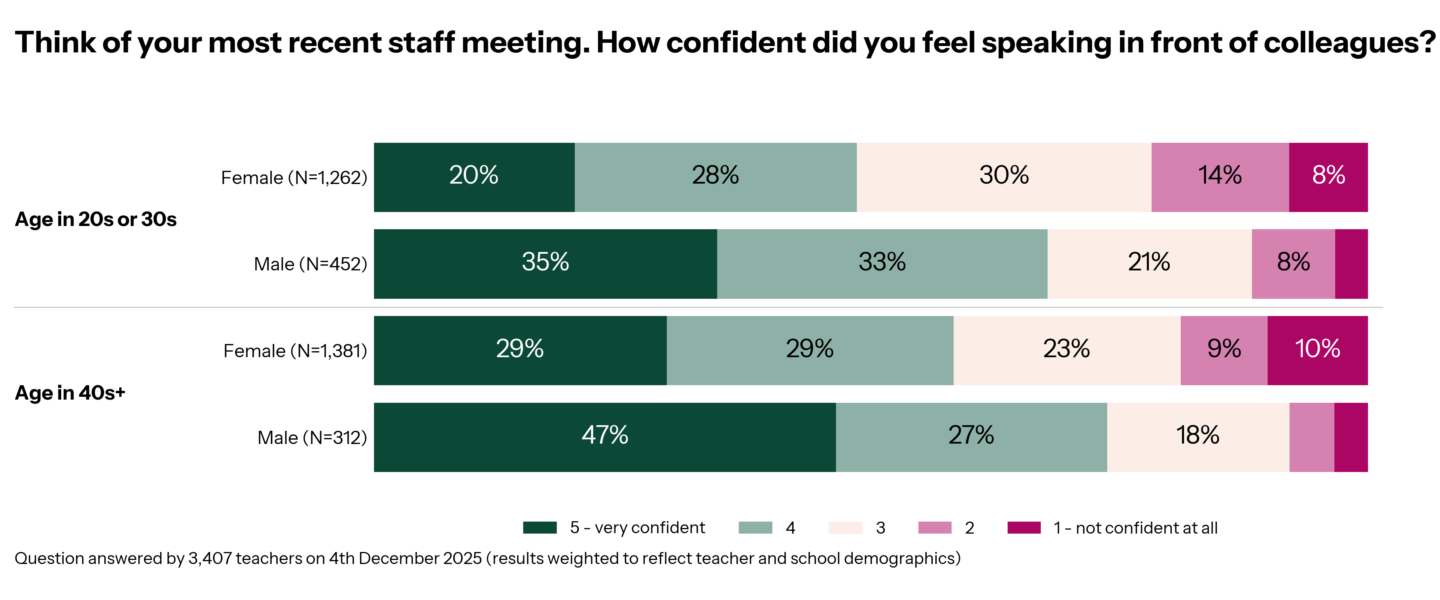
But whatever you think of the meeting, those attending must have the confidence to speak up if they wish. However, this isn’t always true for the classroom teachers attending. In fact, younger teachers in their 20s and 30s, are less likely to report feeling “very confident” when compared to teachers 40 and older (24% vs 33%). And a significant number report feeling “not confident at all” in both age groups (7% and 9% respectively).

Although the age gap looks dramatic – things become even more pronounced when you introduce gender.
There is a 15 percentage point gap between female and male classroom teachers reporting they feel “very confident” speaking up in meetings in their 20s and 30s (20% and 35%), and this gap grows to 18 percentage points once teachers reach 40 or older (29% and 47%).
Similarly, at the other end of the scale, there is a male/female gap: 8% of women in their 20s and 30s report they feel “not confident at all” speaking up in meetings, compared to 3% of men in the same age group. This gap only increases with age, and when classroom teachers are over 40 women are more than THREE times as likely to say they have “no confidence” speaking in meetings (10% vs 3%).
What can senior leaders do about this? After all, voices contributing to meetings should fully represent the staff body, and good ideas deserve to be heard, not just the voices of those who have more confidence than others.
Keziah Featherstone, head of Head Teachers Roundtable, says that those leading the school should be proactive in addressing this gap.
“Strong leadership is inclusive, equitable and intentional. It is essential in any workplace, but especially feminised ones such as education, to ensure everyone has their voice valued,” she says.
Featherstone’s advice is to offer all teachers access to tools that will help them overcome this. “There is a range of developmental strategies you can use, including public speaking ones, but the I Am Remarkable movement is a positive revolution.”
The other important approach Featherstone recommends is for leaders to plan for those who don’t speak, and suggests that when whoever is taking the meetings doesn’t “simply open the floor to the most confident or most opinionated” and instead says they should “craft ways to encourage all to contribute”.
If you’re a teacher who is a nervous speaker, try this TED masterclass on confident speakers.
Elf-watch
This week, a Teacher Tapper who got in touch to ask about small mischievous creatures, dressed in red and green and usually found dangling from projectors or half buried in a sand tray…
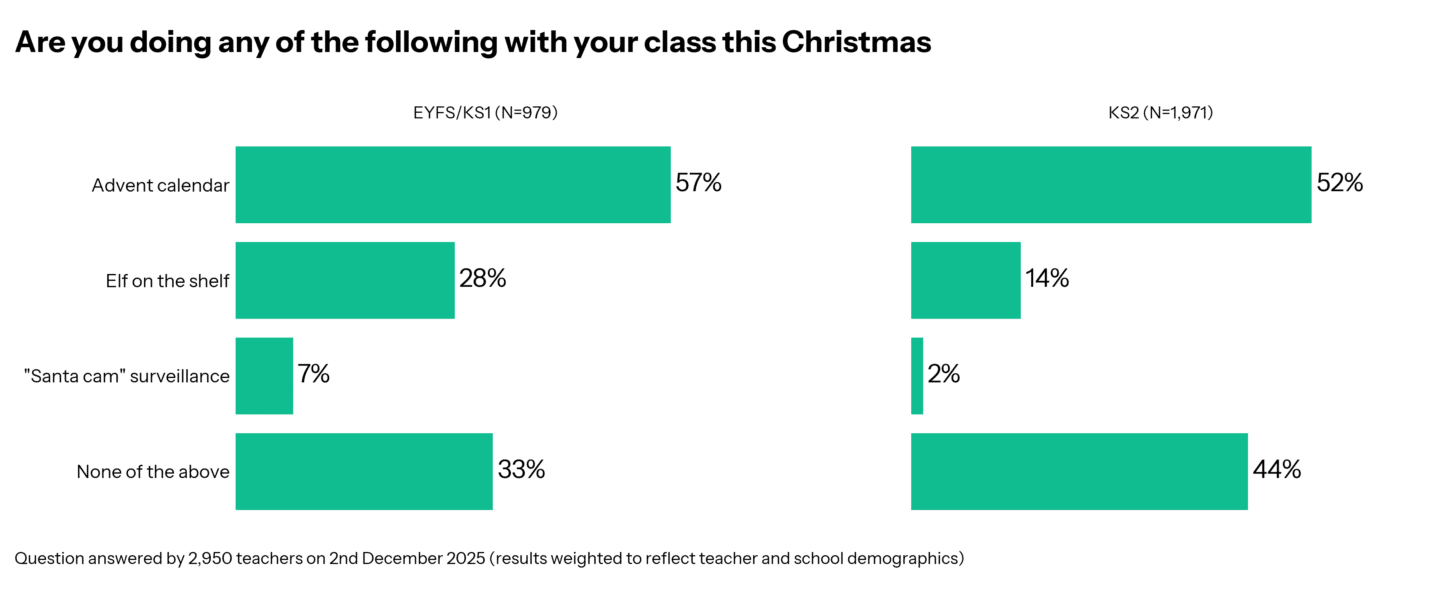
If you’re confused, then perhaps take a peek in one of the EYFS/KS1 classrooms to see if the teacher is doing ‘Elf on the Shelf’ – you have a decent chance of finding it there, with 28% of teachers telling us they were doing it.
The return of Ups 📈 and Downs 📉
A return of the beloved Teacher Tapp Ups and Downs, where we track what is trending up, and what is fading out, in classrooms across the country.
This week, it’s teachers and tech-know-how: When it comes to using technology in the classroom, do you know more than your students?
⬆️ UP the overall number of teachers who say they know ‘considerably more’ than their students (44% UP from 37% in 2018).
⬆️ The biggest jump UP is in primary schools, where those saying they know ‘considerably more’ have moved UP from 45% in 2018 to 56% today.
⬇️ And everyone is enjoying a boom in tech-confidence, trending DOWN is the number of over 50s saying they know ‘considerably less’ – 4% DOWN from 6% in 2018.
Daily Reads
The top read this week from Third Space Learning and was all about ditching lesson observations. A quarter of leaders read about the alternatives to observations…perhaps getting some ideas for the new school year!
Got a blog you think we should feature? Email us at england@teachertapp.co.uk and we will check it out!