Teacher Tappers write in all the time with questions they would like in the app, and our MOST requested question topic is parents!
Teachers want to check –
“Is my experience normal?”
“How much contact do other teachers have from parents?”
“Is it just me who spends hours replying to emails and returning calls??”
Fortunately, here at Teacher Tapp, we can find out the answer to these questions – so here are our most frequently asked parent questions – how does your experience compare?
Contacting home
First up, how we communicate. With so many channels of communication, there is the real risk of overwhelming parents and teachers with information. One way to tackle this problem is to filter parent emails through the main office.
- 60% of primary classroom teachers can be contacted only through the main office, but that’s only true for 13% of secondary classroom teachers.
- But with headteachers, slightly different story: around half of primary leaders said their head is contacted only through the main office, and in secondary, it was just 19%.
Do teachers find parent contact manageable?
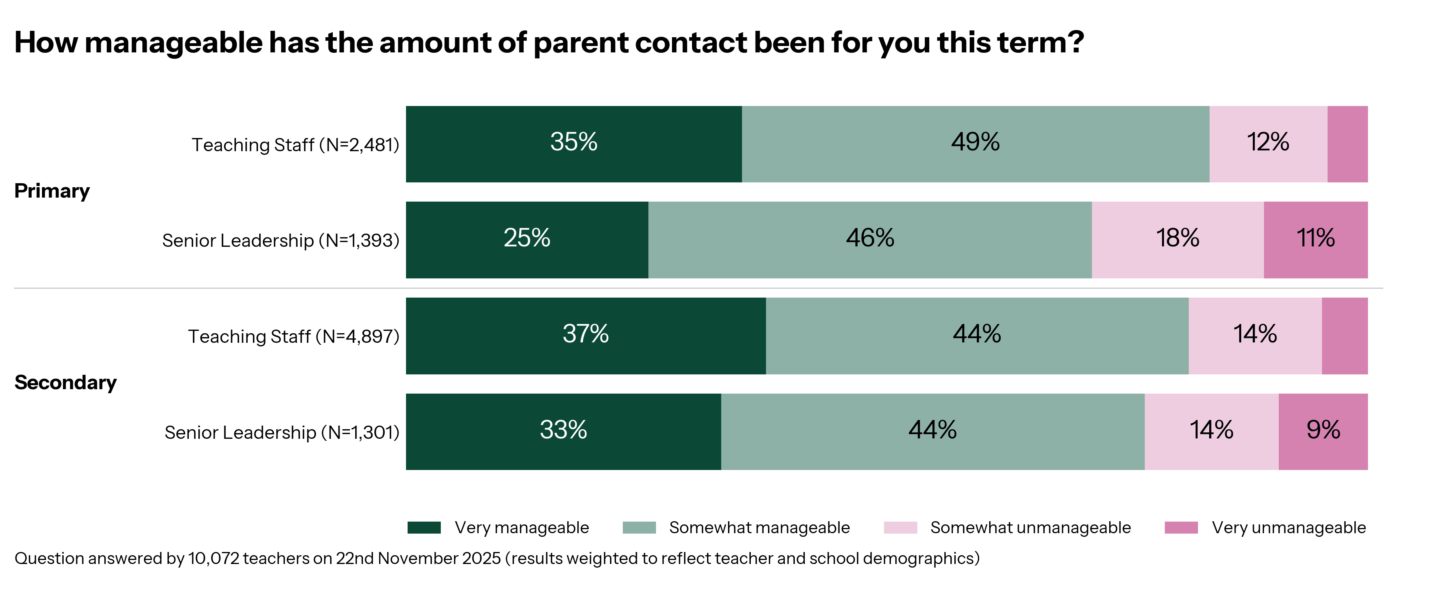
The good news is that overall, for the majority of teachers, they feel the amount of contact they had in the Autumn term was “manageable” (81% of both primary and secondary teachers).
When we break this down by seniority, the toll on senior leaders becomes apparent: just 71% of primary senior leaders describe parent contact as manageable, and the same is true for 77% of secondary leaders.
Banned parents
When parental relations deteriorate to a point where the relationship completely breaks down, schools might then take steps to limit contact or prevent parents from contacting teachers.
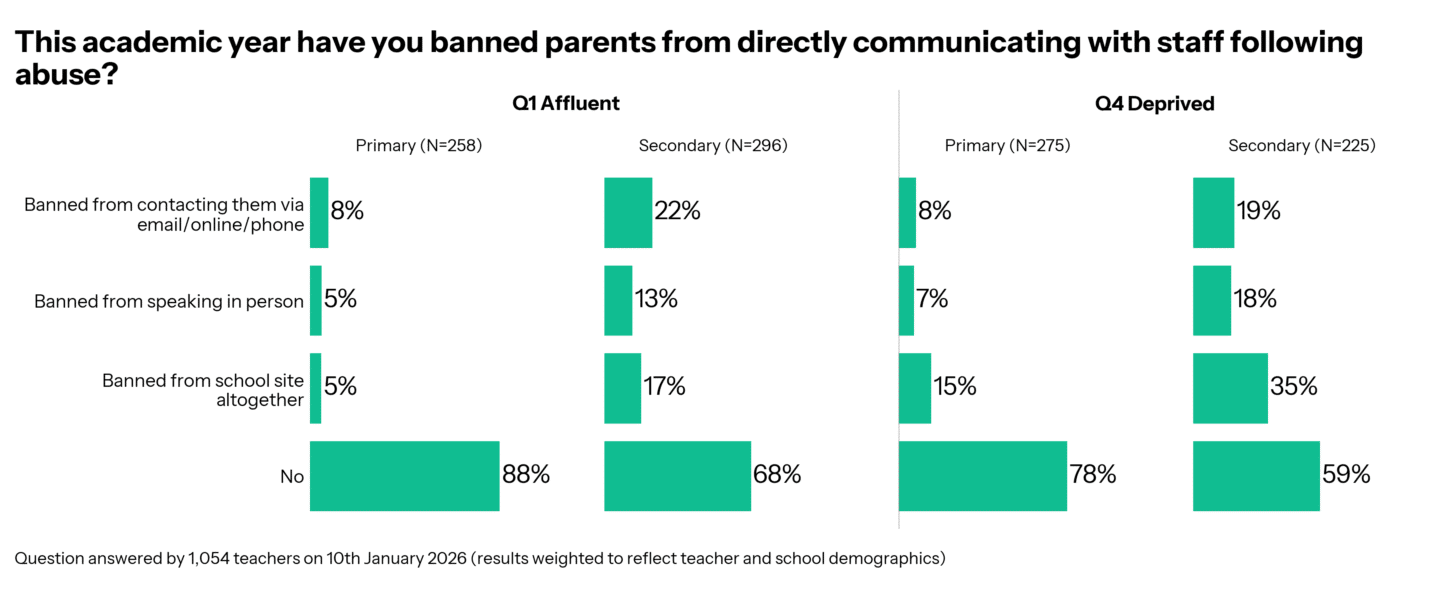
Secondary leaders were three times more likely than primary leaders to report that they had banned parents to some degree (33% vs 17%).
Teachers in the most deprived areas are also far more likely to restrict parents following abuse towards teachers: 32% of secondary leaders in schools with the highest levels of students on Free School Meals (FSM) reported parents had been banned from communicating, compared to 41% of secondary leaders in the most affluent areas and the lowest levels of students on FSM.
In particular, banning parents from the school site was twice as common in secondary schools in the most deprived areas, when compared to the most affluent areas (35% vs 17%).
Dialling in on phone calls
A phone call home can be seen as a quick and high quality method of communicating with an individual parent: it’s not always possible to speak face to face, a letter takes more time and a ‘note’ passed via the student isn’t always easy or appropriate. But the thought of calling home bothers some teachers more than others.
To find out how common it was to be put off by calling home, we conducted a little test with our Teacher Tappers.
Half of the Tappers were asked about how they felt when making a positive phone call, and the other half about their feelings regarding a negative phone call. By asking it like this, we hoped we could unpick what the issue was: making a phone call, or making a negative phone call.
When sharing negative news, 72% of teachers reported they would feel confident picking up the phone.
When sharing positive news, 93% of teachers say they would feel confident making the call.
But who wouldn’t feel confident at all? When sharing negative news, 6% of teachers describe themselves as “not at all” confident, and the same was true for 1% of teachers when making positive phone calls.
Which teachers don’t like phone calls?
So what sort of teachers lack confidence in making phone calls? At the most extreme end, the 1% who are “not confident at all” even when making positive phone calls, are more likely to be ECTs (3% vs 1%).
But those who describe themselves as “not very confident” are more likely to be teachers in their 20s (10%) compared to teachers aged 50 and over (4%).
The majority of teachers have not had training on communicating with parents; only 7% of classroom teachers and 10% of senior leaders have had training on communicating with parents in the last 12 months. 19% of classroom teachers and 26% of senior leaders have had training in the past (just not recently).
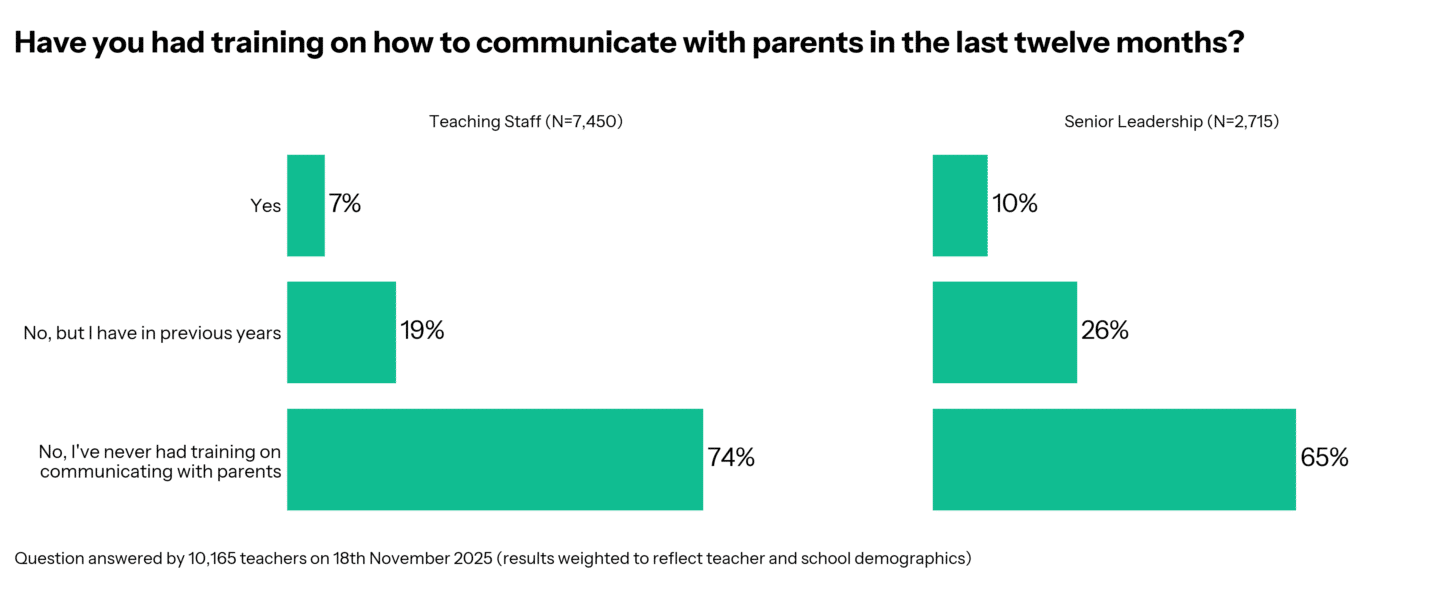
The rest? Nothing. This means 74% of classroom teachers and 65% of senior leaders have never had training on parental communication.
Due to the small number reporting they have had training, it’s difficult to tell how much of a difference training would make. However, we can see that among those who have never had training, only 60% report feeling very confident dealing with phoning home, whereas among teachers who have had training, that increases to 68%.
It might not be a silver bullet, but it looks as if more training specifically on communicating with parents could be a lever to pull if building relationships with parents is a priority in your school.
It is important to note, teachers who are finding parent contact unmanageable are TWICE as likely to want to leave teaching: 40% of teachers who described parent contact as ‘very unmanageable’ say they ‘strongly agree’ they would leave teaching if they could find another job that matched their salary, compared to 20% of teachers who describe parent contact as ‘very manageable’.
Parent complaints: the numbers
We asked Teacher Tappers to tell us about the parent complaints they have dealt with most recently – and, as always, we were blown away by the replies. Here is what we found out once we crunched and processed all the responses…
- 1,915 teachers responded.
- SEND was mentioned 278 times
- 120 teachers said they had no complaints so far this year
- 26% of replies referred to complaints about other students or friendship fallouts
- 4 responses referenced use of AI – these included parents using it, parents complaining about teachers using it in class, to select students for a trip, and two teachers who described the complaints coming in being AI-created.
Some notable complaints
And now, for the complaints that made these teachers take a deep breath…
“A parent complained that as a headteacher I had only organised two Nativities, one Key Stage 2 production, a Christmas market, Christmas shop, grotto, Christmas lunch, two carol services, Christmas parties and a pantomime — when apparently I should have done three Nativities.”
“I informed a parent that their child had taken an item from another child, concealed it, and, when questioned, admitted what they had done. This is standard procedure at our school. The parent then sent a lengthy email to the office and headteacher, accusing me of being unprofessional and unkind for calling their child a ‘thief’, which they said was a harmful label. I had never used the word ‘thief’ at any point.”
“A parent complained that studying Romeo and Juliet at Key Stage 3 was inappropriate because they believed it would encourage teenagers to run away together and think that ‘love is blind’.”
“A parent complained that I was too slow in replying to their email. It had been twelve hours.”
Future questions 💬
What should we ask next with our parents questions? If you have suggestions – send them in! england@teachertapp.co.uk