Hey there, Teacher Tappers!
We hope you had a lovely Easter weekend – our numbers tell us…
🐣 Most of the Easter egg hunts took place in the South West.
🍫 North West was were the chocolate eating was most likely to happen.
👨🍳 🥘 Cooking roast dinners happened more in the East of England, but 🍽️ eating a roast dinner happened more in the Midlands!
We hope you are getting the downtime you need this week if you’re on holiday (which, according to our numbers, is almost everyone!).
Prize draw winners
🎉 Our March Prize Draw has come to an end, and FOUR lucky teachers scooped £100 gift cards each. We had our main winner, and this time, all four fellow Tappers belonged to the maths department! We’re hoping for lots of jubilation along the maths corridor once the holidays are over!
Not a winner? Don’t worry – we have a new plan up our sleeve for April. Keep your eyes peeled, and this time, there is potential for EVERYONE to be rewarded…
Cheating with AI
Last week, Teacher Tapp was asked to attend a discussion on social media and AI in the House of Lords, and share the important findings all of you Tappers have contributed when answering questions about AI and your students. You can watch a video here.
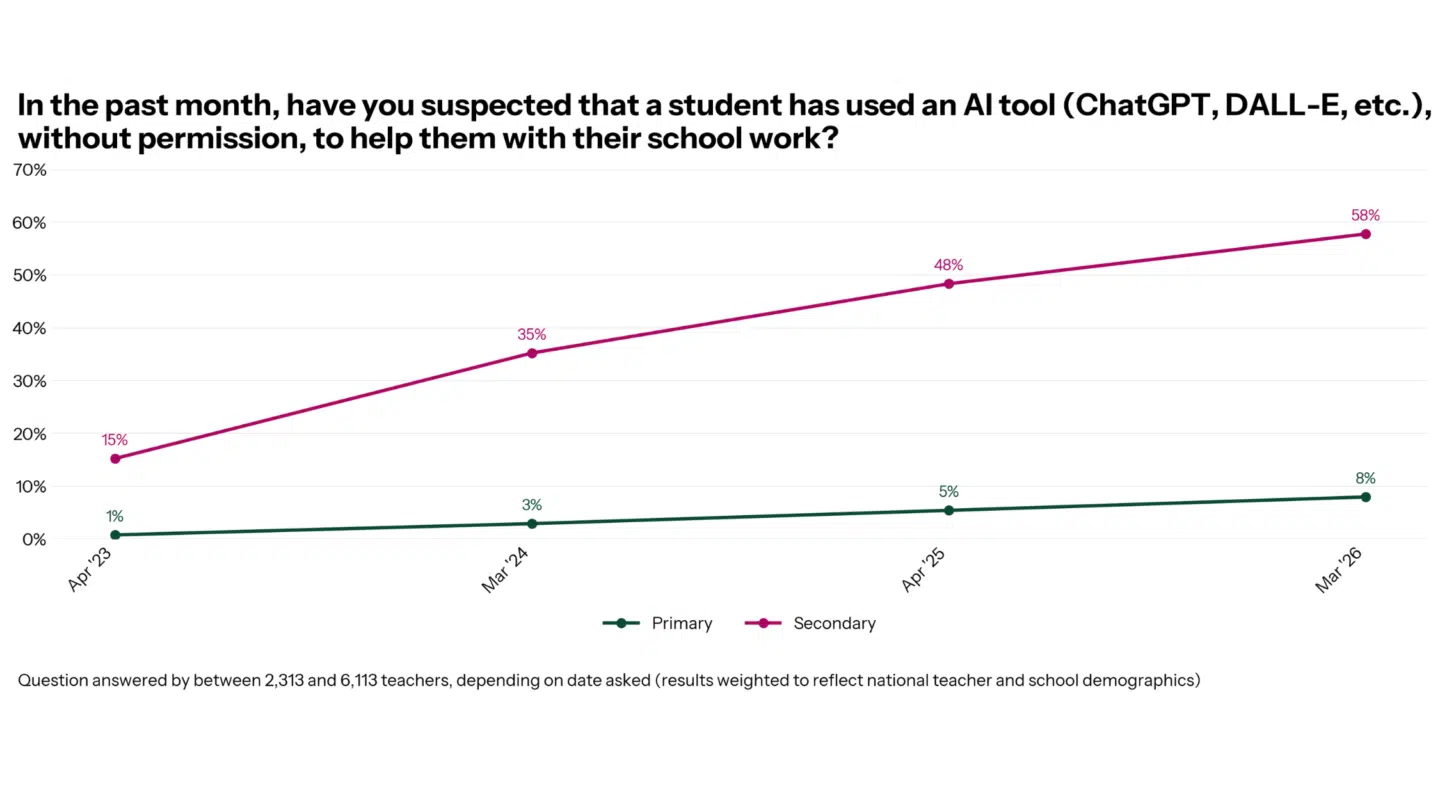
One of the data points discussed was teachers’ experiences with students using an AI tool without permission.
Since 2023, there has been a steady rise in primary and secondary teachers reporting a student has used an AI tool without permission. For secondary teachers, it began at 15% in 2023, grew to 35% in 2024, 48% in 2025 and then 58% in 2026. Primary teachers, the problem is more niche, but has risen from 1% to 3% to 5% to 8%.
Can this predict the future? If things don’t change and these trends continue, with a slowing growth in secondary, next year we could expect that number to increase to 65%, and in primary to 12%. However, at this point, we have no way of telling what other changes might come about that could speed up or slow down this trend. What we do know is that teachers in the classroom now have an extra sword to juggle: spotting when a student has used an AI tool when they shouldn’t, and then taking action to address it.
Subjects with the biggest changes in AI use
The experience of maths teachers has undergone the biggest transformation: in 2023 5% reported a student had used AI when they shouldn’t have; now it’s 61%.
English and Humanities have seen similar rises from 21% and 22% in 2023 UP to 64% and 63% today.
For primary teachers, things haven’t significantly changed for EYFS/KS1 (0% up to 2%). But things have changed for KS2 teachers, moving from 1% in 2023 to 10% in 2026. Perhaps if you haven’t already got rules about when AI should or shouldn’t be used, now is the time to write them.
| Subject | 2023 | 2026 | Change |
|---|---|---|---|
| Maths | 5% | 61% | +56pp |
| English | 21% | 66% | +45pp |
| Humanities | 21% | 64% | +43pp |
| Other incl PE | 22% | 63% | +41pp |
| Languages | 13% | 53% | +40pp |
| Arts incl D&T | 14% | 56% | +42pp |
| Science | 13% | 47% | +34pp |
| KS2 | 1% | 10% | +9pp |
| EYFS/KS1 | 0% | 2% | +2pp |
Devices in schools
Sometimes when people talk about how technology is used in schools, ideas are suggested with the assumption that every child has a laptop. But what is the reality?
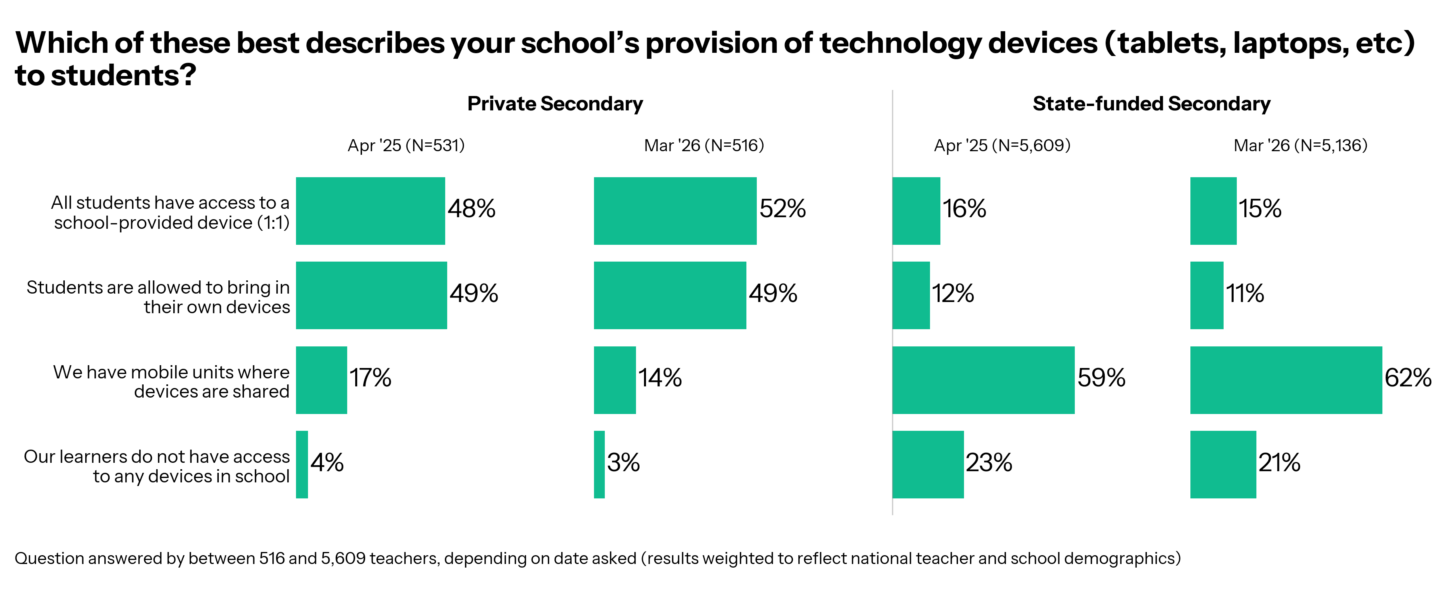
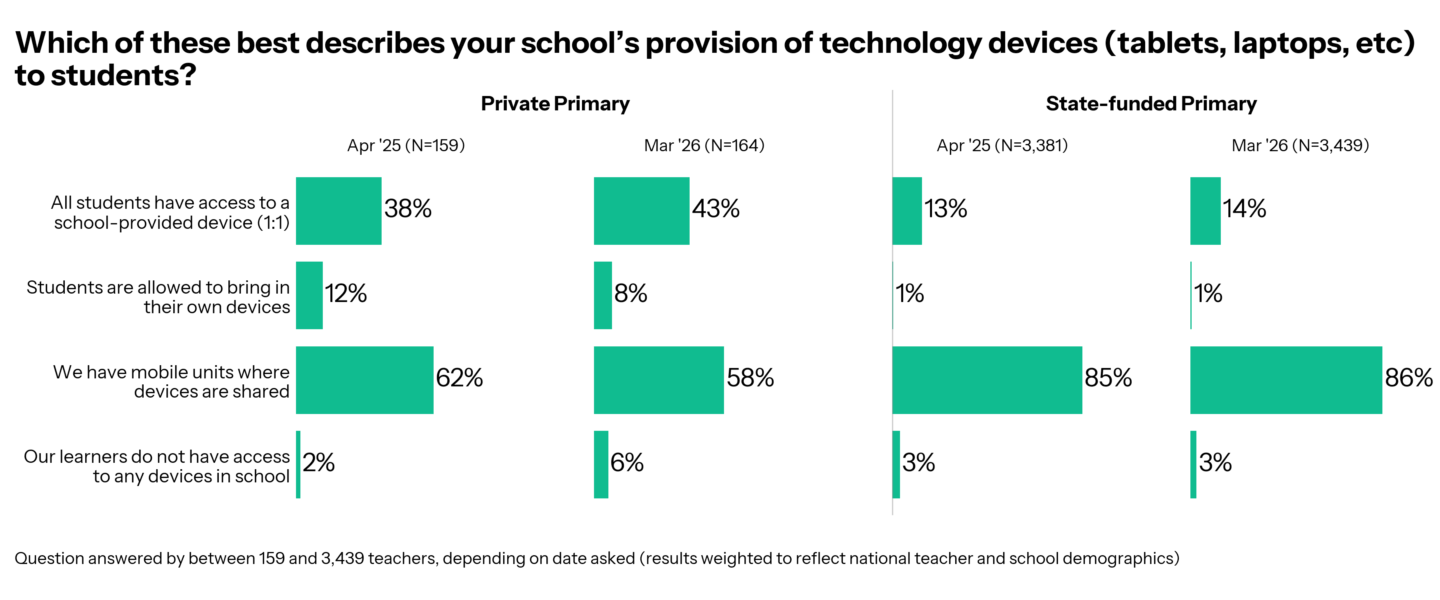
Teachers told us the most common practice for sharing technology devices like laptops and tablets is to have mobile units where devices are shared, with 84% of primary teachers reporting their school uses this set-up, and 56% of secondary teachers saying the same. But when we take a closer look, there is some big variation in these numbers once you take into account private and state schools.
In private secondary schools, 52% of teachers say they have 1:1 devices, and this is UP on last year when it was 48%. In state schools, just 15% say the same, and this is virtually unchanged from the previous year, when it was 16%. Access to technology is far more restricted in state schools, and that gap is growing.
Primary teachers report similar gaps, and similar changes: 38% of teachers in private primary schools reported 1:1 devices, this is now UP to 43%. In state schools, again, that figure is smaller, and it is not shifting: 13% in 2025 and 14% in 2026.
Next, we want to find out perceptions on whether this technology gap is a problem in schools, and how much ‘screen time’ is actually happening. What questions should we ask about screen time in school? When is it used, and have you experienced pushback against screen time, or problems because pupils aren’t getting enough opportunities to use tech? Would you be interested to know what teachers would choose to have in their “ideal” school? Let us know, england@teachertapp.co.uk 📧
Teacher Tapper asked…how many teachers are neurodiverse?
A Tapper wanted to know how many teachers considered themselves neurodiverse, and how much it varies between subjects. There was only one way to find out: ask!
Languages teachers were the least likely to identify themselves as neurodiverse (62% said outright ‘no’), and arts inc D&T were the most likely to say they were (33% yes and 22% not sure).
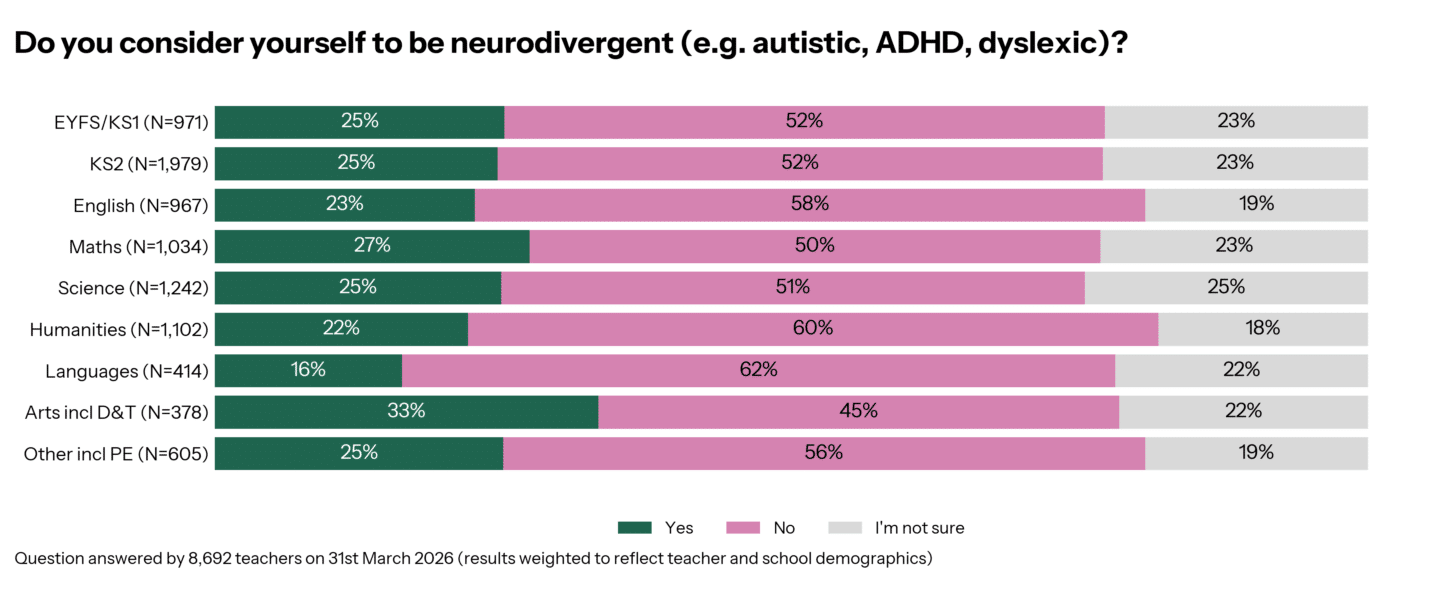
How does this compare? Hard to say. NHS Cambridge University Hospital estimates that 1 in 7 people are neurodivergent, which would put teachers higher than the general population. However, with lots of other contextual factors to consider, like awareness of neurodiversity among teachers, it’s hard to draw strong conclusions.
Zoom in on … teacher pay deal
Teacher pay will soon be in the headlines again once the pay offer officially goes out to teachers – but in the meantime, we checked teachers’ reactions to the current proposal by asking how reasonable they thought the proposal to offer
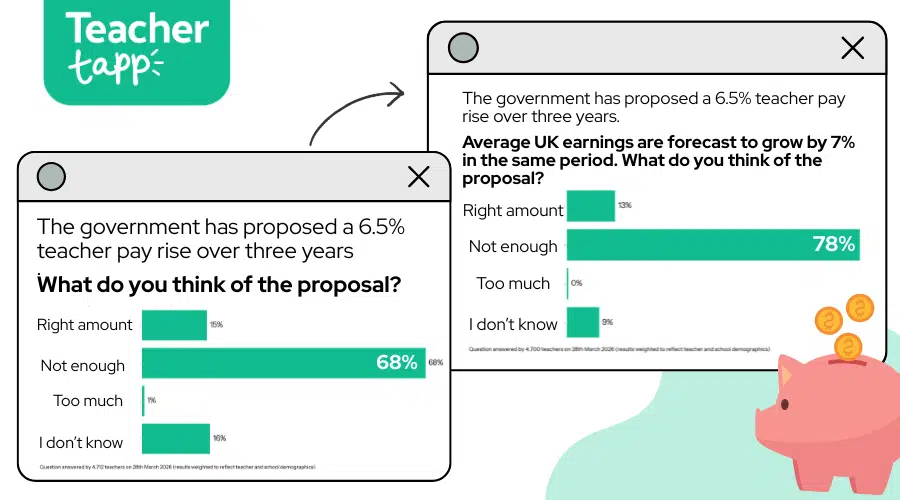
To get a better understanding of how teachers were reacting to the proposal, we split Teacher Tappers in two, and half were asked what they thought of a 6.5% increase over three years, and the other half were given some extra context, and asked what they thought of a 6.5% increase over three years given salaries were due to increase by 7% over the same time frame.
- Without the context, 15% thought it was the right amount, 68% thought it wasn’t enough, 1% thought it was too much, and 16% didn’t know.
- With the context, a small change in the number who thought it was the right amount (13%), more thought it wasn’t enough (78%), and no one thought it was too much, and fewer opted for ‘I don’t know’ (9%).
Last week we shared our TLR findings and we have been wowed by the HUGE number of Tappers writing in with suggestions, stories and analysis questions. Watch out for an update in the blog next week!
Behaviour tracker
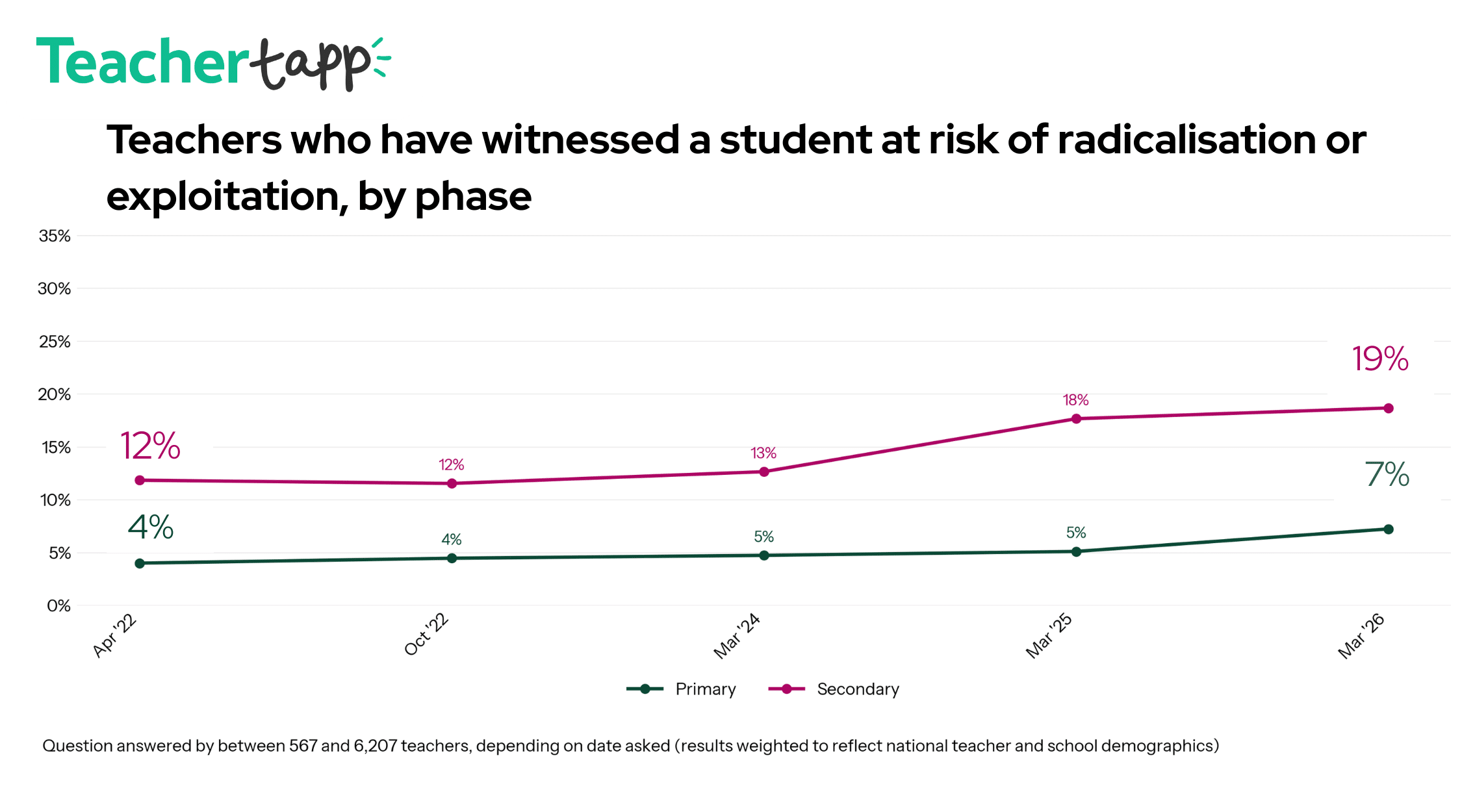
Safeguarding trends have been on our radar last week – not least because it was one of the issues we were discussing in the House of Lords when exploring the impact social media has on young people.
Teachers who have witnessed a student at risk of radicalisation or exploitation have risen since 2022, in secondary, moving from 12% to 19% and in primary, 4% and 7%.
Daily Reads
It was the thought of saving money that made you click this week! Teacher money-saving tips from the King of money saving himself.
There are so many great blogs out there and we love featuring them on Teacher Tapp. If you have a blog you think we should feature, then please email us at england@teachertapp.co.uk and we will check it out!