Hey there, Teacher Tappers!
Well done, we have nearly completed January! It might have 31 days, but everyone knows the truth is it is the longest month. The good news is that we’re nearly at the end. And what’s more, with February comes half-term, so it isn’t all bad!
January prize draw – last few days
Another reason to be cheerful is the fact in just a few days, we will be announcing the winners of the January Prize Draw!You are the most important part of Teacher Tapp, and we want to continue saying “thank you” for making such a valuable contribution! From the 5th January until the 31st January, for every 15 questions you answer on Teacher Tapp you’ll receive a ticket for the Teacher Tapp Prize Draw.
Soon, five Tappers will win a £100 gift card! The prize draw will happen on 2nd February. Full Ts&Cs are here. Good luck!
Fidgets
Fidget spinners burst onto the scene back in 2017. It felt as if overnight, the tiny plastic objects were in every pencil case, and surely all the teachers in the classroom at this point have a war story about the time one was launched across the classroom.
This week, a Tapper got in touch to say there had been a resurgence of their use at his school, and wanted to know if all schools were experiencing the same. Of course, we went to work to find out!
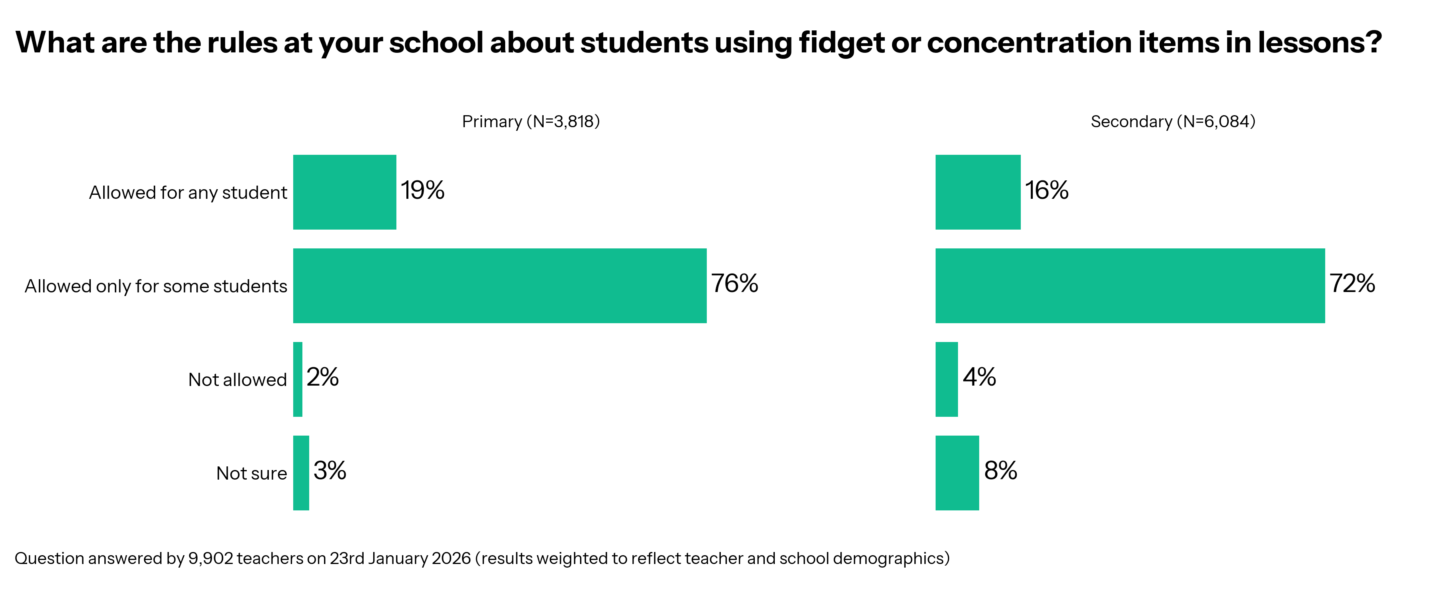
The answer was that yes, lots of teachers had seen fidgets in their classroom: 72% of primary and 62% of secondary teachers had students using fidgets in lessons this week. But what are the rules in schools regarding the concentration items? Responses were pretty similar from primary and secondary school teachers.
- 19% of primary teachers and 16% of secondary teachers told us fidget items are allowed for any student.
- 76% of primary teachers and 72% of secondary teachers reported they were permitted only for some students.
- Fidgets were banned in a small number of schools (2% of primary and 4% of secondary teachers).
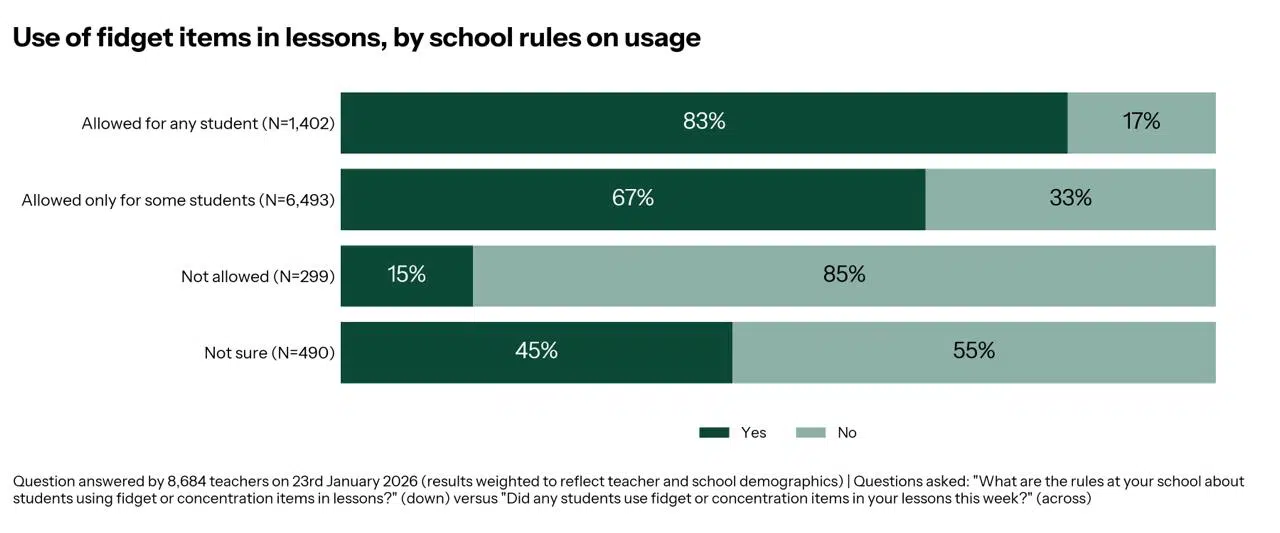
As every teacher knows – you can have a rule, but that doesn’t mean all students will follow it. To find out how the school rule on fidgets impacted the likelihood of a teacher seeing a fidget being used, we crossed these two questions. By doing this, we found out:
- Students are not always following the rules – 15% of teachers in schools where fidgets are banned are still using them.
- Even in schools where fidgets are allowed for every student, not every teacher saw them being used (17% reported not seeing a fidget).
Social media
From fidget spinners, to the head-spinning problem of social media.
This week, we wanted to find out which social media platforms were giving teachers the biggest headaches. The results suggest some are more of a problem than others!
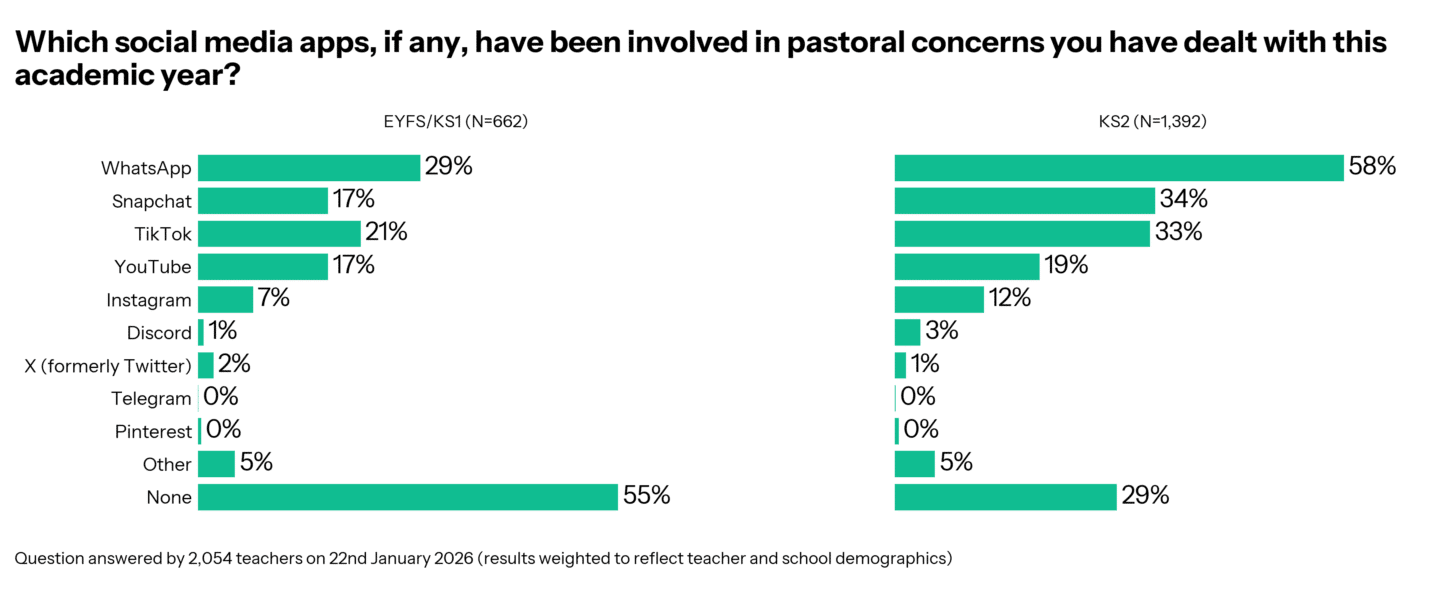
Taking primary teachers first, it’s clear the problem is very much concentrated in KS2, however, that doesn’t mean EYFS and KS1 teachers escape the issues related to social media. In EYFS/KS1, 45% of teachers had dealt with pastoral concerns that involved social media apps, and the same was true for 71% of KS2 teachers.
Whatsapp topped the list in both key stages as the most common app to be involved in a pastoral concern (29% EYFS/KS1 vs 59% KS2). The second most common in EYFS/KS was TikTok (21%) and Snapchat in KS2 (34%). Although we know mobile phone use in primary isn’t an issue when it comes to phones out in the classroom (0% reported phones out in lessons when we last asked), clearly their use outside of the school is overspilling into school time.
Over in secondary, the picture looks very similar…but more apps are involved! Two-thirds of teachers reported they dealt with pastoral concerns involving social media (slightly fewer than KS2 teachers), and Snapchat overtakes Whatsapp as the biggest cause for concern (52%). TikTok is second at 48%, followed by WhatsApp (43%).
Unlike primary, teachers in secondary reported dealing with pastoral concerns with every app on our list – even the more obscure ones like Telegram (1%) and Pinterest (1%).
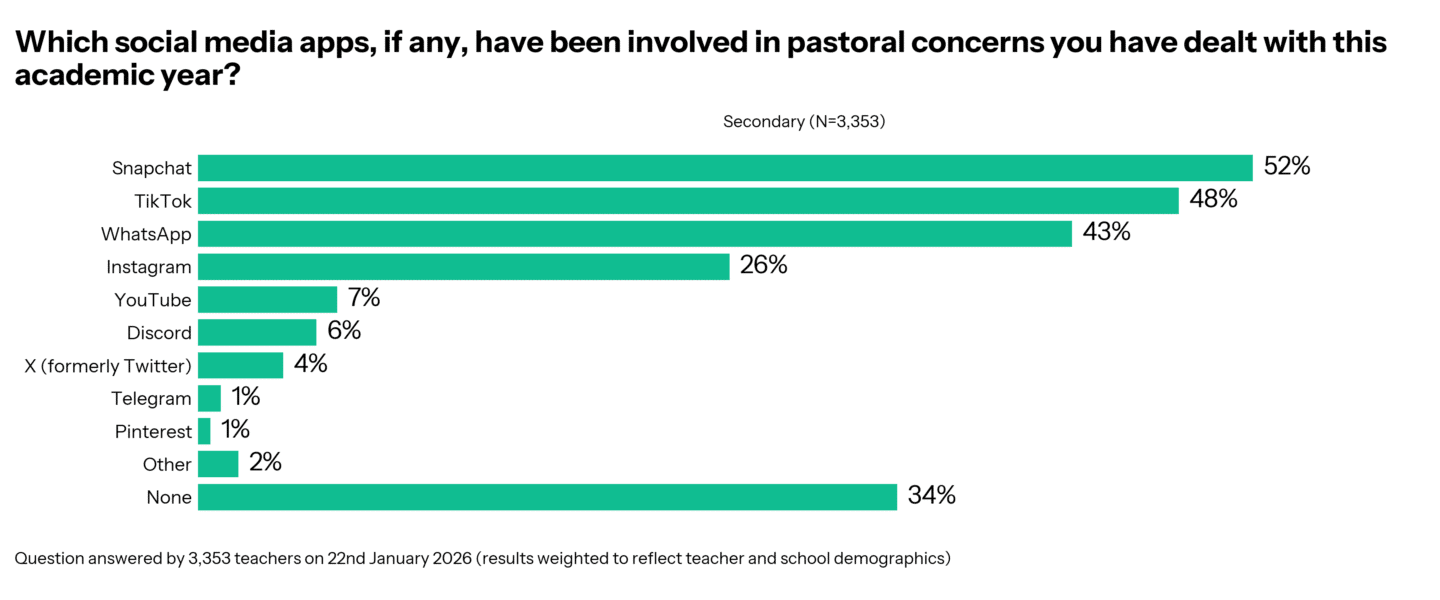
Together, this paints a picture of teachers dealing with problems from a range of different apps, and the problem only growing with the age of the student. The result? Teachers have to have a decent knowledge of many platforms in order to best advise and support their students.
GCSE duration
Now jumping back to the classroom, and exams! GCSEs are set to be shortened, according to the recent Curriculum and Assessment Review. But is the planned trim of 10% too much, too little or just right?
Students in England typically sit between 24 to 31 hours of external exams. But this experience isn’t the same all around the world: Exam time is 16 hours in Ireland, 18 hours in New Zealand and 10 hours in Canada. But how does knowing this change how teachers answered?
To find out, we ran a little experiment. ‘Anchoring’ is a psychological technique in which you can change people’s perceptions by offering ‘contextual’ information.
Having the information about different countries could change perceptions about our own exam time. We polled teachers on their opinion on the 10% cut. In one version, we added context (anchors) and in another, just the England entitlement with ‘too much or too little’.
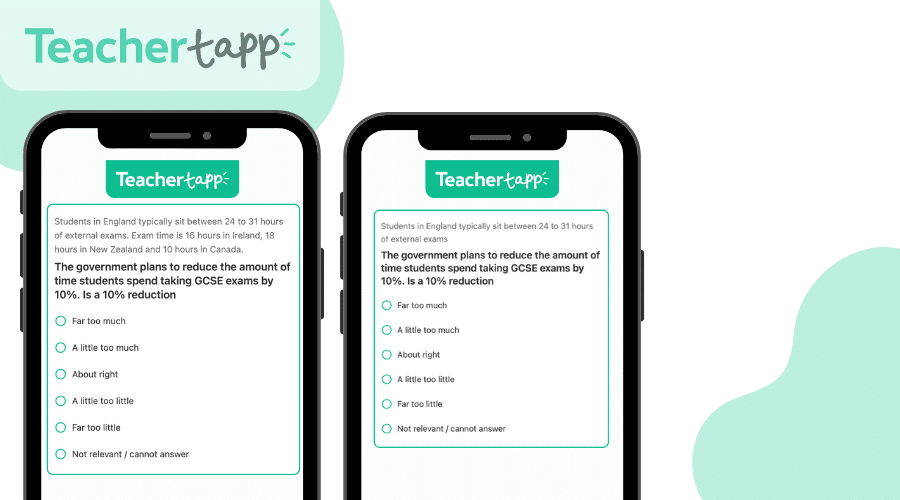
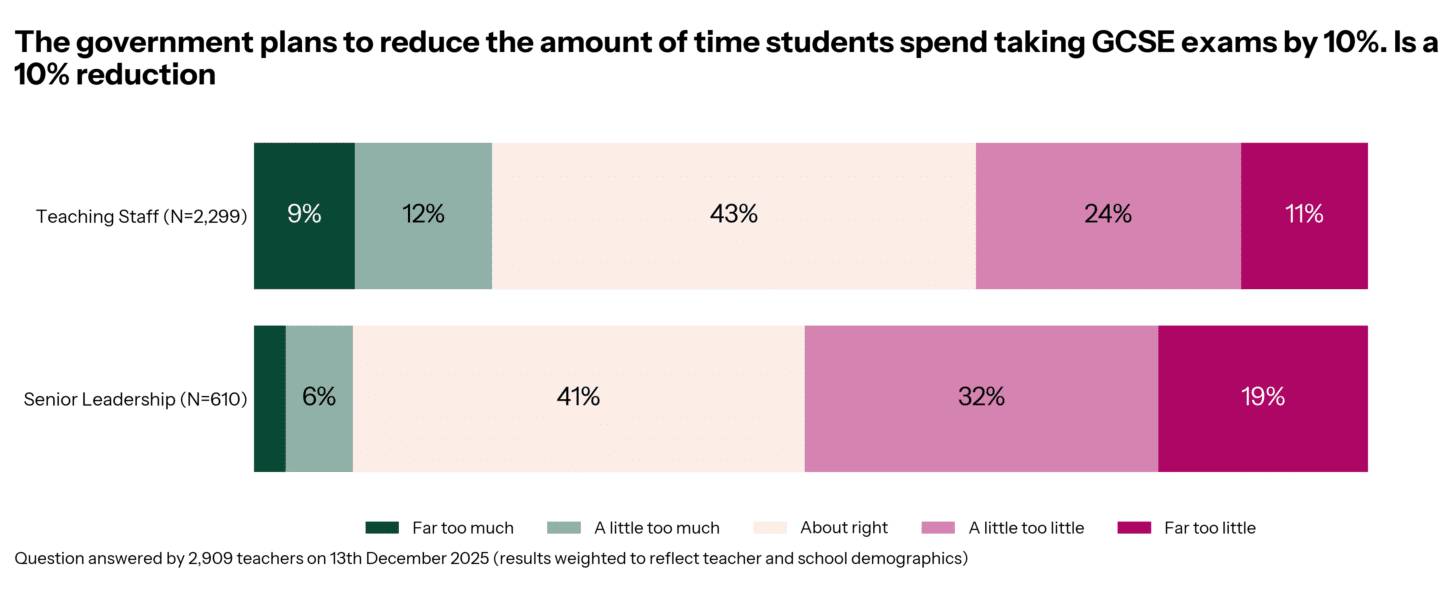
Without the anchor outlining average exam time around the world:
- Teachers: 21% thought it was too much, 43% about right, and 35% too little.
- Leaders: 8% thought it was too much, 41% about right, 51% too little.
With the anchor outlining average exam time around the world, things changed
- Teachers: 12% thought it was too much, 39% about right, and 49% too little.
- Leaders: 10% thought it was too much, 27% about right, 63% too little.
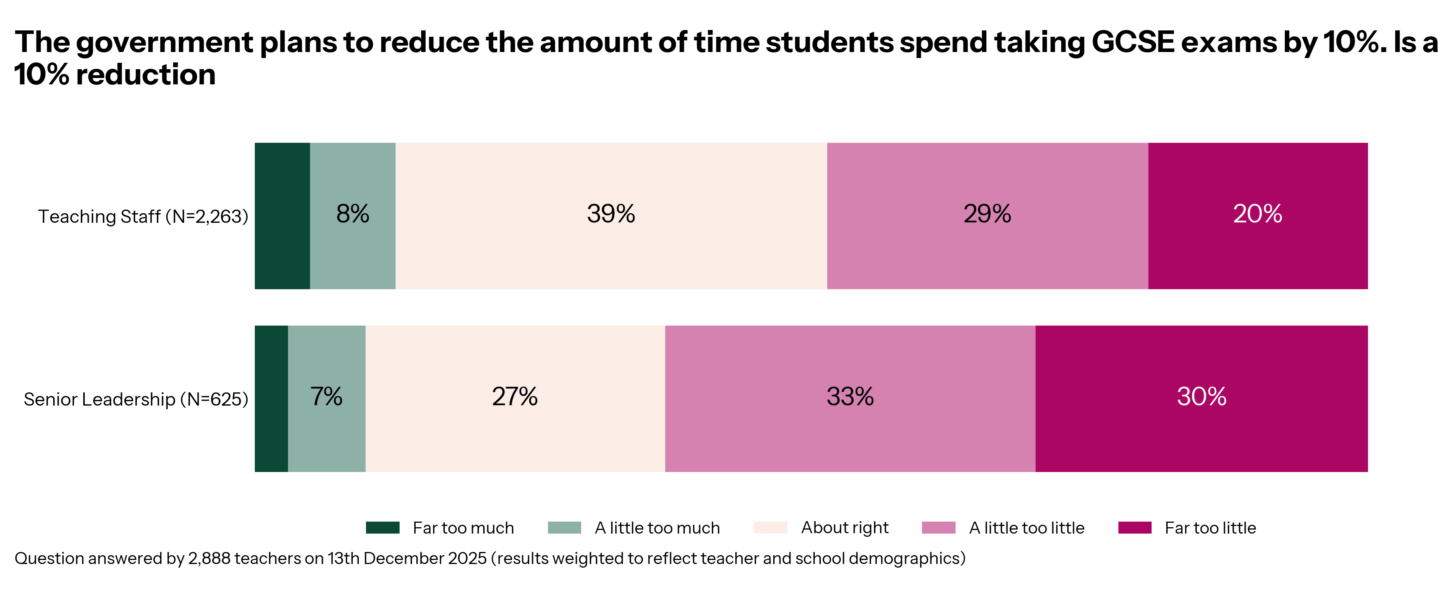
So what difference does anchoring make? When teachers and leaders see England’s exam time on its own, a 10% cut feels broadly “about right”. But add a bit of international context and views shift: concerns that the cut is too big fall away, and many more start to feel it doesn’t go far enough. This is anchoring in action – once people realise England is an outlier on exam time, the proposed reduction starts to look cautious rather than bold, especially to leaders who are more likely to think in system-wide terms.
What we don’t know yet is how these 10% reductions will look in practice – once the new papers are out, we will be asking more questions about your feelings about them!
Ups ⬆️ and ups ⬇️
⬆️ More teachers agreeing that their school CPD programme helps them improve (46% UP from 42% in 2025)
↔️ No change – the number of primary teachers reporting their students are “less school ready” compared to previous years (89% in 2026 and 88% in 2024)
⬆️ More teachers had disrupted lessons (40% in January 2026, UP from 32% in January 2025).
Daily Reads
The top tip of last week was all about homework – and if AI means it needs a rethink.
Got a blog you think we should feature? Email us at england@teachertapp.co.uk and we will check it out!