
January is still with us (how?? 🤪) and we still have another week to go. If you’re feeling tired, you’re not alone. More teachers reported their lessons stopped due to behaviour this January vs this time last year. In primary, it jumped UP from 36% to 46%, and in secondary from 28% to 36%. If you’re feeling more frazzled than usual, it’s not just you!
New January Prize Draw
With a New Year comes a new prize draw! You are the most important part of Teacher Tapp, and we want to continue saying “thank you” for making such a valuable contribution! We would love to be the new habit you want to make in 2026, and that’s why from the 5th January until the 31st January, for every 15 questions you answer on Teacher Tapp you’ll receive a ticket for the Teacher Tapp Prize Draw.
Five Tappers will win a £100 gift card, and the prize draw will happen on 2nd February. Full Ts&Cs are here. Good luck!
Unpleasant messages
Communications from parents come on a full spectrum: happiness and gratitude, to anger and fury. Despite the hope that all communication will be professional and collegiate, the fact is that teachers deal with everything on the aforementioned spectrum, and there are times when messages that fall into the ‘unpleasant’ category have to be handled.
Dealing with these types of upsetting messages can take its toll on teachers. They can be hugely demotivating, upsetting as well as taking up precious time when the way a message is being conveyed also needs to be addressed on top of the issue that the message is about.
To find out how these sorts of messages impact teachers, we split our Tappers into two groups: one half was asked a hypothetical question about what they would do if they received an unpleasant message from a parent; the other half was asked what they did the last time they had an unpleasant message. This allows us to look at an ‘ideal’ version and compare it to reality.
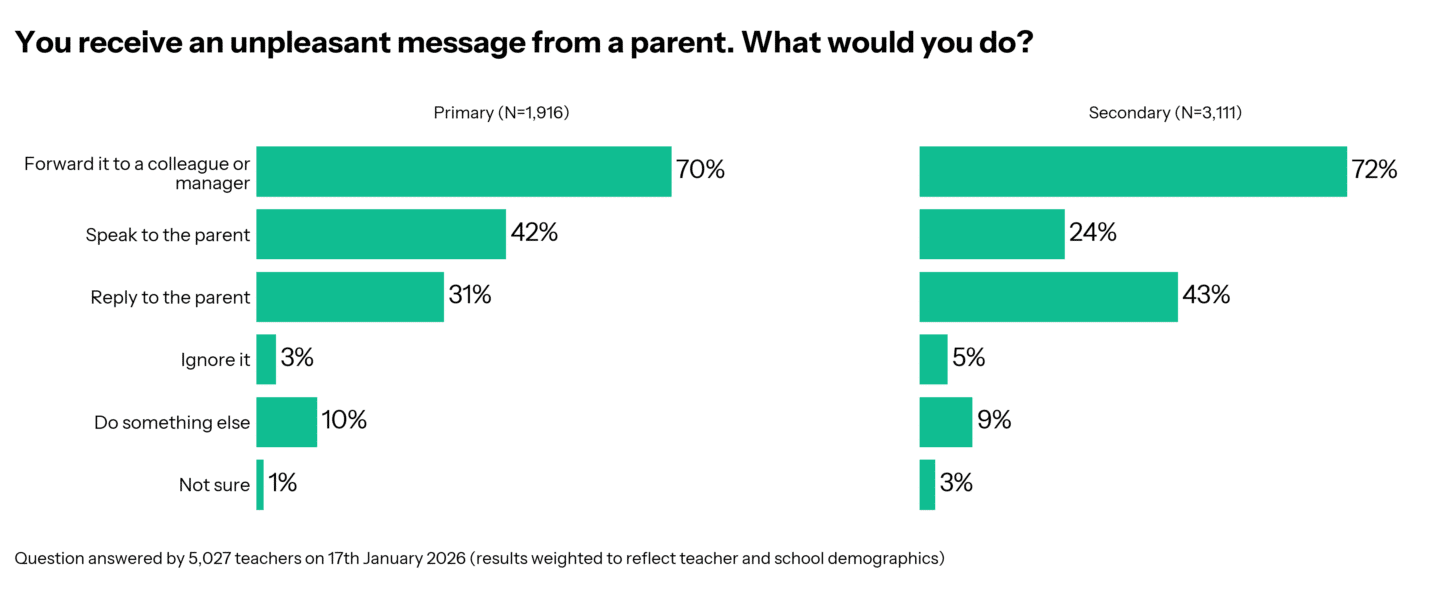
Among the teachers who were thinking about a hypothetical situation, the vast majority of teachers in primary and secondary both reported they would forward the message to a colleague or manager (70% and 72% respectively). More primary than secondary teachers would speak to the parent (42% vs 24%), and more secondary than primary said they would reply to the parent (43% vs 31%).
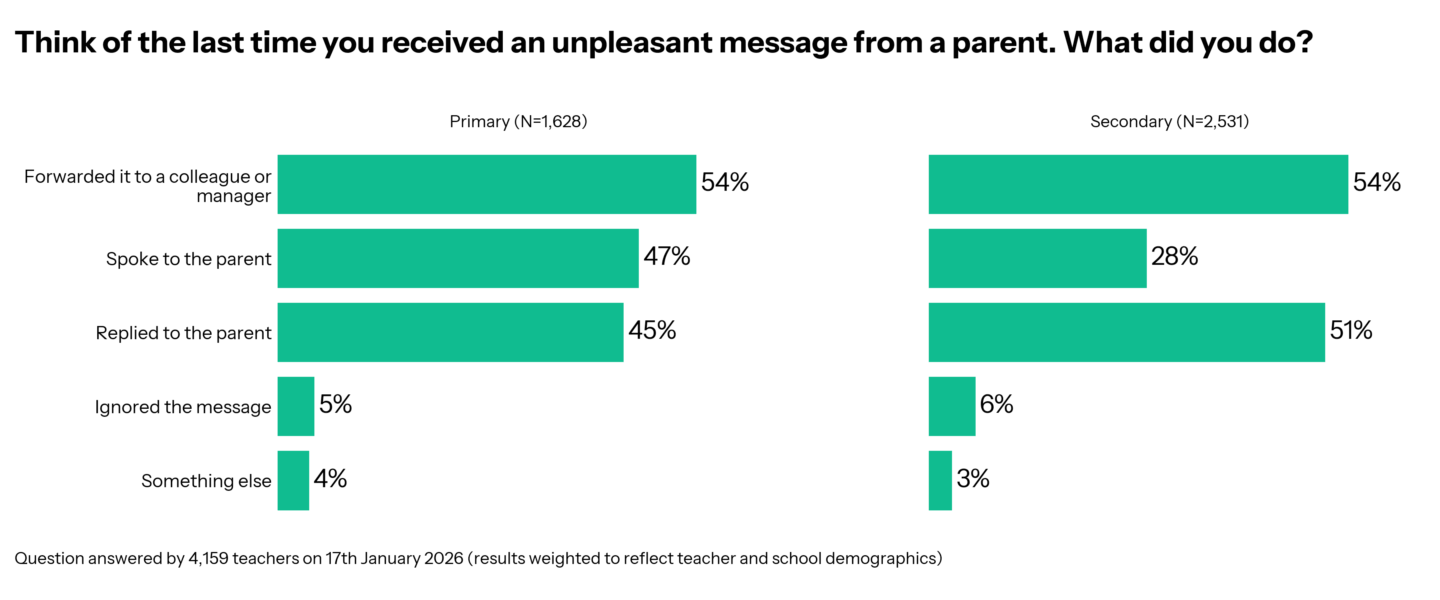
Now, what about reality? 13% of Tappers have never been on the receiving end of an unpleasant message, but for the rest of you, there are a few notable differences between the hypothetical and reality.
Although 70% of primary and 72% of secondary teachers in the hypothetical group believed they would forward the message to a colleague, among the group drawing upon their last real experience, just over half forwarded their message (54%).
Teachers were also more likely to reply to the parent in the real-experience group, compared to the hypothetical group. Among primary hypotheticals, 31% thought they would reply to the parent’s message, but the reality was 45%. Similar picture among secondary teachers with 43% predicting this would be their action, but 51% did it the last time they had an unpleasant message.
Why might we get gaps like this? One very good reason: real life is messy. In the hypothetical, we think about the best possible scenario. We have the energy and time to deal with the problem, whereas in the day-to-day, our classrooms are busy and unpredictable. Forwarding to colleagues might feel uncomfortable, or you meant to do it but never got around to it. Similarly, with the replies in the hypothetical, you can avoid having to directly deal with the parent, but in reality, these things happen because of the relationships you have built with the child or family. Sometimes hitting reply is just easier!
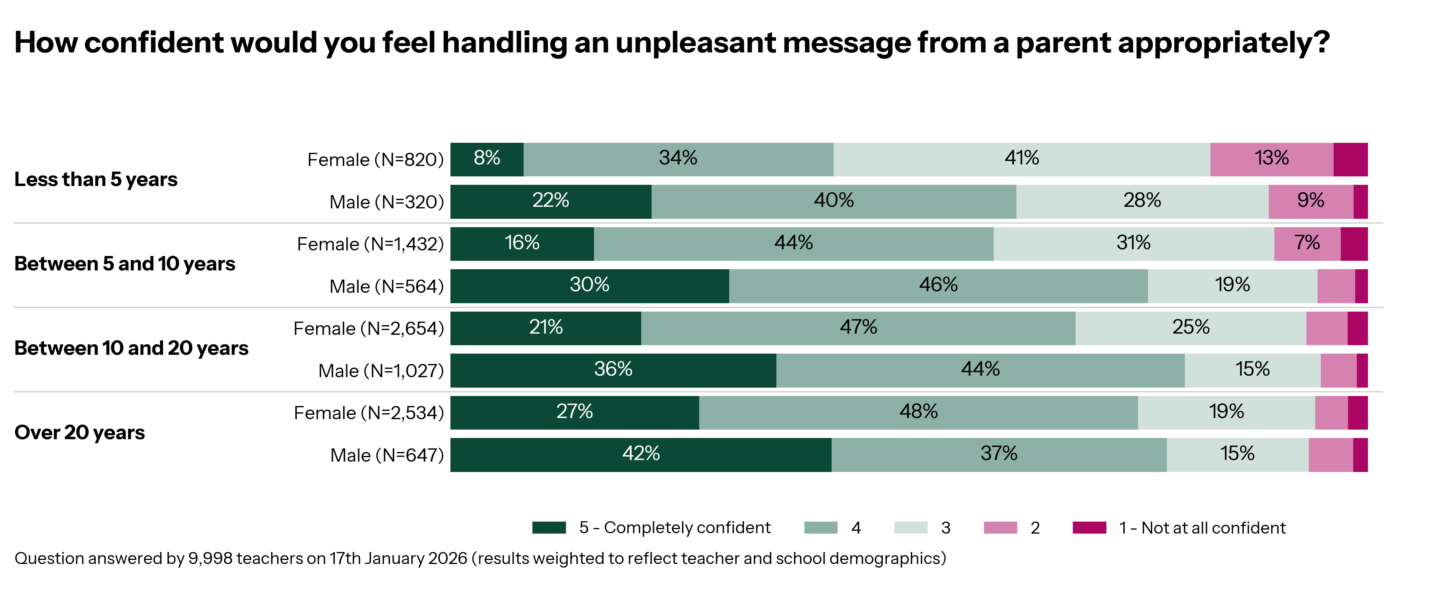
Confidence tackling these types of emails don’t greatly differ between primary and secondary teachers – but what does make a difference is the years of experience and whether you are male or female.
The good news for teachers who are at the start of their career: if this is something you worry about now, it does get better!
Over time, the percentage of females who rate themselves as ‘completely confident’ doubles once you get past 5 years, and then sees an average 30% increase when you move from 5-10 years, to 10-20 years, and then 10-20 years to over 20 years.
For males, the rise is less dramatic, but over time, the percentage of male teachers feeling ‘completely confident’ almost doubles from 22% to 42% once they hit over 20 years.
About half of senior leaders reported that their school had “clear” guidance on how to respond to inappropriate parent communication. However, only a quarter of classroom teachers said the same – suggesting that perhaps the guidance exists, but it isn’t as clear or available as you might hope.
Among classroom teachers who do report their school has clear guidance on responding to inappropriate parents communication, 23% of teachers feel ‘completely confident’ dealing with it.
However, this almost halves among classroom teachers who report their school does not have clear guidance on responding to inappropriate parent communication: just 13% of teachers feel ‘completely confident’.
What might leaders want to take away from this? If you have guidance on how to deal with inappropriate communications, then check the clarity of the wording and re-circulate it. If you don’t already, offer less experienced staff members training or support when responding to inappropriate messages. All these things can build confidence among your staff.
Parent complaints and concerns
Now, from unpleasant to just unhappy: what are the most common complaints teachers deal with? The answer varies, depending on the phase.
The good news is that 45% of secondary classrooms and 28% of secondary leaders avoided complaints or concerns from parents last week.
Among those who did deal with parents with complaints or concerns, these were the top issues for secondary classroom teachers:
- 1️⃣ The top reason for parents to be in touch was regarding behaviour or sanctions for students (39% of classroom teachers).
- 2️⃣ Next, it was the academic progress or assessment of a student (37%).
- 3️⃣ The third most common reason was related to SEND or support (31%).
For secondary senior leaders, the picture was a little different.
- 1️⃣ Again, the top reason for parents to be in touch was regarding behaviour or sanctions for students (49% of senior leaders).
- 2️⃣ Next, it was joint SEND issues and bullying and friendship (41%)
- 3️⃣ The third most common was joint again: teaching and staff conduct, and school policies and procedures (37%)
Primary teachers were more likely than secondary teachers to be on the receiving end of parental concerns: 26% of classroom teachers and 18% of senior leaders had a week without any complaints. For those who did, these were the most common topics:
- 1️⃣ The top reason for parents to be in touch was bullying (47% of classroom teachers).
- 2️⃣ Next, it was SEND or additional support (45%).
- 3️⃣ The third most common reason was uniform or lost property (35%).
Among those primary senior leaders who received concerns or complaints, the topics changed:
- 1️⃣ The top reason for parents to be in touch was SEND or additional support (58% of senior leaders).
- 2️⃣ Next, it was bullying (53%).
- 3️⃣ The third most common reason was behaviour or sanctions (43%).
Social media regulation
In Australia, a social media ban for young teens was introduced in December, in practice this means that the main social media sites – including Instagram and Facebook – stop Australians aged under 16 from having accounts on their platforms.
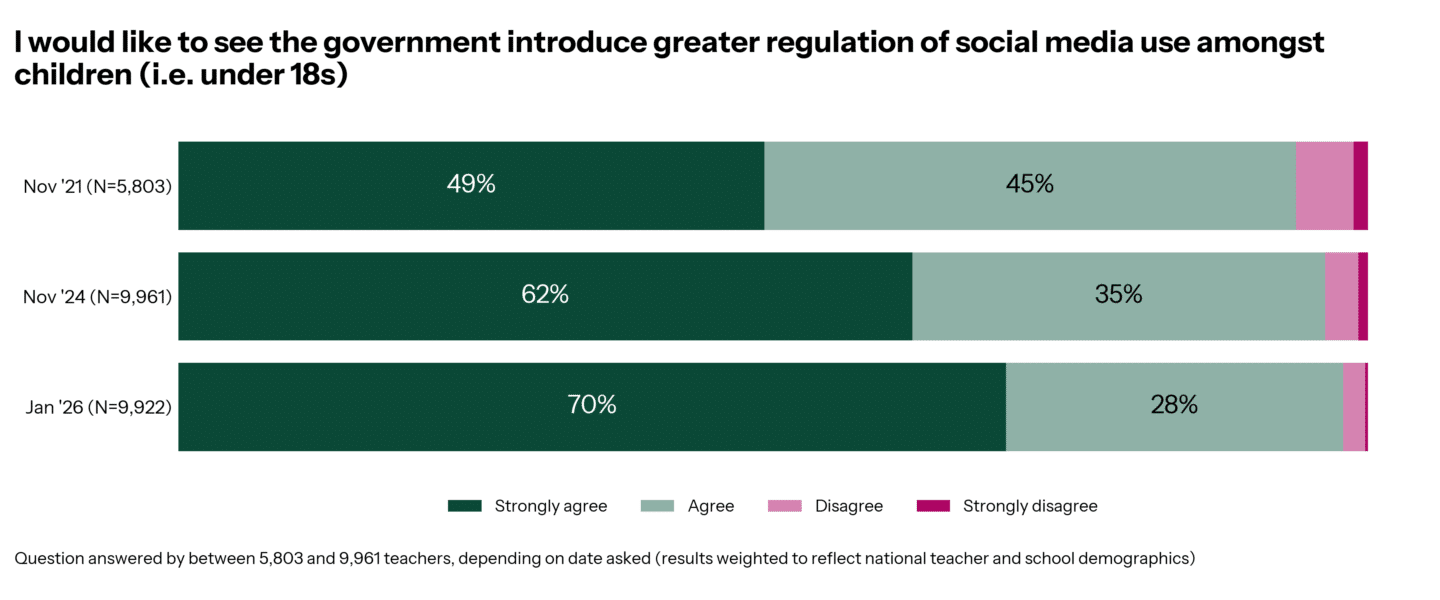
How popular would a similar ban be in England? Among teachers, it would appear to be very popular. Comparing results from this month to previous years, the strength of feeling on this topic is increasing: in 2021, 94% agreed, today that figure is UP to 98%, with those strongly agreeing jumping from 49% in 2021 to 70% in 2026.
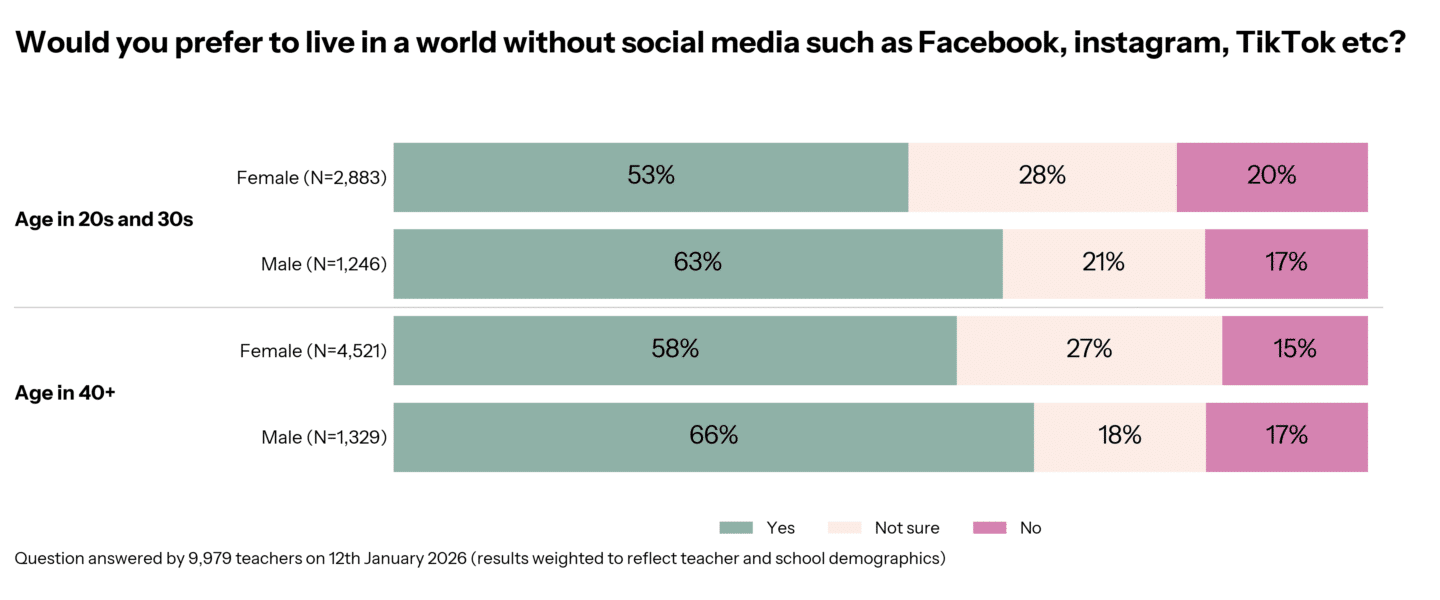
And when it comes to social media for yourselves, many would also like a version of the world without the ping and pressure of posting, liking and sharing.Men are more likely than women to say they want rid of socials: 53% of female and 63% of male teachers in their 20s and 30s would prefer a social-media-free world. Older teachers are more likely to agree they would like a world without social media: 58% of female teachers and 66% of male teachers aged 40+.
Maths GCSE pass rate
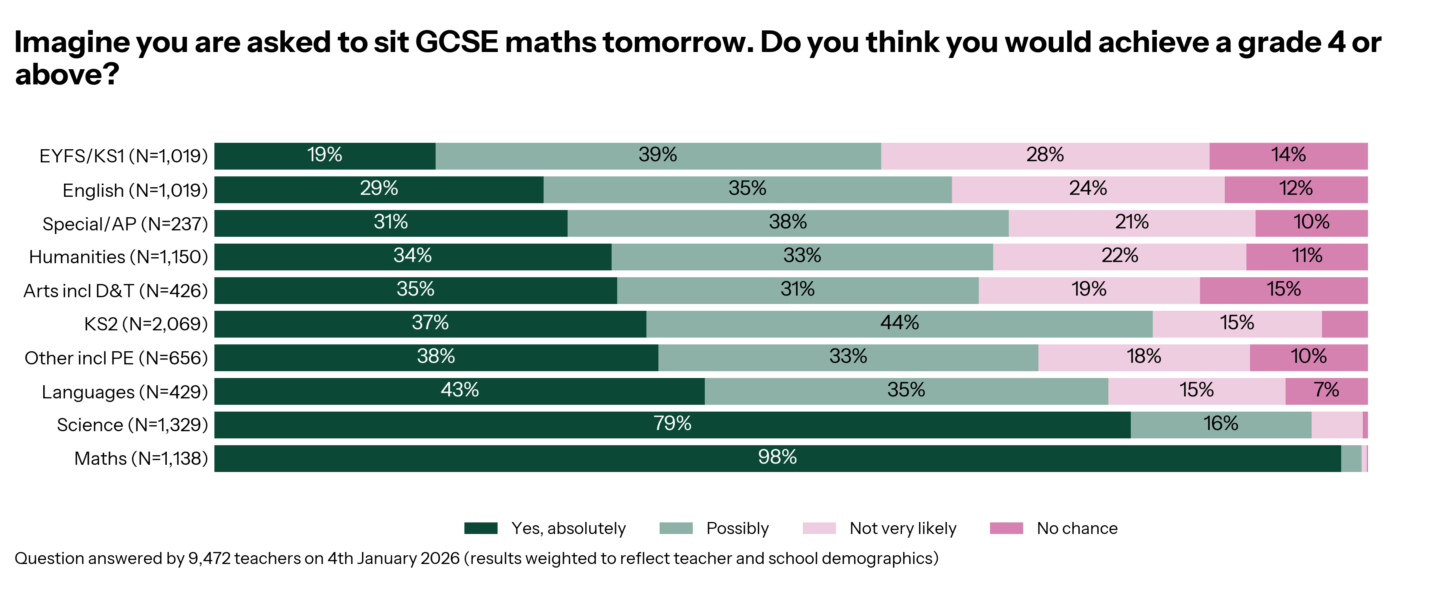
To teach in England, a maths GCSE at grade 4 or above is a fixed requirement. But those GCSE certificates could be decades-old. If you woke up tomorrow, and were presented with a GCSE maths paper and a pencil, would you pass?
Unsurprisingly, our maths teachers are super confident in their mathematical prowess (98% say they absolutely would pass), and science teachers were also very confident (79%), but then everything takes a bit of a dip.
Less than half of language teachers (43%), and 38% of PE plus other teachers, and 37% of KS2 teachers think they would ‘absolutely’ pass.
EYFS/KS1 teachers had the lowest confidence (19%) followed by English teachers 29%.
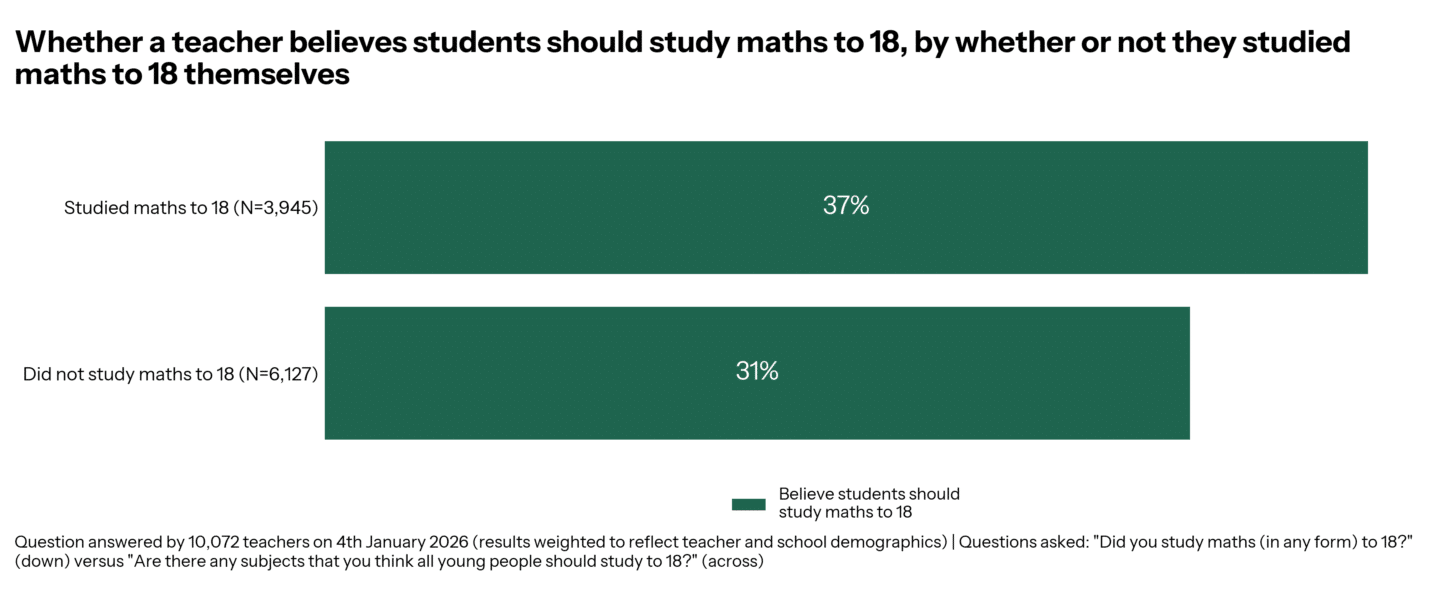
All students study maths until age 16, but should this be extended to 18? At one point, this was the idea floated when the British Baccalaureate was announced in 2023 (and then promptly dropped when the government changed in 2024). Most teachers don’t think maths should be studied to 18, but 37% of those who studied maths themselves to 18 believe students should, but the same is true for only 31% of those who did not study maths to 18.
A new KS3 diagnostic maths test is on the horizon, but details as to what that test will contain or how the results will be used haven’t been released. What questions should we ask about this new test? Let us know by getting in touch england@teachertapp.co.uk.
Damaged classroom tech
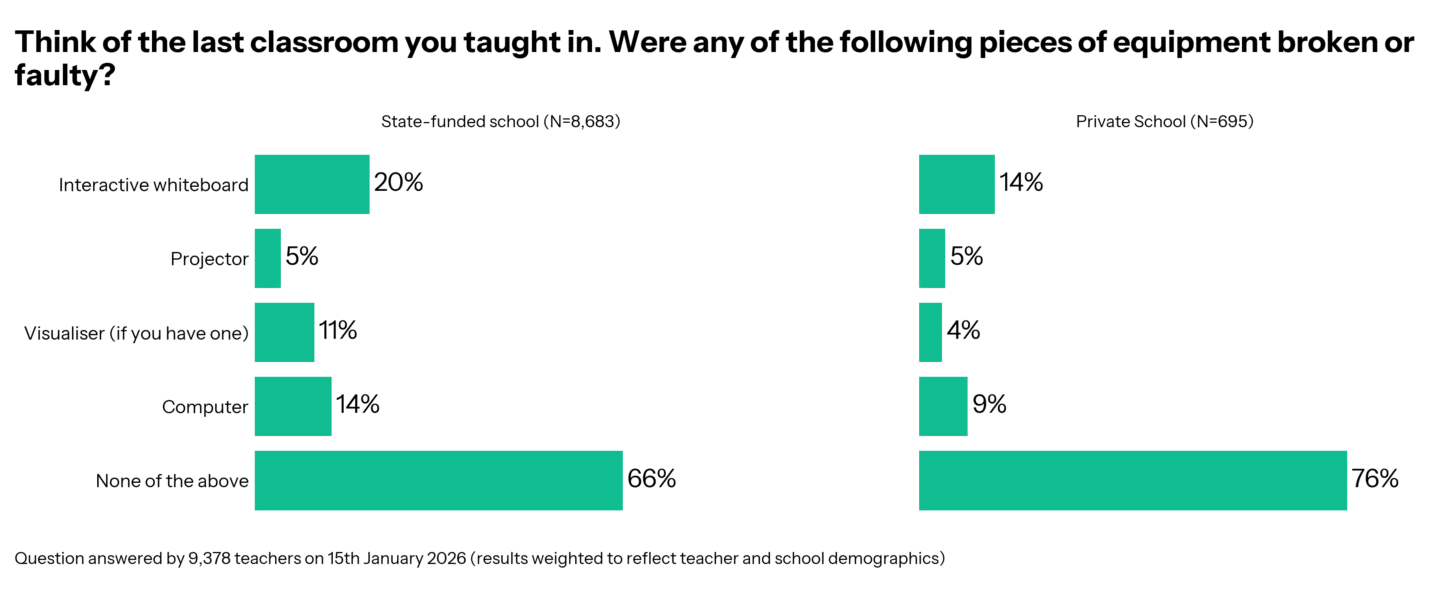
Having a classroom full of tech is great – but it’s even better if it works. One third of state-funded schools have faulty or broken technology, compared to 24% of teachers in private schools.
Interactive whiteboards were the most likely item to be faulty or broken (20% in state, 14% in private), followed by the computer (14% in state and 9% in private).
Daily Reads
It was the power of AWE that had teachers clicking this week – 12% of leaders read this blog all about coaching in schools (and it had an average 4* rating!).
Got a blog you think we should feature? Email us at england@teachertapp.co.uk and we will check it out!