
The ‘teaching’ part of being a teacher is really hard. Just planning and delivering content for children to learn from is complicated, and that’s why learning how to be a teacher involves study, observation, trial and error. It rightly takes up most of the focus of initial teacher training, the Early Career Framework, and the CPD that teachers undertake once they’re established in the classroom.
But when do teachers learn about the other parts of teaching? Specifically, the part where you are managing people? Often, when teachers eventually become middle and senior leaders, the training on how to manage a team or an individual comes too late, or not at all.
To better understand what the problems facing schools are, we’ve pulled together our findings about managing teachers, and being managed, for you to see what the national picture looks like.
Performance management
The yearly performance review is a staple event for every employee and manager. Although every school needs to do them, experiences of the process vary.
Department for Education guidance has now removed performance-related pay, and states that “The removal of
the requirement for performance-related pay is to allow schools to have a greater opportunity to focus on professional development in objectives and appraisals”. However, 8% of teachers still report they have been given results-related targets linked to pay progression this year.
Now, onto the Tapp data…
First up, not all leaders conduct performance management reviews: 58% of primary middle leaders and 22% of senior leaders did not do reviews this year; similarly, 38% of secondary middle leaders and 11% of senior leaders did not carry out performance reviews this year.
However, among those who do the workload is heavy: 80% of headteachers are doing 5 or more, and the same is true for 52% of senior leaders.
The load lightens for middle leaders. for these leaders, just 18% have 5 or more performance management reviews, and the most common response was just one performance management review (30%).
That’s an awful lot of reviews to be squeezed in!
Now, onto how teachers feel about the reviews. There is a clear difference in experience for teaching staff, and leadership: 24% of teachers feel ‘more motivated’ following their review, compared to 31% of senior leaders.
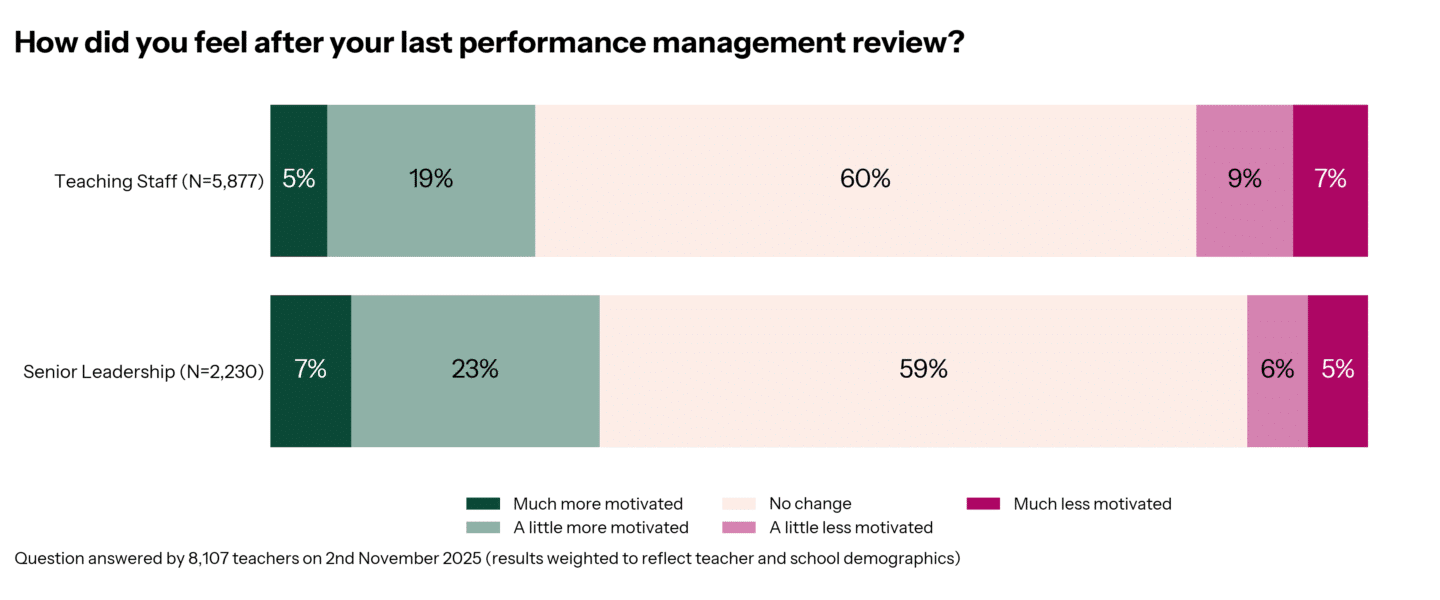
Okay, we know how many reviews are being done, who feels more positive after them – but is there an commanality among teachers who are leaving their review feeling more motivated?
We also asked Tappers if they felt their leader cared about their development. Teachers with less than five years of experience are more likely to strongly agree with the statement that the leader who did my most recent performance management review cares about my development, compared to teachers with over 20 years of experience (44% vs 26%).
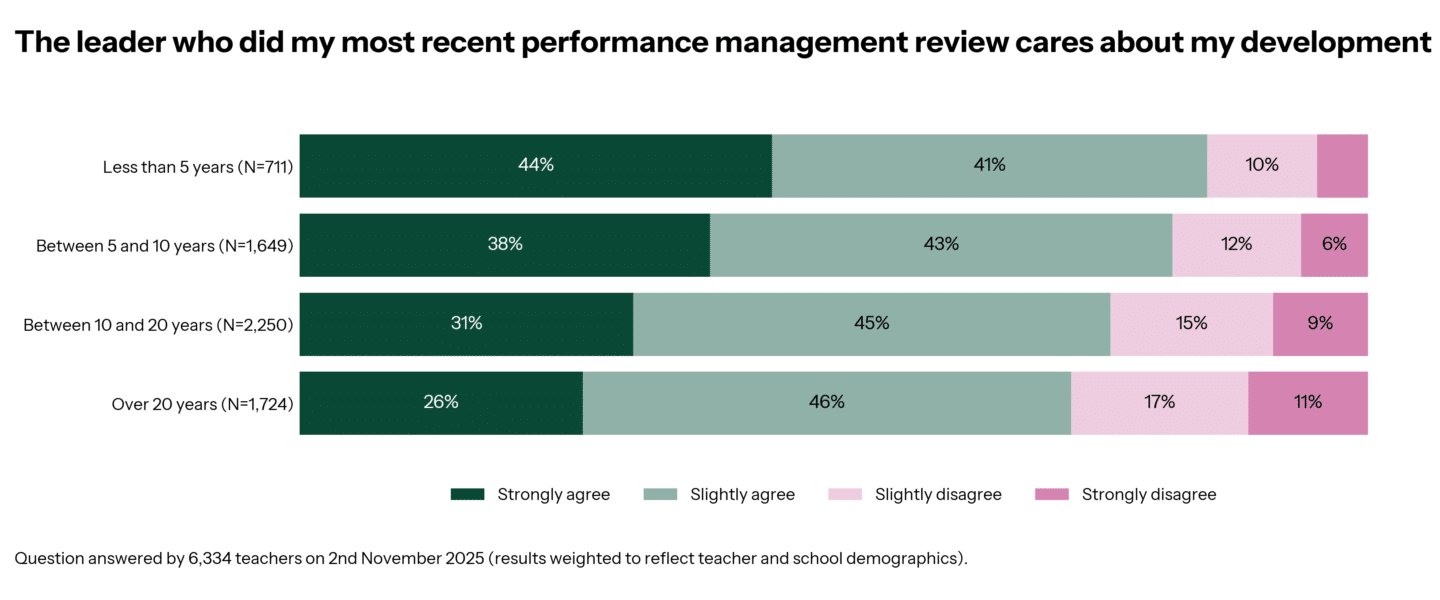
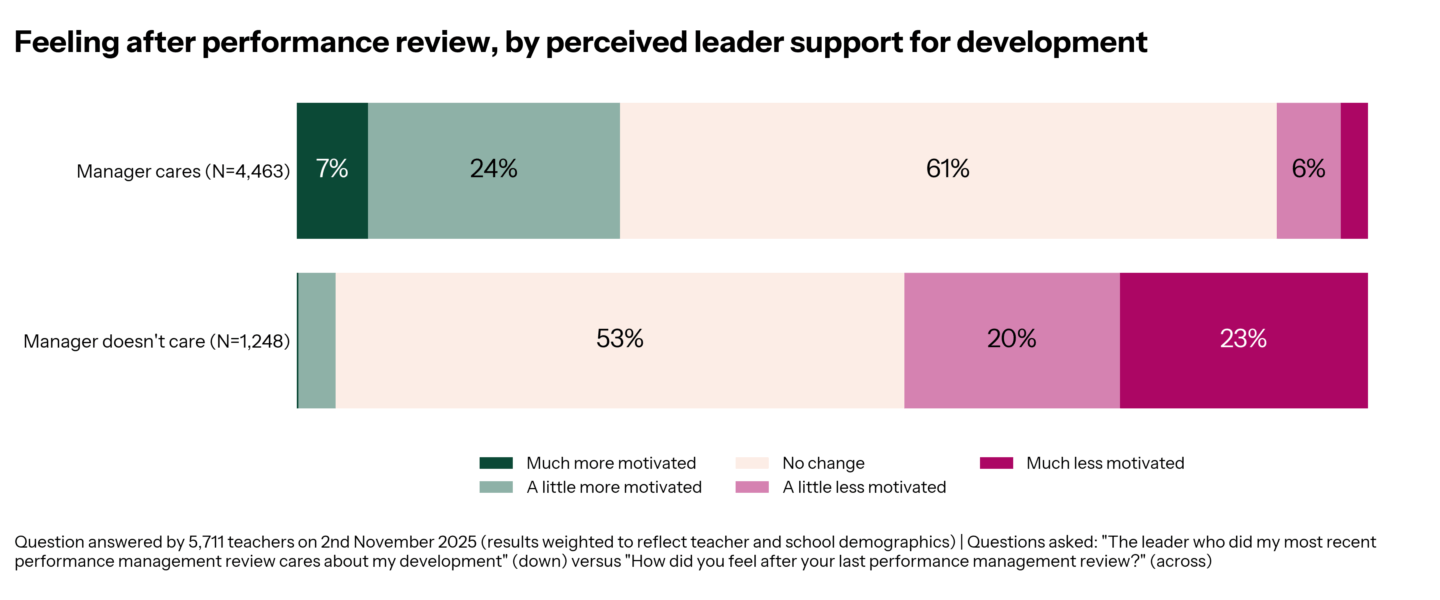
But does it matter if the teacher believes their line manager wants them to develop? It would seem to make a big difference to how they feel about their performance management! When we crossed these two answers, we found a clear pattern:
Teachers who believe their manager cares are more than SEVEN TIMES as likely to feel positive after their performance management review, compared to teachers who reported that their manager didn’t care (31% vs 4%).
💬 Leaders, perhaps this is something that is missing from the way you deliver your performance management: do you also take the time to ensure the teacher you are completing the performance management for knows you care about developing them as a teacher? Maybe the check-ins on development get covered once a year in the review, but are never mentioned for the twelve months in between. Small tweaks could lead to big rewards.
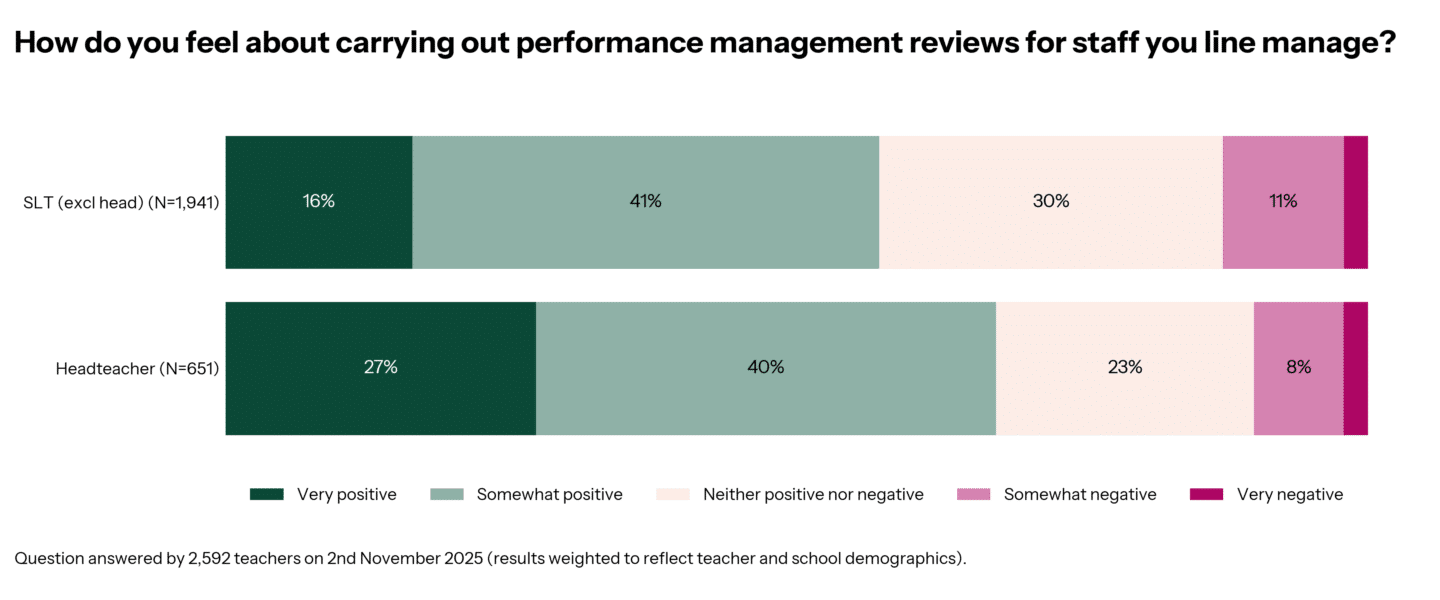
Of course, the people actually carrying out the performance management have a tricky job on their hands, and from your responses, we can see the line managers carrying out performance reviews also have mixed feelings about completing the task.
We asked line managers how positive/negative they felt carrying out the reviews, and reassuringly, more felt positive than negative, but headteachers were more likely to report feeling very positive compared to senior leaders (27% vs 16%).
However, leaders who have had training in conducting performance management reviews are more likely to report feeling positive compared to leaders who have not had training (67% vs 53%). Perhaps one solution is ensuring that, before staff are given the task of carrying out performance reviews, they are given training on how to do these successfully.
Line management
All schools will have a slightly different system for organising staff, and but Teacher Tappers responses revealed that typically all teachers have a person who is their line manager (just 1% of senior leaders, 2% of middle leaders and 1% of classroom teachers reported that they DO NOT have a line manager).
Among those who do have a line manager, meetings are more common the more senior you are, until you become a headteacher: 26% of classroom teachers, 54% of middle leaders, 67% of senior leaders and 49% of headteachers have weekly or fortnightly meetings.
This adds up to a lot of hours! But how effective is this time?
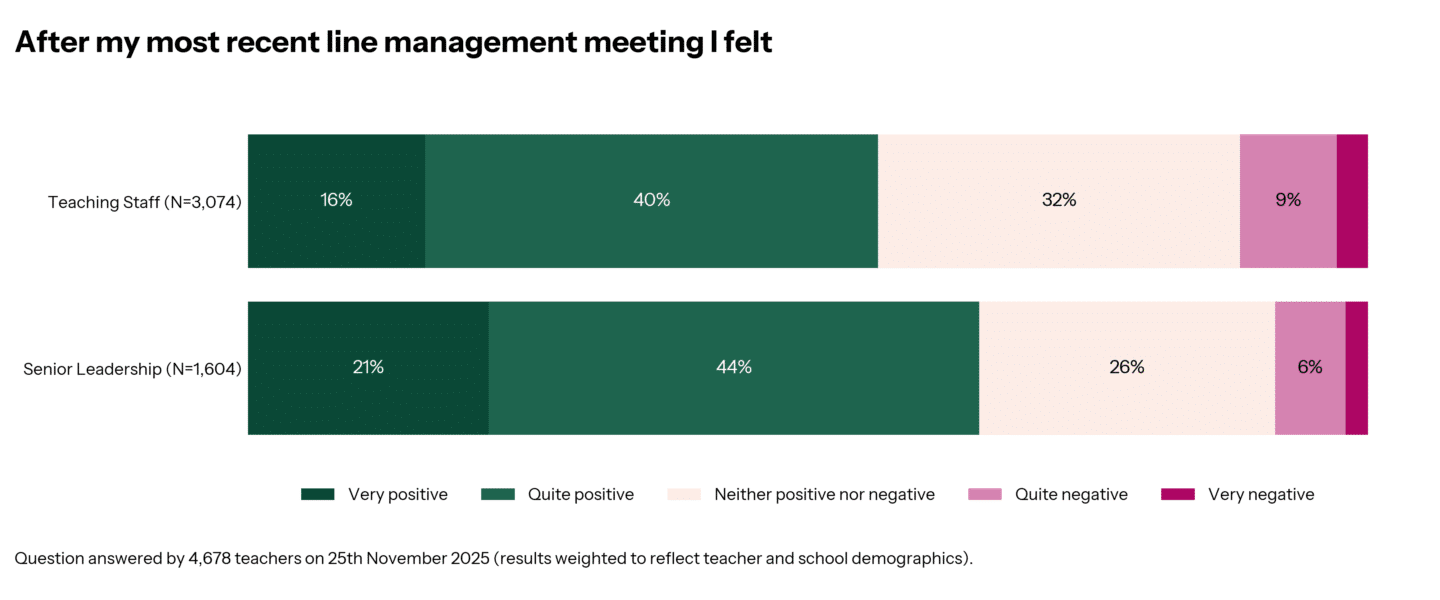
To kick off with, we asked how teachers felt after their most recent line management meetings. Teachers are less likely to report feeling positive after their line management when compared to senior leaders (56% vs 65%).
What else did we find out about line management meetings…
Teacher Tappers also told us about the rooms their line management took place in.
- 75% have meetings in rooms where they can speak privately.
- Just over half have the same room every time (54%).
- 15% have the room booked for them.
- And for around one in ten, they are in different rooms where they can be overheard, and the space isn’t booked for them.
In your own words…
Performance management should help teachers grow, but as these graphs show, that isn’t always the case.
When we asked Teacher Tappers for their honest views, thousands of comments started to make the above findings make sense. The most common theme? It often feels like a pointless tick-box exercise. Multiple Teacher Tappers described “just going through the motions,” creating paperwork to show targets were met, and an experience that “depends on which member of SLT you get.” When a process feels arbitrary, it rarely inspires meaningful development.
Limits in the system
Another common theme was the limits built into the system: for teachers on UPS3, the process can feel redundant. With no further pay steps to aim for, many say the process has nothing left to offer: “Complete waste of time if you’re on UPS3!” Others feel the expectations keep rising, even when they’re already performing at a high standard.
Out-of-date use of targets
A major frustration is the continued use of data-linked targets, despite Department for Education guidance advising against it. in 2025, 7% of teachers reported they had a target linked to exam data, DOWN from 17% in 2022. Teachers told us they’re held to account for attendance figures or GCSE outcomes they cannot realistically control. As one put it: “Children are seen as numbers. Really demoralising that achievements and breakthroughs aren’t valued.”
Too much on some plates
School leaders aren’t immune to the problems either. Many described the system as “paperwork-heavy” and impossible to implement meaningfully alongside everything else. One Head wrote in to say they had to do “20 performance managements” alone; another admitted they “wrote their own appraisal for governors to sign off”. Not exactly a motivating experience.
Where they get it right – it’s great
Yet there is a glimmer of hope. A growing number of schools are moving away from traditional performance management altogether, replacing it with “professional conversations”, coaching models, and development-focused meetings. These are consistently described as more supportive, affirming and purposeful. As one teacher put it: “We have moved to a coaching model, which is much better.”
Taken together, the message is clear: teachers and leaders want performance management that builds trust, encourages reflection, and genuinely supports professional growth – not a ritual that generates paperwork without purpose.