Hey there, Teacher Tappers!
Big news for edu podcast fans – we have compiled our very own Teacher Tapp Podcast Chart 2026
Primary teachers
🥇 Two Mr Ps in a Pod
🥈 Teach, Sleep, Repeat
🥉 Thinking Deeply about Primary Education
Secondary teachers
🥇 They Behave For Me
🥈 Mr Barton’s Podcast
🥉 Mind the Gap
Senior leaders
🥇 They Behave For Me
🥈 Mind the Gap
🥉 Mr P ICT and Mr Barton’s Podcast

If you’re back at work already, we hope the break gave you the life you needed. And if you have a few more days of break to go, then we hope you are relaxed and recharging!
New referral incentive 🤑
This month, EVERY tapper can scoop a reward by using their referral code to bring new Tappers to the fun of daily questions and edu-data. Every new sign-up you bring to the app will get you a £5 Amazon voucher, with a maximum of three per Tapper. Find your referral code in your app by looking for the megaphone in the top right-hand corner 📣. Ts and Cs are here.

Booster classes
Primary schools everywhere are gearing up for KS2 Sats week, beginning on Monday, 11th May.
But how many schools are running booster classes over the Easter holidays? On the whole, it was just a small number with 6% of state-primary schools putting on booster sessions. But this figure changes when taking into account the number of students who qualify for Free School Meals (FSM) in the school.
10% of teachers in schools with the highest numbers of students on FSM said they had KS2 Sats boosters, but just 2% of teachers in schools with the lowest numbers of students on FSM reported the same.
This pattern is similar to what we see in secondary schools, with 68% of state secondary schools running GCSE booster classes. This rises to 76% among teachers in schools with the highest level of FSM, and drops to 50% in schools with the lowest level of FSM.
Are boosters making a difference?
Feelings about the effectiveness of the boosters were generally positive:
14% of primary teachers felt they had a significant positive difference, 61% felt it made a slight positive difference, and 25% thought it made no difference.
Secondary teachers were more ambivalent: 6% thought it made a significant positive difference, 51% a slight positive difference, and a huge 42% didn’t think it made a difference.

However, some subjects were more positive than others: teachers of the arts were more positive, with 70% believing it made a positive difference, whereas English teachers were the least likely to respond positively, at 50%.
There is always a time cost (and sometimes financial cost – more on that later) for running booster sessions. Primary teachers are more likely to say they think booster sessions are worth the time and effort they require (60% agree vs 40% disagree). Secondary teachers are more evenly split (47% agree vs 53% disagree).
How many teachers are paid for running boosters?
Some teachers are compensated for running booster sessions:
- 61% of secondary teachers reporting they are paid, and 4% given time off in lieu.
- 34% of primary teachers said they were paid, and 18% said they were given time off in lieu.
We have already had a teacher get in touch to ask about how supervised booster sessions are – and what behaviour is like in these sessions. Do you have suggestions of questions we should ask? Let us know by sending in your suggestions to england@teachertapp.co.uk 📧.
Rise in term-time holidays
Some parents take children out of school for term-time holidays, and ask their son or daughter to keep quiet about their trip away.
In private schools, this is less of a problem (though not absent altogether: 57% of private primary and 50% of private secondary reported this had happened this academic year).
In state schools, 79% of primary school teachers reported they had experienced it this year, up four percentage points compared to when we asked in February last year.
70% of state-funded secondary teachers say this has happened this year, up five percentage points compared to last year.
The year-on-year increase might be explained by the fact that we asked in April this year, compared to February last year – going forward, we will be sticking to April, so we will have to wait and see if this makes a difference. The difference in phases might be due to more primary-aged children being taken out for holidays, or primary pupils being more likely to say something when they are meant to be keeping quiet!
Teacher Tapper asked…how many primary leaders are paid for leading a subject?
Since we asked our questions about TLRs a fortnight ago, we have had an unprecedented number of teachers write in with question suggestions about TLRs. Thank you to everyone who took the time to write in!
To kick us off in our deep dive into TLRs, we start with some questions we have asked in the past about primary TLRs and subject leadership.
First off, there has been a drop in the number of primary teachers who have a say in what subjects they lead 51% in 2026 DOWN from 59% in 2022.
Of that number, 44% are happy about the choice of subjects they lead on, and 7% are unhappy.
Primary teachers often become subject leads very quickly:
- 23% before the end of NQT/ECT year
- 49% within a year of NQT/ECT
- 28% at a later date.
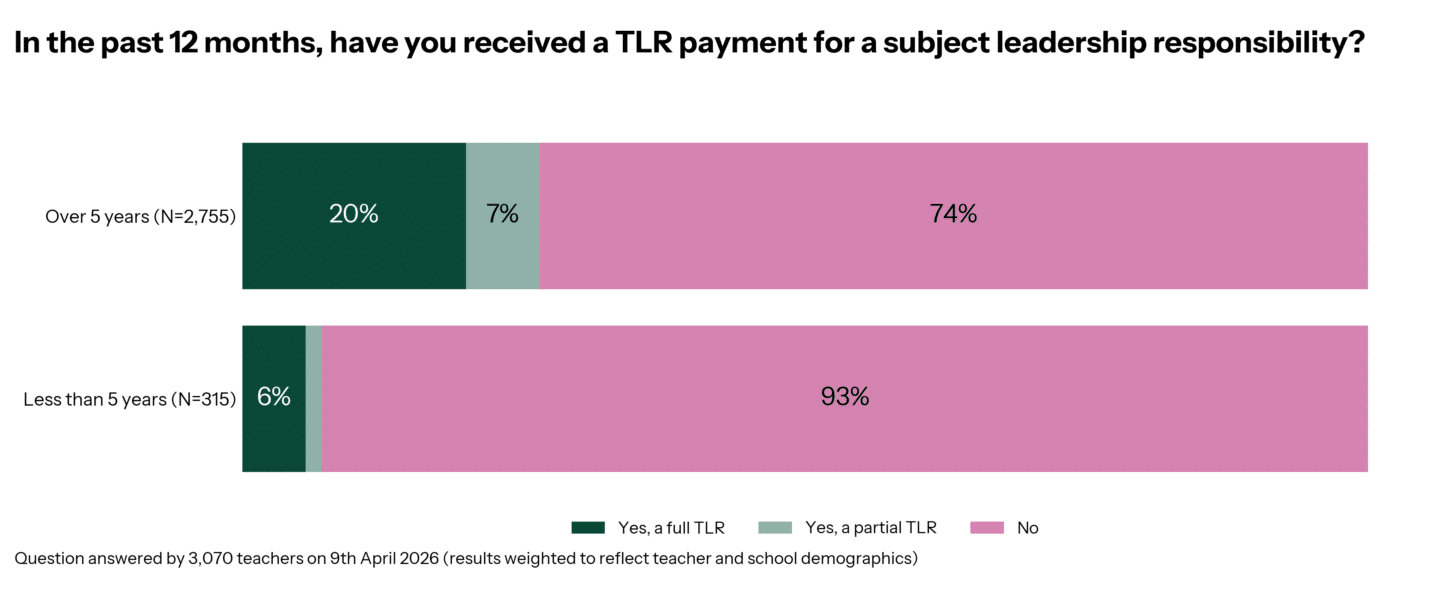
Being paid a TLR for subject leadership responsibility is relatively uncommon: just 18% report being paid a full TLR, 6% a partial TLR and a massive 77% have no TLR at all.
Compared to previous years, TLR payments for subject leadership in primary are on the decline: in 2022, 23% were paid a full TLR, compared to 18% today. Not only that, but teachers with less than 5 years of experience are the least likely to report receiving TLRs: just 7% are paid TLRs for subject leadership, compared to 27% among teachers with over 5 years of experience.
Zoom in on … teachers promoting teaching
The best advert for teaching is a workforce that would encourage others to also enter the profession. So what can we intuit from the enthusiasm for teaching among teachers?
32% of secondary teachers and 25% of primary teachers would encourage a young person they cared about to become a teacher. Before the pandemic in 2019, these figures were higher at 39% for secondary and 37% for primary. Then, in June 2020, when recruitment for teaching underwent a small boom due to the economic uncertainties caused by lockdowns, these figures rose to 46% in secondary and 40% in primary.
After this brief rise, things started to drop again: between 2020 and 2023, the number of teachers recommending teaching fell to 28% in secondary and 23% in primary. Then, since 2023, there has been a growth in secondary to 32%, and this has remained stable. However, in primary, there was an increase to 29% in 2024, but then dropped to 27% in 2025, and then 25% in 2026.
The gap between primary and secondary was closing in 2023, with a 3 percentage point gap. Today, that gap is at its widest at 7 percentage points. What might this suggest about what is coming next? If this trend continues, it looks like secondary will remain stable, and primary might continue to drop – especially as falling student numbers puts a question mark over job security.

Vaping in schools
Teachers who have NOT caught a student vaping have risen across all schools, increasing from 33% in 2022 to 37% in 2026.
Teachers in fee-paying schools have seen the largest increase, from 48% to 60%.
In state-funded schools, the increase has been less dramatic, rising from 31% to 34%.
Teachers who have not caught a student vaping or with vaping equipment this year

Daily Reads
It was our new Teacher Tapp blog-in-a-quiz that came out on top this week with more then 1,000 of you playing it! Check it out here.
There are so many great blogs out there and we love featuring them on Teacher Tapp. If you have a blog you think we should feature, then please email us at england@teachertapp.co.uk and we will check it out!