Hey there, Teacher Tappers!
Hello February! The first month of 2026 has come and gone, and now we’re into the Spring term, with a half term just round the corner, and the academic year really going strong.
For teachers new to the classroom, the first term is often considered the hardest. Check out how the Teacher Tapper ECTs and their mentors have been getting on in their special ECF tracking blog here.
New prize draw…and it has a twist!
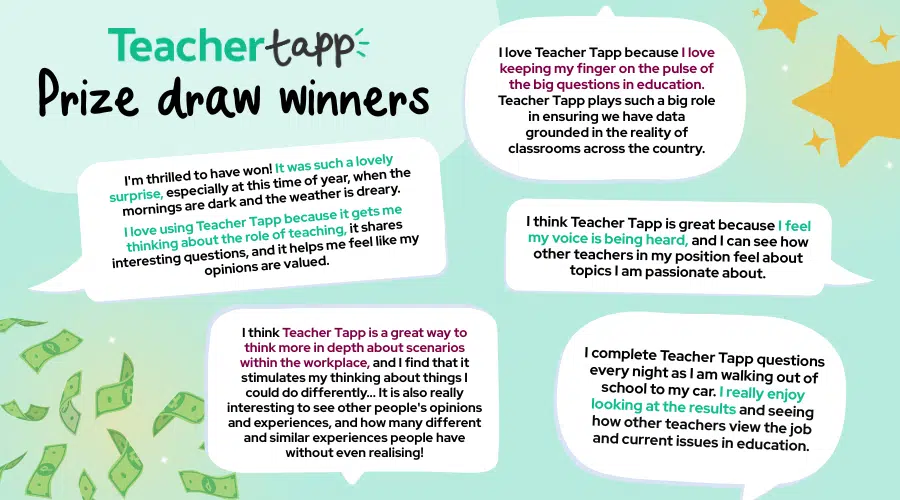
This month, our prize draw has a little difference…and it could result in some Tappers winning BIG!
Every 15 questions you answer earns you a ticket in the Teacher Tapp Prize Draw. When one ticket is drawn at the end of the month, that Tapper wins a £100 Amazon gift card (so far, so normal) BUT, here is the twist…this month every other Tapper at the same school (with the same URN in their profile) who has at least one ticket also wins £100.
To give you an example…Ms Patel answers 45 questions on Teacher Tapp during February. That earns her 3 tickets in the prize draw. At the end of the month, one ticket is randomly selected – and it’s one of Ms Patel’s – woohoo! She wins a £100 Amazon gift card. But because Ms Patel isn’t the only Teacher Tapper at her school, Mr Klu, Ms Owen, Dr Darby are are also Teacher Tappers who have at least one ticket in the prize draw and have the same school URN in their profile as Ms Patel. So they also win a £100 Amazon gift card! Woohoo!
Don’t worry about having to round up all the Tappers in your school; we will make sure everyone who has won a gift card gets one. But if you want to encourage others to sign up, don’t forget you’ve got the refer button in the app to share your code.
If you’ve earned at least one ticket, you’re in – and the more tickets you earn, the more chances you have to win. You can read the full terms and conditions here.
What is going on with behaviour?
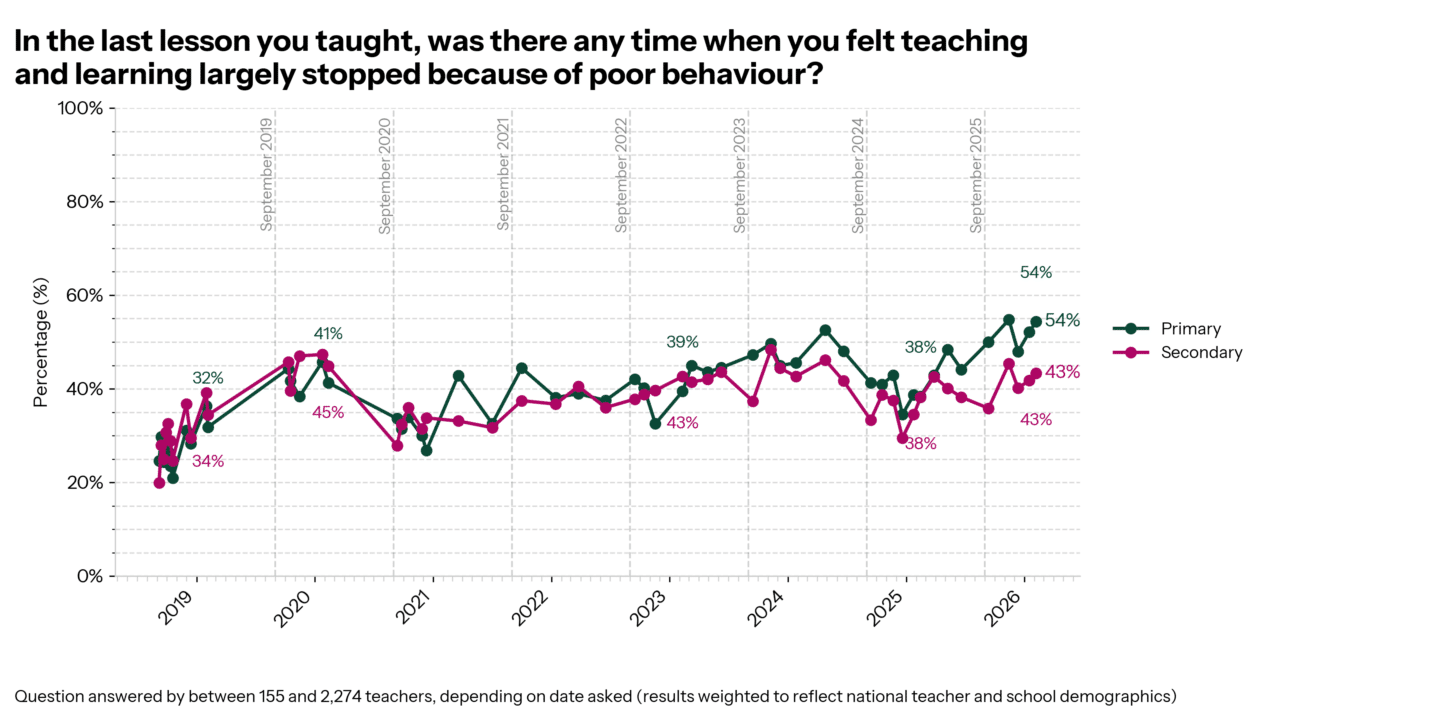
This February, behaviour for classroom teachers was the most disruptive since we started recording in 2019.
54% of primary classroom teachers and 43% of secondary classroom teachers reported that students’ behaviour disrupted their last lesson to the point that teaching and learning stopped.
Back in 2019, reports of disruption were lower overall and more closely aligned between primary and secondary. The pandemic years were marked by considerable volatility rather than a clear direction of travel. But from 2021 onwards, the trend becomes more consistent; reports of lessons being derailed by behaviour begin to creep upwards in both phases, but the increase was steeper and more sustained in primary. While secondary also worsens over time, it does so more slowly and with smaller peaks.
By the academic year 2023–24, the divergence is clear. Primary moves above secondary and largely stays there, with the gap gradually widening. In the most recent data, primary reaches new highs, while secondary remains elevated but notably lower showing that disruption is not only more common now than it was five years ago, it is also increasingly a primary-phase issue, with the difference between primary and secondary growing rather than narrowing over time.
One way to manage behaviour is through sanctions, and the news has been filled recently with reactions to incoming changes to how schools use fixed-term exclusions, and whether students are on-site or off-site for the exclusion.
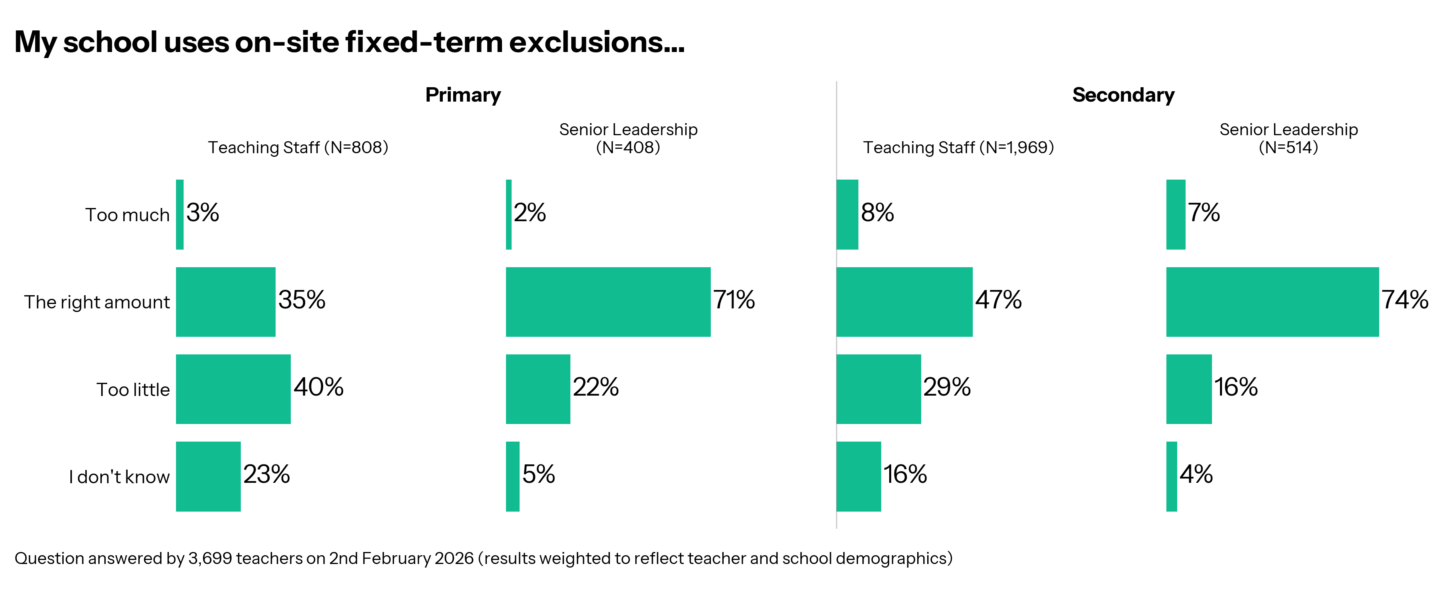
Excluding a student but keeping them on-site is more common in primary than secondary; 41% of primary leaders reported that their school didn’t use on-site exclusions, compared to 23% of secondary leaders. But among those schools that do use them, only a small minority feel they are used too much (3% of primary teachers, and 8% of secondary teachers). A significant proportion feel they are underused: 40% primary teachers and 29% of secondary teachers.
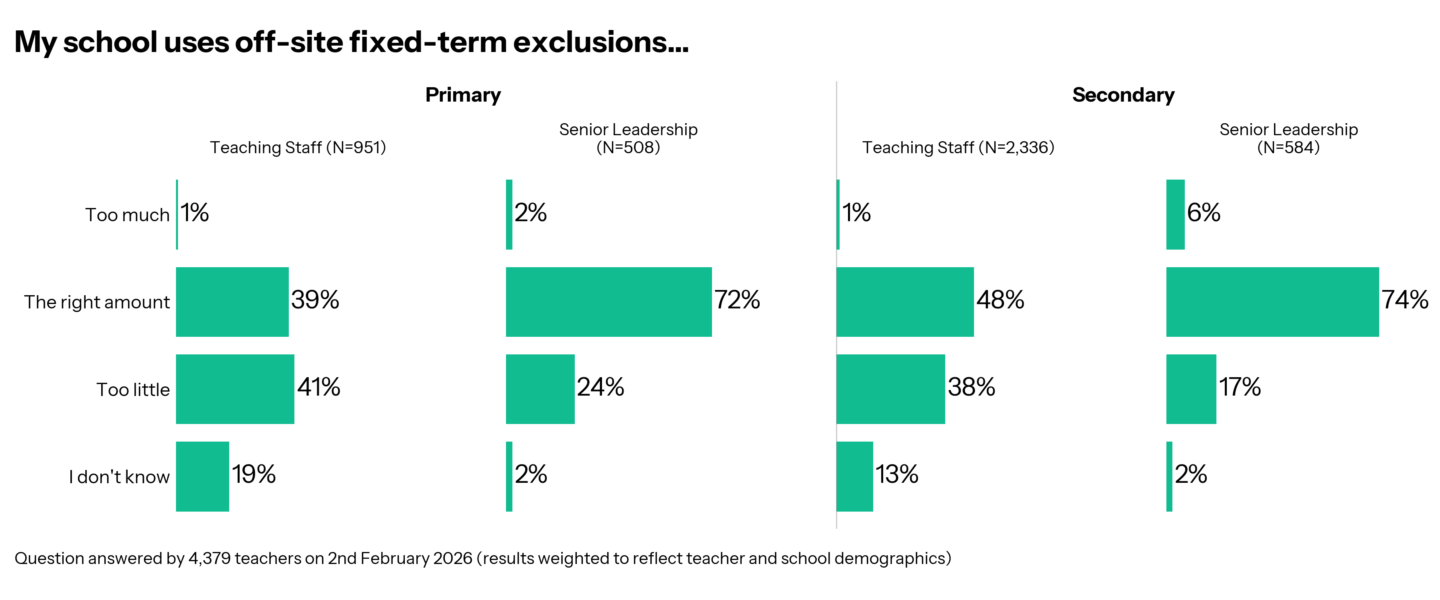
An off-site exclusion is generally considered a more serious sanction, and their use is more common across both phases with only 24% of primary leaders and 6% of secondary leaders say they aren’t used.
Only a small proportion of teachers feel that off-site fixed-term exclusions are used too much (1% of primary and secondary teachers), and whilst most feel they are used ‘the right amount’, many feel they’re underused (41% of primary and 38% of secondary teachers).
You can read more about these breakdowns in this Schools Week piece here.
Email monitoring
Last month, a Teacher Tapper wrote in to tell us about her experience with emails at her school. She had discovered that senior leaders were routinely reading the emails of all staff, and they were being monitored beyond being flagged for safeguarding keywords or suspected inappropriate images.
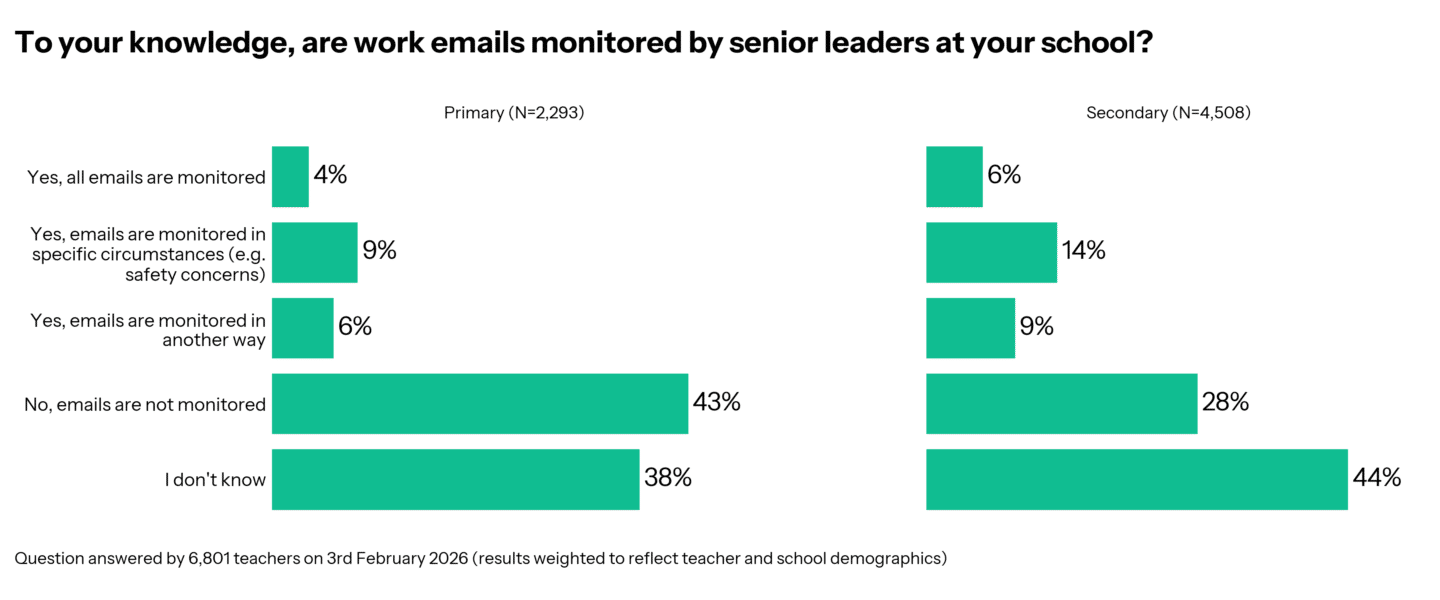
Tasked with finding out whether or not this was typical of all schools, Teacher Tapp set to work! First of all we asked teaching staff if they were aware that senior leaders were monitoring emails, and discovered most believed their emails were not being read by their SLT.
Then we checked with leaders to find out what is actually happening and found that the majority (73% of primary and 59% of secondary) do not monitor emails.
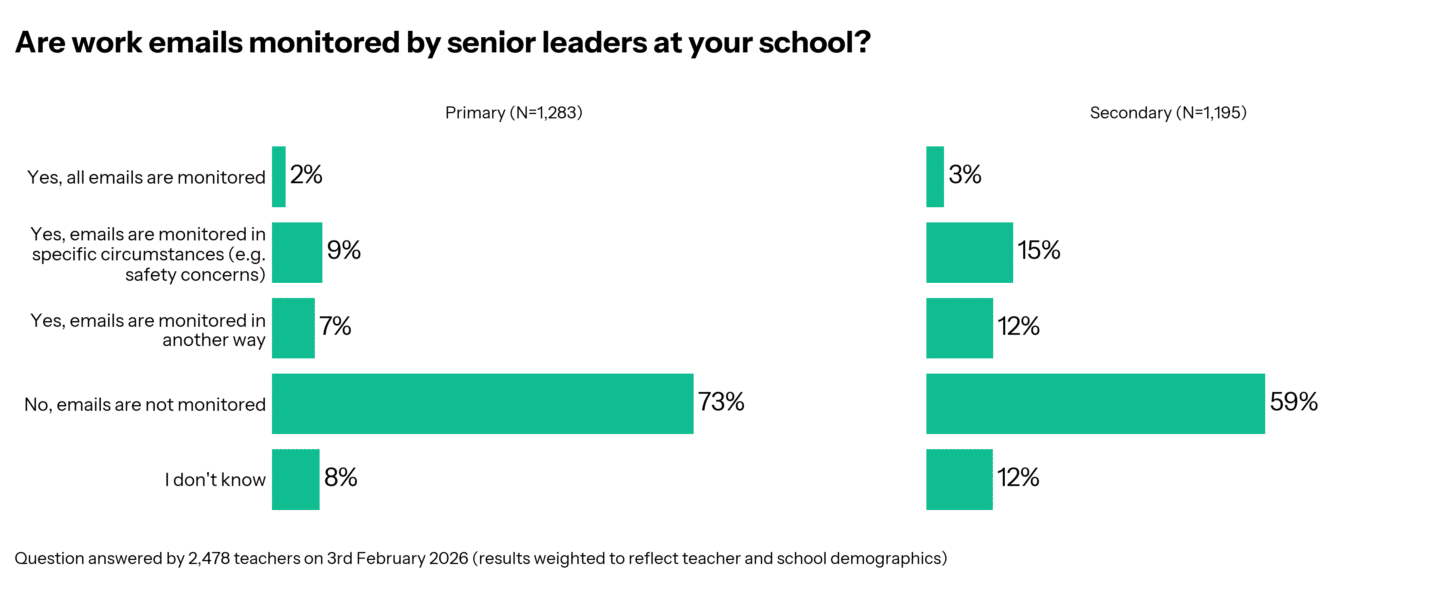
Overall, these results suggest that if you’re unsure whether emails are monitored at your school, they probably aren’t…but that’s not guaranteed. Around one in five primary school leaders and three in ten secondary school leaders told us they do monitor emails. So if you’re unsure, it’s sensible to check what the policy is in your school.
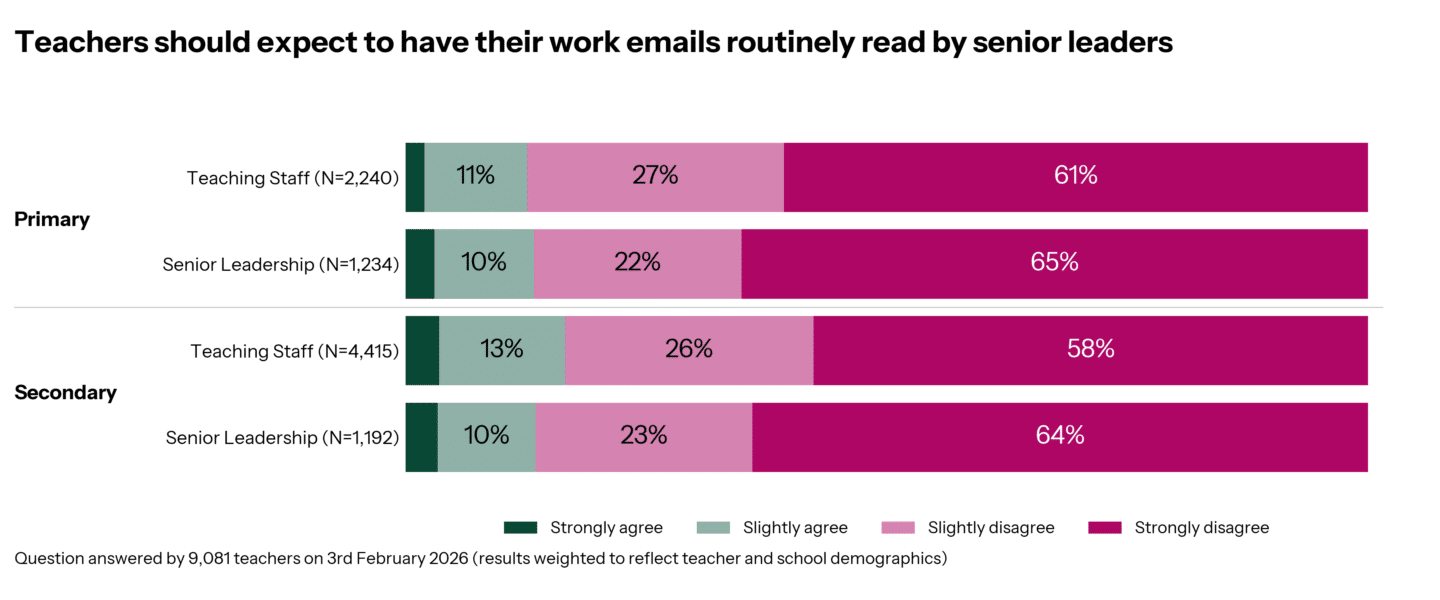
On the whole, the idea that senior leaders should routinely read emails isn’t that popular! And that’s true for teaching and leadership staff.
88% of primary teachers and 87% of primary leaders disagree that emails should be routinely read by senior leaders. And the picture is similar in secondary with 84% of secondary teachers and 87% of secondary leaders also disagreeing.
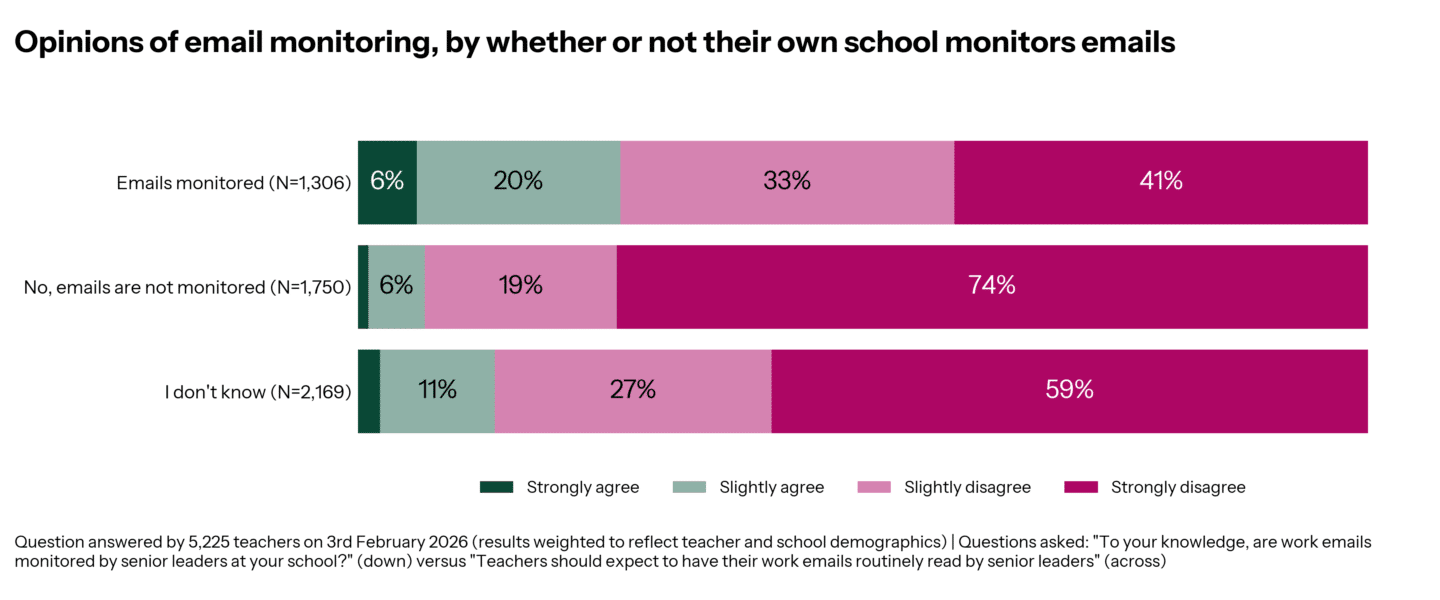
However, the good news is in schools where emails are monitored, staff tend to feel more favourably about it, with 26% of teachers in schools using email monitoring agreeing teachers should expect emails are routinely read by senior leaders. Where emails are not monitored, the idea is far less popular, with just 7% agreeing reading emails should be expected.
Menopause policies
Last week, our most read tip came from Tes and covered the important topic of supporting perimenopausal staff. Inspired by the popularity of the blog, and combined with the many messages sent in about it, we decided it was time to repeat our question about menopausal policies.
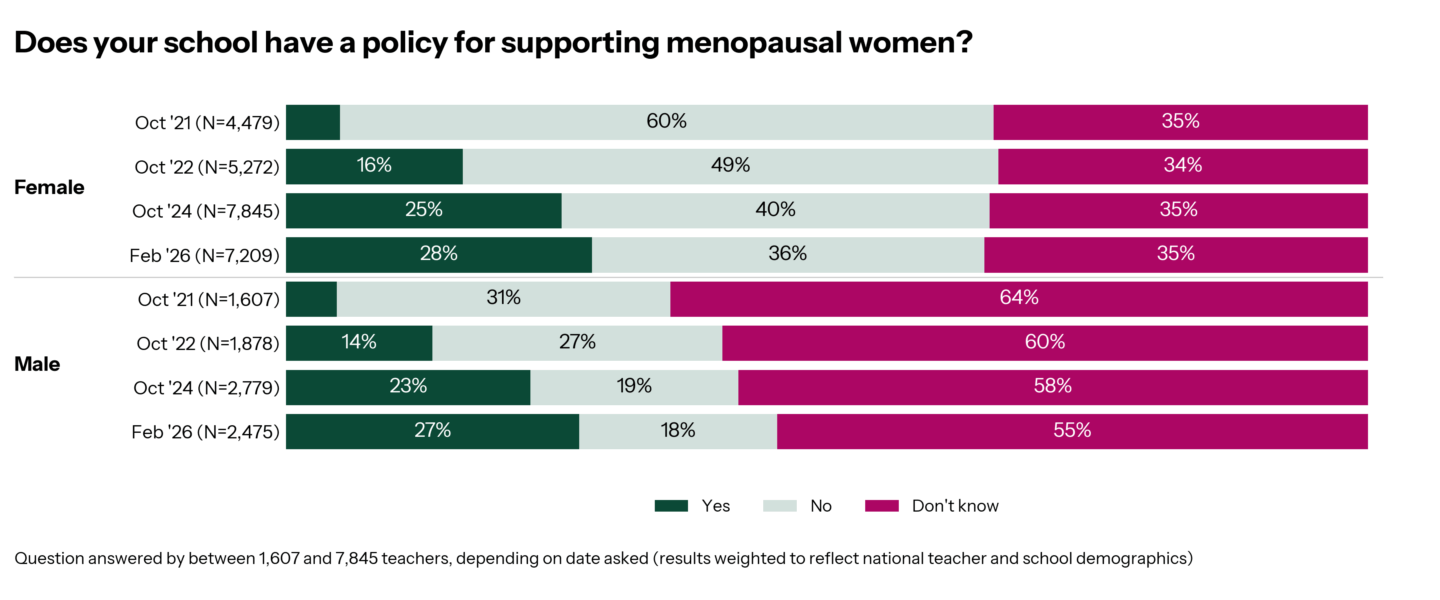
Over time, there has been an overall increase in the number of teachers reporting their school has a policy on supporting menopausal women: 28% in 2026 UP from 5% in 2021. This is a HUGE increase of 460%.
However, another shift we have picked up in the data is the big increase of male awareness around the existence of policies relating to the menopause. Among women, awareness of the policy has not shifted – about a third every year don’t know if their school has one (and a quick check shows this is mostly younger teachers).
The number of men who are unaware still outstrips women, but since 2021, that number is shrinking: from 64% in 2021 to 55% in 2026. This might be explained by the existence of more policies, and also generally more awareness of the needs of perimenopausal women.
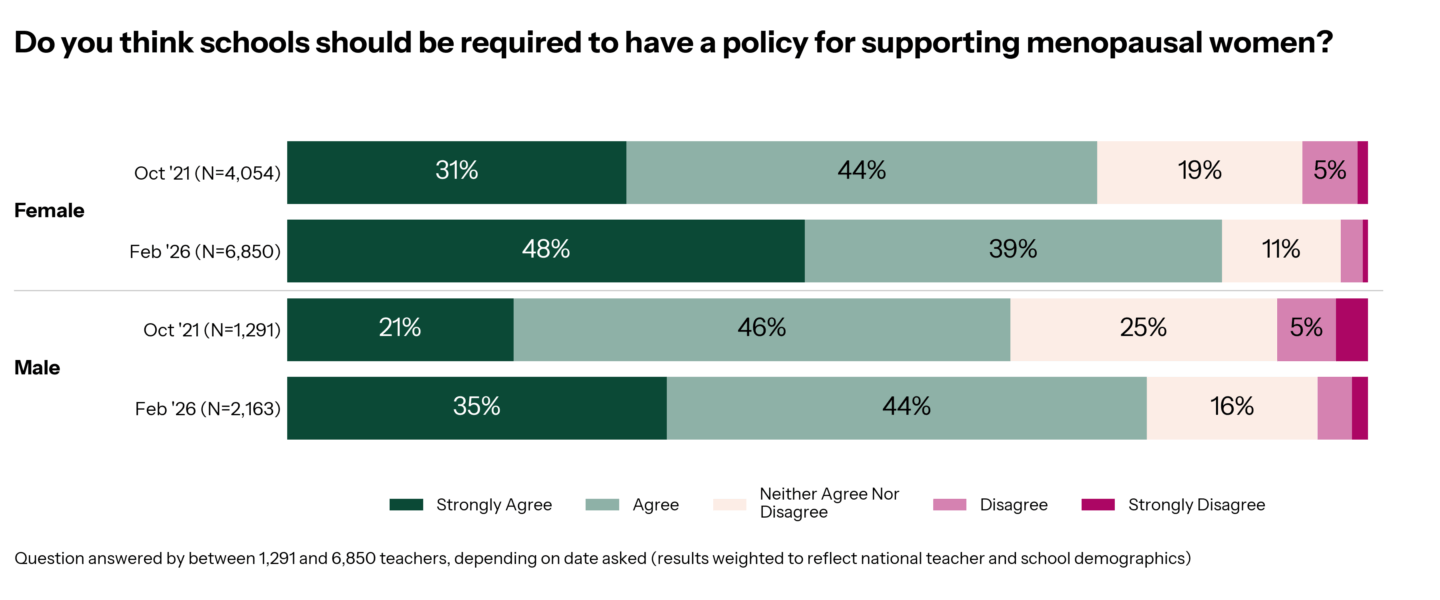
Another shift has been the increase in the number of both male and female teachers who feel schools should have policies on how schools support menopausal women: 75% of women and 67% of men were in support of policies in 2021, rising to 87% of women and 79% of men in 2026. There is a persistent gap of 8 percentage points between men and women – but support is on the increase.
Ups ⬆️ and ups ⬇️
⬆️ More schools offer teas and coffee for free in their staffroom compared to 2017 ☕️ 59% UP from 44%
🔄 Staff who report good working relationships in their departments has stayed the same! Around nine in ten this year, and last year, and the year before…all the way back to 2022!
⬆️ More secondary teachers report spending longer times with their tutor groups ⏰ 41% spend upwards of 26 minutes a day, UP from 36% in 2022.
Daily Reads
It was our ECT blog that made a splash last week! A huge 19% clicked and read. If you missed it, don’t worry – you can read it here.
Got a blog you think we should feature? Email us at england@teachertapp.co.uk and we will check it out!