Hey there, Teacher Tappers!
Hello February! The first month of 2026 has come and gone, and now we’re into the Spring term, with a half term just round the corner, and the academic year really going strong.
For teachers new to the classroom, the first term is often considered the hardest. Check out how the Teacher Tapper ECTs and their mentors have been getting on in their special ECF tracking blog here.
January prize draw – have you got a winning code?
Another bonus from completing January is the announcement of our prize draw winners. Quick, check your app to see if you have one of the winning codes 👇👇👇
- plain-cell-1076
- super-cell-8586 CLAIMED ✅
- icy-frost-8385
- tiny-waterfall-8068
- still-bar-9529
If you spot one of your codes, write in and let us know! You are the winner of a £100 gift card! england@teachertapp.co.uk.
Attendance robots
The rather futuristic-sounding ‘attendance robots’ have been trialled in schools, designed to assist young people in continuing their education when not in the classroom, and make their return to school easier. But how do teachers feel about the robots? As you might expect, feelings are mixed.
The number of Teacher Tappers who have had direct experience with the robots is pretty low, with just 5% of secondary and 1% of primary teachers reporting that they have had attendance robots in their classrooms. And awareness of their existence isn’t particularly high either, with 72% of primary and 81% secondary teachers telling us they have never heard of attendance robots.
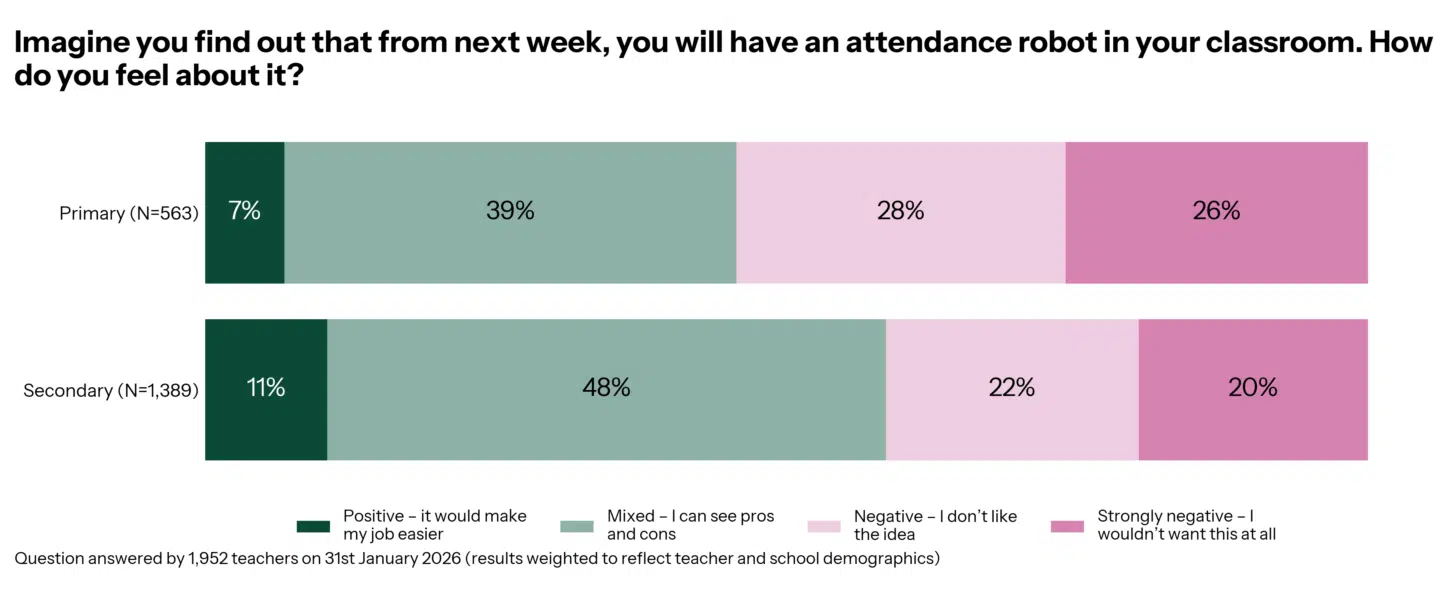
Among those who have heard of them, feelings are split about their presence in the classroom:
- 7% of primary and 11% of secondary teachers would feel positive about the presence of an attendance robot.
- 39% of primary and 48% of secondary teachers would feel mixed, seeing pros and cons to having one in the classroom.
- More than half of primary teachers would feel negatively about the suggestion of an attendance robot (54%), and of those teachers, 26% of those wouldn’t want it at all. Feelings are slightly less anti in secondary, with 42% feeling negatively, of those, 20% wouldn’t want a robot in their class at all.
If using these robots is part of the Department for Education’s big plan for improving attendance, then more work is needed on reassuring teachers that their use will improve outcomes in their classrooms. As things stand, teachers are generally pretty wary about the idea of using them.
Primary assessments
Now, if only we could get these robots taking the assessments in primary schools, teachers might feel more warmly towards them. Something that splits opinions even more than the prospect of a robot in the front row is the current statutory primary testing setup.
Currently, primary schools run the following assessments for their students: Reception Baseline Assessment (RBA), Phonics Check Test, the Multiplication Check Test (MTC), and the KS2 Sats including the KS2 writing paper.
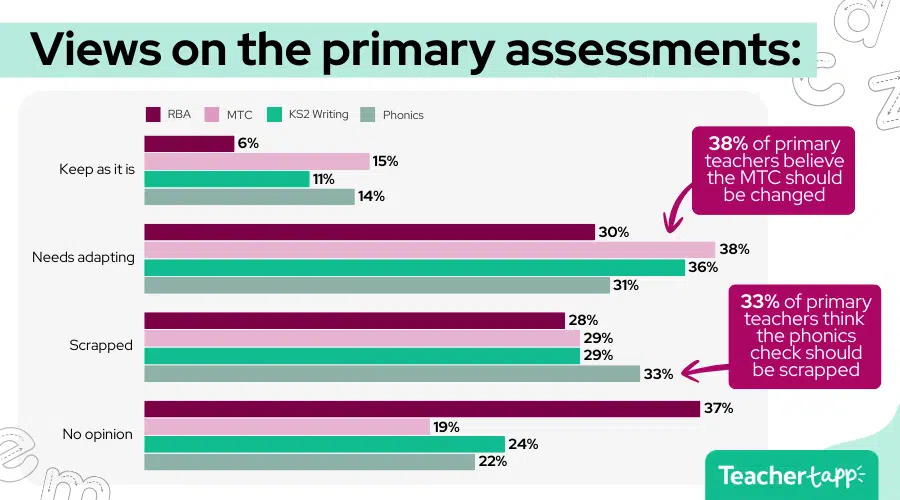
Last month, we asked about the RBA, MTC, KS2 Writing and phonics check to gauge how keen teachers were to keep, adapt or scrap the assessment. As part of the curriculum review, a promise has been made that the assessments are going to be reviewed and checked to see if they need adapting to meet the needs of all learners.
38% of primary teachers would like to see the MTC adapted, compared to 36% who would like to see the KS2 Writing assessment changed, 31% who want the phonics check adapted, and 30% who feel the RBA should be adapted.
However, a third of teachers would scrap the phonics check altogether, compared to 29% who would scrap the MTC and KS2 Writing, and 28% who want to drop the RBA.
Mobile phones
Once again, mobile phones have hit the headlines, with the Education Secretary, Bridget Phillipson, calling for schools to use their powers to ban mobile phones throughout the whole school day.
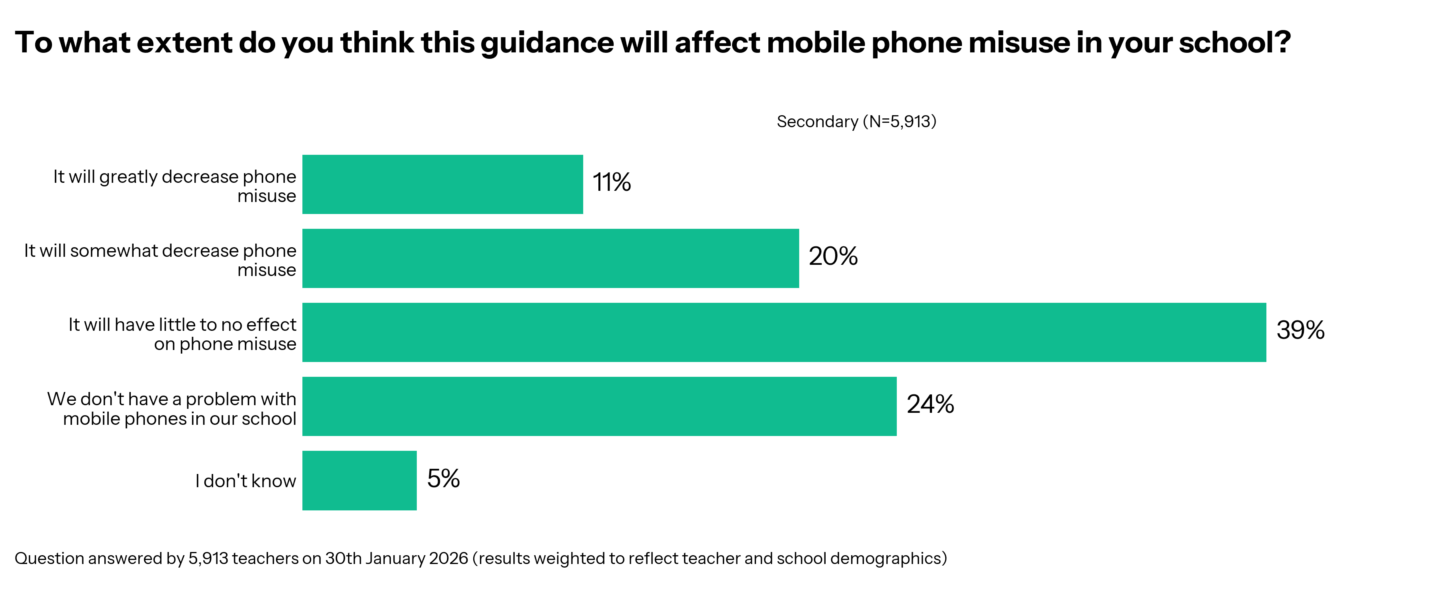
But how did this news go over with secondary teachers? Reassuringly, 31% thought the new guidance would reduce phone use in their school, and within that figure 11% feeling it would ‘greatly’ reduce phone use.
For 39% of teachers, they felt the guidance wouldn’t make a difference, and 24% reported that phone use wasn’t a problem in their school.
The announcement didn’t appear to be prompting a huge number of schools to change their policy, with just 11% of secondary leaders reporting a plan to change their policy in the future, but 6% say they are currently considering a change.
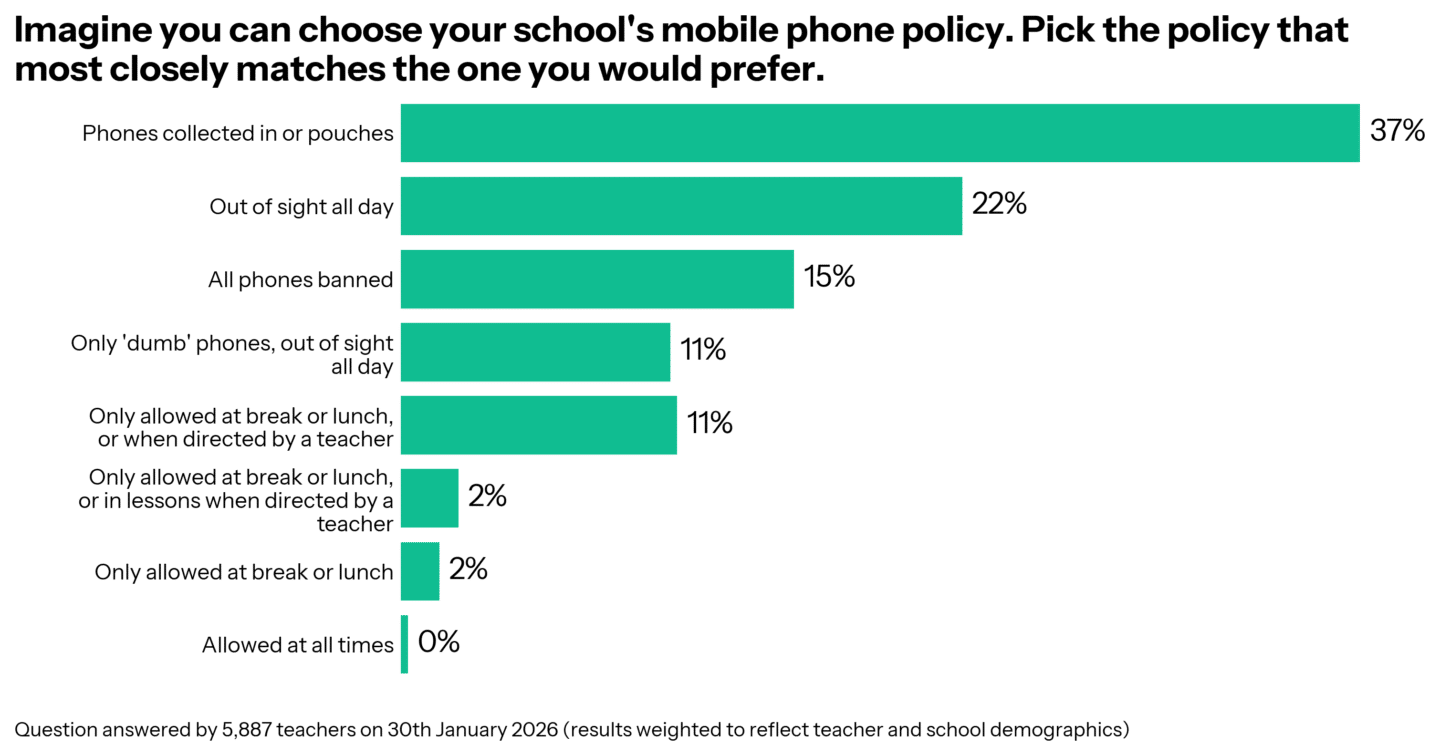
When it comes to the ideal policy, how popular is Phillipson’s suggestion that phones should be banned throughout the day? Pretty popular! 85% of teachers would choose a policy that would restrict phone use all day including break and lunch, with just 11% picking a policy that allowed them at break and lunch, plus when directed by a teacher, 2% at break and lunch plus in lessons if directed by a teacher, and 2% just allowed at break and lunch.
The most popular policy was one where phones were not allowed on a student’s person at all: collected in, or in pouches (37%).
Downs ⬆️ and downs ⬇️
⬇️ Primary teachers reading to their class ‘every day’ (43% in 2026, DOWN from 48% in 2024)
⬇️ Teachers ignoring pupil behaviour out of fear of ‘kick-back’ on social media (23% DOWN from 27%)
⬇️ Teachers reporting their school uses lesson observation grades (8% in 2026 DOWN from 28% in 2018)
Daily Reads
This week the BIGGEST read was clicked by 10% of the panel! It’s all about making workplaces more friendly towards perimenopausal women.
Got a blog you think we should feature? Email us at england@teachertapp.co.uk and we will check it out!