Hey there, Teacher Tappers!
Easter holiday is on the horizon for many of you now, but exactly how long you have to wait before your break begins varies around the country.
For the vast majority of teachers in London, East of England, South East and the Midlands, holidays begin on March 30th. However, more than a quarter of teachers in the North West, South West, North East and Yorkshire will be waiting for the following week to turn on their Out of Office.
New prize draw – but ticket codes are gone!
🎉 Our March prize draw is back – and this time there are no ticket codes to worry about!
If you tap at least once between 6–31 March, you’ll automatically be entered. The winner will see a message in the app from 2 April. And there’s more: any Teacher Tappers who have the same school listed in their profile as the winner, and who also tapped between 6–31 March, will receive gift cards too.
Last month, three extra Tappers scooped prizes. Will we see even more winners this month?! Get your whole workroom signed up and tapping! You can check the full terms and conditions here.
1265 hours and teacher pay
Over the last few weeks, videos about the future of directed time and 1265 hours have been appearing on socials – but why?
They seem to be in reaction to a letter from the Secretary of State, Bridget Phillipson to the School Teachers Review Body (STRB) panel that was published last year. In this letter, Phillipson asked the STRB to look into directed time.
At the moment, all local authority schools in England and Wales, plus all the academies that choose to use the same guidelines, have 1265 hours to “direct” classroom teachers to work. In the School Teachers’ Pay and Conditions document, it explains directed time as when a teacher “must be available to perform such duties at such times and such places as may be specified by the headteacher”
But of course, it’s important to note that teachers aren’t expected to work just 1265 hours a year (if only!), the document also says: “In addition to the [1265] hours a teacher is required to be available for work…a teacher must work such reasonable additional hours as may be necessary to enable the effective discharge of the teacher’s professional duties.”. Once a teacher is on the leadership scale, 1265 hours no longer applies.
Does this mean 1265 is for the cut? Not necessarily. Every year, the Secretary of State writes a letter outlining the remit of what the STRB can consider when making its recommendations for teacher pay. Just because something is referenced in the letter, it doesn’t necessarily mean anything will change.
In fact, in her letter, Phillipson writes: “I appreciate that directed time is also an unusual contractual provision, potentially creating a constraint on schools’ deployment of teachers, other than what is best for pupils and staff. However, I also recognise that a change to the current system of directed and undirected time could bring substantial complexities and unintended consequences to the system, and any such change would need careful consideration.”
Phillipson has asked that the STRB give their “views of the benefits and drawbacks of the current working hours arrangement”.
It sounds like there is a chance schools will see a change to the directed time arrangement – but what do school leaders think about the “benefits and drawbacks” of the current set-up?
First off – how many schools use directed time? Just 14% of leaders in state schools and 60% of leaders in independent schools told us they don’t use it.
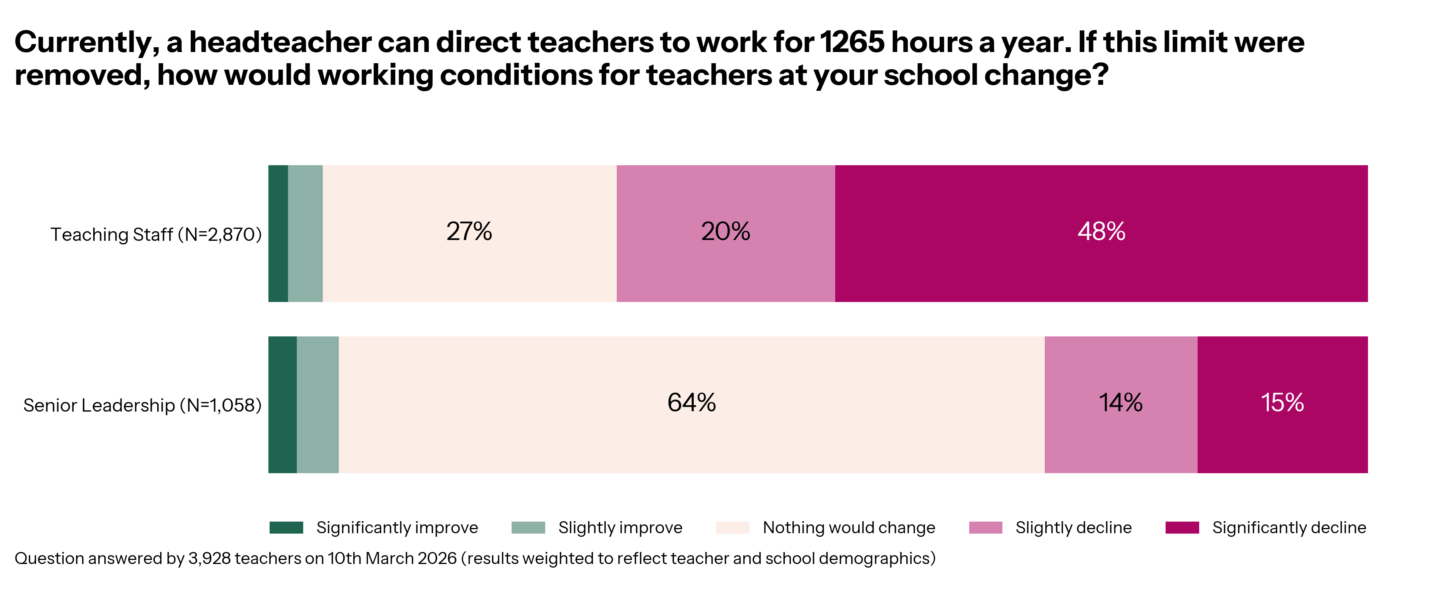
To gauge opinions of the impact of removing directed time, the panel was split, and half were asked about how working conditions for staff would change, and the other half were asked about the educational offer for students.
Teaching staff felt more negatively about the prospect of losing a directed time limit, with 68% believing working conditions would decline, compared to 29% of senior leaders. Most leaders thought working conditions would not change (64%) but just 27% of classroom teachers agreed with them.
However, they did agree on one thing: a minority thought working conditions would improve: 5% of teachers and 7% of school leaders.
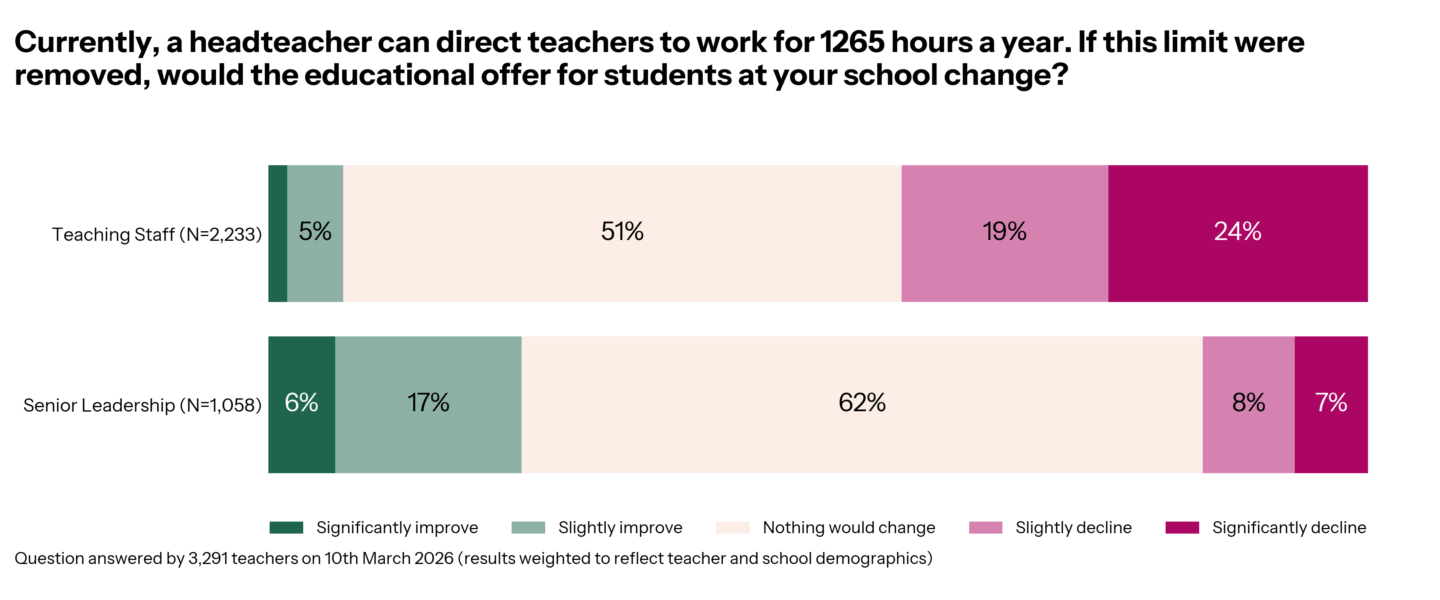
When it came to considering the impact removing a directed time limit would have on the educational offer, there was far more positivity from school leaders: 23% thought the offer would improve, compared to 6% of teachers.
Those who thought things wouldn’t change were in the majority (51% of teachers and 62% of leaders).
More teachers than leaders thought the educational offer would decline (43% vs 15%).
Of course, what is key here is what would come with the removal of the limit. Once the STRB give their recommendations, you can be sure we will be asking teachers more about their opinions!
World Book Day reflections
Now, moving away from policy to the popularity of celebration days!
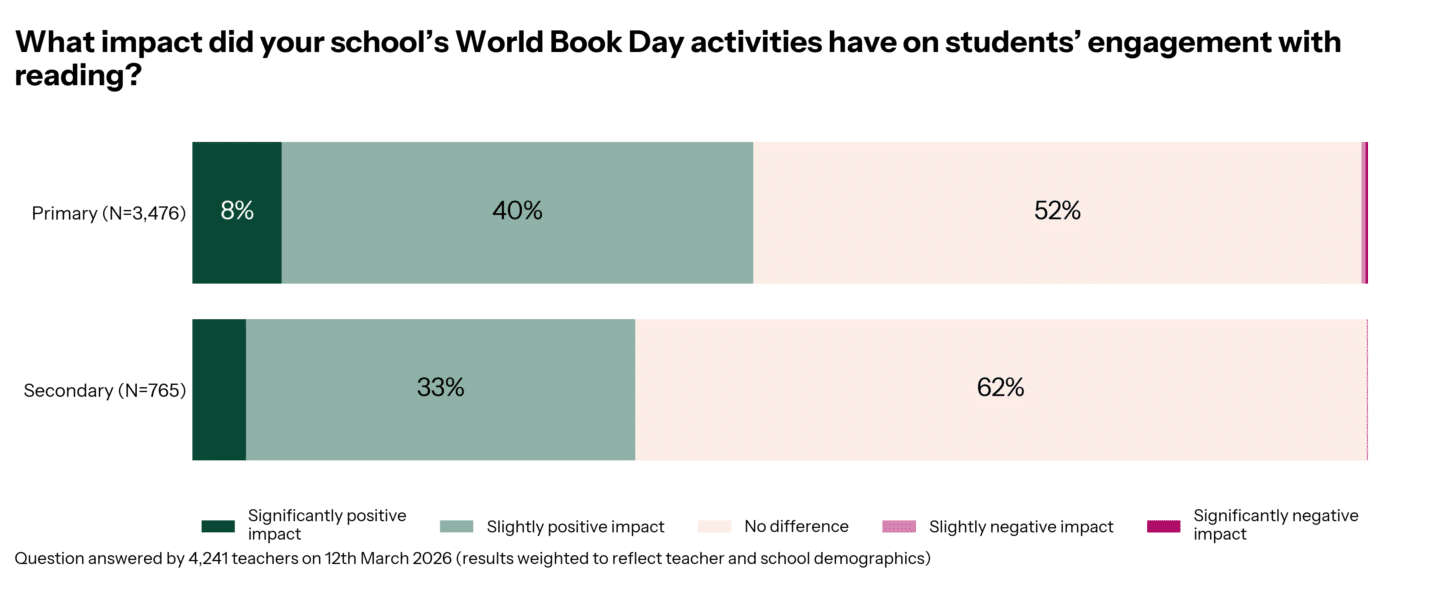
World Book Day has been a permanent fixture in the school calendar for many years now, with just 2% of primary teachers reporting their school didn’t do anything for World Book Day, and 11% of secondary English teachers saying the same. The shops were awash with dressing up choices, and bookshops were offering discounts on special selections of children’s literature: but what was the impact in schools?
In fact, opinions were pretty positive among those whose schools did celebrate it, with 48% of primary teachers reporting a positive impact, and 38% of secondary English teachers agreeing.
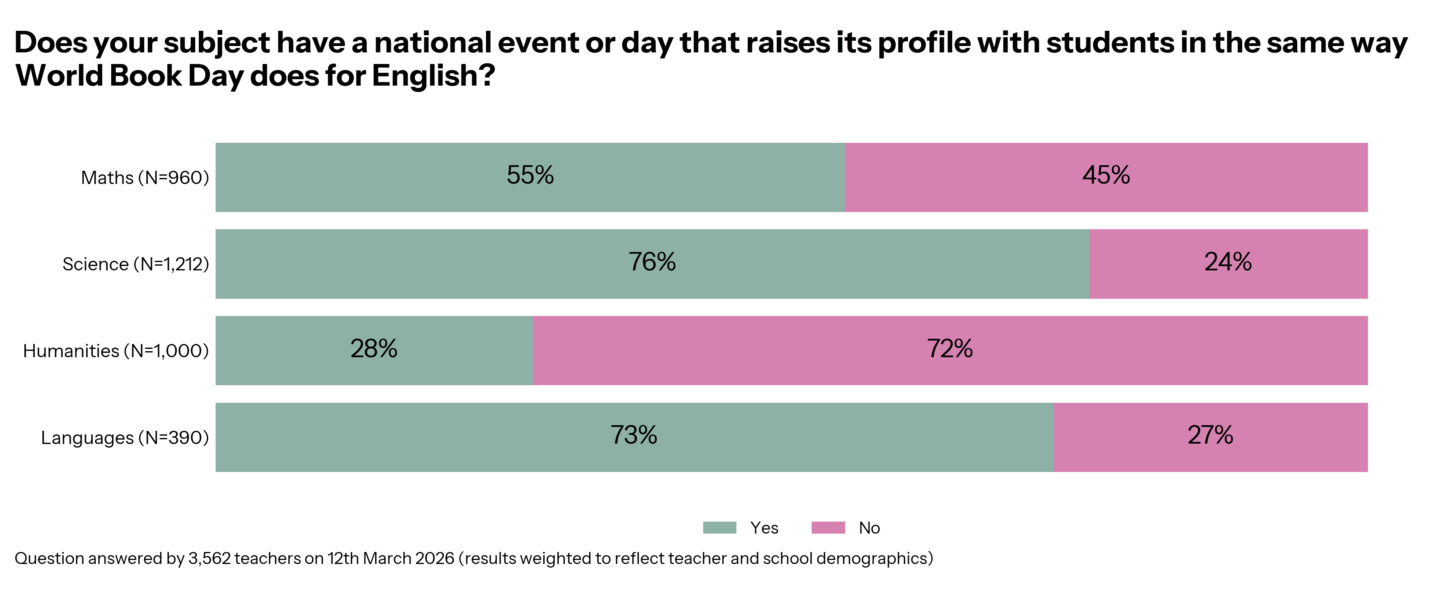
However, do other subjects feel as if their own specialism has an equally high profile day to recognise its importance?
Maths teachers were split 55% agreeing and 45% disagreeing that they had a national day to raise the profile of maths like World Book Day does for English.
Science and languages were more aligned, with 76% and 73% agreeing they had a day to celebrate their subject.
Humanities teachers were the most likely to feel left out, with only 28% feeling they had a high-profile day to celebrate their subject. Time to introduce more humanities-themed events, maybe?
Curriculum coordination
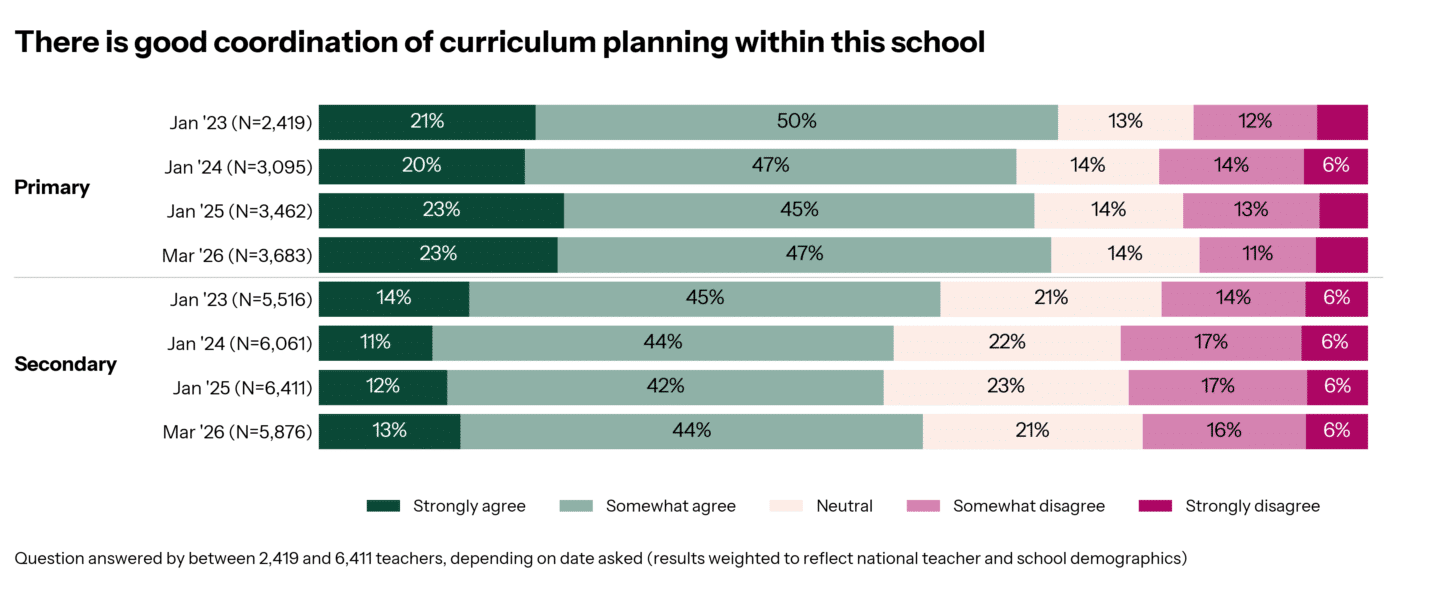
Under previous Ofsted frameworks, the curriculum was a particular focus. But how has the perception of teachers of the coordination of curriculum planning changed over time?
This year, 23% of primary teachers “strongly agree” their school has a good coordination of curriculum planning at their school, compared to 21% in 2023.
In secondary schools, 13% strongly agreed there was a good coordination of curriculum planning in their school this year, compared to 14% in 2023.
This is an important question to monitor over the next few years, as the new Ofsted framework begins to influence leaders’ planning and priorities.
Teacher Tapper asked…
A few weeks ago, a Teacher Tapper wrote in to ask us to check how many schools had heads of year with teaching timetables. We set out to find out…
- 74% have all heads of year with teaching timetables.
- 14% some heads of year have teaching timetables.
- 12% have no heads of year with teaching timetables.
How does your school compare? Are you a head of year with a teaching timetable that feels your time in the classroom is compromised by your pastoral responsibility? Or would you be reluctant to take on a head of year role if the job became entirely non-teaching?
Write in with your question suggestions england@teachertapp.co.uk 📧
Zoom in on … marking
If no one was checking, how much marking would you do?
🎨 15% of arts and music teachers would do NO marking at all.
📖 26% of English teachers would carry on marking at the same rate.
🔢 But maths teachers are clearly happier about their current marking load, with 42% saying they wouldn’t change.
Daily Reads
The most-read blog last week was a special freebie for Teacher Tappers: We need to talk about the neurodivergent teachers in our schools
Watch out for some questions on the topics it raises in the next few weeks…
Thank you so much for the great suggestions you have been sending in recently! We really appreciate you getting in touch. And if you have a blog you think we should feature, then please email us at england@teachertapp.co.uk and we will check it out!